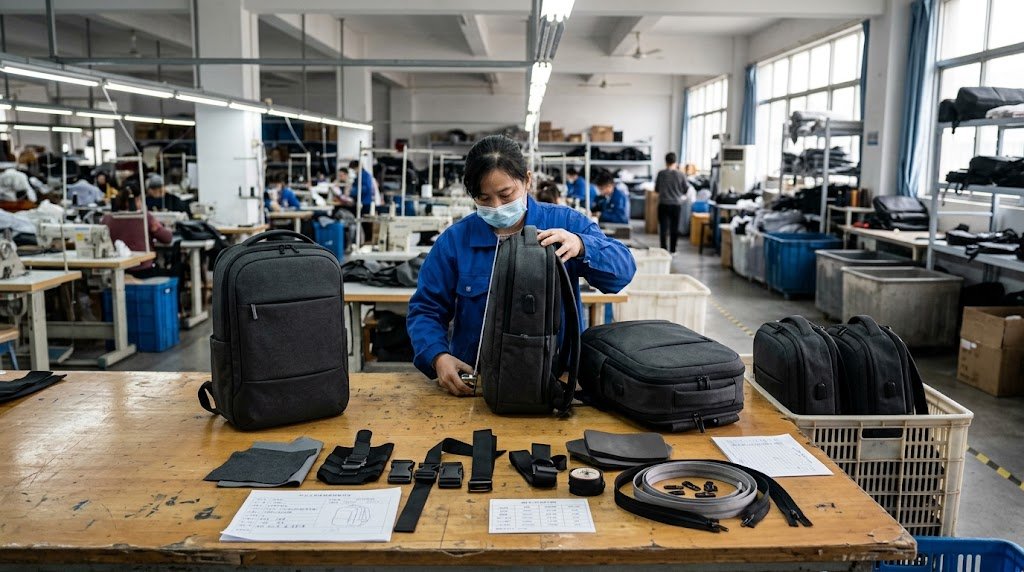
You’ve shortlisted a few factories. One of them quoted you a price and said "500 units minimum." Now you’re staring at a spreadsheet wondering: Is this real? What exactly am I paying for? What can go wrong?
I’ve been on the production side of this conversation for 10+ years. I’ve seen first-time buyers get burned. I’ve also seen buyers who asked the right questions walk away with a killer product. This article is what I’d tell you if you were sitting across from me in the factory.
The short answer: A 500-unit MOQ custom gym bag order typically takes 35–55 days from approved sample to shipment, costs $8–$15 USD per unit depending on materials and complexity,a $100–$300 sample fee (credited on order), and requires 3–5 rounds of communication before production locks. The biggest delays aren’t factory problems — they’re artwork approval and material decisions buyers leave too late.
What Does "500-Unit MOQ" Actually Mean for a Gym Bag Factory?
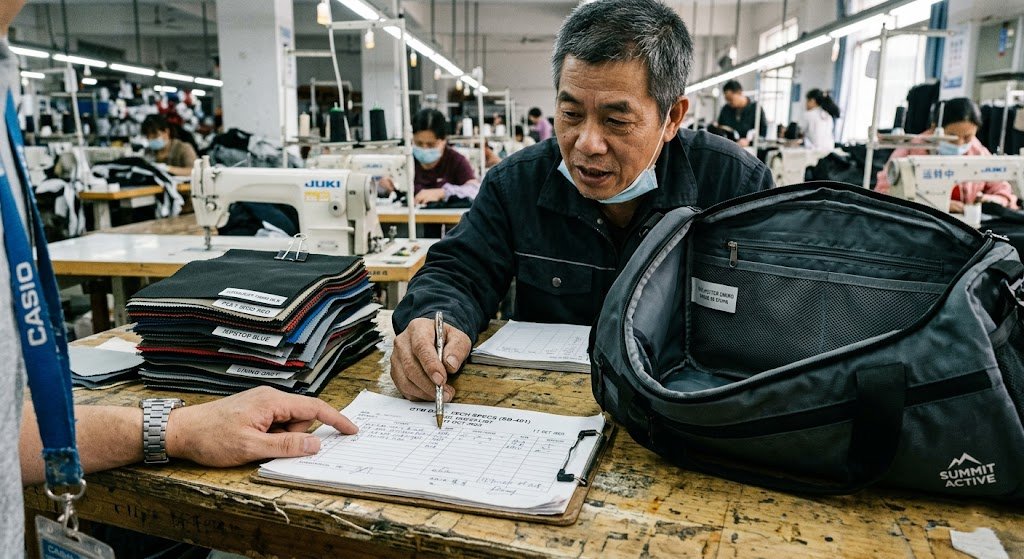
500 units is a real MOQ — but it’s not a magic number. At our factory, 500 units means we can run one fabric cut, one zipper colorway, and one main label print. Go beyond that customization and the economics shift fast.
Here’s the honest math. When we cut fabric for a gym bag, the cutting table runs most efficiently at 300+ pieces per layer. At 500 units, we’re running 2–3 layers. That’s manageable. But if you want 3 colorways at 500 total — that’s 167 units per color — now we’re in sample-run territory, and pricing reflects it.
Why the Cutting Table Is Your Real Constraint
| Factor | Reality |
|---|---|
| Cutting table efficiency | Runs most efficiently at 300+ pieces per layer |
| At 500 units | We stack 2–3 layers — the math works |
| Below 200 units | One thin layer, same setup overhead, unit cost spikes |
| Fixed setup cost | Pattern cutting, thread loading, machine calibration — constant regardless of quantity |
⚠️ The Most Expensive Mistake New Buyers Make
"3 colorways, 500 units total"
That means ~167 units per color → three separate cutting runs → three times the setup cost → your per-unit price quietly triples.
The right approach:
- If you want multiple colorways, plan for 300+ units per color
- Choose one hero color for your first order and expand at reorder
What 500 Units Covers — and What It Doesn’t
| Customization Type | Included at 500 Units | Notes |
|---|---|---|
| 1 fabric color | ✅ Yes | — |
| Custom woven label | ✅ Yes | Label factory MOQ is also ~500 |
| Printed logo on fabric | ✅ Yes (screen print) | — |
| 2+ colorways | ❌ No | Usually 300/color minimum |
| Custom zipper color | ⚠️ Sometimes | Depends on supplier stock |
| Custom metal hardware | ❌ No | MOQ usually 1,000–3,000 pcs |
| Embroidery | ✅ Yes | Setup fee ~$30–50 |
| Heat transfer label | ✅ Yes | — |
🏭 Factory Secret: Custom zipper pulls — the ones with your logo cast into the metal — have an MOQ of 2,000–5,000 pieces at the zipper factory. At 500 bags, you’re either paying for dead stock or choosing a stock pull with a custom tag. Custom pulls only make financial sense at 2,000 units and above.
What Fabrics Actually Work for Gym Bags at This Volume?
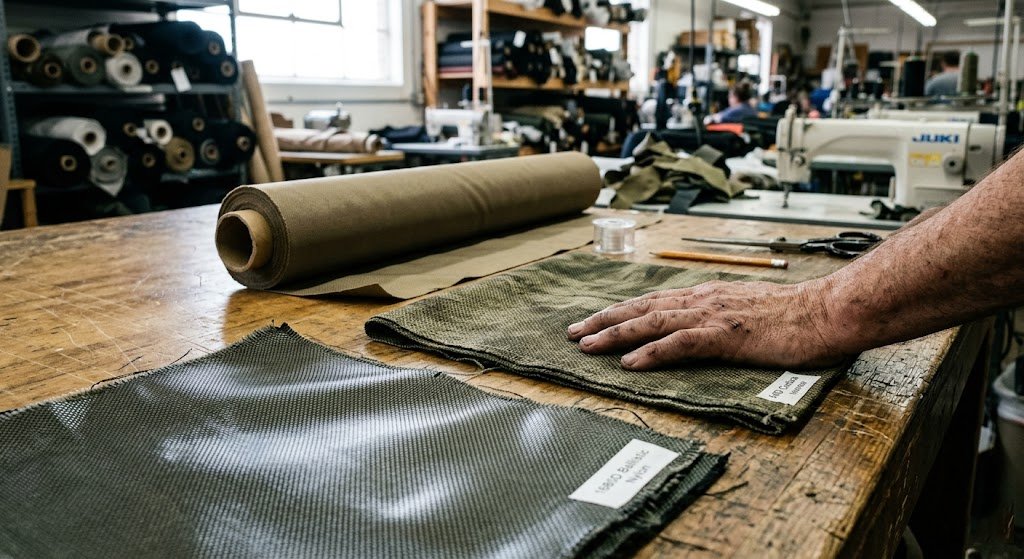
The three fabrics that perform best for 500-unit gym bag orders are 600D Oxford polyester, 1680D ballistic nylon, and 840D Cordura nylon. Each has a different price-to-durability ratio — and one of them is almost always a mistake for new buyers.
Before you finalize your fabric, it helps to know what bag structure you’re working with. If you’re still figuring out the right gym bag style for your brand — duffel, drawstring, backpack hybrid — our guide on 11 types of gym bags breaks down each format with real use cases. Knowing the structure first makes the fabric decision much easier.
Fabric Comparison for Gym Bags
| Fabric | Weight | Durability | Cost/Unit Impact | Best For |
|---|---|---|---|---|
| 600D Oxford Polyester | Light | Good | Baseline | Entry-level, budget-conscious brands |
| 900D Polyester | Medium | Very Good | +$0.50–1.00 | Mid-range gym bags |
| 1680D Ballistic Nylon | Heavy | Excellent | +$1.50–2.50 | Premium lifestyle brands |
| 840D Cordura Nylon | Medium-Heavy | Excellent | +$2.00–4.00 | Performance / outdoor crossover |
| Waxed Canvas | Medium | Good | +$3.00–6.00 | Heritage / fashion-forward brands |
Why Cordura Is Often the Wrong Call
- It’s premium — what serious gear brands use
- But at 500 units, you’re paying a 40–60% fabric premium
- For daily gym use, locker rooms, weekend travel — customers won’t feel the difference vs. 840D standard nylon
- Spending an extra $3/unit on Cordura can price you out of your target market entirely
⚠️ The Coating Problem Nobody Warns You About
Two rolls of 600D polyester with identical spec sheets can perform completely differently after six months in the field. The denier is consistent. The coating is not — and the coating determines whether your bag fades, peels, or holds up.
What happened in 2019: A client ordered 800 duffel bags. We used 600D from a new mill — good price, clean sample. Six months post-delivery, the client sent photos: bags were chalking and fading on the handles and base. The PU backing had been quietly changed from 0.5mm to 0.3mm. We ate the cost of replacements.
What to demand from any factory:
- Ask: "What mill does this fabric come from, and when did you last visit them?"
- Request cross-section samples — not just surface swatches
- If the answer is vague or defensive: walk away
For reference on performance fabric standards, ASTM D751 covers coated fabrics testing — worth understanding if you’re making durability claims in your marketing.
How Long Does a 500-Unit Gym Bag Order Actually Take?
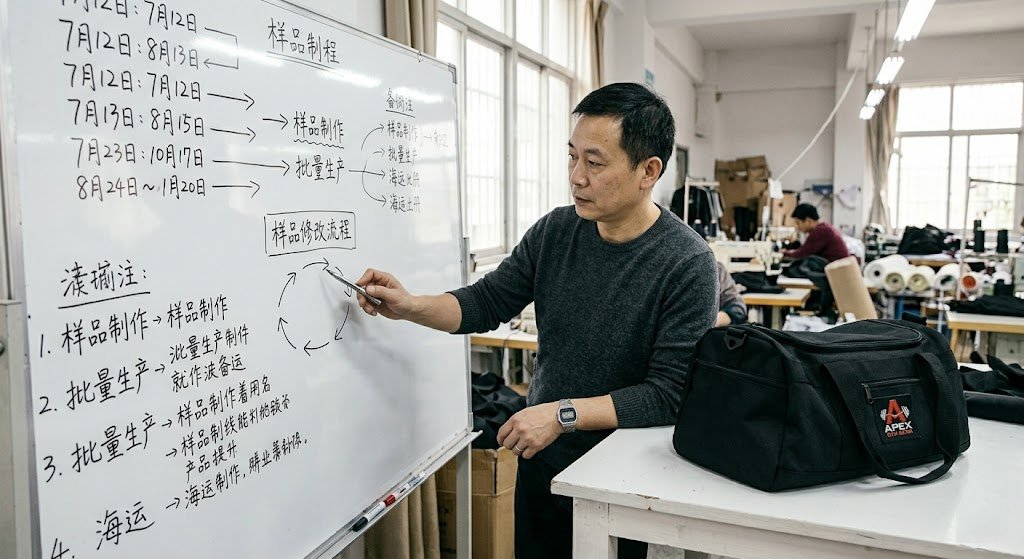
From approved sample to goods-ready-to-ship: 35–55 days for a standard custom gym bag at 500 units. Add 15–30 days for ocean freight to the US or Europe. Total door-to-door is typically 50–85 days from order confirmation.
Here’s the timeline I give every new client:
Production Timeline Breakdown
| Milestone | Days | Notes |
|---|---|---|
| Order confirmation + 30% deposit received | Day 1–3 | — |
| Pre-production (PP) sample made | Day 4–10 | — |
| PP sample shipped to buyer | Day 11–14 | — |
| Buyer approves (or requests revision) | Day 15–18 | Each revision adds 5–7 days |
| Mass production | Day 19–42 | — |
| QC inspection + packing | Day 43–47 | — |
| Goods loaded, Bill of Lading issued | Day 48–52 | — |
| Ocean freight — US West Coast | Day 53–73 | ~18–25 days |
| Ocean freight — US East Coast | Day 53–80 | ~28–35 days |
The Revision Loop: The Biggest Hidden Time Killer
A revision loop is any change request made after pre-production sample approval. Each loop pauses production, requires a new sample or mock-up, and restarts the approval clock.
- 1 loop = 5–10 extra days
- 2 loops = you may miss your shipping window entirely
Lock down every one of these before paying the deposit:
| Item to Confirm | How to Do It Right |
|---|---|
| Logo placement | Specify exact position in cm from seam, in writing, on the PP sample |
| Label font / size | Provide a print-ready file — not a rough sketch |
| Zipper color | Approve against a physical zipper swatch, not a screen photo |
| Strap length | Measure on the actual sample, not estimated from a tech pack |
| Pantone match | Approve under D65 lighting, not office fluorescent |
🏭 Factory Secret: "I’ll send the logo tomorrow" is the most expensive sentence in custom manufacturing. Across hundreds of orders, unconfirmed artwork delays a new order by an average of 8.3 days. Have your files ready before you send the first inquiry.
What Does a 500-Unit Gym Bag Quote Actually Include?
A factory FOB quote covers materials, labor, and packaging. It does NOT include freight, import duties, your country’s customs clearance fees, or third-party inspection. Plan for landed cost to be 18–28% above the FOB price.
This gap is where first-time buyers get surprised. Let me break it down with real numbers.
Cost Breakdown: $15 FOB Gym Bag, 500 Units
| Cost Element | Estimated Amount |
|---|---|
| FOB Unit Price | $15.00 |
| Ocean Freight (500 units ÷ LCL share of 20ft) | ~$1.80–2.50/unit |
| US Import Duty (HTS 4202.92, typically 17.6%) | ~$2.64/unit |
| Customs Clearance (broker fee ÷ 500) | ~$0.40/unit |
| Third-Party QC Inspection | ~$0.50/unit |
| Estimated Landed Cost | ~$20.34–21.04/unit |
The Tariff Trap First-Time Buyers Walk Into
The wrong HTS code can cost you 5–10% extra import duty — on every single unit, before the goods even clear the port.
Real example: A client sourced gym bags with a dedicated shoe compartment and classified them under HTS 4202.92. Their broker flagged it two days before the container arrived: bags with a primary shoe compartment can fall under a different sub-heading with a higher duty rate. The difference was 4.4% on a $12,000 shipment — $528 in unexpected duty, plus reclassification fees.
How to avoid it:
- Consult a licensed customs broker before finalizing your bag’s feature list
- Describe your bag’s primary compartment function honestly — "gym holdall" and "sports bag with shoe compartment" are classified differently
- Check USITC HTS Search under 4202.92 to understand the rate landscape
- Build duty into your landed cost model from day one
What Quality Checks Should Happen at 500 Units?
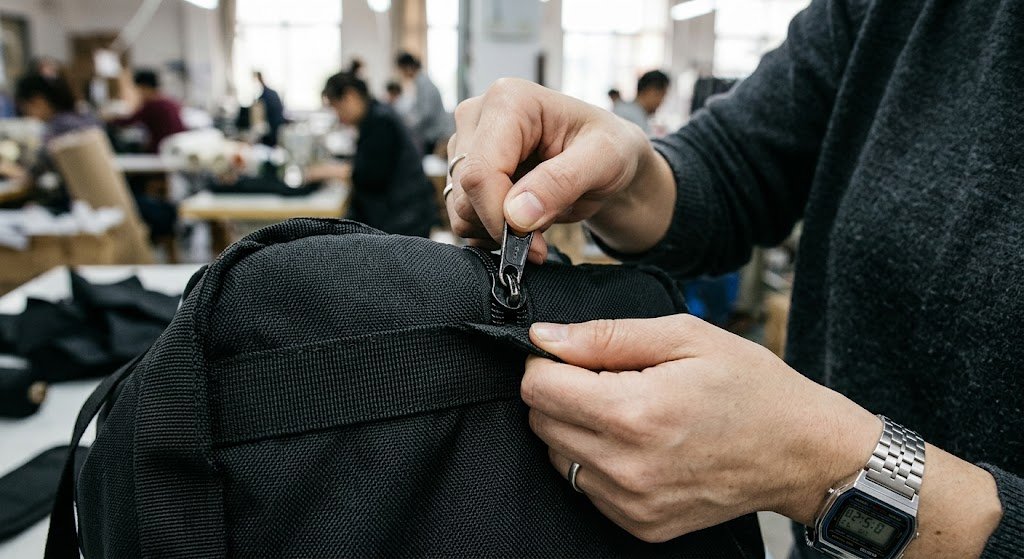
At 500 units, a third-party pre-shipment inspection is non-negotiable. It costs $200–$350 and checks stitching density, zipper pull force, handle attachment strength, color consistency, and label placement. Skipping it is how you receive 500 bags you can’t sell.
I’m going to say something that might sound strange coming from a factory owner: don’t trust just the factory’s own QC. Not because factories are dishonest — but because our QC team’s job is to ship on time. A third-party inspector’s job is to protect you.
Key Inspection Checkpoints for Gym Bags
- Stitching: Minimum 8–10 stitches per inch on stress points (handles, straps, zipper tape)
- Zipper pull force: Should withstand minimum 15 kg pull without separation (ISO 5590 for zipper testing)
- Color consistency: AQL 2.5 standard — max 2.5% defect rate accepted
- Label placement: ±3mm tolerance from spec
- Waterproof coating: Water column pressure test if DWR coating is claimed
- Hardware: D-rings, buckles — minimum 20 kg load test
What AQL 2.5 Means in Practice
For a 500-unit shipment, AQL 2.5 means the inspector samples 80 bags — and the shipment fails if more than 5 are found defective.
| Defect Class | Definition | Gym Bag Examples | Threshold |
|---|---|---|---|
| Critical | Safety risk to end user | Broken zipper pull that cuts hand, toxic dye | Zero tolerance |
| Major | Affects product function | Strap delaminating, zipper not closing fully | AQL 2.5 |
| Minor | Cosmetic, doesn’t affect function | Slight logo offset, minor thread tail | AQL 4.0 |
🏭 Factory Secret: We welcome third-party inspectors. The factories that push back — "our QC is already very strict" — are the ones I’d be nervous about. Confidence invites scrutiny. Defensiveness tells you something.
Book directly through QIMA or SGS — not through your factory.
What Artwork and Branding Setup Do You Need Before Production Starts?
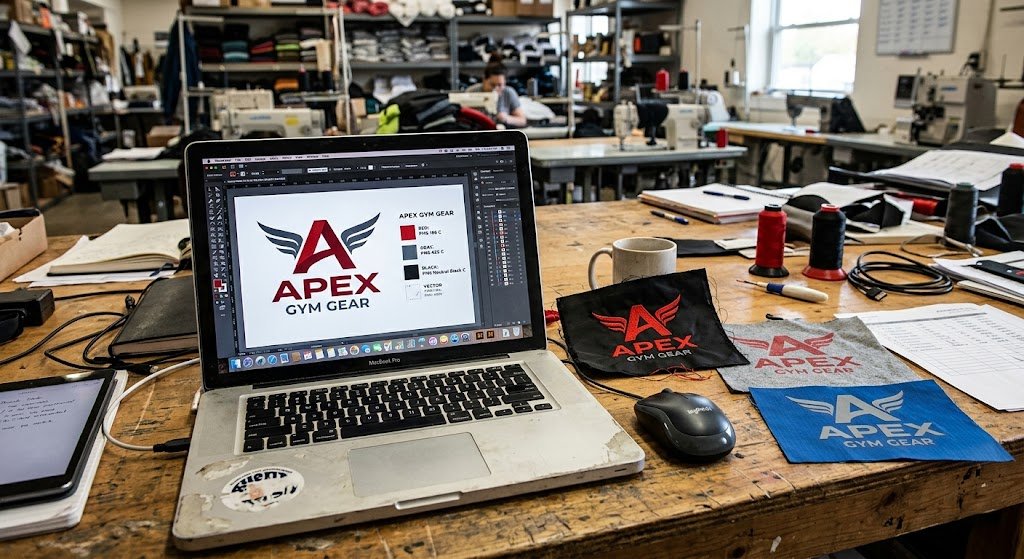
Before production can start, you need: vector logo files (AI or EPS format), a confirmed Pantone color code, label artwork in print-ready format, and written approval of the pre-production sample. Missing any one of these adds at least 5–10 days.
This is where most delays happen. Not in the factory — in the inbox.
The Three Branding Methods and When to Use Each
The three standard branding methods for custom gym bags are embroidery, screen printing, and heat transfer. Each suits a different logo type, fabric, and durability requirement. Choosing the wrong one wastes your setup fee and delays production by 3–5 days for a redo.
| Method | Best For | Avoid When | Setup Fee |
|---|---|---|---|
| Embroidery | Simple logos, 3 colors or fewer; high wash durability | Lines under 2mm, gradient fills | $30–50 |
| Screen Print | Bold, flat graphics on smooth fabrics (600D/900D polyester) | Textured fabrics, light ink on dark base | Low |
| Heat Transfer (HTL) | Full-color or photographic-quality logos; best color fidelity | High-frequency washing expected | No tooling fee |
Branding Checklist Before You Place a 500-Unit Order
Missing any one of these adds at least 5–10 days to your timeline:
- Vector logo file (.ai or .eps — NOT a JPEG, NOT a PNG)
- Pantone (PMS) color code for all brand colors
- Hang tag design (if applicable) — print-ready PDF
- Woven or printed label artwork confirmed
- Packaging specs (polybag size, carton print, UPC barcode if required)
- Written approval email for pre-production sample
🏭 Factory Secret: "I’ll send the logo tomorrow" is the most expensive sentence in custom manufacturing. I’ve calculated the idle time this causes our sample room. On average, unconfirmed artwork delays a new order by 8.3 days — across hundreds of orders. Have your files ready before you even send the first inquiry.

Is 500 Units the Right Starting Point for a New Brand?
For most new brands, 500 units is actually the right floor — not a burden. It’s enough to test retail, run an Amazon launch, or seed a corporate gifting campaign. Going lower usually costs you more per unit and limits your customization options significantly.
I get asked this constantly: "Can we do 200 units?" Technically, some factories can. But here’s the reality:
- Below 300 units, fabric cutting efficiency drops significantly — your per-unit cost jumps $2–4
- Label factories often have their own 500-unit minimum
- Custom zipper tape is already off the table
- Some hardware suppliers won’t engage
What You Actually Get at 200 Units vs. 500 Units
At 500 units, you are a production client. At 200 units, you are a sample job with a higher price tag. The difference is not just cost per unit — it’s the level of factory resource, oversight, and customization access you can realistically expect.
| What You Get | 200 Units | 500 Units |
|---|---|---|
| Dedicated production manager | ❌ Shared | ✅ Assigned |
| Pre-production (PP) sample | ⚠️ Sometimes | ✅ Standard |
| Full customization access | ❌ Limited | ✅ Full range |
| Priority in production queue | ❌ No | ✅ Yes |
| Per-unit cost efficiency | ❌ High ($2–4 premium) | ✅ Optimised |
| Buffer for QC rejects | ❌ None | ✅ Built in |
At 200 units, you’re a favor, not a client. I’d rather be honest about that than take the order and underdeliver.
One More Thing Before You Decide on Quantity
The biggest mistake first-time buyers make isn’t the MOQ number — it’s choosing a factory before they know what questions to ask. By the time most buyers realize they’ve picked the wrong supplier, they’ve already paid a deposit.
Before you send any inquiry — ours included — get answers to these first:
- Can the factory provide the fabric mill name and location?
- Do they welcome or resist third-party inspection?
- Is their "3–4 week" lead time in writing?
Before you send any inquiry — ours included — read our gym bag factory buying guide. It covers the exact questions to ask any supplier, the red flags that show up before you pay, and the non-negotiables that separate a real factory from a trading company pretending to be one. It’s written from the same factory floor as this article.
Ready to See What Your Gym Bag Would Actually Cost?
If you’ve read this far, you’re serious. You’re not browsing — you’re planning.
Want a factory quote in 24–48 hours? Just send us:
- A Tech Pack, rough sketch, or reference photo.
- Estimated quantity & target market
- Preferred fabric or target price range
→ Send us your specs and get a factory quote from osgwbag.com
No middlemen. No agents taking a cut. Direct from the factory floor.
FAQ: Custom Gym Bag Manufacturing at 500 Units
Q1: What is the typical MOQ for custom gym bags from a Chinese factory?
Most mid-size Chinese bag factories set a 500-unit MOQ for fully custom gym bags. Below 300 units, customization options shrink and per-unit costs rise 20–40%. Some factories advertise 100-unit MOQs but apply significant price premiums that erase the savings.
Q2: How much does it cost to manufacture a custom gym bag at 500 units?
FOB factory cost typically ranges from $8–$22 per unit at 500 pieces, depending on fabric, features, and branding method. Add 18–28% for freight, duties, inspection, and customs clearance to calculate your true landed cost per unit.
Q3: How long does a 500-unit custom gym bag order take to produce?
Production lead time is 35–55 days from order confirmation and approved artwork. Add 15–30 days for ocean freight to the US or Europe. Total door-to-door timeline is typically 50–85 days. Artwork delays and revision loops are the most common causes of timeline extensions.
Q4: What fabrics are best for custom gym bags at this MOQ?
600D and 900D polyester Oxford are the most cost-effective. 1680D ballistic nylon and 840D Cordura nylon offer premium durability for higher-end positioning. Waxed canvas works for fashion-forward brands. Avoid letting a supplier upsell you to Cordura unless your price point justifies the $2–4/unit premium.
Q5: Do I need a third-party inspection for a 500-unit gym bag order?
Yes — always. A pre-shipment inspection from a firm like QIMA or SGS costs $200–$350 and checks stitching density, zipper pull force, color consistency, and label accuracy. At 500 units, one bad production run is a $7,500–$11,000 problem. The inspection fee is the cheapest insurance you’ll buy.