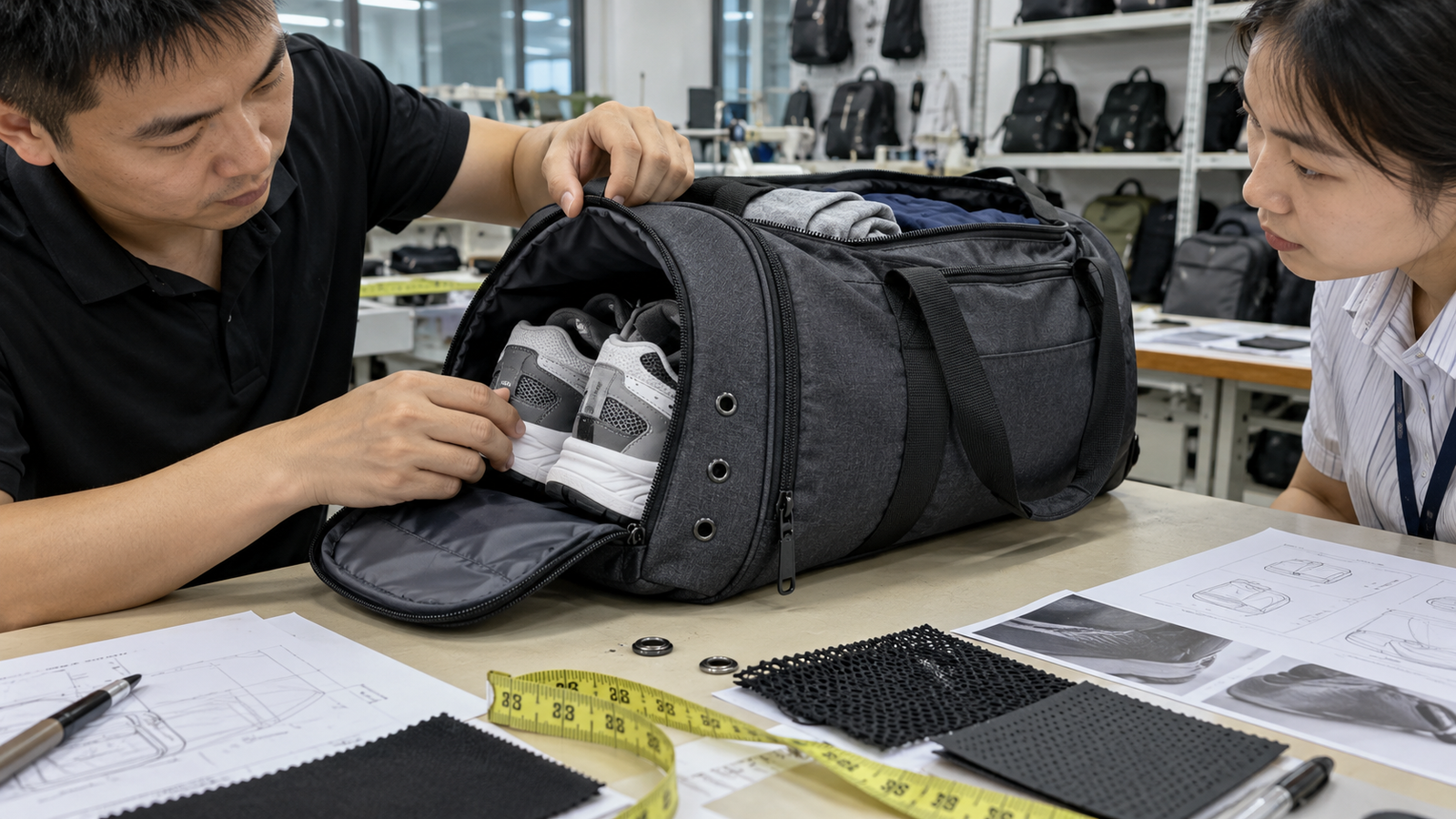
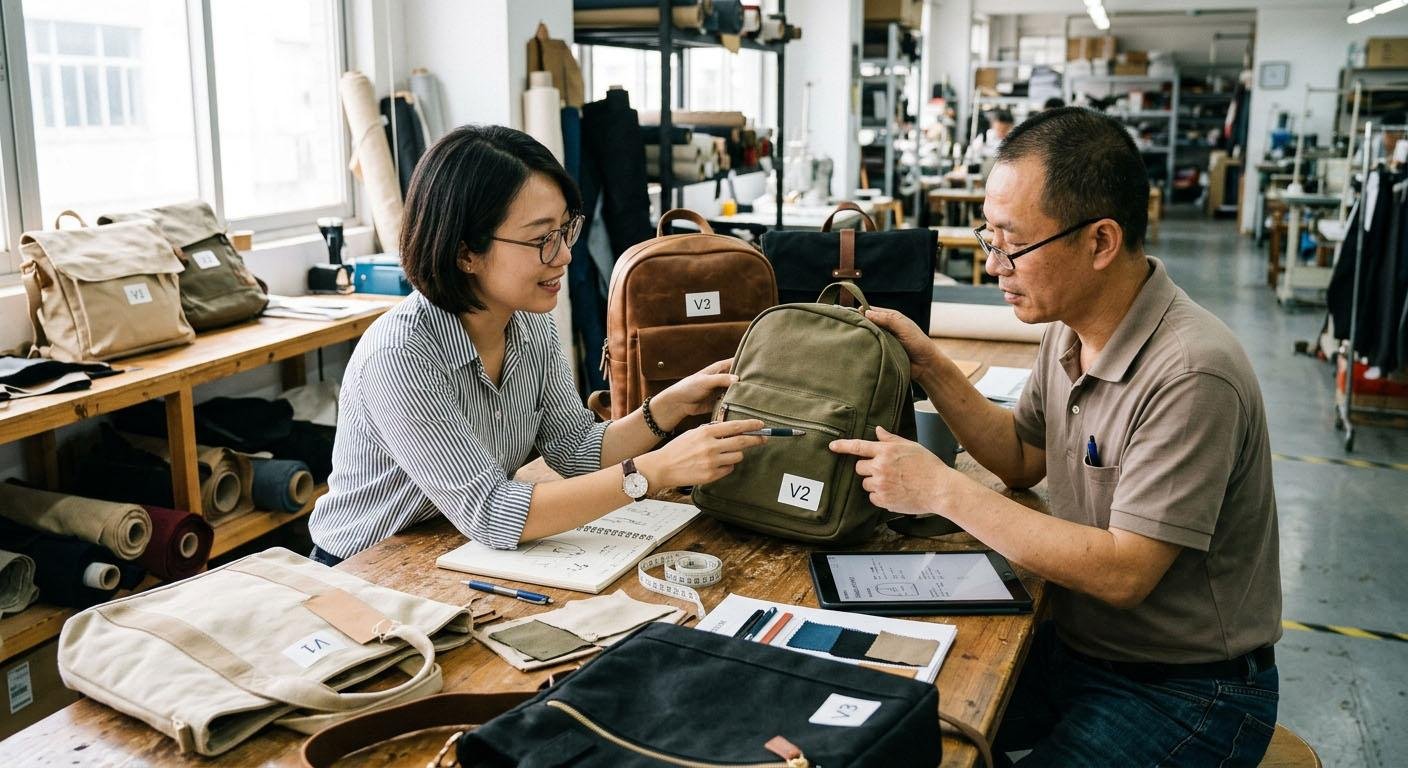
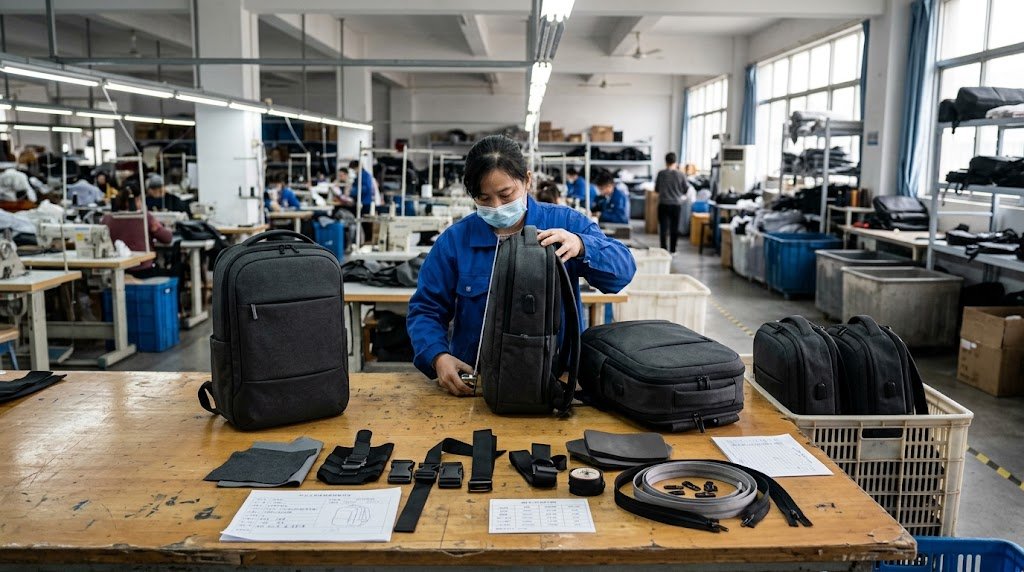
Bag factories calculate fabric consumption from the actual cutting patterns and marker layout, not simply from the finished dimensions of the bag.
Once the patterns are developed, the factory arranges the required panels within the usable fabric width and calculates how much marker length is needed for each complete bag set. Pattern shape, fabric direction, printing requirements and the space that cannot be efficiently used between pieces can all change the result.
This is why two bags with similar finished dimensions can have very different fabric consumption. It also explains why two factories may calculate different figures for the same design if they are working with different usable widths, pattern layouts or production allowances.
At the early quotation stage, consumption is often estimated. It becomes more accurate after the pattern, material width, printing method and construction are confirmed.
Why Bag Dimensions Alone Cannot Tell You Fabric Consumption?
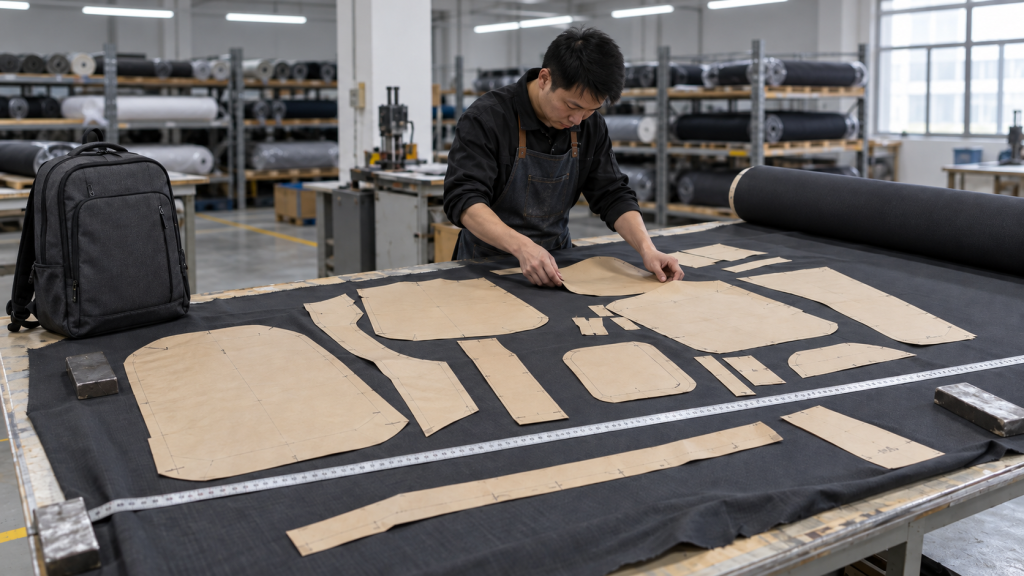
Finished bag dimensions are useful for understanding overall size, but they are not enough to calculate fabric consumption accurately.
A backpack measuring 45 × 30 × 18 cm, for example, is not cut as one rectangular piece. It may include separate front and back panels, gussets, zipper panels, pockets, shoulder straps, handle parts and reinforcement pieces.
Bag dimensions describe the finished product. Fabric consumption is calculated from the cutting patterns.
Fabric Consumption Starts with Pattern Pieces
The factory normally calculates each material from the actual pattern pieces required for production.
A front panel that looks almost rectangular on the finished bag may include:
- curved edges
- zipper openings
- seam allowances
- folded sections
- reinforcement extensions
- notches or assembly references
These details increase the real cutting size beyond what can be seen from the finished dimensions alone.
Two backpacks with similar capacity can therefore use very different amounts of fabric. A simple design with a few large panels may use less material than a similar-sized backpack with multiple pockets, shaped side panels, padded shoulder straps and a more complex back construction.
Estimated Consumption vs Pattern-Based Consumption
At the early quotation stage, the final cutting patterns may not exist yet.
If the factory only has photos, dimensions or a basic drawing, consumption is usually estimated from similar constructions and previous production experience. A detailed bag tech pack can reduce some of this uncertainty by defining dimensions, materials and construction more clearly before sampling.
Once the CAD patterns and material details are confirmed, the factory can calculate a more accurate pattern-based consumption.
Early consumption is an estimate; production consumption becomes more reliable as the product definition is finalized.
This is why material cost may need to be updated after sampling if the final pattern, fabric width or construction differs from the assumptions used for the original quotation.
How Pattern Nesting and Fabric Width Determine Consumption?
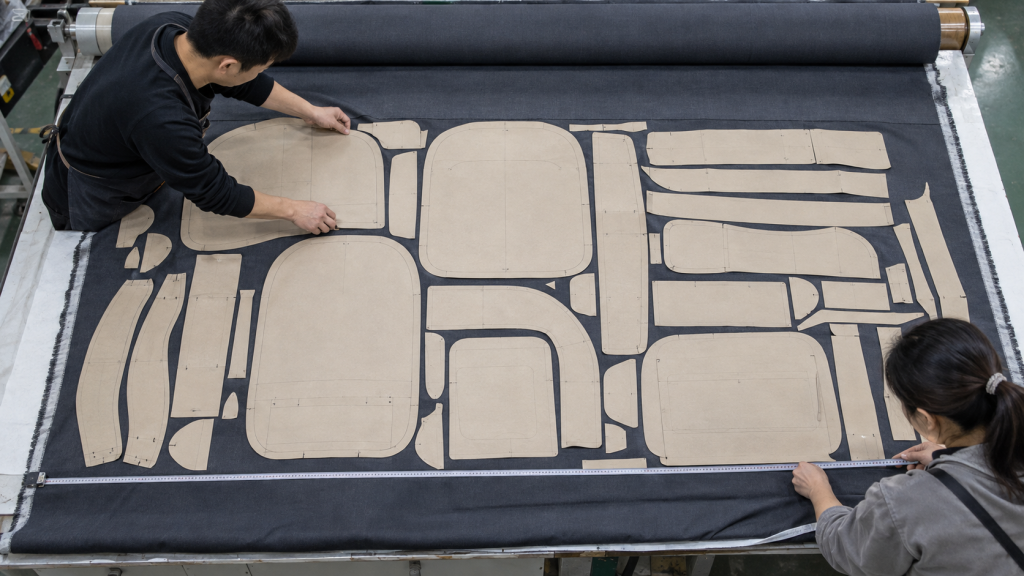
Once the patterns are ready, fabric consumption is not calculated simply by adding up their total area and dividing by the fabric width.
The factory first has to arrange the pattern pieces into a workable marker within the usable width of the material.
The same total pattern area can produce different fabric consumption depending on how efficiently the pieces can be nested.
Pattern Area Is Not the Same as Marker Consumption
In theory, it may seem possible to calculate:
total pattern area ÷ fabric width
But real bag patterns do not fit together without gaps.
A marker may contain:
- Curved panels
- Irregular pocket shapes
- Paired left and right pieces
- Small reinforcement parts
- Required spacing between pieces
- Panels that cannot be freely rotated
These restrictions leave areas of fabric that cannot always be filled with another usable pattern piece.
Total pattern area is useful for estimation, but actual consumption depends on marker efficiency.
For a completed marker, a simple way to understand the calculation is:
Fabric consumption per bag ≈ marker length ÷ number of complete bag sets in the marker
For example, if a marker is 8.4 m long and contains all required pieces for 10 bags from that material: 8.4 m ÷ 10 = 0.84 m per bag
This calculation only makes sense when:
- the fabric width has been confirmed
- the marker layout has been completed
- all relevant pattern pieces for that material are included
It should therefore be treated as a way to understand production consumption, not as a formula that can be applied from bag dimensions alone.
Commercial CAD and nesting systems work on the same basic principle: pattern pieces are arranged within defined material dimensions while respecting repeat, matching and orientation constraints. Gerber/Lectra’s CutWorks nesting documentation provides a useful technical reference for how these constraints are handled in marker planning.
Nominal Width vs Usable Cutting Width
A fabric supplier may describe a material as 150 cm wide, but the factory may not be able to use the full 150 cm for cutting.
Some width may be lost because of:
- selvedges
- damaged or uneven edges
- coating inconsistency
- printing edges
- normal width tolerance
The marker therefore needs to be planned according to the usable or cuttable width, not only the nominal roll width.
Consumption should be calculated from usable cutting width, not simply the nominal roll width.
Where a formal width measurement is required, ASTM D3774-18(2024) covers measurement of textile fabric width, including usable width.
This can also affect material cost in ways that are not obvious from the price per meter.
A cheaper fabric with a narrower usable width may produce poorer nesting efficiency and, in some cases, a higher material cost per finished bag. This is one reason material cost should be evaluated as part of the complete backpack manufacturing cost rather than by fabric price per meter alone.
Why a Small Pattern Change Can Cause a Large Consumption Change
Fabric consumption does not always increase in direct proportion to the size of the bag.
For example, suppose two large panels can fit side by side within a 150 cm usable width.
If each panel is increased by only 1–2 cm, they may suddenly no longer fit in the same row.
The total pattern area has increased only slightly, but the marker may now need significantly more length to produce the same number of bags.
A small change in panel width can create a much larger change in fabric consumption if it changes the nesting layout.
This is why revisions such as increasing bag depth, widening a front pocket or changing a shoulder strap dimension can sometimes have a larger cost impact than the physical size change appears to justify.
Why Fabric Direction, Surface Finish and Printing Change the Marker?
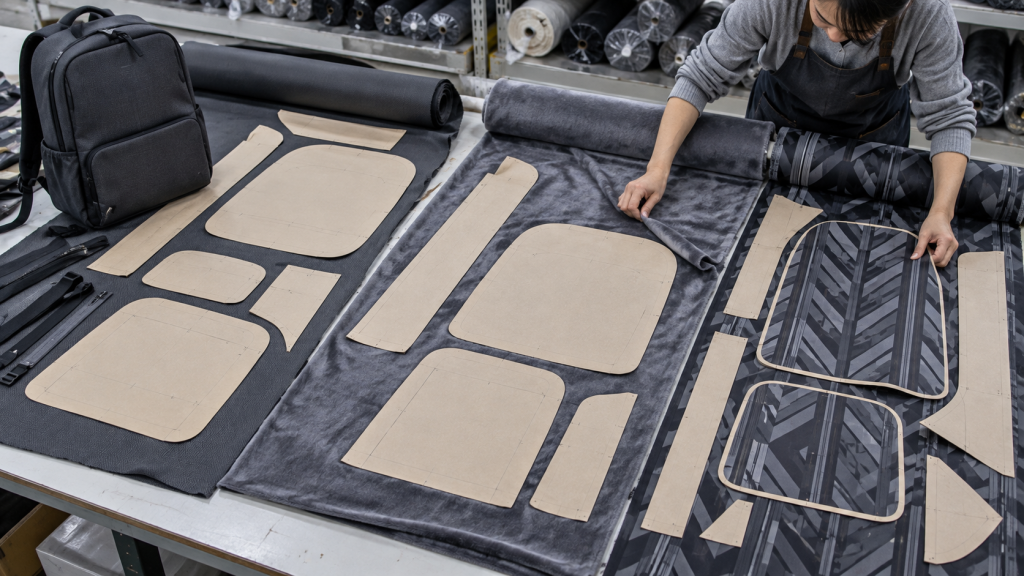
Pattern nesting is not only about finding empty space on the fabric.
Some materials allow relatively flexible placement, while others require the pattern pieces to follow a specific direction because of fabric structure, surface appearance or printing.
A pattern may physically fit sideways, but that does not mean it should be cut sideways.
Fabric Direction Can Limit Pattern Rotation
For many woven fabrics, the pattern maker needs to consider the warp or grain direction when arranging the marker.
Rotating a panel by 90° may affect:
- stretch and dimensional stability
- strength in the required direction
- surface appearance
- the way the finished panel behaves after sewing
Surface treatments can create similar restrictions.
Coated, calendered or brushed fabrics may show slight differences in shade, gloss or hand feel when panels are cut in different directions.
This becomes especially important with materials such as fleece, brushed tricot, velboa and velvet-like fabrics. If the material has a visible nap, the main visible panels may need to follow the same direction to avoid apparent color or texture differences.
That reduces the number of ways the factory can rotate and nest the pieces, which can increase marker length even when the pattern area itself has not changed.
For buyers comparing shell, lining, mesh and coated materials, our bag fabric knowledge guide provides more background on common bag material constructions and finishes.
Printed Fabrics Add Another Layer of Cutting Constraints
Printed fabric does not always give the pattern maker the same freedom to move or rotate pieces.
| Print Type | Effect on Marker Layout |
|---|---|
| Random / non-directional all-over print | Relatively flexible nesting |
| Directional print | Main panels may need to face the same direction |
| Stripes or checks | Extra fabric may be needed when lines must match across panels |
| Large repeat print | Patterns may need to move to capture the correct motif position |
| Fixed-position artwork | Panel placement is controlled by the artwork rather than nesting efficiency |
For example, if a stripe on the front pocket must align with the main body, the pocket pattern cannot simply be placed in any available gap.
Pattern matching creates visual consistency by sacrificing some cutting efficiency.
Fixed-Position Printing Can Change Both Consumption and Production Method
Fixed-position printing creates an even stronger restriction because the artwork is designed around specific bag panels rather than repeated freely across the roll.
Typical examples include:
- a logo centered on the front panel
- a graphic that must sit in a defined area of the bag
- artwork that continues across a pocket or flap
- sublimation graphics developed for individual pattern pieces
In these projects, artwork placement takes priority over nesting efficiency.
The production sequence may also change. Instead of printing a full roll first and then arranging the patterns freely, the factory may need to position the artwork for each panel and then cut according to that printed location.
This reduces nesting freedom and can also affect:
- fabric consumption
- sublimation paper usage
- ink or printing cost
- registration allowance
- panel positioning during cutting
Fixed-position printing can increase both fabric and printing consumption because the artwork position becomes part of the cutting requirement.
For this reason, a quotation based on ordinary all-over printing may need to be recalculated if the project later changes to fixed-position printing.
Why Different Bag Materials Need Separate Consumption Calculations?
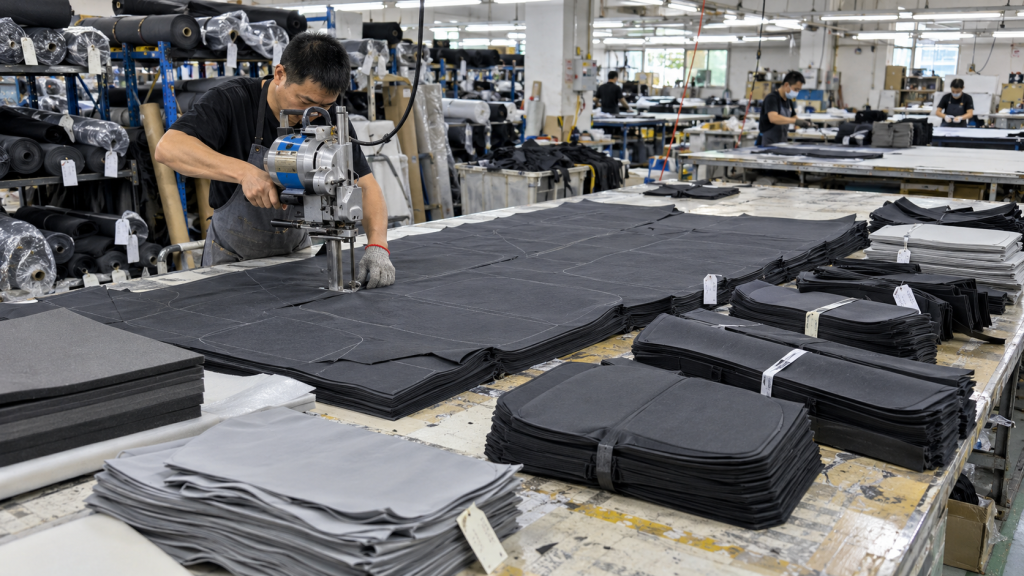
For a simple product made from one fabric, consumption can be relatively straightforward.
A backpack is different. It may use several materials at the same time, and each material can have its own width, pattern group, cutting method and production loss.
For a complex bag, fabric consumption should normally be calculated by material group rather than treated as one single number.
Shell, Lining, Mesh and Reinforcement Are Calculated Separately
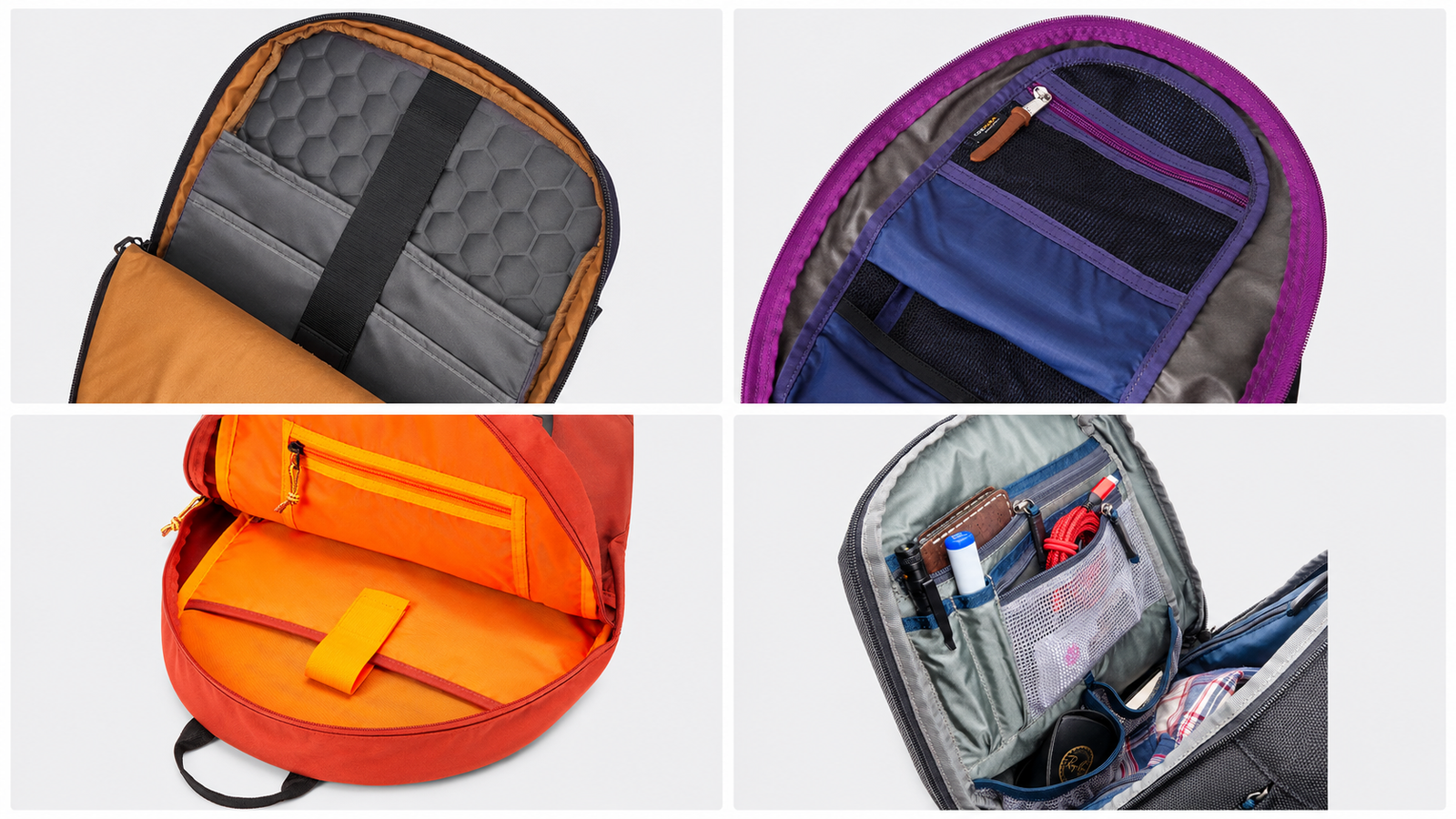
A typical backpack may include materials such as:
| Material Group | Typical Use | Why Consumption Is Calculated Separately |
|---|---|---|
| Shell fabric | Front, back, gusset, pockets | Own fabric width and marker layout |
| Lining | Main compartment and pockets | Different pattern set and usually different width |
| Spacer mesh | Back panel and shoulder straps | Limited to specific panels and may have directional requirements |
| Fleece / brushed lining | Laptop or device-contact areas | Different surface and nesting restrictions |
| Reinforcement fabric | Strap roots, handle backing, bottom areas | Small parts, but may use a separate material |
Even when two materials cover the same part of the bag, their cutting patterns are not always identical.
For example, a back panel may include:
- an outer shell panel
- spacer mesh
- foam
- a PE or PP board
These layers may sit in the same area of the finished backpack, but the patterns can differ. The foam may be cut slightly smaller, the mesh may need extra material for binding, and the shell may include seam allowance or folded construction.
So the factory cannot simply calculate the visible back-panel area and multiply it by the number of layers.
Each layer has to be calculated according to its own cutting pattern and material format.
Foam and Laminated Materials Need Their Own Cutting Yield
Foam should also not automatically be treated like ordinary roll fabric.
EVA, EPE and similar padding materials may be supplied by:
- sheet size
- roll width
- thickness
- density
Their cutting yield can therefore follow a different logic from shell or lining fabric.
Laminated materials add another variable. If a shell fabric or lining is laminated to foam, the usable width after lamination may be slightly narrower because the edges need trimming or the two layers do not align perfectly.
The usable width after lamination can be different from the original fabric width, so laminated materials may require their own consumption calculation.
This is why a factory BOM may contain several separate consumption figures for one bag rather than one overall “fabric consumption” number.
What Does “Cutting Loss” Actually Include?
When buyers hear that a factory has added a few percent for “cutting loss,” it can sound like one simple allowance.
In practice, different types of loss come from different places.
Poor marker efficiency and production loss are not the same thing.
Marker Waste Is Not the Same as Production Allowance
Marker waste comes from the layout itself.
Even with an optimized marker, some fabric may remain unused because of:
- curved or irregular pattern shapes
- gaps between pieces
- direction restrictions
- print matching
- paired parts
- areas too small to hold another usable pattern piece
This is mainly a nesting efficiency issue.
Production allowance is different. It covers material that may be lost or reserved during actual bulk production, for example:
- roll ends
- unusable selvedges
- fabric defects
- splices
- spreading loss
- shade segregation
- replacement pieces
A marker can therefore be quite efficient while the order still needs additional material for production.
This distinction matters when comparing factory quotations. A factory quoting a higher gross consumption may not necessarily have a worse marker if its figure includes allowances that another quotation leaves separate.
Net Consumption, Production Consumption and Purchase Quantity Are Different
Terminology can vary between factories, but for quotation and production planning it is useful to separate three figures:
| Term | What It Means |
|---|---|
| Net pattern consumption | Material required by the cutting patterns themselves |
| Production consumption | Actual cutting requirement after marker layout and normal production losses are considered |
| Purchase quantity | The amount of material the factory actually needs to order from the supplier |
The purchase quantity can be higher again because it may need to include:
- expected fabric defects
- shrinkage where relevant
- roll-end loss
- replacement material
- supplier MOQ
The amount of fabric purchased for an order is not always the same as calculated consumption × order quantity.
For example, if a bag uses 0.65 m of one fabric and the order quantity is 500 pcs, the theoretical requirement is 325 m.
That does not automatically mean the factory can purchase exactly 325 m.
The fabric supplier may have a minimum order quantity, the material may require defect allowance, or the factory may need extra fabric for replacement cutting during production.
For buyers, it is therefore important to ask whether a quoted consumption figure refers to net consumption, production consumption or actual purchase planning before comparing numbers between suppliers.
Why Fabric Consumption Changes Between Quotation, Sampling and Bulk Production?
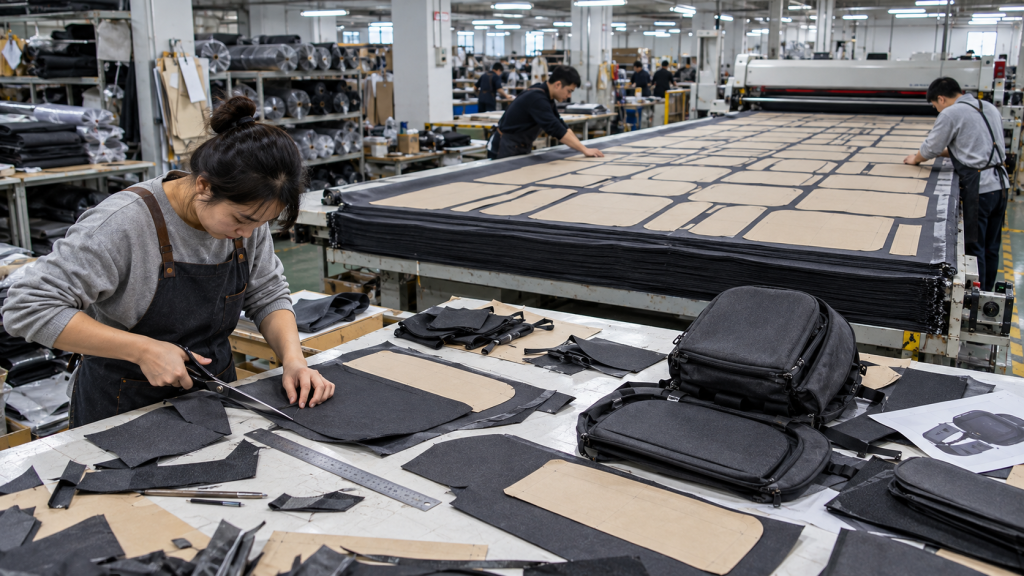
Fabric consumption is not always a fixed number from the first quotation onward.
The figure usually becomes more accurate as the product moves from an image or drawing, to a finished pattern, and finally to confirmed bulk materials and production conditions.
Fabric consumption becomes more accurate as the product definition becomes more complete.
Sample Consumption Is Not Bulk Consumption
Material used in the sample room should not be treated as the final bulk consumption.
A sample may be cut:
- by hand
- from short material pieces
- without an optimized marker
- with extra material reserved for rework
- before the final pattern is approved
For this reason, using 1.5 m of fabric to make one sample does not mean the bulk consumption is 1.5 m per bag.
The opposite is also true. If the bulk marker later shows a consumption of 0.82 m per bag, the sample room may still need more than 0.82 m to make one prototype safely.
Sample-room material use and bulk fabric consumption are two different figures.
Consumption Becomes More Accurate as the Project Develops
A practical way to view the process is:
| Project Stage | Basis for Calculation | Consumption Status |
|---|---|---|
| Early quotation | Photos, dimensions, drawings or similar products | Estimated |
| Sample / pattern stage | Developed CAD patterns and clearer construction | More accurate |
| Pre-production | Final patterns, confirmed material width, printing and construction | Production consumption / purchase plan |
This is why a material cost quoted from an image may later need to be adjusted after sampling.
A small change such as widening a front pocket, increasing bag depth or changing a panel construction may alter the marker layout enough to change the final consumption.
Why Two Factories May Calculate Different Consumption
Different consumption figures do not automatically mean one factory has calculated incorrectly.
Two factories may be working with different assumptions for:
- usable fabric width
- pattern engineering
- seam allowance
- pattern rotation
- material direction
- marker layout
- production allowance
For example, one factory may calculate using a 148 cm usable width while another uses 152 cm. One may allow certain pieces to rotate, while the other keeps all panels in one direction because of surface or appearance requirements.
Different consumption figures should be compared together with the pattern, usable width and allowance assumptions behind them.
However, if the difference is unusually large, it is reasonable for a buyer to ask:
- Is this net or gross consumption?
- What usable fabric width was used?
- Does the figure include cutting or production allowance?
- Is the marker already completed?
- Are directional printing or surface restrictions included?
Those questions are much more useful than comparing two consumption numbers without knowing how they were calculated.
Frequently Asked Questions
Is fabric consumption the same as fabric MOQ?
No. Fabric consumption tells the factory how much material the product uses, while fabric MOQ tells the factory how much the material supplier is willing to produce or sell.
A 500-piece order may theoretically require only 350 m of fabric, but the fabric mill could still have a 1,000 m MOQ per color. Our guide to MOQ for custom backpacks explains why material and production minimums can remain higher than the theoretical requirement.
Does a higher order quantity always reduce fabric consumption per bag?
Not indefinitely. Larger production runs can sometimes improve marker efficiency because more sets of pattern pieces can be nested together, but the benefit usually reaches a practical limit.
Once the marker is already well optimized, increasing the order quantity does not keep reducing consumption per bag.
Can pattern engineering reduce fabric consumption?
Yes, sometimes. A factory may adjust panel splits, seam positions or certain pattern shapes to fit the available fabric width more efficiently.
The change should only be made when it does not weaken the construction or alter the approved appearance.
Is there a standard cutting-loss percentage for all bags?
No. There is no universal percentage that is suitable for every bag or material.
A simple rectangular tote, a curved technical backpack and a directional printed bag can have very different marker efficiency and production-loss requirements.
Can the same bag have different effective fabric consumption by color?
The basic pattern consumption is usually the same, but the effective production or purchase requirement can differ slightly when color quantities are very different.
Each color may need to be spread, cut and purchased separately, so smaller color runs can have proportionally more roll-end loss, production allowance or MOQ-related surplus.
Fabric consumption is not a single number that can be taken directly from finished bag dimensions or a fabric price sheet.
For sourcing and quotation review, the more useful questions are whether the calculation is based on the same pattern, usable fabric width, print direction and production allowance—and whether the figure is still an estimate or already comes from a completed production marker.
The amount of fabric a bag uses and the amount a factory needs to purchase are not always the same number.
If you are developing a custom bag project, send us the product drawing or tech pack, finished dimensions, material specifications, printing requirements and target quantity. We can review the construction and provide a more accurate fabric-consumption estimate as the pattern and material details are confirmed.