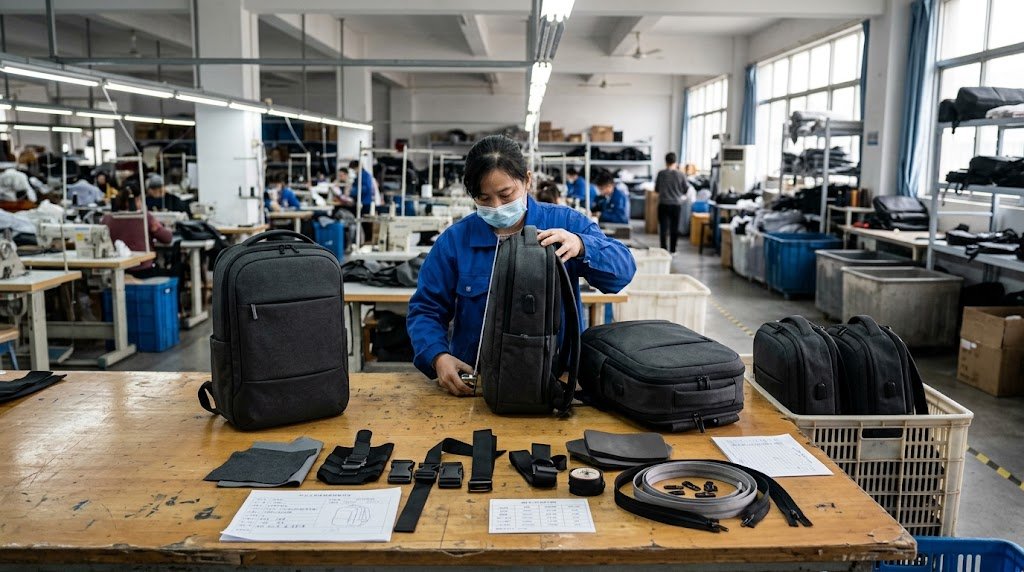
You just finalized your duffel bag design. The sample looks great. You’re about to pull the trigger on 2,000 units — and then a sourcing manager asks: "Does this meet carry-on requirements for United and Ryanair?"
Silence.
This exact scenario lands in my inbox every month. Brands invest in design, pick fabrics, nail the logo placement — and completely forget that the bag has to fit on a plane. Then they come to us after the first production run and ask if we can "adjust the sizing." We can. But it costs money, time, and a new round of samples.
Read this before you order. It’ll save you a painful conversation.
What Are the Standard Carry-On Duffel Bag Size Limits for 2026?
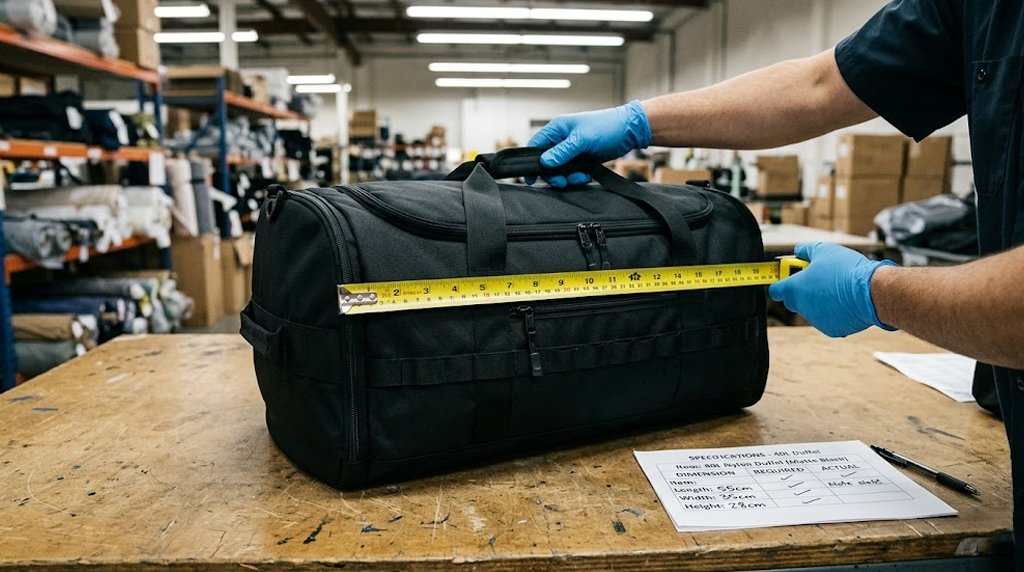
There is no single global standard. But the most widely accepted carry-on limit across major carriers is 22 × 14 × 9 inches (56 × 36 × 23 cm), inclusive of handles and straps. For duffels specifically, most airlines apply this same linear dimension rule — which means your bag’s stuffed size, not its empty shell, is what gets measured at the gate.
That distinction matters a lot in manufacturing. A duffel isn’t a hard-shell suitcase. Fill it with clothes and it expands. If your brand is marketing a bag as "carry-on compliant," we need to spec it conservatively — not just technically within limits when empty.
The US Carrier Standard (Your Safe Default)
The three major US carriers — United, American, Delta — all land within a hair of each other:
| Airline | Max Carry-On Size (cm) | Max Weight | Notes |
|---|---|---|---|
| United Airlines | 56 × 35 × 22 | No stated limit | Must fit overhead or under seat |
| American Airlines | 56 × 36 × 23 | No stated limit | Soft bags may compress |
| Delta Air Lines | 56 × 35 × 23 | No stated limit | All dimensions incl. handles |
Source: United Airlines carry-on baggage policy
If you’re selling into the US market only, design your carry-on duffel to sit comfortably under 55 × 35 × 22 cm when packed. Give yourself 1–2 cm of margin. Duffel fabric compresses — hard-shell suitcases don’t. That margin is your buffer.
The European Budget Airline Trap
This is where brands get destroyed. European budget carriers are not playing the same game as US majors.
| Airline | Free Cabin Bag | Priority/Paid Bag | Weight |
|---|---|---|---|
| Ryanair | 40 × 20 × 25 cm | 55 × 40 × 20 cm | 10 kg max |
| easyJet | 45 × 36 × 20 cm | 56 × 45 × 25 cm | No stated limit |
| Wizz Air | 40 × 30 × 20 cm | 55 × 40 × 23 cm | 10 kg max |
Source: Ryanair baggage policy
Ryanair’s free cabin bag allowance — 40 × 20 × 25 cm — is the landmine. That 20 cm depth is brutal for any duffel with structure. We’ve had clients label 3,000 units "cabin-approved" before realizing their European customers couldn’t board without paying extra bag fees. The refund requests were painful. Don’t be that client.
If your target market includes budget travel customers in Europe, spec to Ryanair’s free allowance or clearly state "full-service carriers only" on every label and listing.
The Gulf and Asia-Pacific Weight Problem
Don’t forget these if you’re selling into GCC or APAC markets:
| Airline | Max Carry-On Size (cm) | Max Weight |
|---|---|---|
| Emirates | 55 × 38 × 20 | 7 kg |
| Air China | 55 × 40 × 20 | 5 kg |
| Singapore Airlines | 55 × 38 × 20 | 7 kg |
Source: Emirates cabin baggage allowance
Air China’s 5 kg weight cap is the one that catches people off guard. A well-made 40L duffel in 600D polyester with metal hardware can weigh 1.0–1.4 kg empty. Load it to carry-on capacity and you’re easily at 5–6 kg total. If your bag is built for the Chinese domestic travel market, lightweight fabric selection isn’t optional — it’s a compliance requirement that shapes your entire materials spec.
How Do Checked Duffel Bag Size Limits Work in 2026?
For checked duffels, most major airlines cap total linear dimensions at 158 cm (62 linear inches) — that’s length + width + height combined. Weight limits are typically 23 kg (50 lbs) for economy class. Any bag over these specs triggers oversized or overweight fees, sometimes $100–$200 per flight leg.
Checked duffels are a completely different product category from carry-ons. Built for abuse — conveyor belts, cargo holds, handlers who are not gentle. We always reinforce the bottom panel with a double-layer base and use heavier fabrics as standard.
The 158 cm Linear Limit: What It Actually Means in Liters
Most brands think in liters. Airlines think in linear centimeters. Here’s the translation:
| Bag Capacity | Typical Packed Dimensions | Linear Total | Verdict |
|---|---|---|---|
| 60L | 60 × 30 × 33 cm | 123 cm | ✅ Comfortably safe |
| 80L | 68 × 33 × 35 cm | 136 cm | ✅ Safe |
| 100L | 75 × 35 × 40 cm | 150 cm | ✅ Safe |
| 110L | 78 × 37 × 42 cm | 157 cm | ⚠️ Right at the edge |
| 120L | 80 × 38 × 44 cm | 162 cm | ❌ Oversized on most airlines |
| 130L+ | 85 × 40 × 48 cm | 173 cm | ❌ Oversized fee guaranteed |
Factory rule: Any bag above 110L gets an explicit "oversized item — check airline policy before travel" disclaimer on hangtag, packaging, and listing. Non-negotiable.
Weight Limits and Fabric Selection for Checked Bags
The 23 kg allowance sounds generous. It isn’t, once the bag’s own weight enters the equation.
The empty weight problem — real numbers from our production floor:
| Spec Level | Fabric | Hardware | Empty Bag Weight | Usable Content Weight |
|---|---|---|---|---|
| Lightweight | 600D polyester | Aluminum | 1.2–1.5 kg | 21.5–21.8 kg |
| Standard | 900D polyester | Zinc alloy | 1.8–2.2 kg | 20.8–21.2 kg |
| Heavy-duty | Ballistic nylon | Brass | 2.8–3.2 kg | 19.8–20.2 kg |
The trap: clients who want heavy-duty hardware, padded straps, and reinforced stitching on a 100L bag. Empty weight hits 2.8–3.2 kg. Customer packs for a ski trip. Hits the limit. Pays fees. Blames the brand in reviews.
My rule: if a checked duffel must handle 23 kg content regularly, target empty weight under 1.5 kg. That means:
- ✅ 600D polyester, not 900D
- ✅ Aluminum hardware, not brass
- ✅ Lightweight mesh lining, not padded fabric
- ❌ No full internal frame on bags above 90L
Testing Protocol: How We Measure Checked Duffel Dimensions
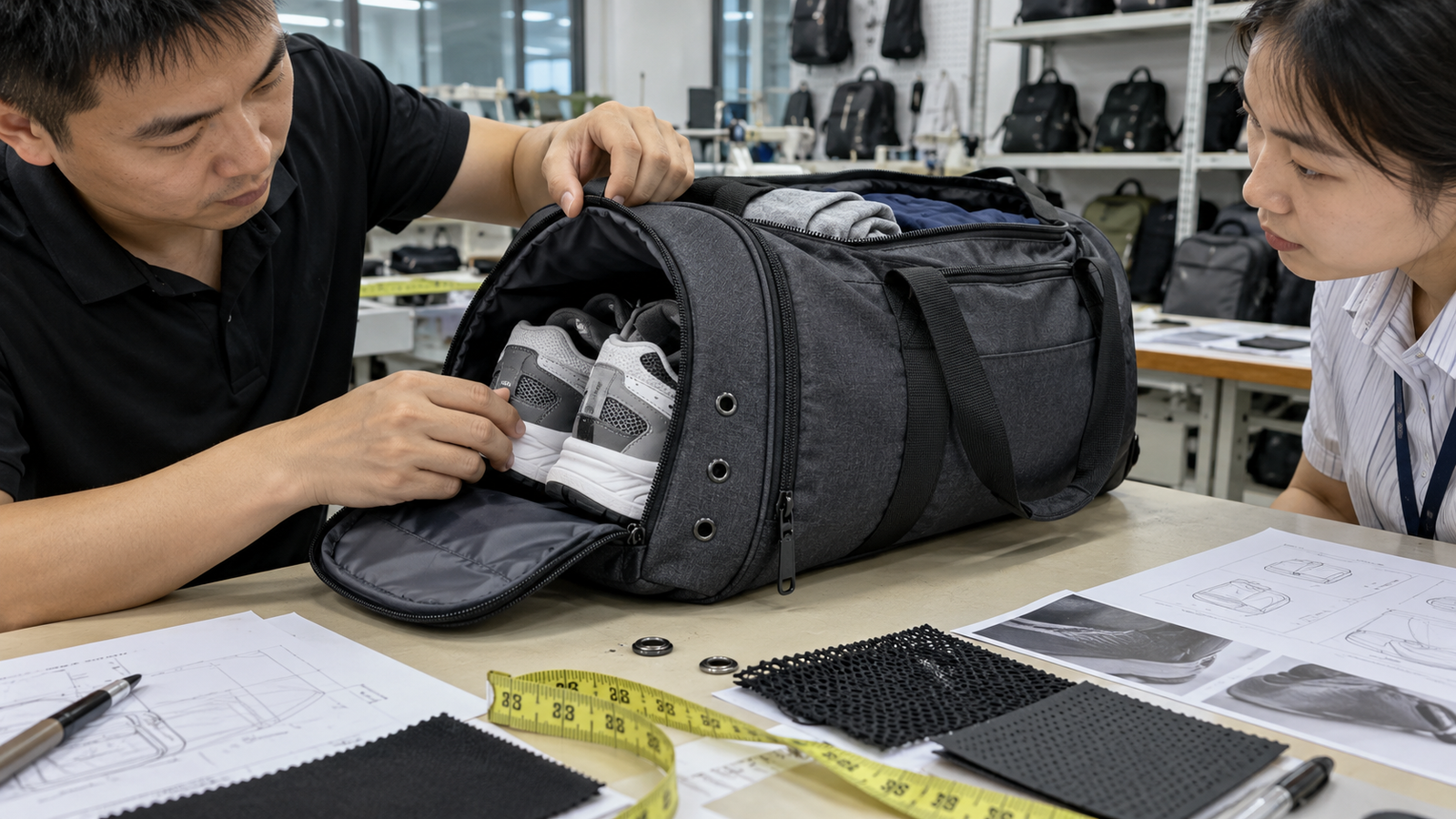
Our factory tests every checked duffel prototype at three load levels and documents all three in the client’s tech pack:
| Test Stage | Load Level | Why It Matters |
|---|---|---|
| Stage 1 | 50% capacity | Shows minimum real-world size |
| Stage 2 | 75% capacity | Typical travel load |
| Stage 3 | 100% capacity | The number that goes on the label |
If the bag hits 158 cm at 100% load, we label it at 158 cm — not at 75% where it reads 148 cm. That transparency keeps our clients out of customer disputes. It also protects them from returns and chargebacks on Amazon and DTC stores.
Which Duffel Bag Sizes Actually Sell — and Which Ones Create Problems?
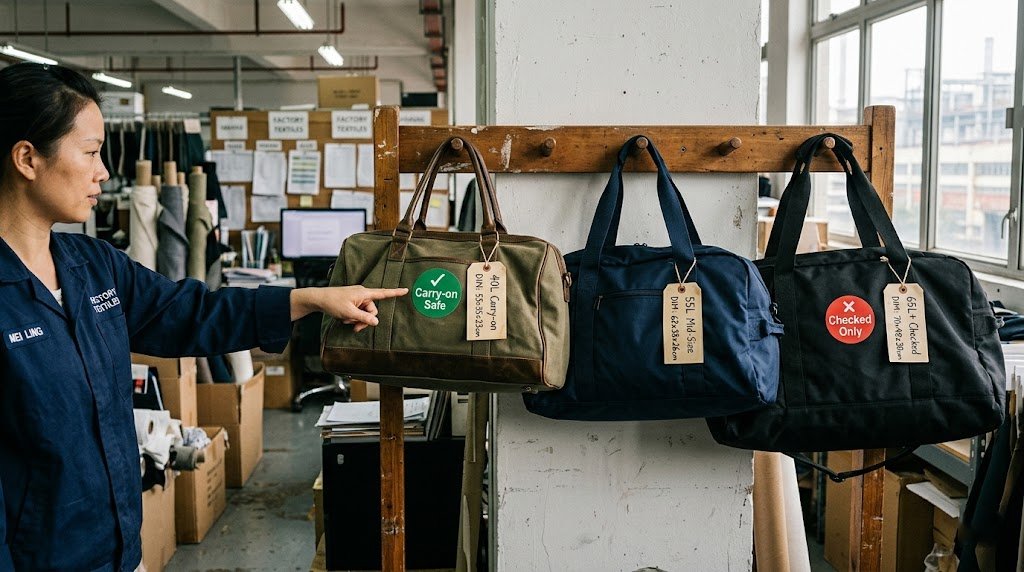
The carry-on duffel sweet spot for most retail and DTC brands is 40–50L at approximately 50 × 30 × 25 cm when moderately packed. This clears US domestic carry-on rules on every major carrier. Anything above 55L starts causing compliance friction at European budget airline gates and needs to be positioned differently.
I’ve produced duffel bags for outdoor brands, gym chains, airline merchandise programs, and corporate gifting campaigns. Here’s what I’ve learned about which sizes work in practice — and which ones torpedo product launches.
The 40L "Universal Carry-On" (Safest Bet)
- Packed dimensions: ~50 × 28 × 22 cm
- Clears: US carriers, Emirates, Air China domestic, Singapore Airlines
- Fails: Ryanair non-priority free allowance (depth too narrow for most structured designs)
- Best for: Business travel brands, gym brands, corporate gifting, mid-market DTC
This is the size I recommend to any first-time brand launching a travel duffel. The margin for error is real. You can use mid-weight fabric (420D–600D), add reasonable hardware, and still land well within US carry-on limits. We produce more 40L duffels than any other size in our factory.
The 50–60L "Tweener" (Requires Honest Labeling)
- Packed dimensions: ~55 × 32 × 25 cm
- Clears: US carriers when moderately packed; Emirates and Singapore Airlines at 50–55L
- Fails: Ryanair, easyJet non-priority, Air China weight limits at full load
- Best for: Outdoor brands, weekend travel bags, brands serving full-service airline customers
This is the most commercially appealing size — and the most legally risky if labeled carelessly. A 55L duffel marketed as "airline carry-on approved" without carrier-specific disclaimers is a one-way ticket to review problems. Narrow the claim to "US domestic carriers" or include an explicit budget-carrier disclaimer. Both options. Never neither.
The 65L+ "Checked Bag" (No Ambiguity, No Problems)
- Packed dimensions: 65 × 35 × 30 cm and above
- Status: Checked bag, full stop. Do not position as carry-on under any circumstances.
- Best for: Team sports equipment, expedition gear, military-style duffels, airline checked-bag merchandise
Some brands try to walk the line with a 65L bag — calling it "carry-on compatible with compression." I’ve watched this strategy generate consistent customer complaints without exception. Position it as a premium checked duffel. Lean into the volume as a feature, not a liability. Customers who need 65L already know they’re checking a bag.
How Should Brands Actually Label Duffel Bags for Airline Compliance?
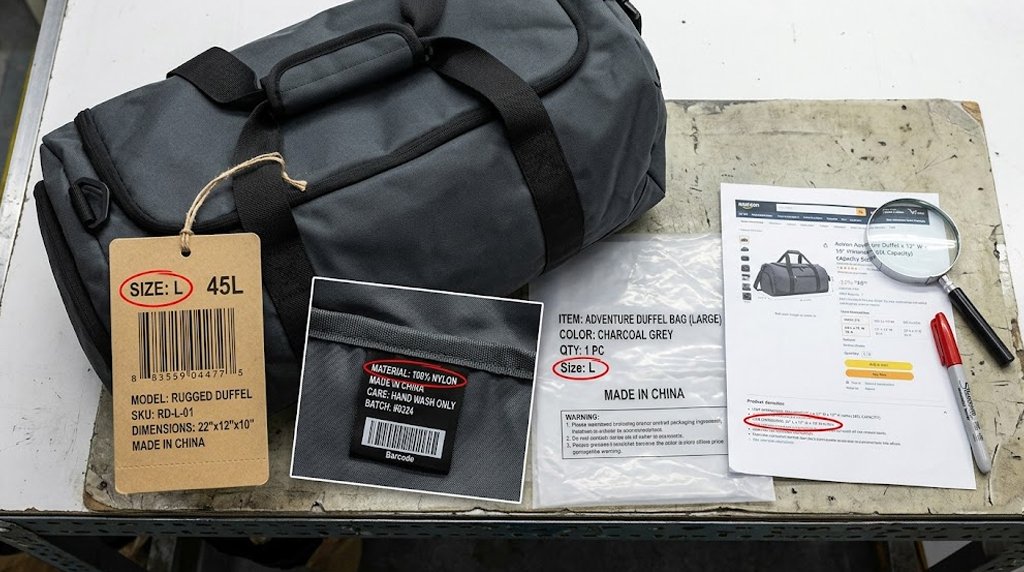
Label your duffel with the packed/stuffed dimensions — not flat or empty — and name the specific airline standard it meets. Vague claims like "cabin-approved" are legally risky. Precise claims like "meets United Airlines carry-on requirements (56 × 35 × 22 cm)" are defensible, reduce disputes, and convert better.
Most brand guides say "add dimensions to the label." That’s half the answer. Here’s exactly how we handle it for export clients.
The Four-Layer Label System We Use for Every Export Order
| Layer | Where It Lives | Required Content | Key Rule |
|---|---|---|---|
| Layer 1 | Exterior hangtag | L × W × H (cm + inches), capacity (L), QR code to FAQ | Min 10pt font. No glossy stock — scans poorly |
| Layer 2 | Interior woven label | Fiber % by content, country of origin, care symbols | Legally required for US + EU import. Missing origin = customs hold |
| Layer 3 | Outer packaging | Carrier-specific claim + measurement disclaimer | Must name the carrier, not just "airline approved" |
| Layer 4 | E-commerce listing | Same as Layer 3 + measurement methodology statement | Add: "Dimensions measured at full load capacity (100% volume)" |
Layer 2 is the one that gets shipments held at customs. Missing "Made in China" on the interior label has delayed our clients’ cargo more than any other single issue. It is not a formality. Under US Customs and Border Protection textile labeling regulations, fiber content + country of origin are mandatory — not optional.
Recommended Layer 3 copy (use this verbatim or adapt it):
"Designed to meet carry-on requirements for US domestic carriers (max 56 × 36 × 23 cm). Verify current requirements with your airline before travel."
That last sentence is non-optional. Airline policies change without warning.
What "Packed Dimensions" Actually Means — and How We Measure Them
This is the spec conversation almost no supplier has with clients. It causes the most post-shipment problems we see.
Our factory measurement protocol:
- Load the prototype at 2 kg of mixed garments per 20L of capacity
- 40L bag = 4 kg load. 60L bag = 6 kg load.
- Measure all three dimensions at that load — with handles in natural position
- Those numbers go on the label. Not the empty bag. Not the flat-on-table shell.
If your current supplier gives you measurements of an empty bag laid flat — those numbers are useless for compliance. Push back. Ask for load-tested measurements. If they can’t provide them, that tells you something important about their export experience.
EU GPSR Labeling: What Changed in 2024 and Why It Still Bites Brands in 2026
Since the EU General Product Safety Regulation (GPSR) came into full effect in December 2024, selling into the EU requires a responsible EU-based contact point on the label or packaging — not just a Chinese manufacturer address.
Who needs this:
- ✅ Brands shipping DTC from China to EU customers
- ✅ Brands selling on Amazon EU (FBA or FBM)
- ✅ Brands using EU-based 3PLs or importers
- ❌ Brands with a registered EU entity already named on packaging (you’re covered)
Most Chinese factories won’t flag this. We flag it on every new export order because a detained shipment or EU product recall is your commercial problem, not ours.
What Do Brands Get Wrong When Ordering Duffels from Chinese Factories?
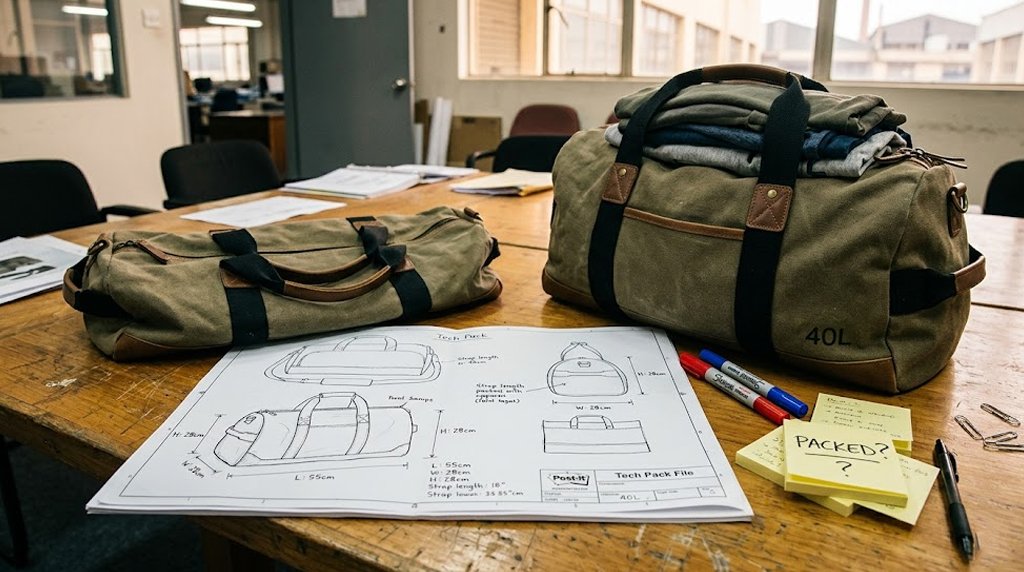
The most common mistake: brands spec bag dimensions without clarifying packed vs. unpacked. The factory produces to empty-shell specs. The bag ships. Customer tries to board. Gate rejects it. Brand gets 1-star reviews about false advertising. This is a communication failure at the spec stage — not a manufacturing defect.
Here’s where the breakdown happens most often — and what a proper brief looks like.
Mistake #1: Treating Dimension Specs as Self-Explanatory
"55 × 35 × 25 cm" means nothing without context. Packed or empty? With hardware or without? If this isn’t in the tech pack in writing, the factory defaults to the easiest interpretation — the empty shell.
Our pre-production checklist for every duffel order:
| # | Check Item | Why It Matters |
|---|---|---|
| 1 | Dimensions: packed or empty? | Empty shell ≠ gate measurement |
| 2 | Target airline market? | US / EU full-service / EU budget / GCC / APAC all have different limits |
| 3 | Handle + strap protrusion accounted for? | Adds 2–4 cm to measured height on most designs |
| 4 | Fabric expansion rate tested at load? | 600D stretches ~3–5% under load; 900D ~1–2% |
| 5 | Structured or unstructured base? | Affects packed volume significantly |
| 6 | Labeling standard confirmed? | US CBP / EU GPSR requirements differ |
| 7 | Weight limit affecting material selection? | Air China 5 kg cap changes your entire spec |
Most first-time buyers cover 3 of 7. Experienced buyers cover all 7. The rework rate difference is significant — and the cost lands entirely on the brand side.
Mistake #2: Assuming "Cabin Bag" and "Carry-On" Are Interchangeable
They’re not. This confusion costs brands money every quarter.
| Term | Region | What It Actually Means | Max Size (typical) |
|---|---|---|---|
| "Carry-on" | US | Overhead bin bag | 56 × 36 × 23 cm |
| "Cabin bag" (large) | EU | Overhead bin, paid/priority | 55 × 40 × 20 cm |
| "Cabin bag" (small) | EU | Free allowance, under seat | 40 × 20 × 25 cm |
| "Personal item" | US | Under-seat bag | 45 × 35 × 20 cm |
These are four different products. One spec does not cover all four.
When a brand briefs us on a "cabin bag" without specifying the target market, we always stop and ask. When a factory doesn’t ask — that’s your red flag.
Mistake #3: Ignoring Weight as a First-Order Constraint
Brands obsess over dimensions. They forget weight — until 1,500 units are already produced.
A real case from our factory floor:
- Client ordered 1,500 units: 40L carry-on duffel, 900D polyester, brass zippers, padded base
- Empty bag weight: 1.6 kg
- Target carrier: Air China domestic — 5 kg carry-on limit
- Effective content capacity: 3.4 kg
- Result: bag fails carry-on compliance with a normal load of clothes
What weight limits mean for your materials spec:
| Carrier Weight Limit | Max Acceptable Empty Bag Weight | Recommended Fabric |
|---|---|---|
| 5 kg (Air China) | ≤ 1.2 kg | 420D polyester, aluminum hardware |
| 7 kg (Emirates, SQ) | ≤ 1.5 kg | 600D polyester, zinc alloy hardware |
| No stated limit (US majors) | ≤ 2.0 kg | 600D–900D polyester, any hardware |
Weight is a first-order constraint. It shapes fabric, hardware, lining, and base — all decided at the beginning of development. Changing spec after samples are approved costs time and money. Get it right in the brief.
How Do Structured vs. Unstructured Duffel Bottoms Affect Compliance?
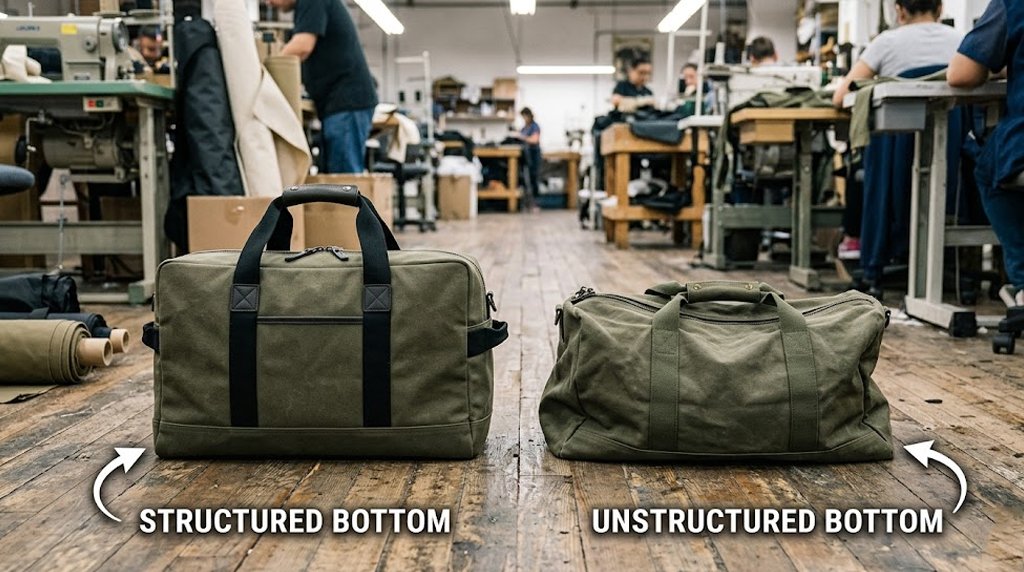
A structured base — 3–5mm EVA foam insert or molded panel — locks the bag’s footprint under load. An unstructured base splays outward when packed, making the bag taller and harder to fit into an overhead bin or gate size gauge. For carry-on compliance, structured always wins.
This is the most counter-intuitive thing in duffel design. Buyers assume a soft collapsible base helps squeeze into tight spaces. In practice, it does the opposite.
Why Unstructured Bases Fail the Gate Size Gauge
Here’s the physics, plain and simple:
| What Happens | Unstructured Base | Structured Base |
|---|---|---|
| Load pushes down on base | Base spreads laterally | Base holds its footprint |
| Bag width | Increases | Stays at spec |
| Bag height | Increases (contents pushed up) | Stays at spec |
| Gate gauge result | Fails — taller than labeled | Passes — as designed |
| Overhead bin fit | Unpredictable | Consistent |
Height is the hardest dimension to compress at the gate on demand. Width and depth — passengers squeeze a bit. Height — you can’t. A structured base eliminates this entirely.
Real numbers from our QC testing:
- 40L unstructured duffel empty: 52 cm height
- Same bag at full load: 58–60 cm height (+6–8 cm)
- US carrier limit: 56 cm height
- Result: fails the gate gauge at full load
The EVA Foam Insert: Our Standard Recommendation
For every carry-on duffel we produce for compliance-sensitive markets, we spec a 3mm EVA foam board base insert as standard.
Cost vs. benefit breakdown:
| Item | Detail |
|---|---|
| Insert spec | 3mm EVA foam board, cut to base footprint |
| Unit cost added | $0.40–$0.80 depending on bag size |
| Cost on 2,000-unit order | $800–$1,600 total |
| What it prevents | Gate rejections, 1-star reviews, return requests |
| Bonus effect | Bag holds shape on retail shelf — looks more expensive |
I have never had a client say that cost wasn’t worth it after their first round of gate-compliance customer feedback. Not once.
Molded Base Panels vs. EVA Inserts: When to Upgrade
Use this decision table:
| Criteria | EVA Foam (3–5mm) | Molded Panel (ABS/PP 1.5–2mm) |
|---|---|---|
| Retail price point | Under $120 | Above $120 |
| Durability over time | Good (2–3 years heavy use) | Excellent (5+ years) |
| Humidity resistance | Moderate — can compress | High — maintains shape |
| Unit cost added | $0.40–$0.80 | $1.20–$2.00 |
| Brand positioning | Mid-market functional | Premium travel |
| Recommended for | Gym bags, corporate gifting, mid-DTC | Premium travel duffels, retail flagship SKUs |
My rule: retail under $120 → EVA foam. Retail above $120 → molded panel. The cost difference is a rounding error at premium price points and a real margin decision at mid-market.
5 FAQs: Airline Duffel Size Limits and Brand Labeling
Q1: What is the standard carry-on duffel bag size for 2026?
The most widely accepted limit is 56 × 36 × 23 cm (22 × 14 × 9 in) including handles, set by major US carriers. European budget airlines like Ryanair enforce stricter limits — 40 × 20 × 25 cm for free cabin bags. Always spec your duffel to the strictest market you’re targeting, not the most permissive one.
Q2: How do I measure a duffel bag for airline compliance?
Measure the bag at full or near-full load capacity using realistic contents (clothing, shoes), including external pockets in a packed state. Handles and straps count toward total dimensions on most airlines. Never measure an empty, collapsed bag — that number is commercially misleading and will generate gate-compliance complaints.
Q3: What must be on a duffel bag label for US import compliance?
Under US Customs and Border Protection textile labeling requirements: fiber content by percentage, country of origin, and care instructions are mandatory. For brands selling under a US label, an RN or WPL number may be required. Packed dimensions and capacity are brand discretion but should always reflect loaded measurements.
Q4: Can I market a 60L duffel as "carry-on approved"?
Only with carrier-specific disclaimers. A 60L duffel at full load typically exceeds 56 × 36 × 23 cm on US carriers and far exceeds Ryanair’s free cabin limits. You can position it as carry-on compatible for US domestic full-service carriers at partial load — but add a measurement methodology note. A blanket "carry-on approved" claim on a 60L bag creates regulatory exposure under EU GPSR and consistent negative reviews.
Q5: How do Chinese bag factories handle airline compliance labeling?
Experienced export factories include packed and unpacked dimensions, care labels, fiber content, and country of origin as standard deliverables. They advise on market-specific requirements — US CBP textile rules, EU GPSR, APAC carrier weight limits — before production begins. If a factory can only produce a basic woven content label and has never discussed packed-dimension measurement methodology with you, that is a clear sign of limited export experience. Ask to see sample label sets from previous export orders before committing.
Ready to Get This Right From Day One?
Our factory has produced carry-on duffels, checked duffels, gym bags, and travel gear for brands across the US, EU, Australia, and Southeast Asia. We don’t just cut fabric — we help brands spec their products correctly before a single sample is made.
If you’re developing a duffel bag line and want dimensions, construction, labeling, and compliance claims that hold up in every target market:
Ready to get a factory quote? Tell us your specs → Contact us at osgwbag.com

Related reading: