


Buyers often pick a backseat car organizer by pocket count alone. That leads to returns, one-star reviews, and wasted sourcing budget. The real question is not "how many pockets?" — it’s "what does the end user actually need, and what part of the build is most likely to fail first?"
A backseat hanging car organizer is a storage panel or pouch system that attaches to the back of a front car seat to hold items for rear passengers or the driver. Its real value comes from stable mounting, smart pocket layout, correct material strength, and reinforced stitching — not pocket count.
We’ve sampled this product for buyers selling into very different markets — Amazon FBA in the US, supermarket chains in Germany, pet retailers in Australia. The complaint pattern repeats: a buyer approves a sample from a photo and a pocket count, then three months later customers are returning units with torn cup holders or straps that slipped off the headrest.
What Actually Makes a Backseat Organizer Survive Daily Use?
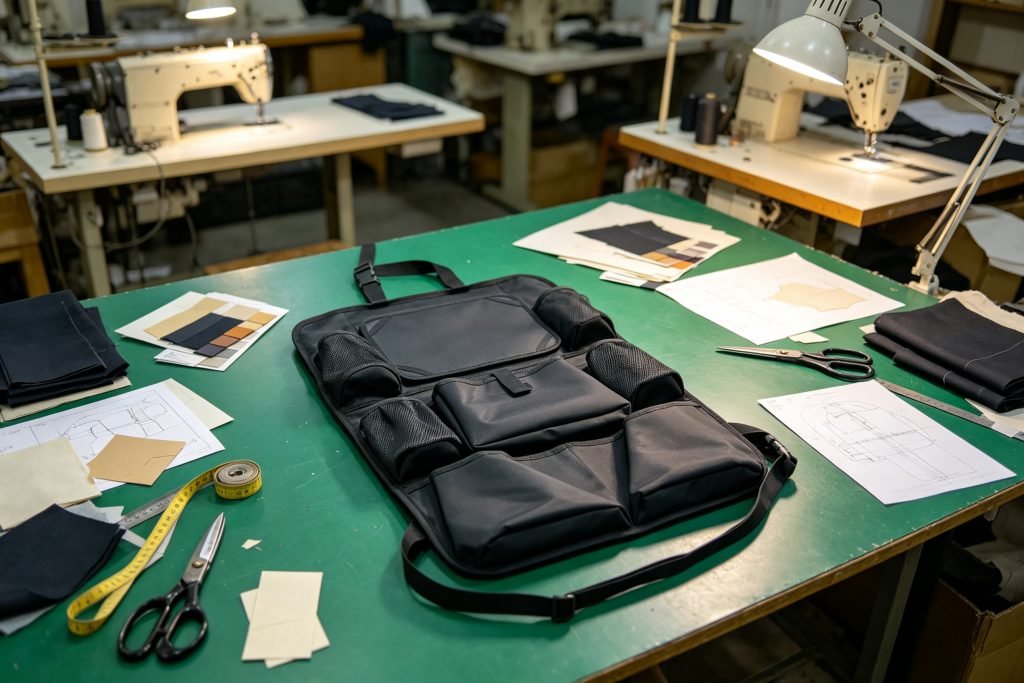
A backseat organizer survives daily use when the mounting straps hold under repeated pulling, the pocket panel keeps its shape under load, the fabric resists abrasion and spills, and every stress point is reinforced with bartack or box stitching — not when it simply has more pockets.
On any new sample, the mounting system is the first thing we test by hand — not because it’s the most expensive part, but because it’s the part that generates the most warranty claims. A strap that stretches after two weeks on the road will generate returns fast in markets like the US, UK, or Germany, where buyers expect daily-use durability out of the box.
The Three Functional Zones
| Zone | Function | Common Failure Point |
|---|---|---|
| Mounting straps | Attach to headrest posts or seat top | Slipping, loosening, or stretching over time |
| Pocket panel | Hold and organize items | Sagging, poor pocket shape, weak zipper pulls |
| Back contact layer | Sits against the seat back | Scratching seat leather, sliding, or bunching |
1. Mounting Systems
The mounting system directly dictates user satisfaction. If you are targeting premium retail or longer product lifecycles, upgrading this spec is your best investment.
- Standard Spec: Simple loop straps with plastic buckles.
- Premium Spec: Dual-point adjustable systems with anti-slip silicone backing.
- The ROI: While the adjustable multi-point system adds $0.15–$0.40 per unit, it is consistently the #1 upgrade that drops return rates.
2. Fabric Selection
Fabric specs must align with the target user profile. Copying a single spec sheet across different product lines is a major compliance and market risk.
- Material Options: Oxford polyester (600D–1200D), canvas, neoprene, and faux leather.
- The Pitfall: A family-focused organizer (needs heavy-duty scratch resistance and easy cleaning) and a business-commuter organizer (needs premium texture and rigid shape) should never share the same fabric spec.
For a side-by-side breakdown of abrasion resistance, cost, and feel across the main fabric options — Oxford cloth vs. polyester vs. PP non-woven — see our Car Organizer Fabrics Compared guide.
3. Stitching & Edge Reinforcement
Stitching quality is impossible to judge from a supplier photo, making it the most common failure point we flag during Pre-Shipment Inspections (PSI). We size every PSI check using attribute-based sampling per ISO 2859-1, not a handful of units pulled at random off the top of a carton.
- High-Stress Areas: Strap attachment points and pocket openings.
- Manufacturing Standard: Reinforced bartack stitching, bound edges on pocket openings, and double-stitched seams.
- The Reality: These structural details are what separate a product that survives 12 months of daily use from one that tears within the first month.
A Detail Most Buyers Never Ask About: Headrest Compatibility
This is something we flag on almost every new project, and it rarely comes up in buyer briefs. Headrest post spacing and shape are not standardized globally — single-pole headrests, dual-pole headrests, and oval-post headrests all exist across different vehicle markets, and a strap loop sized for one will sit loose or won’t fit at all on another.
If your end market is mixed (general consumer, not OEM-fitted for one car model), we recommend:
- An adjustable strap length with at least 15–20cm of range, not a fixed loop
- A buckle or velcro closure rather than a sewn loop, so the same SKU fits more headrest shapes
- Testing the sample against at least two or three different seat types before approving — not just the demo seat in the factory showroom
This single spec decision is responsible for a large share of the "doesn’t fit my car" complaints we’ve seen on review pages over the years.
What Are the Main Types of Backseat Car Organizers by Use Scenario?
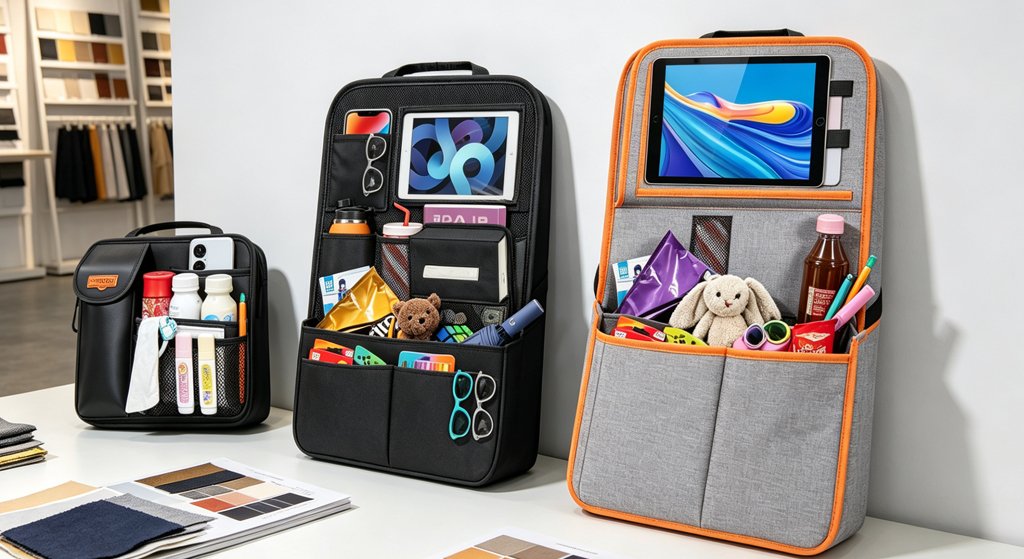
Product type isn’t just about size or style — different scenarios need different pocket depth, access points, and materials.
Backseat car organizers split into five main use types: children and family travel, long-distance road trips, business commuting, pet-related use, and everyday general storage. Each needs a different pocket size, access point, material, and cleaning approach.
How to Match Type to End User
| Type | Target User | Key Pocket Needs | Best Material | Cleaning Requirement |
|---|---|---|---|---|
| Children & family | Parents with young kids | Cup holders, tablet sleeve, toy pockets, snack slots | Easy-clean Oxford or neoprene | High — must wipe clean fast |
| Long-distance travel | Road trip users | Larger document and bottle pockets, tissue holder | Heavy Oxford or canvas | Medium |
| Business commuting | Daily urban drivers | Tablet/laptop sleeve, document pocket, minimal clutter | Faux leather or ballistic nylon | Low–medium |
| Pet-related | Dog/cat owners | Open mesh, waterproof base layer, waste bag slot | Waterproof-coated Oxford | High — must resist moisture |
| Everyday general use | General car owners | Mixed small pockets, flexible layout | Mid-weight Oxford | Low–medium |
Tailoring Specs to Your Target Segment
Different target demographics demand entirely different product architectures. Here is how to specify your product line based on market data:
Family & Children Organizers (High Volume)
- Key Requirements: Padded tablet sleeves, easy-clean wipeable surfaces, and market-specific cup holders. (Tip: Verify bottle diameters—US sippy cups and EU water bottles vary significantly). If the SKU is marketed primarily to children rather than to the parent/driver, check early whether it falls under CPSIA children’s-product testing and certification requirements for the US market — this affects lab testing, tracking labels, and documentation before mass production.
- Market Insight: Solid bright or neutral colorways consistently outsell busy patterns in current sales data.
Business Commuter Organizers (Premium Tier)
- Key Requirements: Slim profiles and premium fabric textures.
- Market Insight: Rear passengers in this segment prioritize legroom and knee clearance over total pocket count. Fewer, well-tailored pockets work best.
Pet-Focused Organizers (Growing Segment)
- Key Requirements: Genuinely waterproof (not just water-resistant) base layers and specialized odor-resistant mesh.
- Market Insight: In the US, UK, and Australian markets, failing odor retention tests is the #1 reason competitors’ samples get rejected by buyers.
⚠️ Product Layout Pitfalls to Avoid
Design for the end-user, not for a glossy catalog photo. Watch out for these common layout flaws during product development:
- The Leak Hazard: Never place a tablet sleeve directly below or behind a cup holder. Any spill will ruin the electronics.
- The Sagging Pocket: Ensure document pockets have internal rigid backing or reinforced edge binding. Without it, the weight of a heavy device will cause the panel to sag and ruin the organizer’s shape.
These structural flaws are classic design failures that typically show up at the sampling stage. This is exactly why we always push buyers to test new samples with real, weighted items—like full water bottles and actual tablets—rather than empty, flat mockups before greenlighting mass production.
Why Is “More Pockets” a Weak Buying Standard?
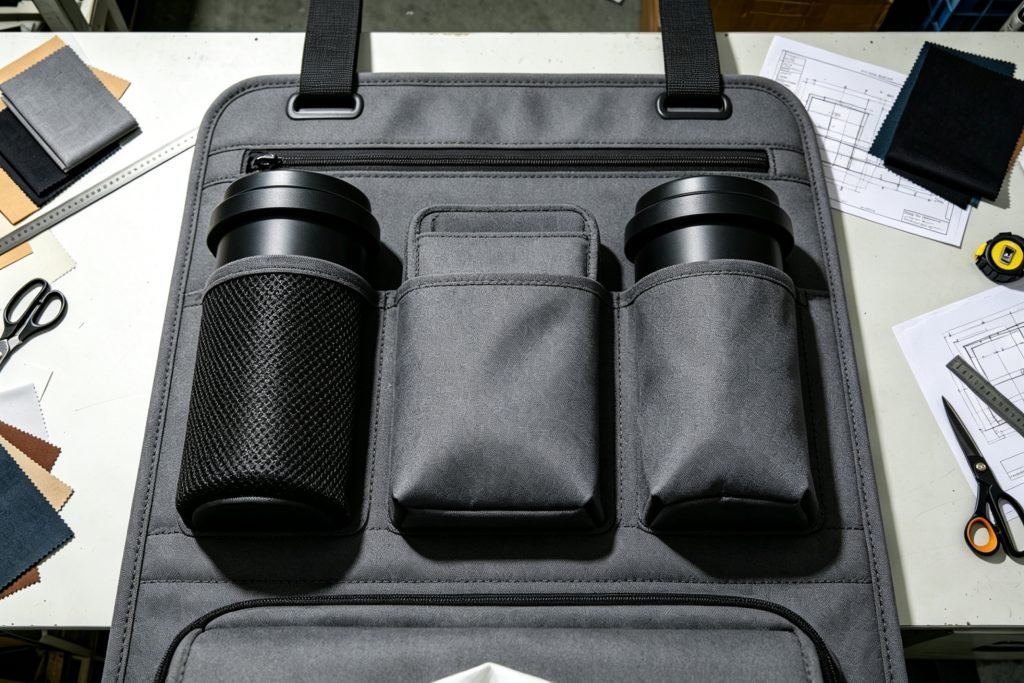
“More pockets” is a weak buying standard because pocket count says nothing about pocket size, depth, reinforcement, or fit to the items actually being stored. A cup holder too wide to hold a bottle securely, or a tablet sleeve too thin to use, creates end-user frustration no matter what the listing photo shows.
We ask every buyer one question early in a project: what is your end user actually going to put in this pocket? The answer changes the entire spec sheet.
Ask This Instead
| Wrong Question | Better Question |
|---|---|
| How many pockets does it have? | What sizes are the pockets, and what items actually fit? |
| Is the fabric thick? | What’s the fabric weight (denier), coating, and abrasion rating? |
| Does it look full-featured? | Does the layout match the target user’s real storage habits? |
| Is the price low? | What stitching and reinforcement supports this price point? |
| How many units can you produce? | What’s the defect rate, and how is each batch QC’d? |
🔍 From Our QC Floor: A Real-World Case Study
This is the kind of engineering detail that never shows up in a glossy listing photo or a copied spec sheet. Here is how we translated this philosophy into practice during a recent sampling round for a US-based brand:
The Challenge: The 600ml Load Test
Our QC team ran a rigorous stress test on the client’s initial cup holder design: inserting and removing a 600ml water-filled bottle repeatedly to simulate harsh daily wear.
- The Failure Point: At just 50 cycles, the original construction showed visible stitch separation at the base seam—a guaranteed recipe for 1-star Amazon reviews within the first month.
Our Engineering Solution & Results:
- The Engineering Fix: We re-engineered the stress point by replacing the standard seam with a double box-stitch reinforcement and integrating a rigid base insert to distribute weight evenly.
- The Result: The revised sample easily surpassed 500+ cycles with zero structural failure.
The Takeaway: This was a simple, one-line engineering modification on the spec sheet, but it represents the exact difference between a product that tanks your brand reputation and one that survives years of daily use. We catch these structural flaws at the sampling stage—testing with real, weighted items—before a single yard of fabric is cut for mass production.

What Should B2B Buyers Check Before Choosing a Model?
B2B buyers should evaluate a backseat car organizer across six areas before committing: mounting stability, fabric durability and coating, stitching and edge reinforcement, material odor and compliance suitability, packaging and retail presentation, and customization options available from the factory.
The Checklist We Walk Through With Every New Buyer
1. Mounting stability. Pull the straps by hand after attaching to a headrest. A product that shifts under light manual pressure will shift on the road. Check buckle firmness, strap width relative to load, and whether any anti-slip backing actually grips without scratching the seat surface.
2. Fabric durability and coating. Ask for the fabric weight in denier, whether a PU or TPU coating is applied, and what abrasion and water-resistance testing was done — and to what standard (e.g., Martindale or Wyzenbeek-style abrasion cycles). Don’t accept "waterproof" as a claim without a test reference; ask the supplier to specify it. Oxford polyester in the 600D–900D range is common for mid-market products; 1200D–1800D is used for premium or higher-load products, but always verify the actual strength data rather than the marketing number.
3. Stitching and reinforcement.
| Inspection Point | What to Check |
|---|---|
| Strap-to-panel attachment | Bartack or box-X stitching present |
| Pocket opening edges | Bound or reinforced hem, no raw edges |
| Zipper attachment | Even stitching line, no skipped stitches |
| Bottom seam of cup holders | Double-stitched or heat-sealed base |
| Back panel edge | Finished edge to prevent fraying |
4. Material odor and chemical suitability. For EU-bound orders, ask about REACH-aligned material sourcing and request documentation rather than assuming compliance. This is a sourcing decision, not just a finished-product decision.
5. Packaging and retail presentation. Polybag vs. box, hangtag design, insert cards, and barcode placement all affect landed cost and shelf impression — decide these before bulk, not after the first container ships.
6. Customization options. This is where buyers leave the most value on the table by not asking early. At our factory, typical customization includes logo printing or embroidery, custom color combinations, private-label tagging, and pocket layout changes. Cosmetic changes (color, logo, labeling) usually carry no tooling cost and a low MOQ. Structural changes (a new mold for a rigid cup-holder insert, a different buckle hardware) involve tooling cost and a higher MOQ — and the earlier this is discussed in sampling, the cheaper it is to change.
A Quick Note on OEM vs. ODM for This Product
Most buyers in this category fall into one of two paths:
- ODM (factory’s existing design, your branding): Fastest to market, lowest MOQ, cosmetic customization only. Good fit for testing a new market or sales channel before committing to a unique structure.
- OEM (your design, factory builds to spec): Needed if you want a distinct pocket layout, mounting mechanism, or silhouette competitors can’t copy easily. Higher MOQ and a tooling/sample-development cost, but it’s the path that actually builds a defensible product line rather than a me-too SKU.
For more on how private-label programs work in this category specifically — MOQs by customization tier, lead times, and what’s actually open to change at each level — see our Private Label Car Organizers guide.
We walk new buyers through which path fits their volume and timeline before quoting — it changes the MOQ and lead time conversation significantly.
FAQ
Does a backseat car organizer fit any headrest?
Not automatically. Headrest post spacing and shape vary by vehicle, so a fixed-loop strap may not fit every seat. An adjustable strap with 15–20cm of range, paired with a buckle or velcro closure, fits a much wider range of vehicles than a sewn loop.
What’s a typical MOQ for a custom backseat car organizer?
It depends on whether the customization is cosmetic (logo, color, labeling) or structural (new mold, different hardware). Cosmetic customization usually carries a lower MOQ than structural changes, which require tooling investment. Ask your supplier for MOQ broken out by customization type, not a single blanket number.
How long does sampling usually take?
For a cosmetic variation on an existing design, sampling is typically fast. For a structural change requiring new tooling, expect a longer development cycle — confirm this with your supplier before setting a launch date, since this is the step most timelines slip on.
What’s the biggest mistake first-time buyers make in this category?
Approving a sample from a photo without load-testing the pockets with real items, and without checking strap fit against more than one seat type. Both issues are invisible in a photo and expensive after a container has shipped.
Conclusion
A backseat car organizer is a simple-looking product with real engineering depth underneath it. Match the type to the actual user scenario, evaluate structure and reinforcement over pocket count, and confirm mounting compatibility and material specs before committing to bulk.
Already Have a Sample or Spec Sheet Sitting on Your Desk?
Send it over. We’ll check it against the exact three things above — headrest fit for your target market, load capacity on the pockets, and MOQ broken out by customization type — and tell you straight where it holds up and where it won’t.
That’s the same pass every sample gets before it leaves our room, whether you end up ordering from us or not.







