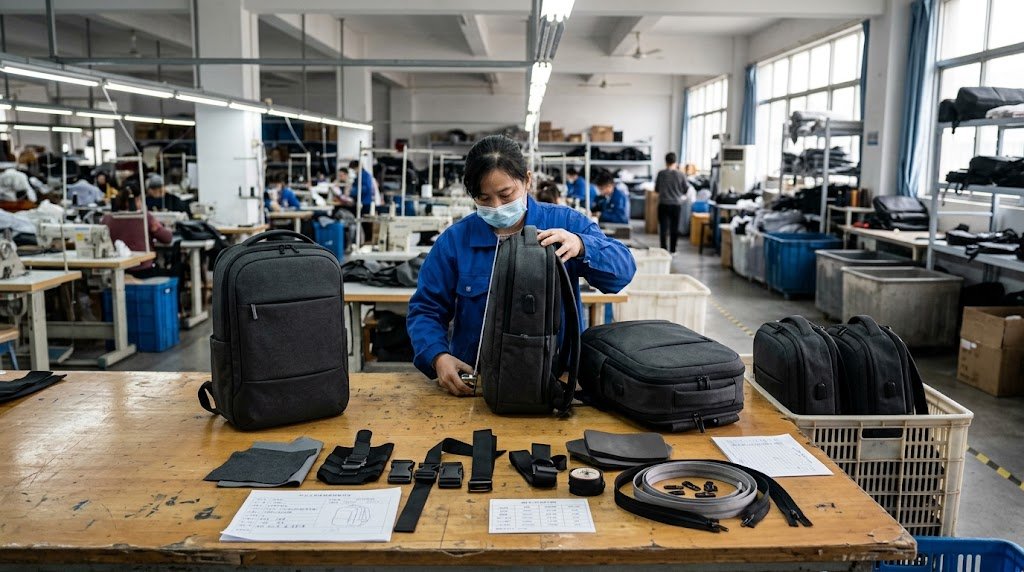
You’re sourcing custom backpacks from China. You want them shipped straight to an Amazon FBA warehouse — no middleman, no freight forwarder unpacking and repacking everything. Smart move. Fewer touches = lower cost = better margin.
But here’s the thing: I’ve seen this go wrong more times than I can count. Not because the bags were bad. Because the factory had no idea what Amazon actually wants when a container shows up at their dock.
I’m going to tell you exactly what we’ve learned — the hard way — about making this work.
Does Amazon Actually Accept Direct Factory Shipments?
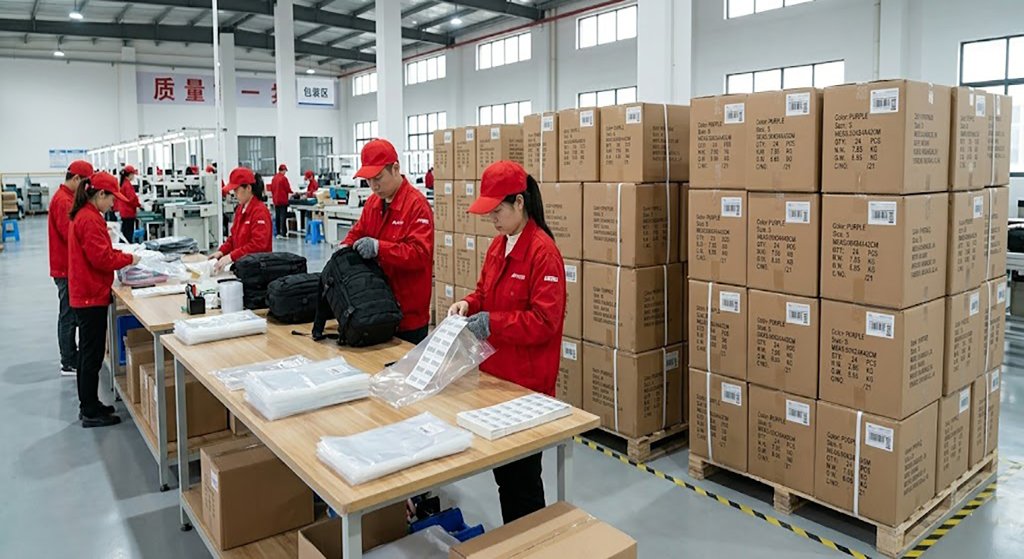
Yes. Amazon FBA accepts direct shipments from overseas factories — but only when your cartons, labels, and documentation meet their exact prep requirements. A single missing FNSKU barcode or wrong carton dimension gets your shipment held or rejected at the fulfillment center, costing you days and fees you can’t get back.
The key point: Amazon doesn’t care if you’re a factory or a fulfillment center. They care about compliance. You either meet the spec or you don’t.
What this means practically: your factory must be able to print and apply FNSKU labels, pack cartons to Amazon’s weight and dimension rules, generate a packing list that matches your shipment exactly, and sometimes apply poly bags or suffocation warning stickers depending on your product type.
Most bag factories in China can do zero of that out of the box. We built that capability over three years of working with FBA sellers. It’s not magic — it’s just process.
What Does "Amazon FBA Ready" Actually Mean for Custom Backpacks?
A backpack shipment is FBA-ready when every unit has the correct FNSKU label, every carton is under 50 lbs and within Amazon’s box size limits, and all documentation matches the shipment ID created in Seller Central — before the shipment leaves the factory floor.
Here’s what that breaks down to in practice:
Unit-Level Requirements
- FNSKU barcode — printed or stickered on each bag, scannable, not blocked by zipper pulls or straps
- Poly bag — required for backpacks since they’re a "suffocation risk" product category. Must be 1.5 mil or thicker with a suffocation warning printed or stickered if the opening exceeds 5 inches
- No loose parts — straps, accessories, or detachable components must be secured or bagged together
Carton-Level Requirements
- Max weight: 50 lbs (23 kg) per carton
- Max dimensions: no single side exceeds 25 inches (unless it’s an oversized item — which most backpacks are not)
- Each carton gets an Amazon shipment label (FBA Box ID) printed from Seller Central
- Carton contents must match the packing list exactly — no mixing SKUs unless you’ve set up mixed inventory
Documentation
- Commercial invoice with declared value
- Packing list matching Seller Central data
- Bill of lading or airway bill with the FBA shipment ID
Factory Secret: We’ve seen buyers lose two to three weeks because their factory printed the FNSKU label on the inside tag pocket where the scanner can’t read it. Label placement sounds obvious. It isn’t. Specify it explicitly in your tech pack.
Which Shipping Methods Work for FBA Direct from a Chinese Factory?
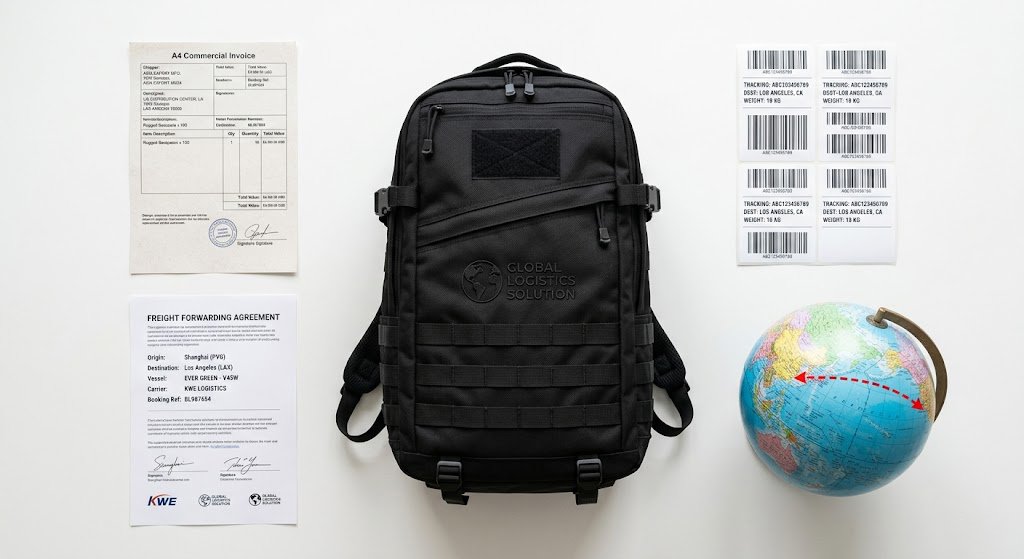
The four real options are sea freight (FCL or LCL), DDP express sea/air/rail, air freight, and courier. For most custom backpack orders under 1,000 units, DDP sea or air is what I actually recommend — not because it’s cheapest, but because it removes the customs headache entirely from the buyer’s side.
Here’s how each method maps to real order sizes:
FCL (Full Container Load) — 2,500+ Units
A standard 20-foot container holds roughly 2,500 units of a 20-inch backpack. That’s your FCL threshold in practice.
Below 1,000 units, FCL rarely makes financial sense — you’re paying for space you’re not using.
| Destination | Typical Transit Time |
|---|---|
| US (West Coast) | 25–30 days |
| US (East Coast) | 35–40 days |
| Germany | 28–35 days |
| UK | 28–33 days |
| Japan | 10–15 days |
| Australia | 18–25 days |
Factory note: FCL gives you the cleanest FBA prep window. We stuff the container at our factory, labels are applied before loading, cartons are counted before the doors close. Nothing gets touched again until it hits the FBA warehouse.
LCL (Less than Container Load) — 200–800 Units
Your cartons share a container with other shippers. A consolidator at the port combines them, a deconsolidator splits them at destination.
The problem: your cartons get handled 3–4 times. FNSKU stickers peel. Cartons get crushed. We laminate every label on LCL shipments — non-negotiable.
Transit times run 5–10 days longer than FCL equivalents due to consolidation/deconsolidation dwell time.
DDP Sea / Air / Rail — 100–1,000 Units
This is the method most buyers in this range should be using, and the one most sourcing articles don’t explain properly.
DDP (Delivered Duty Paid) means the factory or freight forwarder handles everything: export customs in China, international freight, import customs clearance, duties, and last-mile delivery to the FBA warehouse. You pay one price. Nothing touches your desk except the tracking number.
| Method | Best For | China → US | China → Germany | China → UK |
|---|---|---|---|---|
| DDP Sea | 300–1,000 units, no rush | 35–45 days | 32–40 days | 30–38 days |
| DDP Air | Under 300 units, or urgent restocks | 7–12 days | 5–8 days | 5–8 days |
| DDP Rail | 200–800 units, Europe-bound | N/A | 18–25 days | 20–28 days |
Rail (China-Europe freight train) is underrated for European FBA sellers. It’s slower than air but roughly 60–70% cheaper — and transit times have gotten more reliable over the last two years. For Germany, Poland, or Czech Republic FBA nodes, I bring it up with every European client now.
Factory secret: DDP sounds expensive upfront because the quote includes duties. It isn’t. What it removes is the risk of surprise fees, customs holds, and the ISF filing window stress. For first-time FBA importers especially, DDP is worth the premium.
Air Freight / Express Courier — Under 200 Units
Use air when:
- It’s a test order and you need stock fast to validate your listing
- You’re doing a restocking emergency and can’t wait 35 days
- Your backpack is lightweight enough that air rates don’t destroy your margin
Express courier (DHL, FedEx, UPS) handles customs brokerage themselves. Simplest operationally — just make sure your commercial invoice is correct or they’ll hold it for clarification.
Transit times: 5–10 days door-to-door from our factory to most FBA warehouses in the US, EU, or UK.
What’s the Minimum Order Quantity for Custom FBA Backpacks?
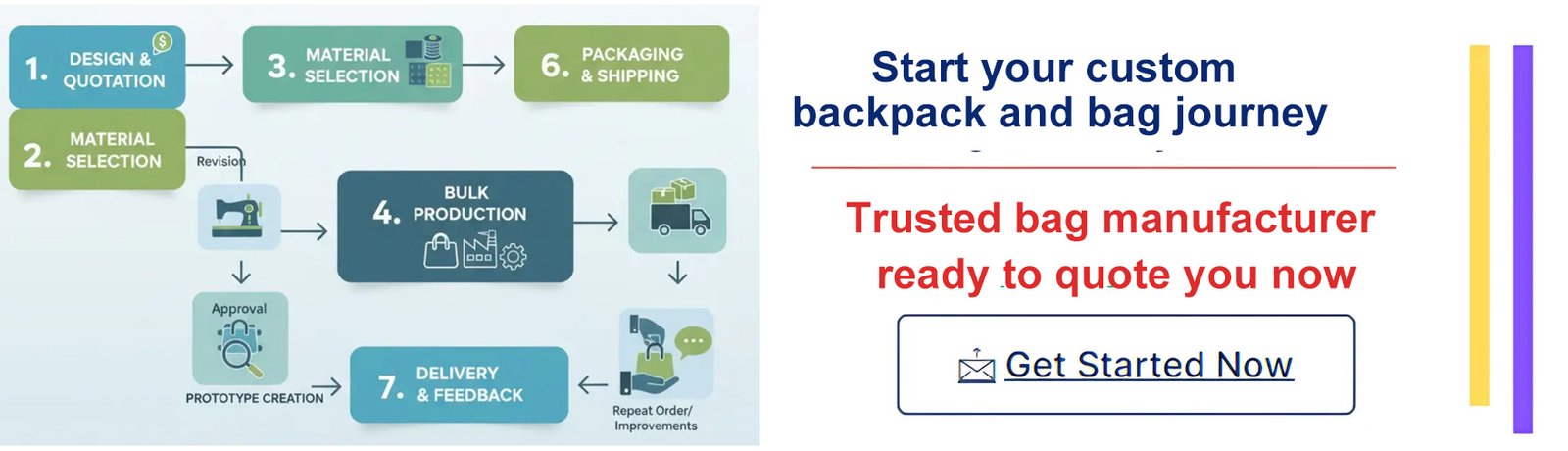
For a fully custom backpack — your own design, your own logo, custom materials — our factory’s minimum is 500 units per style per colorway. If you want the full breakdown on how MOQ changes based on customization level, I wrote about it in detail here. Below that threshold, setup costs (tooling, sampling, bulk fabric cuts) eat your margin before you’ve sold a single unit.
Here’s where buyers get surprised:
500 units sounds like a small order. It’s not small for a manufacturer. We’re cutting fabric, adjusting pattern blocks, mixing custom hardware colors, possibly dyeing webbing. That setup is the same whether you order 500 or 3,000.
What changes at different volume levels:
- 100-300 units: We can do it. Expect a higher per-unit cost. Limited customization on hardware (we pull from existing stock).
- 500–1,000 units: Sweet spot. Better pricing, more room to customize zippers, lining, label placement.
- 1,000+ units: Full flexibility. Custom hardware molds, private label hangtags, EDI-compatible packing lists — we can do all of it.
If you’re testing a new design, I’d rather tell you upfront: order 500, run it through FBA, let the market validate it. Then scale.
What Are the Biggest Mistakes Factories Make with FBA Shipments?
The three most common errors are wrong label placement, carton weights that exceed 50 lbs, and missing or mismatched shipment IDs. Any one of these gets your inventory quarantined — Amazon won’t sort it out for you.
Let me be honest about a mistake we made early on.
A US client sent us their FNSKU labels as a PDF. We printed them in-house and applied them before poly-bagging each backpack. Clean. Correct. Or so we thought.
Amazon rejected 200 units because the barcode was printing at 72 DPI — not scannable. We’d been using a low-res office printer. The client had to pay Amazon’s partnered carrier to pull those units, resticker them at an Amazon prep center, and re-induct them. Total cost: around $400 plus two weeks of lost sales.
After that, we invested in a proper Zebra label printer. 203 DPI minimum. We test every batch with a handheld scanner before cartons are sealed.
The FBA shipment mistake checklist:
- FNSKU barcodes printed at 203 DPI or higher
- Labels applied to a flat, accessible surface on the unit
- Poly bags sealed, suffocation warning present
- Each carton weighed — never estimate
- Carton dimensions entered into Seller Central before printing box labels
- Shipment ID written on Bill of Lading
How Do I Send My Amazon FBA Specs to a Chinese Factory?
Send your factory a one-page FBA Prep Sheet alongside your purchase order. It should include: FNSKU barcode file, poly bag spec, carton weight limit, Amazon shipment ID, and the warehouse address from Seller Central. Don’t assume your factory knows Amazon’s rules. They probably don’t.
Here’s the template we give our own clients to send us:
FBA PREP SHEET

Product: [Style name + colorway]
ASIN: [Your Amazon ASIN]
FNSKU: [Barcode + human-readable code]
Units per carton: [X]
Target carton weight: [X kg / lbs]
Poly bag required: Yes / No
Suffocation warning: Yes / No
Ship to address: [From Seller Central — include FC code, e.g., PHX7]
Shipment ID: FBA[XXXXXXXXXX]
Special instructions: [e.g., "Do not ship before QC photos sent"]
We ask for this before we even cut fabric. If you send it after production, you’re already behind.
What Quality Control Steps Should Happen Before FBA Shipment?

Before any unit ships to FBA, run an AQL inspection — either inline during production or pre-shipment. For a first order, I’d recommend a pre-shipment inspection at 2.5 AQL Level II. For repeat orders with a proven factory, inline QC is enough.
My personal rule: you do not want Amazon to be your quality control department. If defective units make it to FBA and customers start returning them, your account health takes the hit. Amazon’s return data is accurate and merciless.
What we check in our pre-ship QC for backpacks:
- Stitching tension and thread color matching
- Zipper pull alignment and smooth operation
- Hardware — buckle closure force, D-ring weld integrity
- Fabric weight (we pull random pieces and weigh against spec)
- Label placement and barcode scan test
- Poly bag seal integrity
- Carton count and weight — every carton, on a scale
If you’re not on-site, hire a third-party inspection company. QIMA and Bureau Veritas both have inspectors in Guangzhou and Quanzhou. Budget around $300 per inspection day.
FAQ
Q: Can a Chinese factory ship directly to Amazon FBA without a freight forwarder?
Yes. A factory can ship directly to Amazon FBA using sea freight or air freight. The factory becomes the exporter of record in China, and the FBA seller (or their US entity) acts as importer of record. You don’t need a freight forwarder — but you do need a licensed customs broker on the US side to clear the goods. Some freight forwarders bundle both services; using them simplifies the process for first-time importers.
Q: Who is responsible for import duties when shipping from a Chinese factory to Amazon FBA?
The FBA seller is responsible for all import duties, customs clearance fees, and ISF (Importer Security Filing) costs. The factory is the exporter — their responsibility ends once the goods are loaded. Make sure your commercial invoice reflects the correct declared value and HS code for backpacks (typically 4202.92 for textile outer surface backpacks), or you’ll face delays at customs.
Q: Does Amazon charge extra fees if my shipment isn’t FBA-ready when it arrives?
Yes. If Amazon’s fulfillment center receives units that aren’t prepped correctly — missing FNSKU labels, no poly bags, overweight cartons — they will either reject the shipment or apply a per-unit prep fee (currently $0.55–$2.20+ per unit depending on prep type). These fees add up fast on a 500-unit shipment. Do the prep at the factory.
Q: What is the best way to get FNSKU labels to my factory in China?
Generate your FNSKU barcodes in Amazon Seller Central under "Manage Inventory → Print Item Labels." Export as a PDF and send it directly to your factory. Specify label size (standard is 1" × 2-5/8"), required DPI (203 minimum), and label position on the product. We recommend also sending a sample sticker via international post before production starts — so your factory can test their printer on the actual label stock.
Q: Can I order a small test batch of custom backpacks to send to FBA before committing to a large order?
Yes, and I’d encourage it. Most reputable factories — including ours — will do a pilot run of 300–500 units for a new design. It costs more per unit, but it lets you validate your Amazon listing, check real customer reviews, and iron out any FBA prep issues before you’re sitting on 3,000 units. Don’t let any factory pressure you into skipping this step.
Work With a Factory That Actually Knows FBA
Most bag factories in China make bags. We make bags that arrive at Amazon FBA without drama.
We’ve shipped to FBA fulfillment centers in the US, UK, Germany, Japan, and Canada. We know the label specs, the carton rules, the ISF filing window, and what happens when something goes wrong at the port.
If you’re planning a custom backpack order for Amazon FBA and want to work with a factory that won’t make you learn this stuff the hard way,send us your sepcs. Tell us your ASIN, your target unit count, and your timeline — we’ll come back with a real quote, not a vague ballpark.
Ready to get a factory quote? → Tell us your specs

Related reading: