


Last quarter, a U.S. Amazon seller sent me a Slack message at 2 a.m.: "47 one-star reviews in 30 days. Organizer falling apart. What happened?" What happened was simple — he switched from Oxford cloth to PP non-woven to save $0.90 per unit. That $0.90 decision cost him his listing, his Buy Box, and roughly $180,000 in lost annual revenue. Fabric choice isn’t a detail. It’s the decision.
The right car organizer fabric depends on your product tier. Oxford cloth wins for heavy-duty, premium trunk organizers. 600D polyester is the cost-efficient workhorse for mid-range products. PP non-woven only belongs in disposable promo giveaways or as hidden internal dividers. Choosing wrong costs far more than the fabric savings.
At Osgoodway, we’ve built car organizers in all three materials for over a decade. This article is the decision framework we hand to our own buyers — not recycled Alibaba specs. Factory-floor data. Real failures. No filler.
At a Glance: How Do Oxford Cloth, 600D Polyester, and PP Non-Woven Compare?
Before diving deep, here’s the top-level picture. This is the exact matrix I send to new clients on their first inquiry.
| Feature | Oxford Cloth (Premium) | 600D Polyester (Standard) | PP Non-Woven (Budget) |
|---|---|---|---|
| Durability | Exceptional (high abrasion) | Moderate to high | Low (prone to tear) |
| Water Resistance | Excellent (with PU/PVC) | Good | Poor (absorbent) |
| Structural Integrity | Rigid / stiff | Flexible | Soft / flimsy |
| Ideal Price Point | High-end ($25+ retail) | Mid-range ($15–$25) | Economy (<$12) |
| Best Use Case | Heavy-duty trunk organizers | Front-seat organizers | Internal dividers / disposable bags |
| UV Resistance | Good (with UV stabilizer) | Good | Poor — degrades in 3–6 months |
| FOB Fabric Cost | $1.80–$3.50/yard | $0.70–$1.80/yard | $0.15–$0.50/yard |
The takeaway: These aren’t three options on a menu. They’re three different product tiers. Mixing them up — using budget material for a premium product, or overspending on a promo item — is where money gets burned.
Factory Secret: That "600D Oxford" quote you got? Ask for the actual GSM weight, not just the denier. I’ve tested "600D" samples from 5 suppliers in Yiwu — weights ranged from 180 gsm to 310 gsm. Denier alone tells you nothing about finished fabric quality. Always request a GSM test certificate.
What Is Oxford Cloth and Why Is It the Engineering Choice for Longevity?
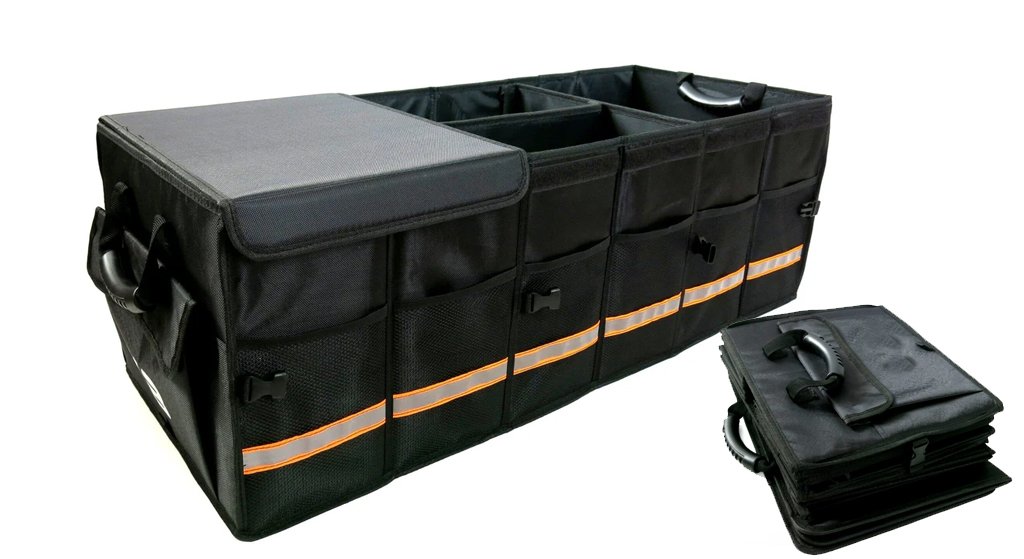
Most "student-level" blogs describe Oxford as a fabric. In the factory, we know it differently. Oxford is a weave technique, not a fiber. It uses a basketweave structure — warp and weft yarns crossing in pairs — which gives it a signature rugged texture and superior tensile strength compared to standard polyester weaves.
This distinction matters because two fabrics can both be "polyester" but behave completely differently. Oxford’s interlocking double-yarn structure creates natural "lock points" that resist pulling apart. Standard polyester plain weave doesn’t have this.
The Technical Edge of Oxford Cloth
- Abrasion resistance. Oxford cloth (especially 600D or 1680D) is significantly more resistant to the "scratch test" than standard polyester. This is critical for trunk organizers that slide against carpet or hold sharp-edged tools. We test per ISO 12947-2 (Martindale method) — Oxford consistently survives 15,000–25,000 cycles vs. 8,000–15,000 for standard 600D polyester.
- The denier secret. While 600D is the industry standard, we often recommend 1680D Oxford for bottom panels specifically. It provides a "ballistic" grade toughness that prevents the sag often seen in cheaper competitors. Full 1680D construction is overkill for a car organizer — but targeted use on high-stress panels? Smart engineering.
- Dimensional memory. An Oxford cloth organizer holds its box shape after 12 months in a trunk. Standard polyester starts sagging after 3–4 months without rigid inserts.
Oxford Cloth Grades for Car Organizers
| Grade | Denier | GSM Range | Typical Use |
|---|---|---|---|
| 300D Oxford | 300 | 130–180 gsm | Lightweight organizers, seat-back pockets |
| 600D Oxford | 600 | 220–320 gsm | Standard trunk organizers — the industry workhorse |
| 900D Oxford | 900 | 350–420 gsm | Heavy-duty tool organizers, commercial fleet use |
| 1680D Oxford | 1680 | 480–600 gsm | Bottom panels, high-stress reinforcement zones |
Factory Insight: The "Hand-Feel" Trap
We often see clients confused by "hand-feel." A high-quality Oxford might feel "thinner" than a cheap PVC-backed polyester. That’s because PVC backing adds bulk and stiffness artificially. But the Oxford’s tear strength is actually 30% higher due to yarn density in the weave itself — not a coating masking weak fabric.
Don’t judge fabric by squeezing it. Judge it by trying to tear it.
Factory Tip: Do the "thumbnail test." Press your thumbnail hard into the fabric surface. If the weave structure springs back with no lasting impression, the yarn density is solid. If you see a permanent dent or the coating cracks — that’s a subspec product.
Is 600D Polyester a Good Enough Alternative to Oxford Cloth?
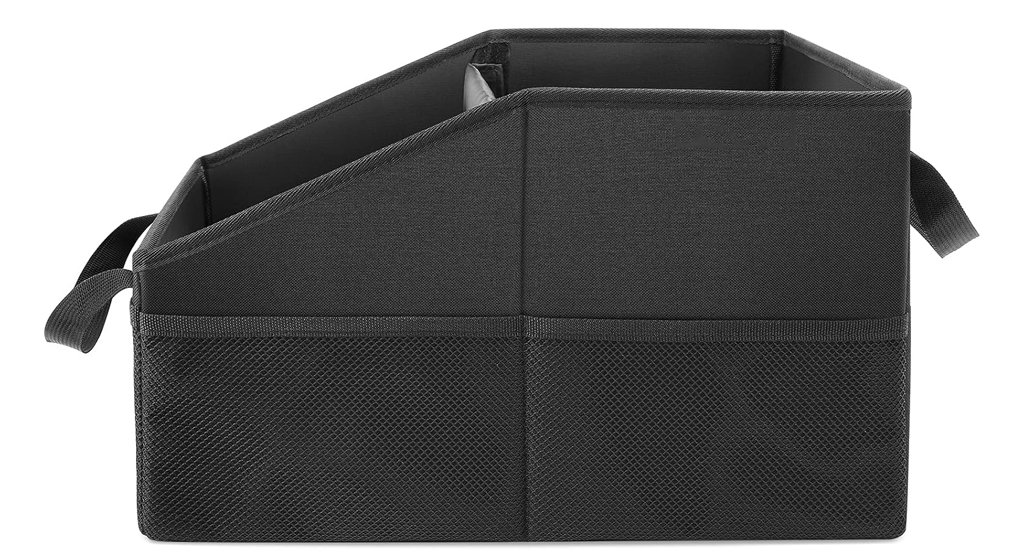
600D polyester is the workhorse of the car organizer industry. It balances cost-efficiency with a professional aesthetic. But here’s what most suppliers won’t tell you: the quality of a 600D polyester organizer isn’t determined by the polyester itself. It’s determined by the backing.
The polyester face fabric is almost a commodity at this point. Two suppliers’ 600D polyester will feel and look nearly identical. The backing material on the reverse side is where the real performance gap lives — and it’s where your product either stands up in a trunk or collapses into a sad heap.
The "Backing" Breakdown: PVC vs PU vs TPE
This is the section that separates informed buyers from everyone else.
| Backing Type | Water Resistance | Stiffness | Odor Risk | REACH / Prop 65 Safe? | Cost |
|---|---|---|---|---|---|
| PVC Backing | Excellent — waterproof | Very high (self-standing) | ⚠️ High — chemical smell in heat, VOCs | Depends on formulation | Baseline |
| PU (Polyurethane) Coating | Very good | Medium — flexible | Very low — no "smell" | ✅ Yes | +$0.15–0.30/yard |
| TPE Backing | Good | High — the "Goldilocks" option | Low | ✅ Yes | +$0.20–0.35/yard |
When to Choose Each Backing
- PVC backing makes the organizer waterproof and very stiff (self-standing). But cheap PVC cracks in sub-zero winter temperatures and often carries a strong chemical odor (VOCs). We had a Japanese client return 3,000 units because of the "chemical smell." If you sell in cold climates or premium markets — avoid budget PVC.
- PU (polyurethane) coating is more expensive but flexible and eco-friendly. It doesn’t "smell" and passes strict REACH and Prop 65 compliance tests for US and EU markets. This is our default recommendation for brands selling on Amazon US or in the EU.
- TPE backing is the "Goldilocks" solution. It offers the stiffness of PVC with the environmental safety of PU. Newer to the market. Costs a bit more. Worth it if you need a rigid, standing organizer without the VOC risk.
Where 600D Polyester Falls Short
- No self-standing structure without backing. Without a rigid backing or PP board inserts, a 600D polyester organizer is a floppy bag. Oxford holds shape on its own; polyester needs help.
- Seam slippage. Standard polyester’s plain weave is looser than Oxford’s basketweave. Stitched seams pull apart under lower force. We test per ASTM D1683 — 600D polyester slips at 50–70N; Oxford holds past 100N.
- Abrasion ceiling. In a trunk where groceries, tools, and strollers slide around daily, 600D polyester pills and shows wear faster than Oxford at the same denier.
Factory Secret: If a client insists on 600D polyester to hit a mid-range price point, we add 0.4mm PP board inserts to every compartment and use TPE backing. Adds ~$0.35/unit total but solves both the structure and the odor problem. This combo hits the $15–$25 retail sweet spot.
Why Do Some Car Organizers Have a "Toxic" Chemical Smell?
If you browse the one-star reviews of the top 10 car organizers on Amazon, "Toxic Chemical Odor" is a recurring theme. This isn’t just a minor nuisance; it’s a major compliance red flag.
In our lab, we’ve traced this "New Car Smell" (the bad kind) to two primary sources: low-grade recycled PVC backings and non-compliant high-lead dyes. When these materials sit in a shipping container for 30 days and then move to a trunk that hits 140°F in the sun, they begin to "off-gas."
The Osgoodway Manufacturing Standard: "Headache-Free" Sourcing
To move your product from "cheap import" to "automotive grade," we implement a three-tier compliance protocol:
- PFC-Free & Low-VOC Materials: We prioritize fabrics that use solvent-free coatings. For our EU and US clients, we ensure every roll of fabric meets REACH and California Prop 65 standards before it even hits the cutting table.
- The "De-gassing" Phase: Most factories pack products the second they come off the sewing line to save time. At OSGW, we implement a mandatory 24-to-48-hour de-gassing phase in a temperature-controlled, ventilated area. We air out the materials before final folding and poly-bagging.
- Azo-Free Dye Certification: We exclusively use Azo-free dyes to ensure that even under high heat, there are no carcinogenic aromatic amines being released into the vehicle’s cabin.
Factory Tip: If you are sourcing from a new supplier, ask for their VOC Test Report (e.g., VDA 278). A factory that doesn’t know what VDA 278 is likely isn’t controlling their chemical off-gassing. This single document is your best insurance against a mass-return event triggered by "chemical smell" complaints.
Should You Ever Use PP Non-Woven Fabric for a Car Organizer?
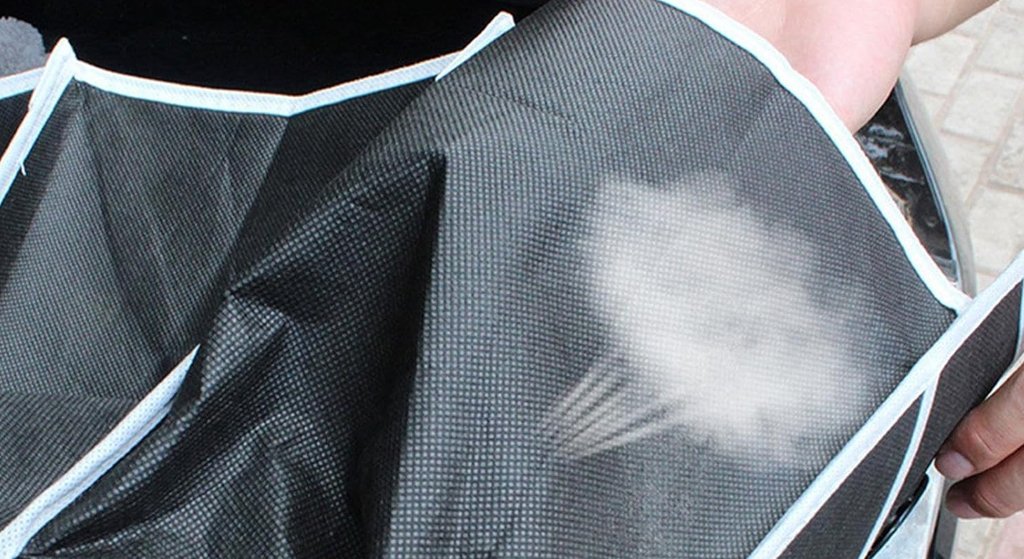
Let me be direct: if you’re building a brand, don’t use PP non-woven as your primary shell. It’s made by bonding fibers together rather than weaving them, which means no yarn structure, no elasticity, and no meaningful tear resistance.
If a car organizer is priced under $10 on Amazon, it likely uses PP non-woven. I’ve watched three Amazon sellers tank their listings with PP non-woven organizers. The reviews all say the same thing: "fell apart in two weeks."
Why PP Non-Woven Fails as a Primary Shell
- Low "gram weight" problem. Non-woven fabric is measured in GSM (grams per square meter). In car organizers, anything under 80 GSM will tear at the seams within weeks of use. Even at 100 GSM, it’s dramatically weaker than any woven fabric.
- UV sensitivity. Non-woven degrades quickly when exposed to sunlight through car windows. Polypropylene has poor photo-oxidative stability — a PP non-woven organizer left near a window yellows and becomes brittle within 3–6 months (reference: polymer degradation studies in Polymer Degradation and Stability).
- No elasticity. Once stretched, it stays stretched. Once torn, the tear propagates — there’s no yarn structure to stop it.
- Sewing nightmare. Our sewers hate working with non-woven. The needle holes don’t close back up. Machine tension has to be dialed way down. Daily output drops 20–30%. That labor cost gets baked into your quote.
Where to Use PP Non-Woven Professionally
At OSGW, we don’t use non-woven for the exterior. However, we strategically use 100 GSM non-woven for internal dividers or hidden reinforcement sleeves. This allows us to hit a lower target COGS (Cost of Goods Sold) without compromising the external "premium" feel of the Oxford or polyester shell.
| Scenario | Why It Works |
|---|---|
| Internal dividers / liners | Hidden inside a woven organizer. No abrasion, no UV exposure, no customer contact. |
| Dealership giveaways | Cost is king. $0.60–$1.00/unit for a branded organizer that lives in a trunk for 3 months. |
| Seasonal promo items | Holiday gift-with-purchase. Nobody expects it to last a year. |
| Market testing | You need 500 units to test a new organizer design before investing in Oxford tooling. |
The Cost Trap Nobody Warns You About
Here’s the counterintuitive truth: PP non-woven can be more expensive than polyester in the long run.
- Return rates on PP non-woven organizers run 8–15% in our experience. Oxford runs 1–3%. Polyester runs 3–6%.
- Negative reviews kill your Amazon listing velocity. One client’s BSR dropped from #12 to #180 after switching to non-woven to "save costs."
- You end up running two production cycles: the cheap non-woven run, then the replacement run in proper fabric.
Factory Tip: If you must use PP non-woven, specify minimum 90 GSM and needle-punched bonding (not thermal bonding). Needle-punched non-woven has roughly 2x the tear resistance of thermal-bonded at the same weight. And never use it on exterior panels. Ever.
To turn this from a "material list" into an Industry White Paper, we should treat the odor issue as a critical engineering challenge. In the automotive industry, this is known as VOC (Volatile Organic Compounds) management.
I recommend inserting this right after the "Backing Breakdown: PVC vs PU vs TPE" section. At that point in the article, the reader has just learned about backings, so they are primed to understand why those backings cause problems.
How Do These Fabrics Perform in Real Trunk Conditions?
Lab specs on a data sheet and real-world trunk abuse are two different things. A car trunk hits 160°F (71°C) in Arizona summer, drops below freezing in Minnesota winter, gets soaked by leaking grocery bags, and endures constant friction from sliding cargo.
We ran a 90-day trunk simulation test in our Guangdong lab: 12-hour heat cycles (70°C/158°F), UV-B exposure (340nm), and 50-cycle friction abrasion per day. Here are the results.
90-Day Trunk Simulation Results
| Test Parameter | Oxford Cloth (600D) | 600D Polyester (PU-backed) | PP Non-Woven (90 GSM) |
|---|---|---|---|
| Color fastness (1–5, ISO 105-B02) | 4–5 (minimal fade) | 3–4 (slight fade) | 2–3 (noticeable fade) |
| Shape retention after heat cycling | 95%+ | 75–85% (some sagging) | 50–60% (warping) |
| Surface abrasion (visual grade) | No pilling, minor scuffing | Moderate pilling | Surface fibers detaching |
| Water spot resistance (50 wet/dry cycles) | No staining | Minor watermarks | Absorbed and stained |
| Odor after heat cycling | Minimal (PU coat) | Slight (PU) / Strong (cheap PVC) | None |
| Structural integrity at Day 90 | 100% — no failures | 85% — minor seam stress | 40% — tears at stress points |
What This Data Actually Means for Your Product
- Premium product ($25+ retail)? → Oxford cloth with PU coating. No contest.
- Mid-range ($15–$25)? → 600D polyester with TPE or PU backing + PP board inserts.
- Promo / disposable (<$12)? → 90 GSM+ PP non-woven, needle-punched. Accept the lifespan trade-off.
Choosing the right fabric is only 50% of the battle. Even the best 1680D Oxford cloth will fail if the stitching tension is incorrect or the edge binding isn’t heat-sealed. To understand how we integrate these materials into a market-ready product—from CAD design to final load-testing—read our Complete Guide to Car Trunk Organizer Manufacturing.

How Do You Verify Fabric Quality Before Placing a Bulk Order?
Request three things from your supplier before signing a PO: a GSM test report, a Martindale abrasion test result, and a 24-hour heat-exposure sample. If they can’t provide all three, walk away.
I’ve seen buyers commit to 10,000 units based on a hand-feel sample and a data sheet. The production fabric arrives 15% lighter than the sample. The supplier shrugs. You eat the loss.
Your Pre-Order QC Checklist
- GSM verification. Cut a 10cm × 10cm swatch. Weigh it on a precision scale. Multiply by 100. That’s your GSM. Do this on the sample AND on the bulk roll when it arrives. Tolerance: ±5%. Beyond that, reject.
- Martindale abrasion. Ask for test report per ISO 12947-2. Minimum acceptable: 10,000 cycles for mid-range, 15,000 for premium.
- Heat exposure test. Put the sample in an oven at 70°C for 24 hours. Check for: odor, color change, coating delamination, and dimensional change. We do this for every new fabric lot.
- Seam slippage test. Per ASTM D1683. Critical for polyester and non-woven. Minimum: 80N for handles and load-bearing seams.
- Color fastness to light. Per ISO 105-B02. Grade 4+ required for any product near a window.
- Backing type confirmation. Get it in writing: PVC, PU, or TPE? What thickness? What Shore hardness? Verbal confirmations mean nothing.
Red Flags That Signal a Bad Supplier
| Red Flag | What It Actually Means |
|---|---|
| "We don’t have test reports, but trust us" | They don’t test. Period. |
| GSM varies >10% between sample and bulk | Bait-and-switch. They swapped to cheaper material after you approved. |
| Won’t disclose backing type or thickness | Using the cheapest option and hiding it. |
| Sample smells fine, but they refuse a heat test | The off-gassing only shows at temperature. They know. |
| MOQ suspiciously low (100 pcs for Oxford) | They’re a trading company. Your order gets subcontracted to whoever’s cheapest. |
Factory Tip: Visit the factory. Or send a third-party QC inspector for pre-shipment check. Agencies like QIMA or V-Trust charge $250–$350 per inspection. That’s insurance against a $15,000 container of defective goods.
Which Fabric Should You Choose? The Decision Framework
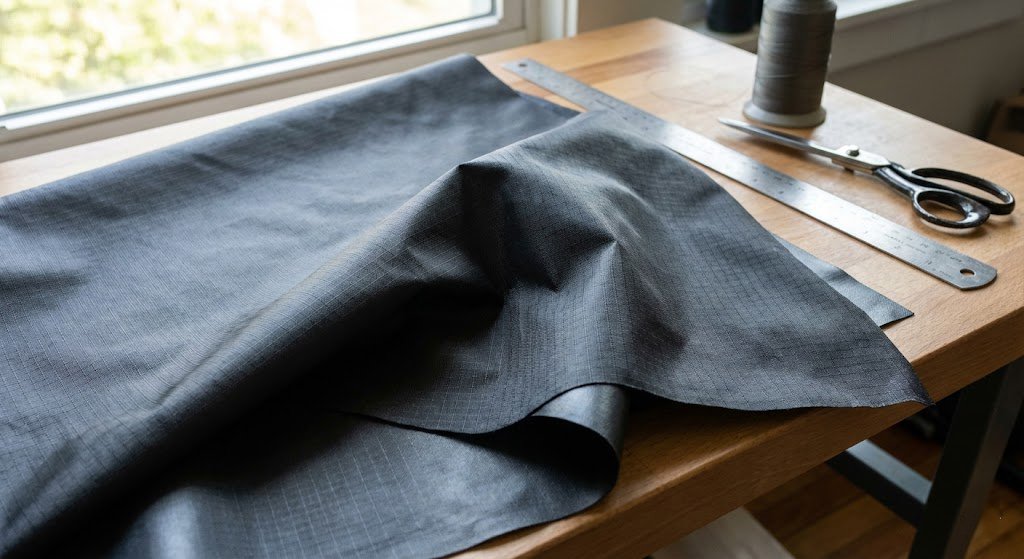
Stop asking "which fabric is best." Start asking "best for what?"
Decision Matrix
| Your Product | Your Priority | Recommended Fabric | Recommended Backing |
|---|---|---|---|
| Premium trunk organizer ($25–$50 retail) | Durability + brand perception | 600D or 900D Oxford | PU coating |
| Mid-range trunk organizer ($15–$25) | Cost/quality balance | 600D Polyester + PP board inserts | TPE or PU |
| Seat-back / front-seat organizer | Lightweight + flexibility | 600D Polyester | PU coating |
| Dealership promo giveaway | Lowest possible cost | 90 GSM PP non-woven (needle-punched) | None |
| Heavy-duty / commercial fleet | Maximum lifespan | 900D or 1680D Oxford (bottom panels) | PVC (REACH-grade) |
| Eco-conscious brand | Sustainability story | RPET Oxford (recycled polyester) | PU (solvent-free) |
The Hybrid Approach: What We Actually Build
Here’s what most blogs don’t tell you: the best car organizers use multiple fabrics.
At OSGW, our most popular build for mid-to-premium clients looks like this:
- Exterior shell: 600D Oxford cloth (PU-coated)
- Bottom panel: 1680D Oxford for ballistic-grade sag resistance
- Internal dividers: 100 GSM PP non-woven — cuts COGS without compromising the external premium feel
- Backing: TPE or PU depending on market (PU for US/EU, TPE for clients who want maximum rigidity)
This hybrid approach lets us hit a $3.50–$4.00 FOB price point with a product that looks, feels, and performs at the $30+ retail level.
One More Thing: RPET — the "Sustainable" Option
We’re getting more requests for RPET (recycled PET) Oxford cloth made from post-consumer plastic bottles. Same performance as virgin PET Oxford in our testing. Costs 15–25% more. If your brand story includes sustainability, it’s worth it — but demand the GRS (Global Recycled Standard) certificate from the fabric mill. Not from your bag factory. From the mill. Greenwashing is rampant and GRS certification is the only credible verification.
Ready to Source the Right Fabric for Your Car Organizer?
You’ve now read more about car organizer fabrics than 99% of buyers in this market. The gap between a good product and a returned product often comes down to a $0.50/yard fabric decision made in a rushed email.
At Osgoodway, we produce car organizers in all three fabric types with full in-house testing for abrasion, heat resistance, seam strength, and VOC emissions. We don’t push the most expensive material — we push the right one for your product tier and price point.
If you’re developing a car organizer and want:
- Free fabric swatches — Oxford, polyester (with PVC/PU/TPE backing options), and non-woven samples
- A side-by-side cost comparison based on your specific design and order volume
- Test reports — Martindale, GSM, color fastness, seam slippage — for any fabric we stock
- The hybrid build recommendation — which fabric goes where for maximum value
→ Contact our product team with your design files or even a rough sketch. We’ll tell you exactly what fabric works, what it costs, and what to watch out for. No hard sell. Just factory-floor honesty.

To solidify this as an Industry White Paper and capture even more "People Also Ask" real estate on Google, we will add a technical FAQ section. This section uses specific long-tail keywords that procurement managers and product developers search for when they are close to making a buying decision.
Place this section immediately after "8. Which Fabric Is Right for Your Product Tier and Budget?" and before the final Call to Action.
Frequently Asked Questions: The Sourcing Manager’s Cheat Sheet
Is Oxford cloth waterproof or just water-resistant?
By itself, Oxford cloth is water-resistant due to its tight weave. However, for car trunk organizers, the "waterproof" rating comes from the internal coating (PU or PVC). At Osgoodway, we typically achieve a hydrostatic head rating of 3000mm to 5000mm for premium organizers, meaning they can hold standing water from a leaked grocery bag without soaking through to your car’s carpet.
Can these fabrics be machine washed?
We strictly advise against machine washing for car organizers made with Oxford or Polyester. The mechanical agitation of a washing machine can delaminate the PVC/PU backing and warp the internal support boards (especially if they are cardboard or thin PE). For high-end brands, we recommend labeling the product as "Wipe Clean Only" to maintain the structural integrity of the fabric coatings.
Why is 600D Oxford more expensive than 600D Polyester?
Even though the "Denier" (600D) is the same, the manufacturing process differs. Oxford utilizes a basketweave (two-over-two or one-over-two) which requires more yarn per square inch and more complex loom settings than the simple plain weave of standard polyester. This results in higher tensile strength and a more premium "technical" aesthetic, justifying the $0.50–$1.20 price gap per unit.
Which fabric is best for meeting Amazon’s chemical compliance?
For the US market (Prop 65) and the EU market (REACH), PU-coated Polyester or Oxford is the safest bet. Standard PVC often contains phthalates and lead that exceed regulatory limits. If your brand positioning is "Eco-Friendly," you should request TPU (Thermoplastic Polyurethane) or GRS-certified Recycled Polyester (rPET).
How do I tell the difference between Oxford and Polyester by sight?
Look at the weave under a magnifying glass (or a smartphone macro lens). Oxford cloth will show a distinct "checkerboard" or "crossed" pattern where the yarns are bundled. Standard Polyester looks like a uniform, flat grid. Additionally, Oxford has a more matte, rugged finish, while standard 600D Polyester often has a slight artificial sheen.
What is the typical lifespan of these materials in a vehicle?
- Oxford Cloth: 3–5 years of heavy use.
- 600D Polyester: 1–2 years before pilling or backing degradation begins.
- PP Non-Woven: 3–6 months before structural failure or UV brittleness.






