Let me be blunt. Most "market trend" articles about car organizers are written by people who have never touched a roll of Oxford fabric. They copy numbers from paywalled reports, slap on some stock photos, and call it insight.
I wrote this because I keep getting the same questions from buyers — Amazon private-label sellers, DTC brands, fleet managers, promo product distributors — and the answers they need don’t exist online. They exist in factory group chats and supplier WhatsApp threads.
This article is for:
- Amazon/e-commerce sellers researching their next product line
- Brand owners looking to private-label or custom-develop trunk organizers
- Importers trying to understand what’s actually happening with China sourcing in 2026
- Procurement teams at fleet or logistics companies
What you’ll walk away with: Actual data, factory-tested material knowledge, and sourcing angles your competitors haven’t figured out yet.
The Market in 2026: Real Numbers, Not Hype
Everyone throws around different figures. Here’s what the data actually shows across multiple research sources:
| Source / Report | Market Size (2024) | Projected Size | CAGR | Forecast Period |
|---|---|---|---|---|
| Verified Market Reports | USD 2.45B (car organizer total) | USD 4.62B | 7.53% | 2026–2033 |
| 360iResearch (collapsible segment) | — | — | 5–7% | Through 2026 |
| DataIntelo | USD 4.5B (2023) | USD 7.8B | 6.2% | To 2032 |
| Verified Market Reports (car storage box segment) | USD 2.5B | USD 4.1B | 6.3% | 2026–2033 |
My take: The "car organizer" definition varies wildly between reports — some lump in seat-back organizers, console trays, and even garage storage. The trunk organizer segment specifically is a subset. But the directional signal is clear: steady 5–7% annual growth, driven by vehicle ownership and the "organize everything" consumer mindset.
According to the U.S. Department of Transportation, registered vehicles in the United States exceeded 270 million in 2023. More vehicles = more trunk spaces = more potential organizer sales. Simple math.
The more interesting story isn’t the top-line number. It’s where the growth is coming from.
5 Trends Actually Shaping This Market Right Now
Trend 1: The 600D Oxford Fabric Arms Race Is Over. The Next Battle Is Finishing.
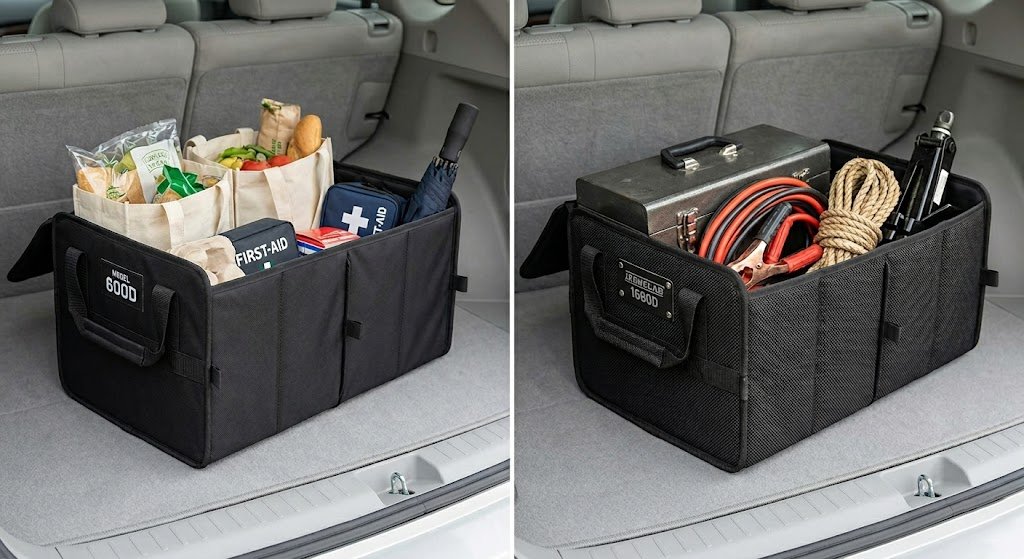
If you’ve browsed Amazon’s trunk organizer category lately, every single listing screams "600D Oxford Polyester." It’s become table stakes. The problem? Most buyers can’t tell 600D from 400D by looking at a product photo.
Here’s what I see on the factory side:
- 600D is the minimum spec for any credible product. Below that, you get visible weave gaps and early fraying.
- 1680D (ballistic grade) is showing up in premium SKUs. K KNODEL’s Heavy Duty line explicitly markets 1680D Oxford Polyester. Tuff Viking uses 1680D with double-thread stitching across their lineup. But here’s the catch: 1680D adds roughly 30–40% to your fabric cost, and the weight increase kills your shipping economics on Amazon FBA.
- The real differentiation is now in coatings and treatments. PU-coated vs. PVC-coated linings, water-column pressure ratings, UV resistance for cars parked outdoors. This is where we spend 80% of our R&D conversations with serious brands.
Factory truth: We once had a client insist on "1680D everywhere" including internal dividers. The finished product weighed 4.2 lbs empty. Their Amazon return rate spiked because customers said it was "too bulky." We re-engineered it: 1680D exterior, 420D interior panels, PE board base. Weight dropped to 2.6 lbs. Returns dropped 60%. More denier ≠ better product.
(For a deep dive into fabric grades, board inserts, and the 8 components that make or break a trunk organizer, see our anatomy breakdown in the sourcing guide.)
Industry standard note: Fabric abrasion resistance is measured using the Martindale method per ISO 12947-2. 600D Oxford with PVC backing typically achieves 20,000–30,000 cycles. If your supplier can’t cite this test standard, that’s a red flag.
Trend 2: EV Frunk Organizers — The Biggest Untapped Custom Opportunity
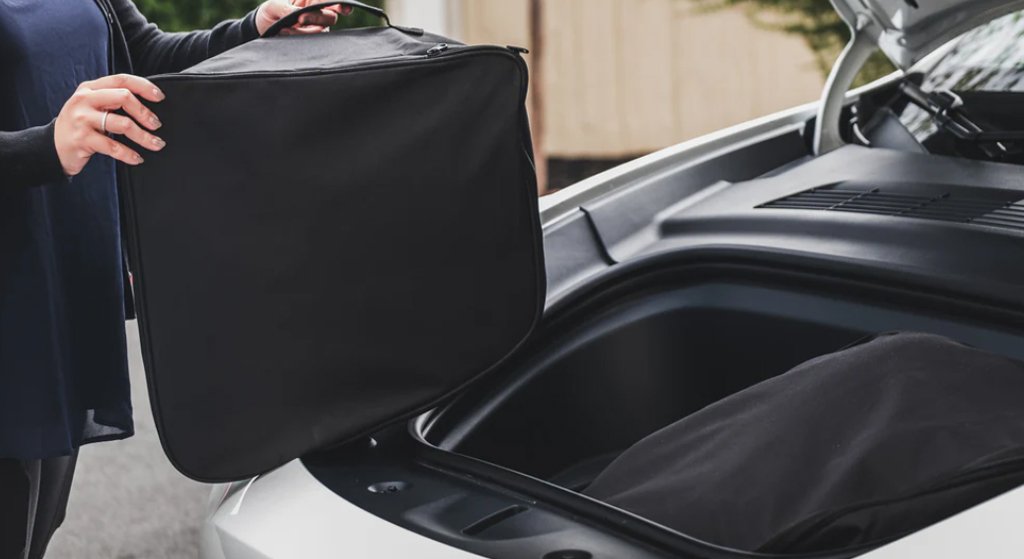
This is the trend I’m most excited about, and almost nobody in the traditional trunk organizer space is talking about it.
Electric vehicles have "frunks" (front trunks). Every Tesla Model Y, Model 3, Cybertruck, Ford Mustang Mach-E, Rivian R1S, and Kia EV6 has one. These are weird, irregular-shaped cargo spaces that generic organizers don’t fit.
Dedicated EV accessory retailers like Yeslak, and Teslarati Shop have already built entire product lines around vehicle-specific trunk and frunk organizers. Even Ford’s official accessory catalogue now lists a frunk organizer for their electric models.
Why this matters for brands and sellers:
- Vehicle-specific fit = premium pricing. A generic trunk organizer sells for $25–35 on Amazon. A Tesla Model Y-specific frunk organizer sells for $45–65. Same materials. Higher margin.
- Lower competition. The "car trunk organizer" keyword has thousands of competitors. "2026 Model Y Juniper frunk organizer" has a fraction.
- Repeat purchase cycle tied to new model years. Tesla refreshes dimensions almost annually. Each refresh creates a new accessory market.
What we’re seeing in our order book:
| Vehicle Category | Order Volume Trend (YoY) | Avg. MOQ Request | Key Feature Demand |
|---|---|---|---|
| Generic trunk organizers | Flat to -5% | 500–1,000 pcs | Collapsible, multi-compartment |
| Tesla-specific (Model Y/3) | +40–60% | 200–500 pcs | Custom-molded fit, TPE liners |
| SUV-specific (RAV4, CRV) | +15–20% | 300–800 pcs | Side pocket systems, cargo nets |
| Cybertruck bed organizers | New category | 100–300 pcs | MOLLE panel, track-mount |
My honest opinion: If you’re entering this market in 2026 and you’re still selling "universal fit" organizers, you’re fighting for crumbs. The money is in vehicle-specific solutions.
Trend 3: Tariffs Reshuffled the Deck — But Didn’t Kill China Sourcing
I won’t sugarcoat it. 2025 was brutal for Chinese manufacturers exporting to the US. Here’s the verified timeline:
| Date | Event | Source |
|---|---|---|
| Feb 2025 | First IEEPA tariff — 10% on all Chinese imports | Fictiv Tariff Tracker |
| April 2025 | "Liberation Day" reciprocal tariffs pushed combined rates above 145% | Zonos Tariff Guide |
| May 2025 | Geneva agreement brought rates down to ~30% above MFN | China Briefing |
| Nov 2025 | 10% tariff reduction as part of U.S.-China trade agreement | Fictiv Tariff Tracker |
| Feb 20, 2026 | Supreme Court struck down IEEPA tariffs (6-3 ruling) | UPS Supply Chain |
| Feb 24, 2026 | Replaced with 10% Section 122 global surcharge | Zonos Tariff Guide |
Section 301 duties from the first Trump administration remain fully in effect. Current net effective tariff rate on Chinese imports stands at approximately 30% above MFN for most product categories, according to TariffsTool.com.
What this means for trunk organizer sourcing:
| Sourcing Strategy | Reality Check |
|---|---|
| "Just move to Vietnam" | Vietnam faces ~46% reciprocal surcharge per TariffsTool. Not cheaper for this category. |
| "Source from India" | India’s reciprocal tariff reduced to 18% after the Feb 2026 deal (Fictiv). But quality infrastructure for soft goods is 5–7 years behind China. |
| "Absorb the tariff" | Possible at 20–30%. Impossible at 145%. Current rates are workable for mid-to-premium products. |
| "Reclassify the HTS code" | Risky but legitimate. Textile-based storage products vs. "travel goods" classification can mean a significant duty difference. Consult a licensed customs broker. |
Factory truth: We lost about 15% of our US-bound trunk organizer orders in mid-2025 when rates spiked. About half came back after rates normalized. The clients who stayed? They were the ones selling at $35+ retail with healthy margins. The $12.99 Amazon sellers got wiped out. Tariffs are a filter. They kill low-margin commodity products. They barely touch brands with real differentiation.
Also worth noting: the de minimis exemption for Chinese goods ended in May 2025. The $800 duty-free threshold no longer applies to shipments from China. This hits small-batch direct-to-consumer sellers hard but doesn’t affect bulk B2B importers much.
Trend 4: "Collapsible" Is No Longer a Feature — It’s the Baseline
Three years ago, "foldable" or "collapsible" was a selling point. In 2026, if your organizer doesn’t fold flat, it’s dead on arrival.
The 360iResearch report on collapsible trunk organizers confirms this shift — the category has fragmented into expandable, foldable, removable, and standard subtypes, each targeting distinct use cases.
What the market actually wants now:
- Collapsible + rigid when deployed. PE board inserts or corrugated plastic panels that give structure. This is where cheap products fail — they fold flat fine but sag like wet cardboard when loaded.
- Modular dividers. Not fixed compartments. Removable, repositionable walls. Our best-selling configurations use velcro-attached dividers with reinforced PE board inserts.
- Integrated cooler compartments. K KNODEL’s Premium model and Tuff Viking’s 4-in-1 both feature built-in insulated cooler sections. This started as a gimmick. It’s now expected in the $30+ price tier.
Spec comparison — what separates price tiers:
| Feature | Budget ($10–18) | Mid-Range ($20–35) | Premium ($35–60) |
|---|---|---|---|
| Fabric | 300–400D polyester | 600D Oxford | 1680D Oxford or PU leather |
| Base plate | Cardboard or none | 2mm PE board | 3mm+ PE board with anti-slip |
| Dividers | Fixed or none | 1 removable | 2–3 repositionable |
| Bottom grip | Nothing | Basic velcro strips | Industrial-grade velcro + silicone dots |
| Handles | Nylon webbing | Reinforced webbing | Padded, cross-stitched |
| Cooler pocket | No | Optional | Integrated PEVA-lined |
| Collapse thickness | 2–3 inches | 1.5–2 inches | Under 1.5 inches |
We tested a $9.99 organizer from a competitor’s factory. The PE board cracked after 14 days of Texas summer heat in a parked car. Our 3mm board with UV-stabilized coating? Still fine after 90 days. The specs matter. Your 1-star reviews are born in the material selection, not in the customer’s hands.
Trend 5: Amazon Is Saturated. The Real Growth Is B2B + Vehicle-Specific Retail.
Here’s a number that should scare any Amazon-only seller: there are 4,000+ active trunk organizer listings on Amazon US right now. Page 1 is dominated by brands with 10,000+ reviews. Breaking in organically is almost impossible without massive PPC spend.
Where the smart money is going:
- Fleet and commercial buyers. Ride-share companies, delivery fleets, mobile service technicians. They buy 50–500 units at a time and reorder quarterly. They don’t care about Amazon reviews — they care about durability specs and bulk pricing.
- Vehicle dealership accessories. Dealerships sell branded organizers as add-ons at point of sale. A Toyota dealership selling a "genuine fit" RAV4 trunk organizer at $49 has zero Amazon competition.
- Corporate promo and gifting. Custom-branded organizers for real estate agents, insurance companies, car rental firms. This is a massive segment that doesn’t show up in "market size" reports because it’s classified under promotional products.
- Subscription box and bundle plays. "New car owner starter kit" bundles that include an organizer + emergency kit + cleaning supplies. Higher AOV, lower CAC.
The Material Guide That Amazon Listings Won’t Tell You
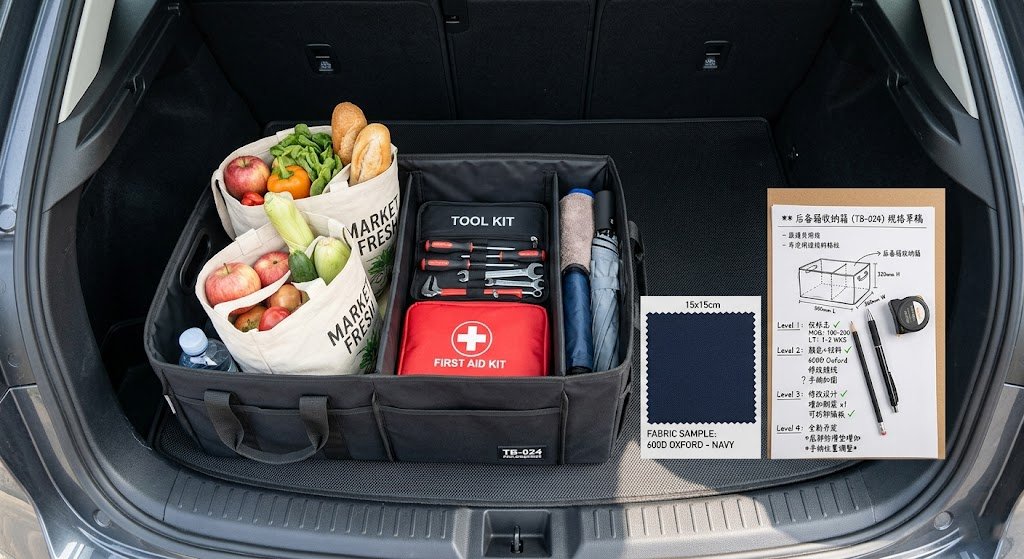
I get asked about materials more than anything else. Here’s the no-BS breakdown.
Fabric Types — What They Actually Mean
| Material | Denier | Cost Index | Best For | Watch Out For |
|---|---|---|---|---|
| Polyester (basic) | 300–400D | 1x (baseline) | Ultra-budget products | Pills, fades, weak water resistance |
| Oxford Polyester | 600D | 1.3–1.5x | Standard mid-range | Quality varies wildly between mills. Ask for the mill certificate. |
| Oxford Polyester | 1680D | 1.8–2.2x | Premium / tactical | Heavy. Tuff Viking’s 1680D organizer weighs 4.2 lbs empty. That adds FBA shipping cost. |
| PU Leather (synthetic) | N/A | 2–3x | Luxury look, easy clean | Peels after 12–18 months in high-heat environments if cheap PU is used |
| Canvas (wax-coated) | N/A | 1.5–2x | Rugged / outdoor aesthetic | Affected by 2025 US tariff increases on wax-coated canvas treatments (360iResearch) |
| Recycled polyester (rPET) | 600D | 1.6–1.8x | Eco-conscious brands | Requires GRS (Global Recycled Standard) certification to make legitimate sustainability claims. Products need ≥50% certified recycled content for consumer-facing GRS labeling. |
The Parts Nobody Talks About
- Stitching thread. Bonded nylon Tex 69–90 thread minimum for structural seams. Cheaper factories use polyester thread — it degrades under UV exposure inside hot trunks. Ask your supplier what thread they use. If they can’t answer, run.
- Binding tape. The edge binding on pocket openings. PP binding cracks in cold weather. Nylon binding doesn’t. This is a $0.02/meter cost difference that shows up as a 1-star review.
- Velcro quality. Generic hook-and-loop loses grip after 50–80 cycles. Mil-spec grade hook-and-loop holds for 1,000+. On trunk organizers, the bottom velcro gets grabbed and ripped 2–3 times per week. Do the math.
How to Evaluate a Trunk Organizer Manufacturer?
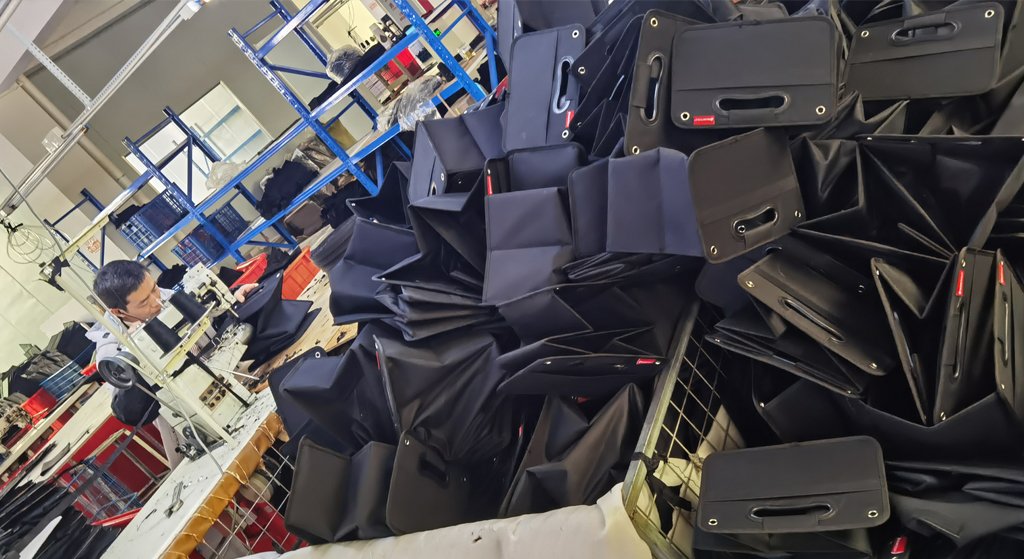
I’m going to be unusually transparent here because I believe the best way to earn trust is to tell you exactly how to vet us — and our competitors.
The 7-Point Quick Audit
| # | Check | Why It Matters | Red Flag |
|---|---|---|---|
| 1 | Ask for their BSCI or SEDEX audit report | Shows labor compliance. Major retailers require this. | "We can get one if you need it" — means they don’t have one. |
| 2 | Request a fabric swatch with mill certificate | Proves the actual denier and coating spec | Sending a finished product sample instead of raw material data |
| 3 | Ask about their QC rejection rate | Good factories reject 3–5% of production. Great ones are under 2%. | "Zero defects" — either lying or not inspecting. |
| 4 | Visit (or have a 3rd-party visit) the cutting floor | This is where shortcuts happen — single-ply vs. multi-ply cutting affects dimensional accuracy | Factory only shows the sample room and packing area |
| 5 | Ask for their PE board supplier name | Shows whether they source structural materials properly | "We make it in-house" — almost nobody does. This is a specialized supply. |
| 6 | Request a heat-aging test report | Trunk organizers sit in 140°F+ cars. Materials must survive. | No testing data available. |
| 7 | Check if they have US/EU import experience | Labeling, CPSIA compliance, CA Prop 65 — these kill shipments at port | "We only do FOB. You handle customs." — not necessarily bad, but means more work for you. |

The Custom Trunk Organizer Opportunity: What "Private Label" Actually Looks Like in 2026
"Custom" doesn’t mean slapping your logo on a generic product anymore. Here’s what real customization looks like at the factory level:
Levels of Customization
| Level | What It Means | Typical MOQ | Lead Time | Cost Premium |
|---|---|---|---|---|
| Level 1: Logo only | Your brand printed/embossed on existing design | 200–500 pcs | 15–20 days | 5–10% |
| Level 2: Color + material swap | Custom colorway, different fabric or lining. Use Pantone PMS references. | 300–800 pcs | 20–30 days | 10–20% |
| Level 3: Modified design | Changed dimensions, added/removed pockets, new divider layout | 500–1,000 pcs | 30–45 days | 15–30% |
| Level 4: Ground-up development | New pattern, vehicle-specific fit, proprietary features | 1,000–3,000 pcs | 45–90 days (incl. sampling) | 25–50% |
Where Level 4 gets interesting: This is where you create products that can’t be copied in 30 days by a competitor. A Tesla Model Y frunk organizer with molded TPE edges, integrated cable management for the charging kit, and a magnetic closure — that’s a product with defensible differentiation.
Our factory’s typical process for a Level 4 project:
- Week 1–2: Client sends vehicle trunk dimensions + feature wishlist. We do CAD modeling.
- Week 3–4: First physical sample produced. Client tests fit in actual vehicle.
- Week 5–6: Revisions. Usually 1–2 rounds. (We once did 5 rounds for a Rivian R1S organizer because the sub-trunk geometry was insane.)
- Week 7–8: Pre-production sample approved. Bulk material ordered.
- Week 9–12: Production + QC + packing.
(For full production timelines, cost breakdowns with actual USD ranges, and our complete OEM vs. ODM vs. Private Label comparison, see our The Complete Guide to Car Trunk Organizer Manufacturing.)
What’s Coming Next: My 2026–2028 Predictions
I’ll stake my reputation on these:
- MOLLE-compatible organizers will cross over from tactical/military into mainstream. The modular attachment system lets users clip on pouches, tool holders, and accessories. Products like Linskip’s Bronco Sport cargo organizer with 3 rows of MOLLE straps are early indicators. We’re already getting sample requests from mainstream automotive accessory brands.
- Recycled material claims will get audited harder. GRS (Global Recycled Standard) certification — administered by Textile Exchange — will become a must-have, not a nice-to-have. Products need minimum 50% certified recycled content for consumer-facing labeling. Amazon’s Climate Pledge Friendly program already requires GRS or RCS certification for recycled content claims. Greenwashing will get punished.
- Vehicle-specific organizers will outsell universal ones by 2028. The data is already pointing this way in our order book.
- Integrated cargo management systems — organizer + cargo net + anti-slip mat sold as a matched set — will become the standard product format for premium brands.
Bottom Line
The car trunk organizer market isn’t sexy. It’s not AI-powered. It’s not going to make anyone a billionaire overnight.
But it’s a $2B+ segment growing at 5–7% annually (per Verified Market Reports and DataIntelo), with massive fragmentation, low brand loyalty, and real opportunities for anyone willing to go deeper than "600D Oxford, collapsible, 5 stars."
The brands that win in 2026 and beyond will be the ones that:
- Pick a vehicle niche instead of going "universal"
- Invest in material quality that survives 140°F trunk temps
- Build actual relationships with factories that understand QC, not just price
- Think beyond Amazon — fleet, dealership, corporate, and DTC channels
Ready to Move From Trends to Action?
If you’ve read this far, you’re not casually browsing. You’re evaluating an opportunity.
Your next step: Read our complete Custom Car Trunk Organizer Manufacturing Guide — it covers the full factory evaluation process, exact cost breakdowns (with real FOB numbers), the 8-component anatomy of a quality organizer, and our honest production timelines.
Or if you’re ready to talk specifics — send us your concept. A sketch on a napkin works. We’ve started with worse.
Osgoodway has built organizers for brands you’ve seen on Amazon’s first page, and brands you’ll see there next year. We’re not the cheapest. But we’re one of the few that will tell you when your idea won’t work before you waste $20,000 finding out.