


Grabbing the wrong backpack can ruin your day. It can lead to sore shoulders, a disorganized mess, and even a damaged bag. The solution is knowing which pack is right for the job.
A hiking backpack1 is technical equipment with an internal frame and a complex strap system to carry heavy loads over long distances. A regular backpack is a simple, frameless bag with shoulder straps, designed for carrying light, everyday items like books, a laptop, and a lunch.
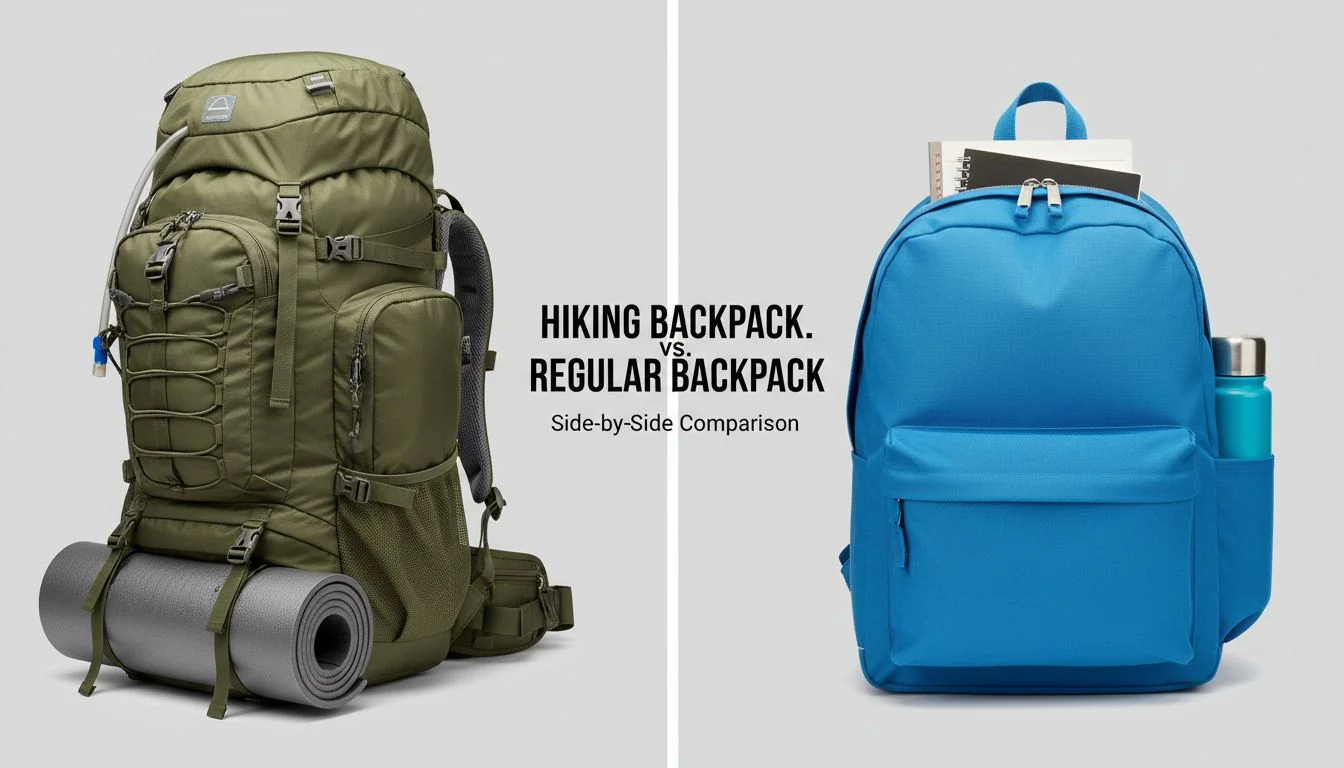
As a bag enthusiast, I’ve seen many people make the wrong choice. I once saw a student on a mountain trail with a flimsy school bag, his shoulders sagging under the weight. On the other hand, I’ve seen commuters on the subway struggling with a huge, technical hiking pack.
Understanding the core differences is the first step to avoiding these mistakes. It ensures you have the right tool for your adventure, whether it’s conquering a mountain or just your daily commute. Let’s break down what sets these two types of bags apart.
[claim claim=”A hiking backpack’s main purpose is to transfer over 80% of its weight to the wearer’s hips.” istrue=”true” explanation=”This is the fundamental principle of a modern internal-frame pack. The hip belt, when properly fitted, rests on the iliac crest, allowing the strong leg and core muscles to bear the load, preventing shoulder and back fatigue.”]
[claim claim=”Regular backpacks and hiking backpacks use the same type of polyester fabric.” istrue=”false” explanation=”Hiking packs use high-denier, ripstop nylon (like Cordura®) for durability and abrasion resistance. Regular backpacks typically use standard, less expensive polyester or canvas, which are not designed for rugged outdoor use.”]
How Do Hiking and Regular Backpacks Differ in Design, Access, and Intended Use?
Choosing a pack with the wrong design is frustrating. You either can’t find your gear on the trail or you’re fumbling with too many features just to grab a notebook.
A hiking backpack is built around an internal frame to transfer weight to your hips, with layered access points for trail gear. A regular backpack2 is a simple, frameless sack designed for quick access to daily items in a controlled environment like an office or school.
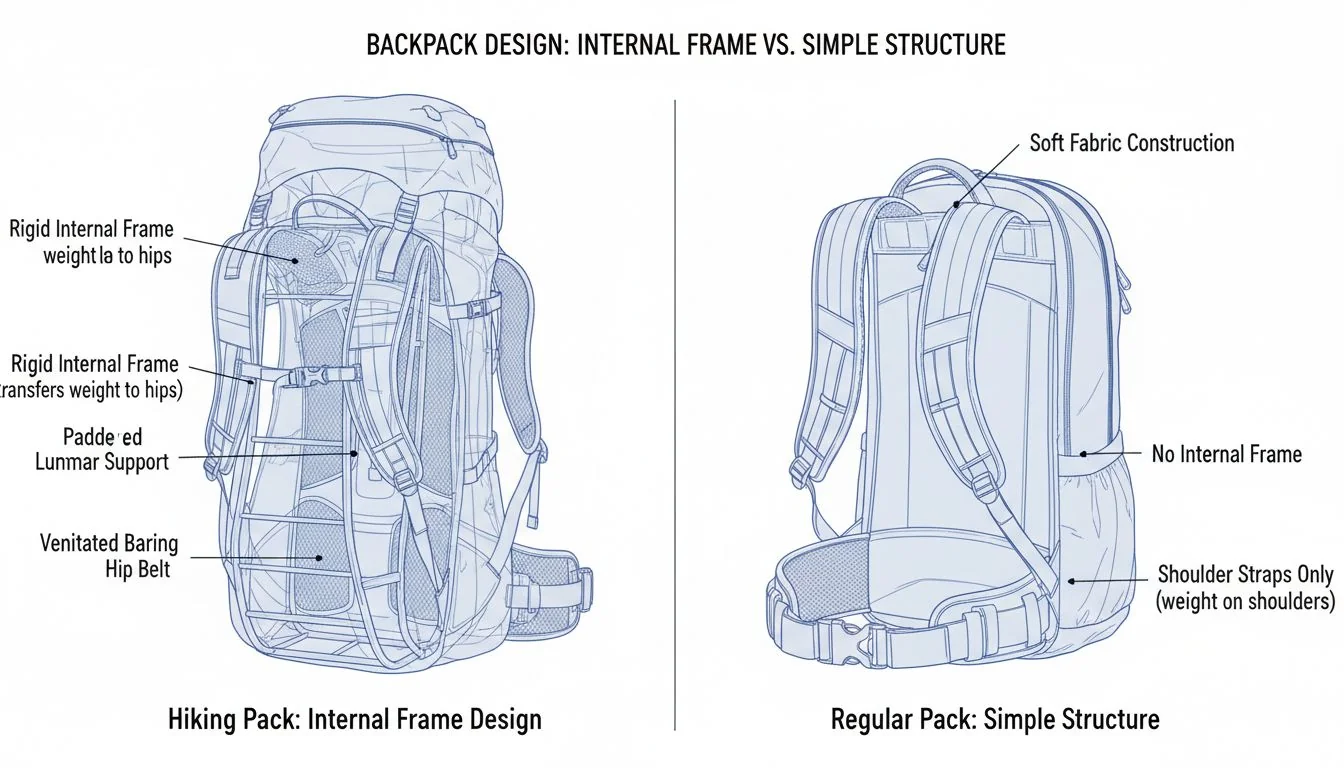
When I first started in the bag industry, I was fascinated by the engineering behind a hiking pack. It’s not just a bag; it’s a wearable machine. The differences in design, access, and use are not just details—they define the entire experience.
Let’s look closer at these core differences.
What is the core design different Between Hiking Backpack and Regular Backpack?
A hiking pack’s design is all about ergonomics and load management. Its tall, narrow shape keeps the center of gravity high and close to your spine for better balance. The internal frame3 is the skeleton that gives it structure and directs weight downwards.
A regular backpack’s design prioritizes simplicity and cost-effectiveness. It’s a soft container where all the weight hangs directly from your shoulders.
How Does Access Differ?
Hiking packs are packed strategically. They are top-loading, so you put the least-used items at the bottom. But they often have other access points, like a front J-zip or a bottom compartment for a sleeping bag. This lets you get specific gear without unpacking everything.
Regular backpacks are all about quick access. A large zipper opens the main compartment so you can easily see and grab your laptop, books, or lunch.
What is the Difference in Intended Use?
The intended use dictates everything. A hiking pack is for the wild—uneven trails, changing weather, and hours or days of walking. A regular backpack is for the city—paved sidewalks, climate-controlled buildings, and short-duration carrying.
| Feature | Hiking Backpack | Regular Backpack |
|---|---|---|
| Design | Internal frame, suspension system, tall & narrow | Frameless, soft structure, simple sack shape |
| Access | Top-loading, front-panel zip, bottom compartment | Simple main compartment with a large zipper |
| Intended Use | Multi-hour/day treks, heavy loads (>15 lbs) | Daily use, short duration, light loads |
[claim claim=”The first internal frame backpack was invented by Greg Lowe in 1967.” istrue=”true” explanation=”Greg Lowe’s innovation of the internal frame pack revolutionized backpacking by creating a more stable, form-fitting pack that moved with the body, a design principle still used today.”]
[claim claim=”All hiking backpacks are top-loading only.” istrue=”false” explanation=”While top-loading is the traditional design, many modern hiking packs offer panel access (like a suitcase) or a separate bottom zipper to easily reach gear without unpacking from the top.”]
How Are the Straps, Fit, and Storage Capacity Different?
Using a pack that doesn’t fit right is a recipe for a miserable trip. The wrong straps or size can cause pain and ruin what should have been a great day outdoors.
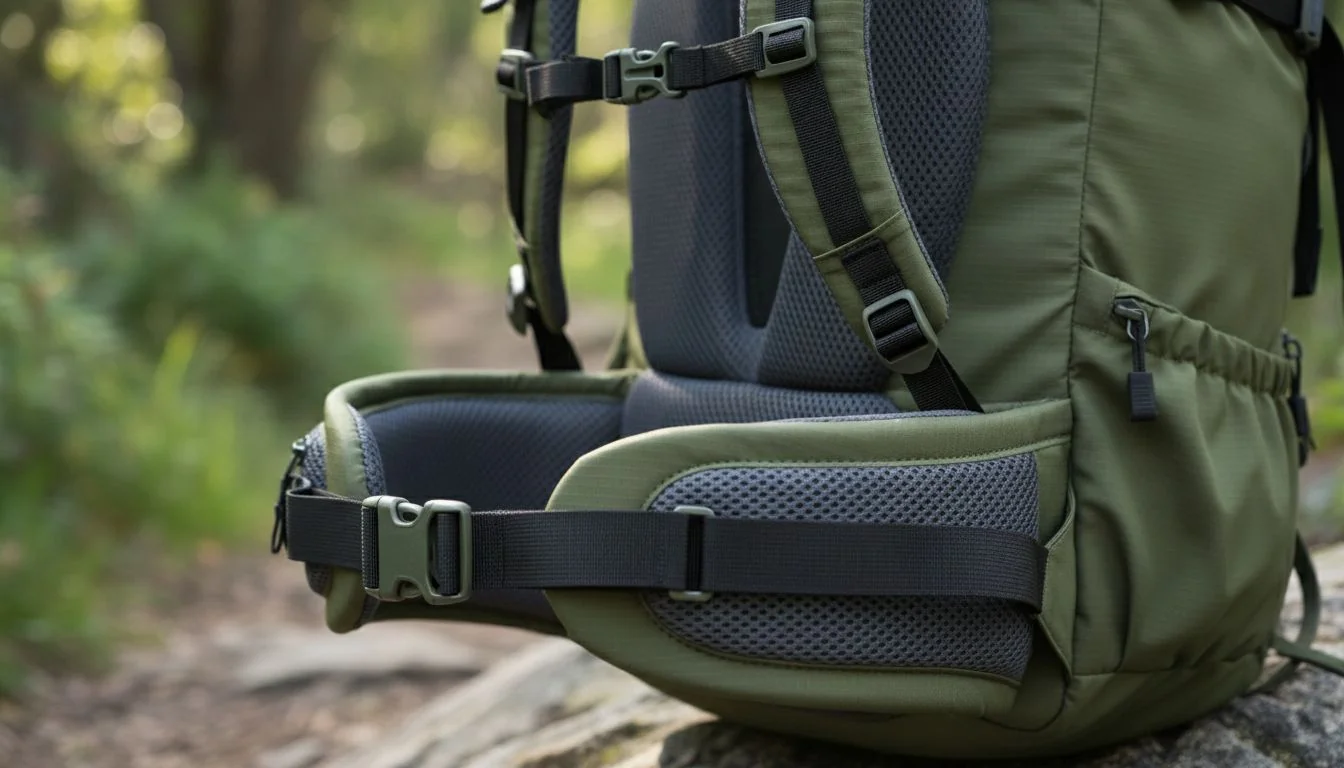
Hiking packs feature a complex, adjustable strap system with a load-bearing hip belt4 and are sized to your torso length for a precise fit. Regular backpacks have simple shoulder straps with minimal adjustment and come in one-size-fits-all. Storage is also vastly different.
| Feature | Hiking Backpack | Regular Backpack |
|---|---|---|
| Straps | Padded hip belt, load lifters, sternum strap | Basic shoulder straps, maybe a simple webbing sternum strap |
| Fit | Sized by torso length, highly adjustable | One-size-fits-all, minimal adjustment |
| Capacity | 40L – 75L+ | 15L – 30L |
Hip Belt: The Weight Carrier
-
This is the most critical part of a hiking pack. A robust, padded hip belt sits squarely on your hip bones.
-
Its main job is to transfer about 80% of the pack’s weight from your shoulders to your stronger hip and leg muscles.
-
Regular backpacks lack this feature, which is why your shoulders get tired so quickly..
Fit: A Precise Science
-
Hiking packs are not one-size-fits-all; they are sold in sizes (S, M, L) based on your specific torso length.
-
Many have adjustable back panels to fine-tune this fit perfectly.
-
Load lifter and sternum straps complete the system, pulling the pack close to your body to prevent it from swaying.
-
A regular pack only allows you to adjust the shoulder straps, offering no real customization.
What do liters really mean for storage?
Storage capacity5 is a major differentiator. Hiking packs have a much larger volume, measured in liters, typically ranging from 40L to 75L+ to accommodate a tent, sleeping bag, food, and clothing. Regular backpacks are much smaller, usually between 15L and 30L, designed for daily essentials.
Here’s a direct comparison of their storage capabilities:
| Backpack Type | Typical Volume (Liters) | Best For Carrying… |
|---|---|---|
| Hiking Backpack | 40 – 75+ L | Tent, sleeping system, food, and extra clothing for multi-day treks. |
| Regular Backpack | 15 – 30 L | Daily essentials like a laptop, books, lunch, and a light jacket. |
[claim claim=”A properly fitted hip belt should cover the top of your hip bones.” istrue=”true” explanation=”The padded part of the hip belt should be centered on the iliac crest (the top of the hip bones) to effectively transfer the pack’s weight to the hip structure.”]
[claim claim=”The sternum strap is designed to carry most of the pack’s weight.” istrue=”false” explanation=”The sternum strap’s purpose is to pull the shoulder straps together, preventing them from slipping off your shoulders and improving stability. It carries almost no weight.”]
How Do the Materials Used in Hiking Backpacks Differ from Regular Backpacks?
The materials used in hiking backpacks differ fundamentally from regular backpacks because they are chosen for maximum performance and durability under stress, while materials for regular packs prioritize aesthetics and cost-effectiveness for everyday life.
Hiking backpacks use high-performance, durable, and lightweight fabrics like ripstop nylon6, with premium hardware like YKK zippers. Regular backpacks use cost-effective materials like standard polyester or canvas, chosen more for aesthetics and daily use than for extreme durability.

In my manufacturer experience, material sourcing is one of the most critical stages. For a high-end brand the choice between a standard polyester and a technical fabric like Cordura® defines the product’s quality, durability, and price point. It’s the difference between a fashion accessory and a piece of performance gear.
1. Primary Fabric: Performance Nylon vs. Standard Polyester/Canvas
This is the most significant material difference and impacts everything from weight to durability.
-
Hiking Backpacks: The gold standard is high-denier ripstop nylon.
- Why Nylon? It has a superior strength-to-weight ratio, meaning it’s incredibly strong and durable without being heavy. It also has excellent abrasion resistance.
- What is Ripstop? It’s a special grid pattern woven into the fabric that stops small punctures or tears from spreading, which is critical on a rugged trail.
- What is Denier (D)? A measure of fiber thickness. Hiking packs use higher deniers (like 210D to 620D) for a tougher fabric. Premium brands often use specialized nylons like Cordura® for maximum durability.
-
Regular Backpacks: They typically use standard polyester or cotton canvas.
- Why Polyester? It is cost-effective, holds dye exceptionally well (great for colors and prints), and is resistant to UV fading. It’s durable enough for daily use but lacks the tear strength of high-performance nylon.
- Why Canvas? It offers a classic, timeless aesthetic and is quite durable against scuffs. However, it is much heavier than nylon and absorbs water readily unless it’s waxed.
2. Hardware: Purpose-Built Zippers and Buckles
The hardware on a hiking pack is chosen for reliability under stress and in bad weather.
-
Hiking Backpacks: Use industry-leading, robust components.
- Zippers: Almost exclusively use YKK zippers, which are renowned for their reliability and resistance to jamming or breaking.
- Buckles: Use high-quality plastic buckles from brands like Duraflex, which are designed to function in freezing temperatures without becoming brittle and snapping.
-
Regular Backpacks: Use hardware chosen for cost and appearance.
- Zippers & Buckles: Often use generic, unbranded hardware. While perfectly functional for daily use, they are more prone to failure under the heavy loads or rough conditions a hiking pack endures.
3. Weather Resistance: Advanced Coatings
While neither is fully waterproof, their level of weather protection is vastly different.
- Hiking Backpacks: Feature a robust DWR (Durable Water Repellent) coating. This is a higher-grade chemical treatment that causes water to bead up and roll off the fabric surface more effectively and for a longer period.
- Regular Backpacks: May have a light water-resistant coating, but it is not designed to withstand a sustained downpour and will wear off much more quickly.
4. Back Panel and Foam: Structural Support vs. Basic Cushioning
The foam used in the back panel and straps directly impacts comfort and moisture management.
- Hiking Backpacks: Use high-density, closed-cell foam. This type of foam provides firm support, resists compression over time, and, crucially, does not absorb water or sweat. It’s often paired with a suspended mesh back panel to create ventilation channels for airflow.
- Regular Backpacks: Use simple, open-cell foam for basic cushioning. It feels soft to the touch but can compress and flatten over time. It also acts like a sponge, absorbing sweat and taking a long time to dry.
At-a-Glance: Material Comparison
| Feature | Hiking Backpack (Performance-Driven) | Regular Backpack (Cost/Style-Driven) |
|---|---|---|
| Main Fabric | High-Denier Ripstop Nylon (e.g., Cordura®) | Standard Polyester or Cotton Canvas |
| Zippers | Industry Standard (e.g., YKK) | Generic, Unbranded |
| Buckles | High-Quality, Cold-Resistant (e.g., Duraflex) | Standard Plastic |
| Weather Coating | Robust DWR (Durable Water Repellent) | Basic or No Coating |
| Foam Padding | High-Density, Closed-Cell Foam | Soft, Open-Cell Foam |
[claim claim=”Cordura® is a brand of fabric known for its high durability and abrasion resistance.” istrue=”true” explanation=”Cordura® is a collection of synthetic fiber-based fabrics used in a wide array of products, including luggage, military gear, and performance apparel, prized for its toughness.”]
[claim claim=”A DWR coating makes a backpack fully waterproof.” istrue=”false” explanation=”DWR (Durable Water Repellent) coatings are water-resistant, not waterproof. They cause water to bead up and roll off but will eventually get saturated in a sustained downpour. For true waterproofing, a rain cover or dry bag is needed.”]
Can You Use a Regular Backpack for Hiking—or Use a Hiking Pack for Everyday?
You might be tempted to use one bag for everything to save money. But using the wrong tool for the job is inefficient, uncomfortable, and can even be unsafe.
Yes, you can, but it’s not a good idea. Using a regular pack for a serious hike will cause significant pain and fatigue. Using a technical hiking pack for daily life is bulky, impractical, and overkill.
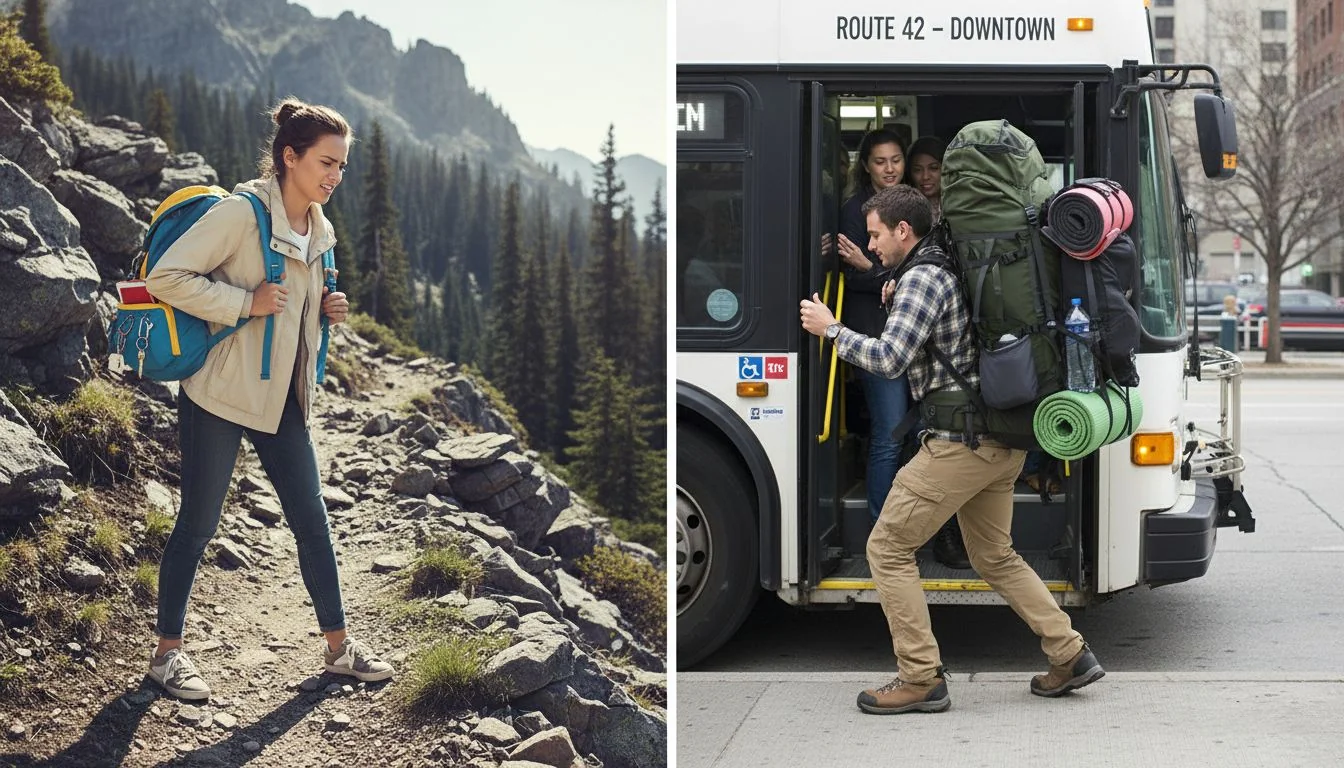
I’ve tried both, and I can tell you from experience that it doesn’t work well. I once took a regular backpack on what I thought was an "easy" hike. After two hours, my shoulders were screaming, and I spent the rest of the day in pain. It’s a classic mistake that highlights why specialized gear exists in the first place.
What are the risks of hiking with a regular pack?
This is only okay for very short, flat walks with a load under 10 lbs (4.5 kg). For anything longer or heavier, all the weight hangs from your shoulders. This leads to intense shoulder, neck, and back pain.
The lack of a frame or hip belt also means the load is unstable, which can throw off your balance on uneven terrain. The pack itself is also likely to get damaged by abrasion or stress.
What are the drawbacks of using a hiking pack daily?
A hiking pack is designed for the trail, not the town. It’s bulky and its frame makes it rigid. The numerous straps can easily snag on doorways, turnstiles, or people on public transport. The top-loading design is also a pain when you just want to quickly grab your laptop or a book. It simply looks out of place in an office or classroom and screams "I’d rather be in the mountains."
| Scenario | Pros | Cons |
|---|---|---|
| Regular Pack for Hiking | Inexpensive, okay for very short/easy walks | Causes severe shoulder/back pain, unstable load, not durable |
| Hiking Pack for Daily Use | Very durable, large capacity | Bulky, heavy, straps snag, difficult access, looks out of place |
[claim claim=”Using a regular backpack for a long hike can lead to nerve compression in the shoulders.” istrue=”true” explanation=”The weight hanging directly from the shoulders can compress the brachial plexus, a network of nerves, leading to pain, numbness, or tingling in the arms and hands.”]
[claim claim=”Hiking packs are designed to be as lightweight as a regular daypack.” istrue=”false” explanation=”Even ultralight hiking packs are heavier than regular daypacks due to their frame, suspension system, and more durable materials. An empty hiking pack can weigh 3-5 lbs (1.4-2.3 kg), while a daypack is often under 1.5 lbs (0.7 kg).”]
How Do You Choose Based on Trip Profile, Budget, and Durability?
With so many options, how do you pick the right one? It feels overwhelming, but a simple framework can make the decision easy and ensure you get the best value.
Your choice depends on your primary activity. A regular backpack ($30-$100) is perfect for daily use. A technical hiking pack ($150-$400+) is a non-negotiable investment for comfort, safety, and durability on any serious trek.
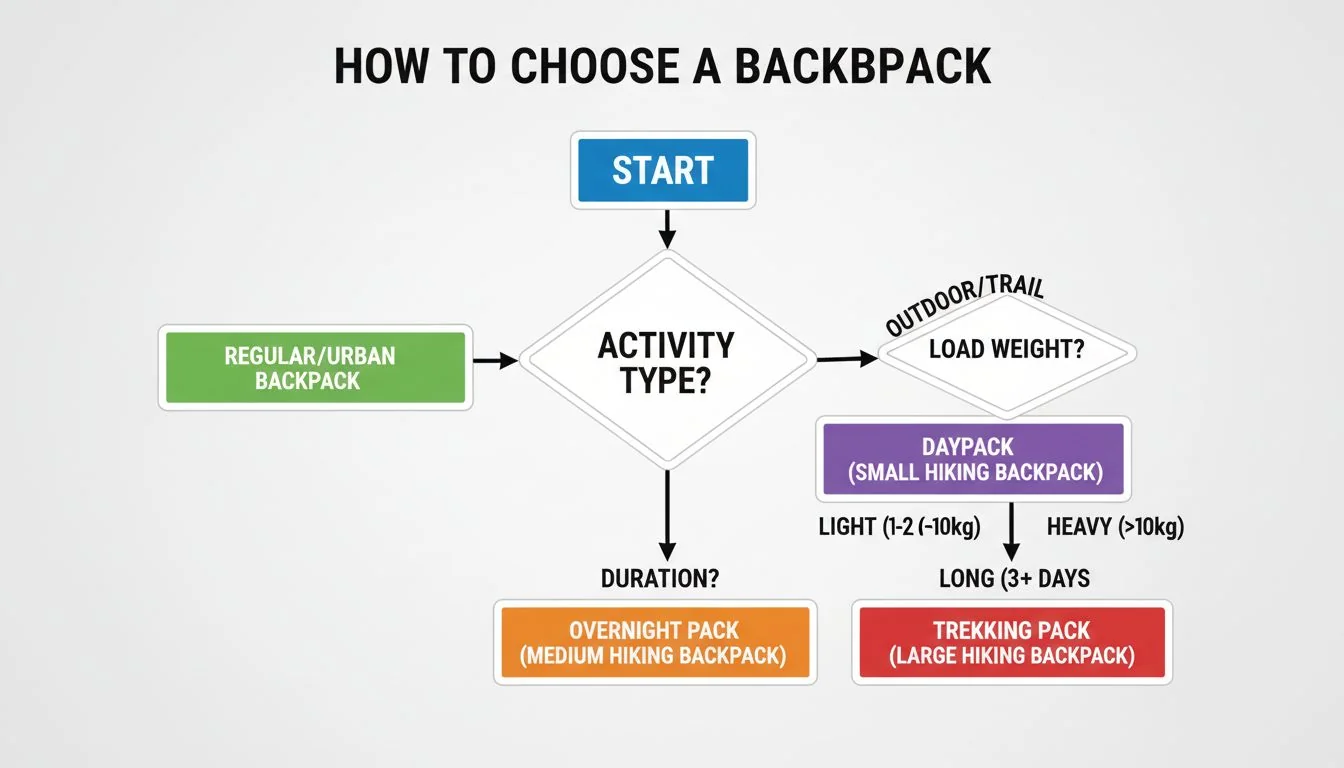
Choosing a pack is about matching the tool to the job. As a product manager, you do this all the time—defining a user profile and selecting features to meet their needs.
Think of yourself as the user. What will you be doing 90% of the time with this bag? Answering that question honestly is the key to making the right choice and a smart investment.
How Does Your Trip Profile Define Your Backpack Choice?
- School, work, or city errands: A regular backpack is a cost-effective and practical choice.
- Day hikes (with more than just basic essentials like water and a jacket) or multi-day backpacking trips: A technical hiking backpack is essential, offering better comfort, support, and safety for outdoor adventures.
What’s Your Budget? What Does It Get You?
- Regular backpacks: Typically range from $30 to $100. They are perfect for everyday use but lack the advanced features for extended outdoor use.
- Quality hiking backpacks: Range from $150 to $400 or more. The higher price reflects advanced technical features like engineered suspension systems, durable materials, and weather-resistant capabilities. Investing in a hiking backpack prepares you for rugged conditions, minimizing discomfort and failure during your trek.
When Should Durability Be a Priority?
- Harsh conditions (scraped against rocks, exposed to rain, or heavily loaded): A hiking backpack is built to withstand years of tough use, making it ideal for rugged outdoor adventures.
- Light use (coffee shop floors, overhead bins during flights): A regular backpack provides enough durability for everyday tasks, handling occasional bumps and scratches.
| Factor | Regular Backpack | Hiking Backpack |
|---|---|---|
| Best For | School, work, and casual city errands | Day hikes, multi-day backpacking trips |
| Price Range | $30 – $100 | $150 – $400+ |
| Key Features | Simple design, basic compartments | Engineered suspension, advanced materials, hydration compatibility |
| Durability | Suitable for light use (e.g., commuting, office) | Built to withstand harsh conditions (rocks, rain, heavy loads) |
| Comfort | Basic padding, no advanced suspension system | Advanced suspension system, padded straps, hip belt for weight distribution |
| Lifespan | 1 – 3 years (based on use) | 5 – 10 years (with proper care) |
| When to Choose | Everyday use, casual trips, light loads | Outdoor adventures, extended hiking, tough conditions |
[claim claim=”The average price of a technical hiking backpack is over $200.” istrue=”true” explanation=”According to market research and outdoor retailer pricing, most quality hiking packs from reputable brands like Osprey, Gregory, and Deuter fall in the $180-$350 price range, making the average well over $200.”]
[claim claim=”You should always buy the biggest hiking pack available so you are ready for any trip.” istrue=”false” explanation=”This is a common beginner mistake. Buying a pack that is too large encourages overpacking, leading to unnecessary weight. It’s better to buy a pack sized appropriately for the typical length of your trips (e.g., 40-50L for weekends, 60-70L for week-long treks).”]
What OEM/ODM Customization Paths Can Brands Unlock with Osgoodway?
As a product manager, you know the theory. But how do you turn these technical differences into a successful product line that stands out? You need a manufacturing partner who gets it.
Osgoodway is your expert partner for both stylish daily packs and technical hiking bags. We offer deep OEM/ODM customization7, helping you source the right materials and build the right features to create authentic, high-quality products that your premium customers will value.

How Can We Customize a Technical Hiking Pack?
- Authenticity is key: We can help you source specific performance fabrics like Cordura® or bluesign® certified ripstop nylons for sustainability.
- ODM & OEM designs: Work with us to create custom frame geometries, unique pocket layouts for specific gear, and select premium hardware for reliability.
What Are the Options for a Custom Daily Backpack?
- Aesthetics and features: For a high-end daily pack, we focus on aesthetics and unique features that match your brand’s identity.
- Material options: We can source premium leathers, eco-friendly canvas, or unique textiles.
- Functional features: Integrate padded and suspended laptop sleeves, anti-theft pockets, and custom-branded hardware to create a bespoke product for your customers.

Osgoodway OEM/ODM roadmap
| Stage | Description |
|---|---|
| 1. Initial Consultation & Needs Assessment | – Discuss product requirements, target market, and specific needs (e.g., features, materials). – Understand your brand’s identity and design vision. |
| 2. Design Concept & Prototyping | – ODM: Collaborate on custom design concepts, frame geometries, pocket layouts, and unique features. – OEM: Provide your own design specs, including dimensions, features, and materials. – Develop prototypes based on the agreed concepts to test functionality and aesthetics. |
| 3. Material Sourcing & Selection | – Source high-performance fabrics (e.g., Cordura®, bluesign® certified ripstop nylons, premium leathers, eco-friendly canvas). – Choose appropriate hardware, zippers, and other accessories. |
| 4. Prototype Review & Refinement | – Evaluate prototypes for fit, function, comfort, and durability. – Refine design based on feedback and ensure alignment with brand identity and user experience goals. |
| 5. Production & Manufacturing | – Start production with selected materials and customized features. – Collaborate with manufacturing teams to meet quality standards. – Provide regular updates throughout the process. |
| 6. Quality Control & Testing | – Perform quality checks on stitching, durability, water resistance, and functionality. – Test backpacks in various conditions to ensure performance in intended environments. |
| 7. Branding & Packaging | – Integrate custom branding elements (logos, hardware, tags). – Develop packaging that reflects your brand’s identity and product purpose. |
| 8. Final Delivery & Launch Support | – Conduct a final inspection and deliver completed products. – Provide support for product launch, including marketing materials and promotional assistance. |
| 9. After-Sales Support & Continuous Improvement | – Collect post-launch feedback, customer insights, and make adjustments for future product cycles. |
[claim claim=”Osgoodway offers both OEM and ODM manufacturing services.” istrue=”true” explanation=”As a versatile manufacturer, Osgoodway can either build products based on your original designs (OEM) or help you adapt and customize our existing product templates (ODM) to fit your brand.”]
[claim claim=”Custom bag manufacturing is only available for orders over 50,000 units.” istrue=”false” explanation=”While large orders are common, flexible manufacturers like Osgoodway understand the needs of high-end brands and can often accommodate smaller, more specialized production runs for highly customized products.”]
Conclusion
Choosing the right pack is simple: a hiking pack is technical gear for the trail, and a regular backpack is a simple carrier for daily life. Match the bag to your journey.
References
-
Explore the advantages of hiking backpacks for comfort and load management during outdoor adventures. ↩
-
Learn about the typical uses and features of regular backpacks for everyday activities. ↩
-
Understand how internal frames enhance weight distribution and comfort in hiking backpacks. ↩
-
Understand the critical role of hip belts in transferring weight and enhancing comfort. ↩
-
Explore the different capacities of hiking backpacks and how to choose the right one for your needs. ↩
-
Find out why ripstop nylon is a preferred material for durability in hiking backpacks. ↩
-
Explore options for customizing hiking backpacks to meet specific needs and preferences. ↩






