


Your supplier is waiting on the spec sheet, and the hip belt line item has been pushed to "next call" three times. Here’s the answer your team actually needs to close it out.
Whether a daypack needs a hip belt depends on two variables: load weight and wear duration. Below 5 kg and 2 hours, a hip belt adds cost without function. Above that, it becomes a measurable comfort factor.
Get these two numbers wrong and you either over-spec a commuter bag or ship a hiking pack that comes back with "shoulder pain" reviews.
What Does a Hip Belt Actually Do on a Daypack?
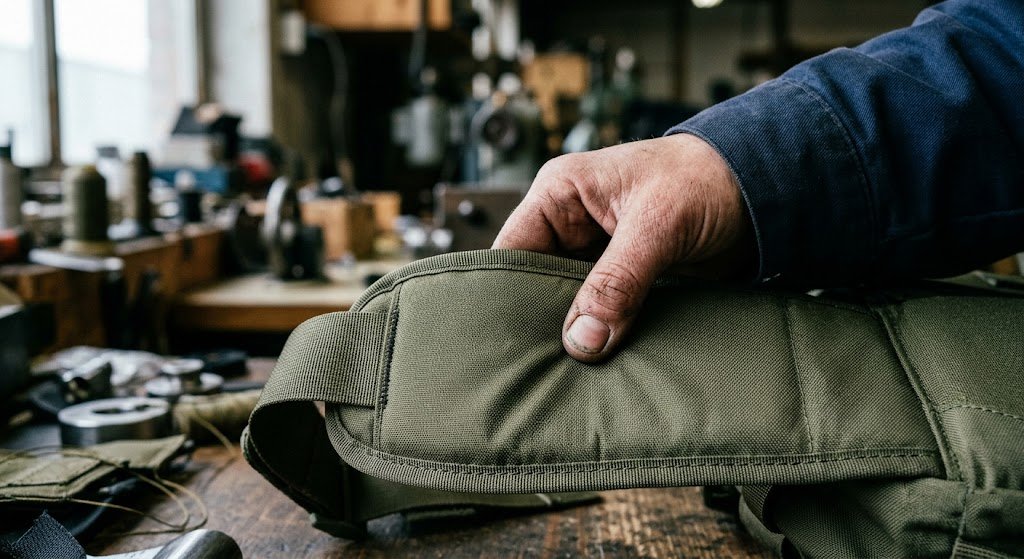
A hip belt transfers pack weight from the shoulders to the pelvis. Research on backpack biomechanics shows a properly tensioned hip belt can shift up to roughly one-third of the vertical load off the spine and shoulders onto the hips, which carry sustained weight with far less muscular fatigue.
The Mechanism
Hip bones are built for static load — that’s how your skeleton holds you upright all day. Shoulders aren’t.
Hip belts have become standard in backpack design specifically because they shift roughly one-third of the vertical spinal force onto the hips, per a 2018 biomechanics study in Applied Bionics and Biomechanics.
AOTA recommends a backpack weigh no more than about 10% of the wearer’s body weight before strain becomes a real factor — roughly 7 kg for a 70 kg adult.
Load Weight vs. Hip Belt Need
| Load | Duration | Hip Belt Call |
|---|---|---|
| Under 5 kg | Under 2 hrs | Skip it |
| 5–7 kg | 2–4 hrs | Optional / detachable |
| Over 7 kg | Over 4 hrs | Standard spec |
🏭 Factory Secret: During QC, we see buyers approve a hip belt sample on the table — looks padded, feels fine in hand — but never load-test it at the target weight before signing off. A belt that feels comfortable empty can dig into the iliac crest at 8 kg within 30 minutes. Always sample-test loaded, worn, walking — not on a desk.
When Should You Skip the Hip Belt on a Daypack?
Picture a commuter walking between the subway and the office, sitting down six times before lunch. That user never reaches the load or duration where a hip belt earns its weight.
Commuter, campus, and minimalist travel daypacks rarely need a hip belt — the user removes the pack too often and carries too little for shoulder fatigue to set in. Omitting it cuts cost, simplifies the build, and keeps the silhouette clean, which this buyer segment usually prefers anyway.
Where we consistently see buyers skip it
- Urban commuter packs — worn 30–45 minutes at a stretch, on/off transit, rarely loaded past 3–4 kg
- Student/campus daypacks — laptop, notebook, water bottle; 15–20 minute walks, removed 5–6 times daily. Pairs well with a laptop backpack spec rather than an outdoor frame
- Carry-on / personal-item travel packs — even at 6–8 kg, the pack gets stowed under a seat more than worn continuously; a fixed belt just adds bulk to a carry-on backpack build that needs to compress flat
- Streetwear / lifestyle daypacks — clean lines matter more than the marginal comfort gain at moderate loads
If your buyer brief says "students," "commuters," or "carry-on," the hip belt line item is almost always a cost line you can cut before it reaches sampling.
When Does a Daypack Always Need a Hip Belt?
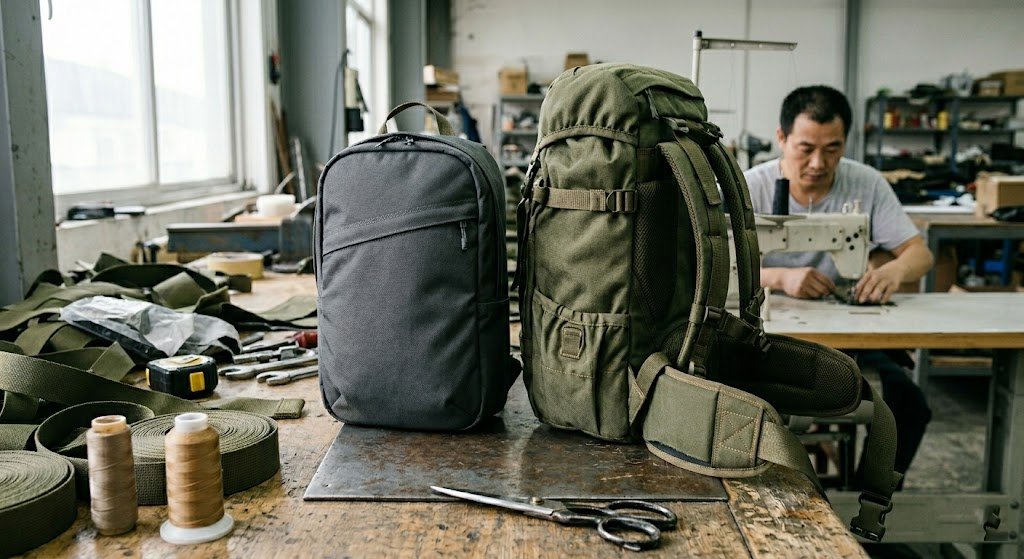
A hiker carries water, snacks, and a shell for 3–5 hours straight. No chair, no subway seat — the pack never comes off.
Hiking and all-day-wear daypacks need a hip belt as standard spec once load passes roughly 7 kg or wear time passes 3 hours. Skipping it signals lower-tier positioning against every competitor pack that includes one.
Why It’s Non-Negotiable Here
- CPSC’s back-to-school safety guidance recommends a waist or hip belt to redistribute weight evenly — this is general load-carriage advice, not an outdoor-niche feature
- No rest breaks on trail means shoulder pressure compounds hour over hour
- Competing hiking SKUs all include one; omitting it reads as a cheaper build
🏭 Factory Secret: Running/cycling hydration packs are the exception — they use a thin webbing strap under 3 kg for bounce control, not load transfer. Don’t spec it like a load-bearing belt. See hydration pack vs. running vest vs. running belt and our hydration pack range.
Good catch — same issue as before, the citation tags don’t carry over as live links once pasted. Here are the two real product/source URLs, wired in as plain markdown links this time:
Is a Detachable Hip Belt the Right Compromise?
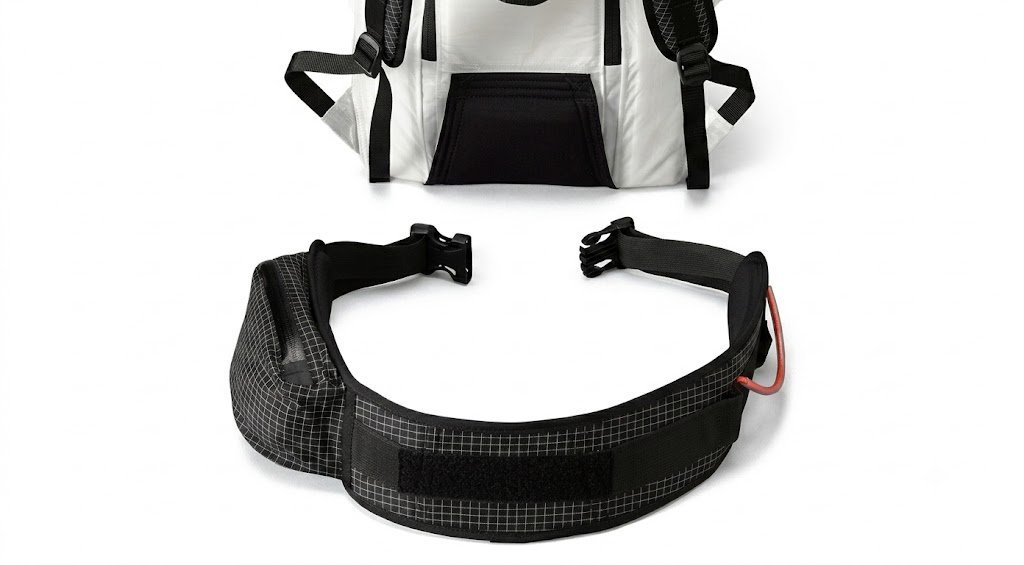
A detachable belt only makes sense when one user genuinely switches between light commuting and heavier carry — and it requires a clean attachment-point design or it looks unfinished with the belt off.
What Happened on One of Our Orders
A buyer last year specced a 22L "do-everything" daypack — commute weekdays, light hiking weekends.
First-round samples used surface-mounted snap tabs. They looked fine in photos.
Then the buyer removed the belt to check the commuter look — the exposed tabs sat right where the lumbar pad ended. It read as "missing a part," not modular.
We re-cut the attachment into a flush webbing loop for round two. It worked, but it cost an extra sample cycle.
You Don’t Have to Take Our Word for It
Two established outdoor brands have already standardized around the exact same lesson.
North St Bags sells a removable waist belt compatible across multiple packs in their lineup. The belt attaches to the pack body using heavy-duty gatekeeper clips, while the belt’s own closure comes in a choice of a lightweight Fidlock magnetic buckle or a heavier-duty COBRA buckle, depending on the load the belt needs to handle.
Waymark Gear sells a separate removable padded hip belt that slides into a 1" webbing loop via a Slik Clip. Their own published customer reviews include a real complaint that the belt easily falls off the pack it’s paired with, requiring the buyer to retrofit it to stay secure — which confirms exactly the failure point we flagged on our own samples: if the webbing loop width isn’t locked precisely to the clip, the belt detaches on its own.
Avoid-List for Detachable Belts
- Request a mock-up with the belt removed, not just attached
- Spec a clip-buckle system (Fidlock-style magnetic or Slik-clip webbing) over basic snap tabs — the market has already moved off snap tabs for exactly the reasons above
- Lock the webbing loop width to the buckle width in the tech pack — a loose match is the documented #1 cause of belts detaching in real-world use
- Budget one extra sample round if hardware placement is unresolved
How Wide and Padded Should the Hip Belt Be?
Belt width and foam thickness should scale with load and duration, not guesswork. A 1.5-inch lightly padded belt suits intermittent 5–7 kg loads; an 8–10L+ hiking daypack carrying 8–10 kg needs a 2.5–3 inch belt with at least 8–10mm of EVA foam to avoid pressure points on the hip bones.
| Daypack Type | Belt Width | Foam Thickness | Use Case |
|---|---|---|---|
| Light commuter/hybrid | 1.5 in | 4–6mm EVA | Occasional 5–7 kg |
| Mid-size hiking (15–25L) | 2 in | 6–8mm EVA | Regular 7–8 kg |
| Full hiking (25L+) | 2.5–3 in | 8–10mm EVA | Sustained 8–10+ kg |
Static peak pressure in the hip area can need to be roughly twice as high as the shoulder to cause equal discomfort — so a too-narrow belt at heavy loads still hurts, just slower.
🏭 Factory Secret: Always reference a comparable retail model by name when you spec "padded hip belt" — width and foam density alone leave room for three different interpretations across factories. "Similar to [Model X], 2.5 inch, 8mm EVA" gets you one sampling round instead of three.
What Compliance Issues Affect Hip Belt Hardware?
Hip belt buckles, snaps, and foam fall under the same chemical regulations as the rest of the pack. EU shipments need REACH-compliant metal hardware; US children’s daypacks need CPSIA lead/phthalate testing on any accessible component. [new]
Why This Gets Missed
- Belt hardware is metal, small, and touches skin for hours — squarely inside REACH’s restricted-substance scope
- Importers buying from outside the EU/EEA carry REACH responsibility, not just the factory
- CPSIA requires children’s products to be tested by a CPSC-accepted accredited lab — an accessible buckle counts as a tested component
What to Request from Your Supplier
- Hardware-specific XRF heavy-metal test reports — not just a fabric REACH certificate
- Separate documentation for buckles, snaps, and sliders
- QC sign-off before tooling, not after a shipment gets held — see our quality control process
How Do You Decide for Your Specific Daypack Program?
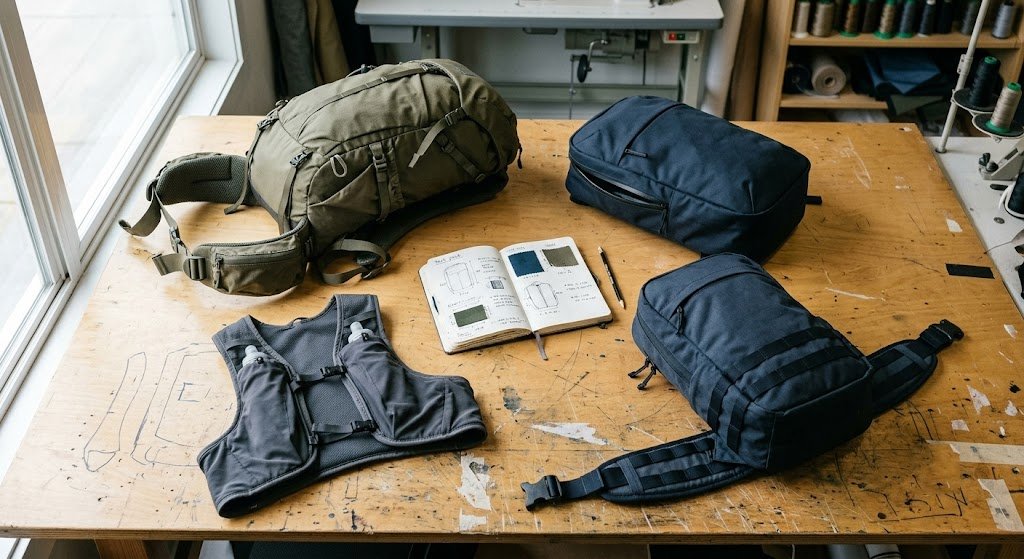
Walk through your actual end user before borrowing a feature list from a competitor’s product page.
Define three numbers: what your user carries, how much it weighs, and how long they wear the pack without removing it. Over 5–7 kg or 2–3 hours, spec the hip belt. Under both, skip it or make it detachable. Two SKUs beats one over-built compromise.
Quick decision framework
- Weekend hiker — 6–8 kg, 3–5 hrs on trail → fixed hip belt, standard spec
- College student — 3–4 kg, 15-min walks, removed often → no belt needed
- Hybrid commuter/weekend hiker — varies by day → detachable, with a loaded mock-up review before tooling
- Runner/cyclist — under 3 kg but needs stability → thin stability strap, not a load belt
If you’re still unsure after running these numbers, two SKUs — one with a fixed belt for the heavier-use segment, one without for the lighter one — almost always outperforms a single "do everything" compromise in both cost and customer reviews.
Frequently Asked Questions
Does a school backpack need a hip belt?
Generally no. A backpack should weigh no more than about 10% of the wearer’s body weight, and most school daypacks carrying laptops and books for short walks between classes fall well under the load and duration where a hip belt adds function. [new]
What’s the minimum load weight where a hip belt makes sense?
Around 5 kg as a soft threshold, with the benefit becoming clearly measurable above 7 kg — this aligns with both AOTA’s body-weight guidance and the load levels tested in published backpack biomechanics studies.
Does a hip belt need its own compliance testing?
Yes if it includes metal hardware shipping to the EU or US. Metal buckles and snaps are tested separately for restricted substances under REACH and CPSIA — a general fabric certificate doesn’t automatically cover hardware components. [new]
Conclusion
The hip belt decision comes down to load weight, wear duration, and hardware compliance.
If you’re still unsure which style fits, or want to see what’s already working on similar daypacks before you finalize your spec, that’s easy to sort out on a quick call.
Osgoodway manufactures hip belt variations across hiking, hydration, and commuter daypacks every week. Send us your target load weight, wear duration, and end market — we’ll share comparable samples and give you straight feedback on your spec before it goes to production.
Contact Osgoodway and learn about our OEM/ODM Services.







