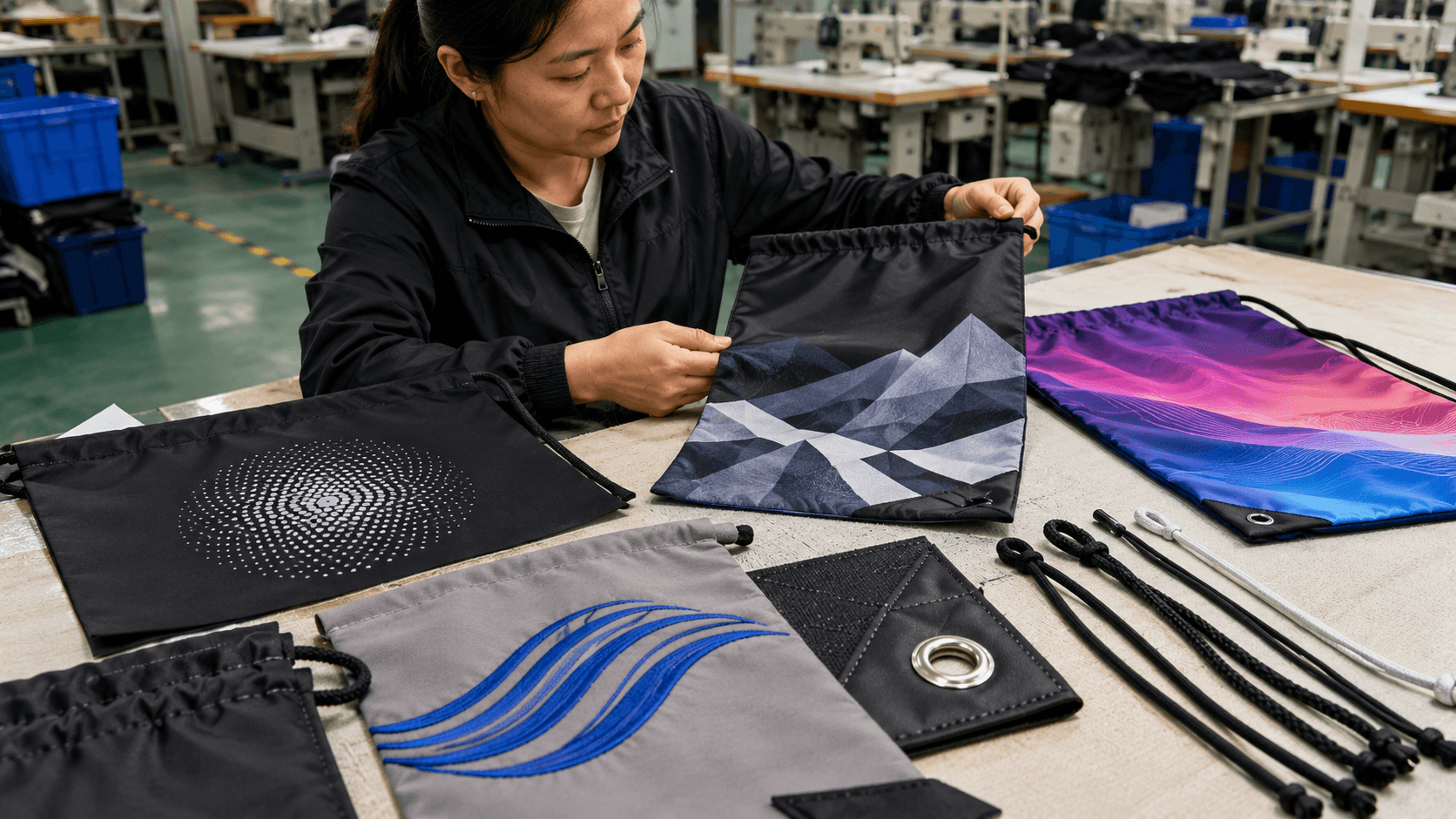
Choosing a drawstring bag material looks simple until an RFQ says only: Material: 210D polyester
That tells a factory part of the story—but not enough to predict the finished bag’s weight, hand feel, durability, printing result, water resistance, or cost.
For most custom drawstring bags, 210D–420D polyester offers the best balance of weight, durability, printing, and cost. Non-woven PP is suitable for low-cost giveaways, cotton canvas works well for premium lifestyle products, while nylon or ripstop is better suited to lightweight technical and outdoor applications.
The strongest fabric is not automatically the best choice.
A 600D polyester bag may be unnecessarily heavy for a marathon giveaway, while a properly constructed 210D bag may perform perfectly for the same application.
The better approach is to match the fabric, coating, logo process, cord system, reinforcement, expected load, order quantity, and target cost as one product specification.
Which Drawstring Bag Material Fits Which Application?
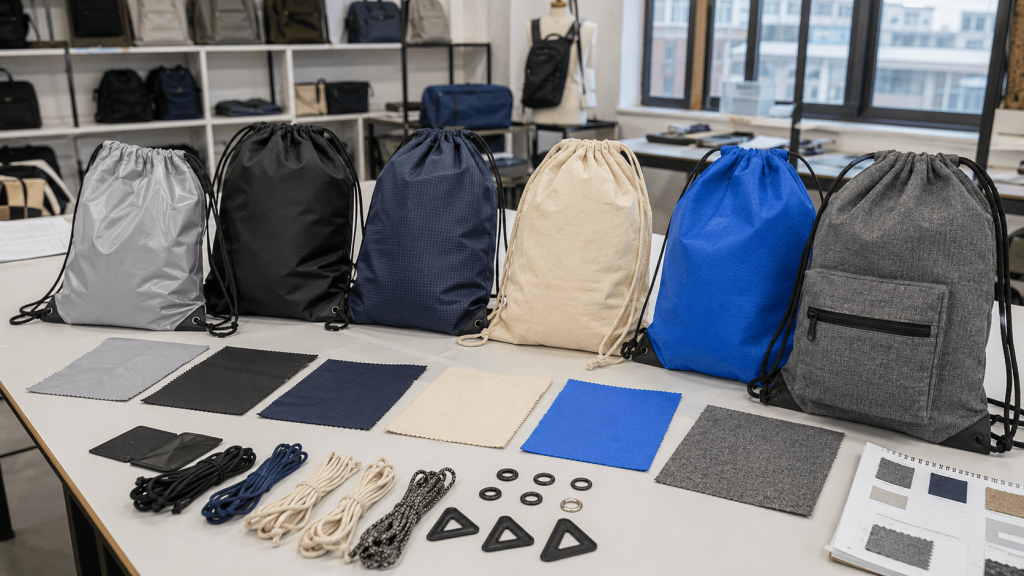
A drawstring bag for a one-day event and one sold as reusable sports merchandise may look almost identical. The material choice, however, can be completely different.
The quickest way to narrow the options is to start with how the bag will actually be used.
| Application | Recommended Starting Material | Why |
|---|---|---|
| Event giveaway | Non-woven PP or lightweight polyester | Low cost, light, easy packing |
| Marathon / race pack | 210D polyester | Lightweight, foldable, economical |
| Gym sack | 210D–420D polyester | Good balance of weight and durability |
| School / activity bag | 420D polyester | Better repeat-use performance |
| Retail merchandise | 420D–600D polyester / canvas | Better hand feel and perceived value |
| Outdoor / travel sack | Ripstop nylon / polyester | Lightweight technical construction |
| Premium lifestyle bag | Cotton twill / canvas | Natural hand feel and branding |
| Sustainable program | RPET polyester | Recycled-content option with normal fabric specs still required |
These are starting points rather than fixed rules. Bag size, expected load, quantity, logo process, construction, and target price can all change the final specification.
The best fabric is not the strongest fabric available. It is the lightest and most economical fabric that can safely meet the intended use.
The Most Common Drawstring Bag Materials
The material name gives us a direction, but it does not tell us everything about the finished bag.
210D Polyester
210D polyester is one of the most practical choices for promotional, event, race, and lightweight gym drawstring bags.
It is light, flexible, easy to fold, economical for bulk production, and compatible with common logo processes. Its main strength is efficiency rather than maximum durability.
420D Polyester
420D polyester is a useful middle ground for reusable drawstring bags.
It gives a more substantial hand feel than lightweight promotional fabrics while remaining relatively flexible, making it suitable for gym sacks, school activity bags, sports merchandise, and better-quality promotional products.
600D Polyester
600D polyester becomes more relevant when the product is designed more like a retail drawstring backpack than a simple giveaway sack.
It works well with zipper pockets, reinforced bottoms, webbing handles, and heavier carrying loads, but it also adds weight, stiffness, and material cost.
Nylon & Ripstop
Nylon and ripstop fabrics are worth considering when low weight, packability, and a more technical appearance matter.
They are useful for outdoor accessory sacks, travel organizers, shoe bags, packable products, and lightweight gear storage.
A proper ripstop construction uses reinforcement yarns within the weave to help limit the spread of a tear.
A visible grid pattern alone does not prove high tear performance.
The actual yarn, weave, coating, fabric weight, and intended load still need to be checked.
Cotton & Canvas
“Cotton” is not a complete material specification.
Lightweight cotton, cotton twill, and heavier canvas can produce very different bags in weight, structure, printing result, cost, and perceived value.
For sourcing, the actual fabric weight in GSM or oz should normally be confirmed rather than specifying only:
Cotton drawstring bag
Canvas is particularly useful when natural texture and brand presentation matter more than minimum weight, such as lifestyle merchandise, gifts, shoe bags, and premium product packaging.
Non-Woven PP
Non-woven polypropylene is mainly used when low cost, low weight, and high-volume production are the priorities.
It can make good commercial sense for trade shows, conferences, events, short-term promotions, and economical product packaging.
It is less suitable when premium hand feel or frequent reuse is an important part of the product promise.
RPET Polyester
RPET should be treated as a recycled-material requirement, not as a performance grade.
“RPET” tells us that recycled PET is being used; it does not define the fabric weight, denier, weave, coating, stiffness, or finished durability.
An RPET drawstring bag can still be lightweight, medium-duty, or heavy-duty depending on the actual fabric construction.
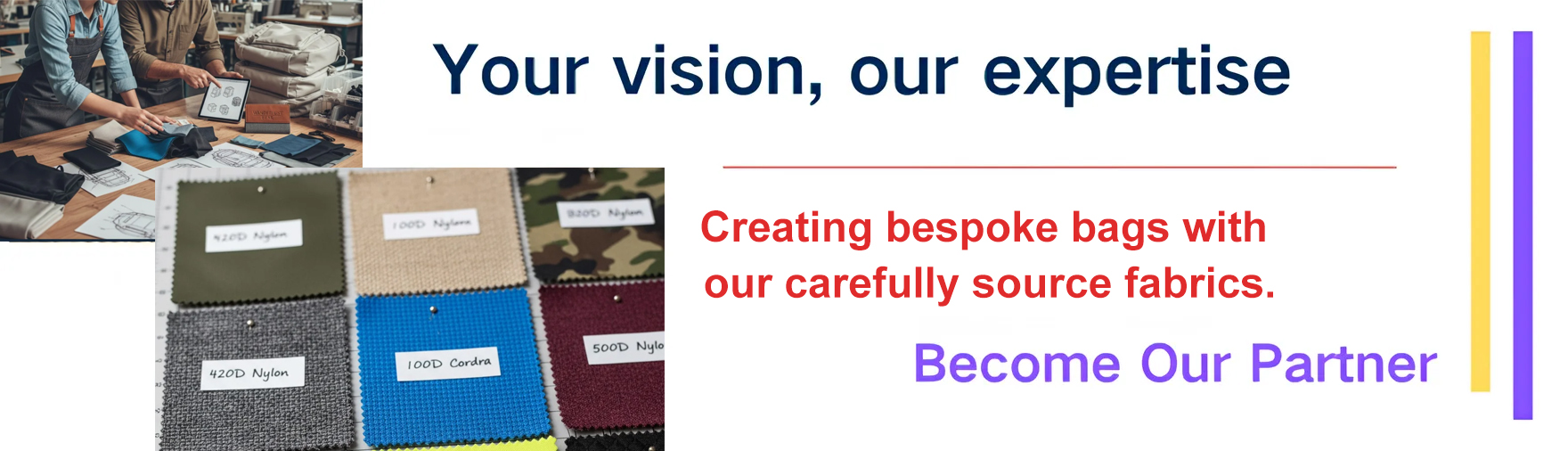
210D vs 420D vs 600D — And Why Denier Is Not Enough
When a buyer asks whether 420D is “better” than 210D, the answer is not simply yes.
Higher denier generally means a heavier yarn, but it does not tell us the finished fabric weight, stiffness, coating, or overall bag performance.
| Specification | 210D | 420D | 600D |
|---|---|---|---|
| Typical positioning | Lightweight / promotional | Repeat-use / mid-range | More structured / retail |
| Foldability | High | Medium-high | Lower |
| Finished bag weight | Lower | Medium | Higher |
| Common construction | Simple sack | Reinforced sack / pockets | Pockets, handles, stronger structure |
| Typical buyer priority | Cost + volume | Balance | Durability + perceived quality |
These differences are useful for initial selection, but denier should never be treated as a complete quality grade.
What Does 210D Actually Mean?
The “D” stands for denier, a measurement of yarn linear density. In practical terms, a higher denier generally means a heavier yarn.
In formal textile testing, yarn number is treated as a linear-density measurement rather than a measurement of finished fabric weight.
What it does not tell you is how much the finished fabric weighs.
210D refers to yarn denier, not the finished fabric weight. Two fabrics sold as 210D polyester can still differ noticeably in GSM, weave density, coating, stiffness, opacity, and hand feel.
This is why two factories can both quote:
210D polyester with PU coating
and still send material samples that feel surprisingly different.
What We Need Beyond Denier
For a more useful material specification, several variables need to be considered together:
- Denier — yarn size
- GSM — finished fabric mass per unit area, which should be specified separately from yarn denier
- Weave density — how tightly the yarns are constructed
- PU or PVC coating — backing used for water resistance, body, or other performance requirements
- Coating amount — affects weight, stiffness, hand feel, and cost
- Calendaring / surface finish — changes smoothness, appearance, compactness, and touch
A lightweight 210D fabric with a relatively light coating can feel soft and flexible.
Another 210D using a denser construction or heavier coating may feel firmer, less transparent, and noticeably more substantial.
“210D polyester” is a material category. It is not a complete factory specification.
That distinction also matters when comparing quotations. A lower price does not necessarily mean two suppliers are quoting the same fabric simply because both descriptions say “210D polyester.”
600D Changes More Than Weight
There is another issue that matters specifically with drawstring bags: the fabric has to gather at the top.
A flexible 210D or 420D body normally collapses and closes easily. Move to a heavier or more heavily coated 600D construction, and the material may resist gathering.
The change can affect:
- Drawstring channel width
- Opening width
- Cord diameter
- Eyelet construction
- Pattern dimensions
- The folds around the closed opening
A perfectly possible sampling result is:
The buyer upgraded the fabric, but the bag became harder to close.
That does not necessarily mean the 600D fabric is wrong. It may mean the original pattern and drawstring system were developed around a lighter material.
For drawstring bags, fabric weight, stiffness, cord system, and opening construction need to work together.
Fabric, Printing And Construction Must Be Designed Together
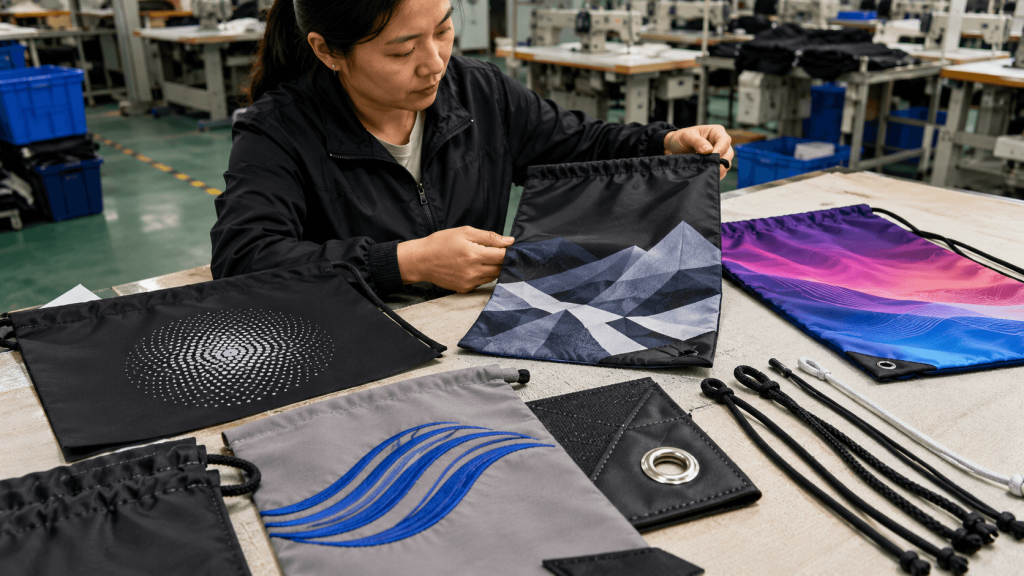
In drawstring bag development, fabric selection cannot be separated from logo decoration and load-bearing construction.
A material may be perfectly acceptable for the bag body but perform poorly with the planned logo process. Likewise, upgrading the fabric will not solve a weak corner attachment or an uncomfortable cord system.
Match The Fabric To The Logo Process
| Decoration | Better Starting Materials | What We Check |
|---|---|---|
| Screen printing | Polyester, nylon, cotton | Surface texture, coating, ink adhesion |
| Sublimation | White / light polyester | Color reproduction, fabric finish |
| Heat transfer | Polyester / selected synthetics | Heat compatibility, adhesion |
| Embroidery | Medium or heavier fabrics | Stabilization, puckering, logo density |
A fabric that carries the load well may still be wrong for the logo process.
For a wider comparison of screen printing, heat transfer, embroidery, patches, labels, and other decoration options, see our guide to choosing the right logo method for custom bags.
A very thin 190T or 210D body may perform perfectly as a lightweight bag, but a large, high-density embroidered logo can cause puckering and distortion.
This is why we prefer to confirm the decoration method before locking the fabric specification.
Water-Resistant Is Not Waterproof
PU coating can make polyester fabric more water-resistant, but it does not automatically make the finished bag waterproof.
Needle holes, seams, the drawstring opening, and other unsealed areas can still allow water to enter.
If waterproof performance is required, the whole construction—not only the fabric—needs to change.
When fabric water resistance needs to be quantified, hydrostatic-pressure testing such as ISO 811 can be used to measure resistance to water penetration.
The Weak Point May Not Be The Fabric
When a loaded drawstring backpack fails, the problem is often not in the center of the body panel.
The load travels through:
Contents → bottom seam → corner reinforcement → eyelet / cord attachment → cord → shoulder
If the reinforcement patch is too small, the eyelet is poorly supported, the seam allowance is insufficient, or the cord attachment is weak, upgrading the body from 210D to 600D does not solve the real problem.
For a loaded drawstring backpack, reinforce the load path before simply increasing fabric denier.
This is particularly important for gym and school bags carrying shoes, bottles, clothes, books, or sports equipment repeatedly.
Cord Is Part Of The Carrying System
Cord should not be treated only as a color accessory.
A thin round cord may be perfectly acceptable for a lightweight giveaway. Add several kilograms of contents, however, and the same narrow cord can become uncomfortable long before the fabric reaches its strength limit.
For more developed school, sports, and retail drawstring backpacks, cord diameter, material, attachment method, and corner reinforcement should be reviewed together with the body fabric.
Material specification and bag construction should be engineered together.
How We Specify A Drawstring Bag Before Sampling?
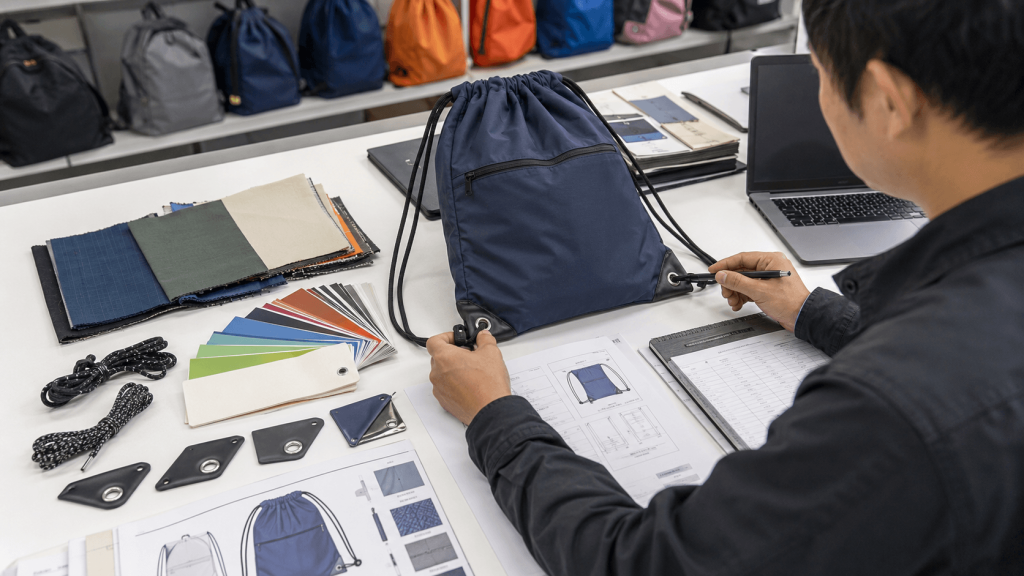
A useful fabric recommendation starts with the product brief, not with a denier number.
Before sampling, we first need to understand:
- What will the bag carry?
- How often will it be reused?
- What is the expected load?
- Is it a giveaway, merchandise item, or retail product?
- What logo process is required?
- Does the bag need water resistance?
- Is recycled content required?
- What is the target quantity?
- What is the target cost?
- Does the design include pockets, handles, or reinforced corners?
Once these points are clear, the material choice becomes much easier.
A Better RFQ Gives A Better Comparison
An RFQ that says only:
Material: 210D Polyester
still leaves too much open.
A more useful specification would be:
210D polyester, PU-coated, specified finished weight and surface finish, approved color, screen-printed logo, reinforced bottom corners with metal eyelets, 5 mm polyester cord.
Now the quotation is based on a much more defined product.
This is also why two suppliers can both quote “210D polyester” and still return noticeably different prices. They may not be quoting the same fabric weight, coating, reinforcement, cord, or finishing standard.
RPET Still Needs The Same Detail
Recycled polyester does not change this rule.
“RPET” tells us that recycled PET is being used; it does not define the recycled-content percentage, fabric weight, weave, coating, or finished performance.
For projects requiring third-party recycled-content certification, the Global Recycled Standard also addresses recycled-material verification and chain of custody.
For an RPET project, we would still confirm:
- Recycled content
- Certification requirements
- Traceability
- Fabric construction
The buyer does not need to arrive with every technical specification already decided.
In many projects, the intended use, dimensions, quantity, target cost, and logo artwork are enough for us to narrow the suitable fabric and construction options before the first sample is made.
Material specification and bag construction should be engineered together.
Frequently Asked Questions
What fabric weight is good for a drawstring bag?
There is no single ideal GSM. Lightweight promotional bags often use relatively light woven polyester, while retail, school, or sports versions usually need a more substantial construction. GSM should be checked together with denier, weave density, coating, and intended load rather than used as a stand-alone quality number.
Which drawstring bag material is best for logo printing?
Polyester is usually the most flexible choice because it works with screen printing, heat transfer, and, on suitable white or light fabrics, sublimation. Cotton and canvas are also good for screen printing. For embroidery, medium-weight or heavier fabrics are generally easier to stabilize than very thin 190T or 210D materials.
Do drawstring bags need reinforced bottom corners?
Not every drawstring bag needs them, but reinforcement becomes important when the cords attach near the bottom corners and the bag carries repeated loads. The reinforcement helps spread stress away from the eyelet or cord attachment. For heavier school, gym, or retail bags, corner construction can be more important than simply increasing fabric denier.
Is cotton canvas better than polyester for branded drawstring bags?
Cotton canvas can feel more premium and natural, making it suitable for lifestyle brands, retail merchandise, gifts, and packaging. Polyester is usually lighter, easier to pack, and more economical for high-volume promotional use. The better choice depends on brand positioning, printing method, order quantity, and how the bag will be used.
Final Words
There is no single “best” drawstring bag fabric. A well-specified 210D promotional sack can be a better product than a poorly designed 600D bag when its material, cord, reinforcement, and decoration are properly matched to the actual use.
If you are developing a custom drawstring bag, SEND US the intended use, dimensions, quantity, target price, and logo artwork. We can help narrow the material and construction options before sampling.