


Picture this: You are standing at the boarding gate of a budget airline. You bought a backpack explicitly marketed as a "40L travel pack," confident it would count as a carry-on. But the gate agent asks you to drop it into the dreaded metal sizer box—and it doesn’t fit. You are hit with a $50 gate-check fee.
Why did this happen?
As a seasoned bag manufacturer at Osgoodway, we see this confusion constantly. The disconnect happens because consumers buy backpacks based on Volume (Liters), but airlines measure bags strictly by Linear Inches (external dimensions).
If you want to avoid surprise fees, or if you are a bag brand looking to design truly flight-friendly products to reduce customer returns, you need to understand the physics of bag measurements. Let’s break down the difference and show you exactly how to measure a backpack the right way.
Why Is There a Misconception Between Linear Inches and Backpack Volume?
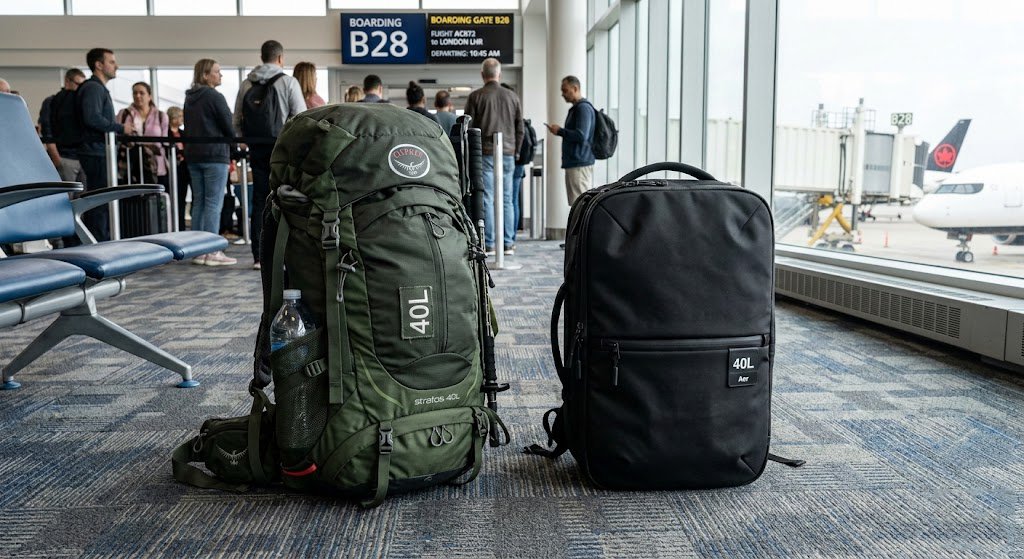
Travelers get fined at boarding gates because they confuse internal storage capacity with external physical measurements.
The biggest misconception is assuming a backpack’s volume in liters guarantees airline compliance. Volume measures internal gear capacity, while linear inches measure the total outside footprint (Length + Width + Height), which is the only metric gate sizers actually test.
How Do Linear Inches and Volume Differ in Practice?
Linear inches define the absolute spatial limits of the overhead bin, whereas volume indicates how much clothing or gear can be stuffed inside.
- Volume (Liters): The internal holding space, officially calculated by factories using standard 20mm plastic spheres.
- Linear Inches (External): The L+W+H footprint, which significantly expands (fabric bulge) when the bag is overpacked.
- Airline Focus: Gate agents strictly measure the external linear inches to ensure a safe physical cabin fit.
Why Can the "Liters" Tag Be Highly Misleading?
Manufacturers calculate liters using all pockets combined, meaning a bulky 40L bag might fail the rigid linear inch test while a sleek 40L passes.
| Bag Type | Advertised Volume | Actual Linear Inches | Airline Result |
|---|---|---|---|
| Tall Hiking Pack | 40 Liters | 52 inches (Over limit) | Forced Gate Check |
| Clamshell Travel Pack | 40 Liters | 44 inches (Compliant) | Carry-on Approved |
Curious about the specific structural differences that matter? Read our guide on what makes a backpack strictly carry-on compliant.
How to Measure Your Backpack Like a QC Inspector
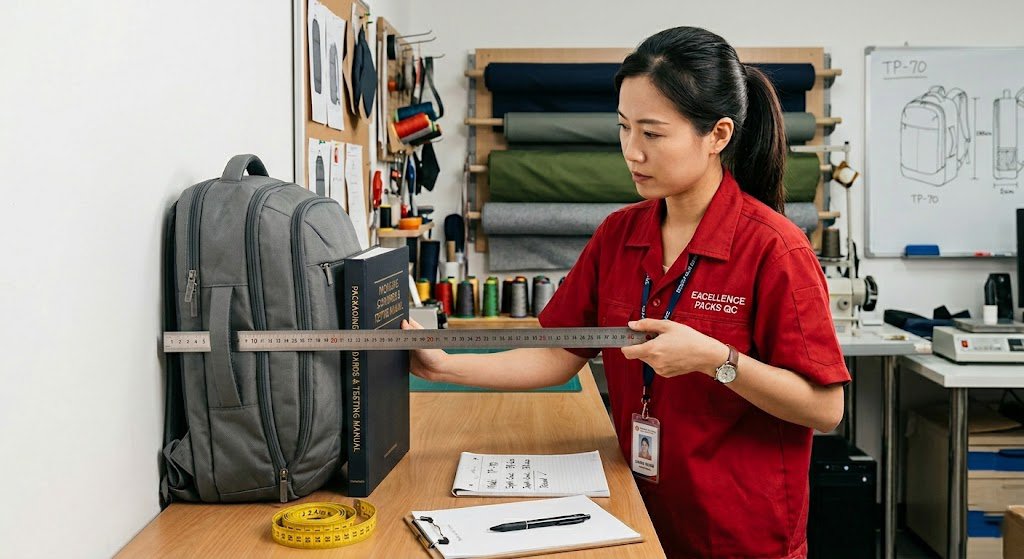
To ensure your bag flies free, you need to measure it like an airline employee—or better yet, like a factory Quality Control (QC) inspector.
A true QC inspector never measures an empty bag. They pack it fully to account for fabric stretch and use rigid tools to find the absolute maximum external dimensional footprint.
Step 1: The Fully Packed Rule
Never measure an empty bag. Unless it has a rigid internal frame, an empty soft-sided backpack lays relatively flat. Pack the bag exactly as you would for your trip. Fill the main compartment, stuff the front pockets, and put your water bottle in the side sleeve. You must account for the fabric bulge.
Step 2: Include the Extremities
Airlines measure the absolute widest points of the bag. When taking your measurements, you must include:
- Top and side grab handles.
- Padded back panels and shoulder straps (these can easily add 1 to 2 inches of depth).
- External compression straps or buckles.
- Wheels or hard bottom feet (if applicable).
Step 3: Use the "Wall and Box" Method (Ditch the Soft Tape)
A soft tailor’s measuring tape will wrap around the curves of the bag, giving you an inaccurate, overly large number. Instead, simulate an airline sizer box:
- Place the fully packed backpack on the floor, flat against a wall.
- Take a stiff, flat object (like a hardcover book or a piece of cardboard) and place it against the opposite side of the bag, parallel to the wall.
- Use a rigid metal tape measure to measure the straight-line distance from the wall to the inside of the book.
- Repeat this process for the Length, Width, and Depth.
Once you have your exact L x W x H, compare it against the latest airline limits in our comprehensive carry-on backpack size guide
Also, while you are measuring, ensure your gear won’t cause issues at security. Check out the TSA-approved dimensions for carry-on backpacks

How Can Brands Design Bags That Beat the Sizer Box?
Brands must reverse-engineer backpacks based on strict airline linear inches rather than arbitrary volume goals. By prioritizing spatial efficiency, controlling fabric stretch, and implementing heavy-duty compression systems, developers ensure their travel packs easily pass rigid gate sizer tests.
Traditional nylon expands up to 15% when overstuffed, pushing an otherwise compliant 40L bag out of bounds. Our factory QA testing proves that utilizing high-denier Cordura paired with a four-point external compression strap system reduces the fully packed depth profile by a crucial 2 to 3 inches.
What Are the Key Design Elements for Carry-on Compliance?
- Clamshell Architecture: Maximizes the internal cubic volume without expanding the external linear footprint.
- Low-Stretch Materials: Utilizing engineered ripstop fabrics prevents the dreaded "fabric bulge" when consumers inevitably overpack.
- Integrated Compression: External straps allow travelers to physically cinch the bag down to fit into the metal sizer box.
Factory Secret: Never approve a tech pack based solely on liters. Always mandate the factory build prototypes to exact airline sizer dimensions.
The Bottom Line
When preparing for a flight, ignore the liters printed on the tag. Your backpack’s true test is its final, fully packed external dimensions. By measuring accurately at home using rigid tools, and by choosing bags engineered for spatial efficiency rather than just high volume, you can walk past the gate agents with total confidence.
FAQs
Does a 40L backpack count as a carry-on or personal item?
Airlines do not measure bags by volume (Liters); they strictly measure by linear inches (L + W + H). A rectangular 40L travel pack might perfectly fit the carry-on sizer, while a tall, skinny 40L hiking backpack will likely exceed the height limit and be forced to be checked. Always check the external dimensions.
Do airlines include backpack straps and handles when measuring?
Yes. Gate agents and sizer boxes measure the absolute widest points of your bag. This includes top grab handles, padded back panels, shoulder straps, and any bulging front or side pockets. You must include these extremities when measuring your bag at home.
Why does my backpack measure larger than the dimensions listed on the brand’s website?
Most brands list the dimensions of an empty bag. Soft-sided backpacks experience "fabric bulge" when fully packed, which can easily add 1 to 2 inches to the depth and width. To get an accurate measurement for the airline, you must measure your bag fully packed.
How do backpack factories actually calculate volume (Liters)?
In professional manufacturing, volume isn’t usually just Length x Width x Height. The industry standard (like the ASTM method) involves filling all closed compartments with small 20mm plastic spheres, then measuring the volume of those spheres. This measures internal holding capacity, not the external footprint required by airlines.






