


Most "sourcing guides" online tell you to "go to Alibaba and request quotes." That’s like telling someone to "go to the ocean and catch fish."
I’ve watched hundreds of buyers burn cash on bad samples, wrong materials, and suppliers who ghost after the deposit. This guide is different. I’m writing it from inside the factory. I’ll show you exactly how we handle bulk custom orders—the real process, the real costs, and the traps nobody warns you about.
What Exactly Are Car Seat Organizers and Kick Mats — And Why Does the Distinction Matter?
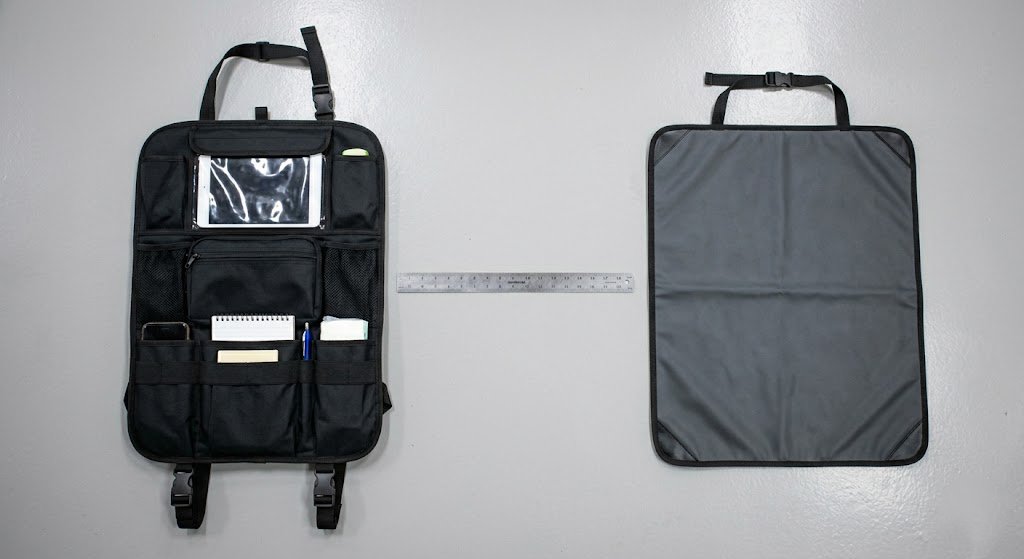
Car seat organizers are storage accessories that attach to the back of front seats, featuring pockets, compartments, and holders for passenger convenience. Kick mats are protective panels designed primarily to shield seat backs from scuffs, dirt, and shoe marks. Many products combine both functions, but the manufacturing process, material choice, and pricing differ significantly.
Here’s where most buyers get confused: they treat these as one product. They’re not. The construction is fundamentally different.
Key Structural Differences
| Feature | Car Seat Organizer | Kick Mat | Combo (Organizer + Kick Mat) |
|---|---|---|---|
| Primary function | Storage & access | Seat back protection | Both |
| Material layers | 2–3 (shell + lining + stiffener) | 1–2 (waterproof face + backing) | 3–4 |
| Typical thickness | 3–5 mm | 1.5–2.5 mm | 4–6 mm |
| Stitching complexity | High (multiple pockets) | Low (perimeter + mounting) | Very high |
| Unit cost range (FOB) | $2.80–$6.50 | $1.20–$3.00 | $3.50–$8.00 |
| Common MOQ | 500–1,000 pcs | 1,000–2,000 pcs | 500–1,000 pcs |
Why This Matters for Your Order
If you tell a supplier "I want a kick mat" but your design has three pockets and a tablet holder, you’ve just described an organizer. The factory will quote organizer pricing. You’ll wonder why it’s "expensive." I see this mismatch on roughly 3 out of 10 first-time inquiries.
🔧 Factory tip: Before you request any quote, decide: are you selling protection, storage, or both? This single decision changes your material spec, your cost, and your MOQ.
Who Actually Buys These in Bulk — And What Do They Need?
Most content skips this part. But understanding the buyer segments helps you position your own product and avoid ordering the wrong spec.
Bulk buyers of car seat organizers and kick mats fall into five distinct segments, each with radically different requirements for materials, MOQ, branding, and compliance.
Buyer Segments at a Glance
| Buyer Type | Typical MOQ | Key Priority | Common Mistakes |
|---|---|---|---|
| Amazon/e-commerce sellers | 500–2,000 pcs | Listing photos, packaging, fast turnaround | Over-engineering the product; ignoring packaging cost |
| Automotive brands / OEM | 3,000–10,000 pcs | Exact color match, material certifications | Underestimating lead time for custom colors |
| Fleet operators (rental, rideshare) | 1,000–5,000 pcs | Durability, easy cleaning, low cost | Choosing the cheapest option; replacing every 3 months |
| Promotional / corporate gift buyers | 500–1,000 pcs | Logo placement, fast delivery | Not checking logo print durability (peels after 2 months) |
| Wholesale distributors | 5,000–20,000 pcs | Lowest FOB price, bulk packaging | Sacrificing quality control to save $0.15/pc |
The Hidden Truth About MOQ
I’ll be blunt: any factory that says "MOQ: 1 piece" for custom car seat organizers is either lying or quoting you a trading company price with a 40–60% markup.
Real factory MOQs work like this:
- Stock designs (no customization): 100–300 pcs possible, but you get what you get
- Custom logo only (screen print/heat transfer): 300–500 pcs minimum
- Fully custom design (your pattern, materials, pockets): 500–1,000 pcs minimum
- Custom material + custom color + custom hardware: 1,000–2,000 pcs minimum (because the fabric mill has its own MOQ)
🔧 Factory secret: The MOQ is rarely about the factory’s capacity. It’s about the fabric supplier’s MOQ. We can sew 100 pieces in a day. But the fabric mill won’t dye a custom color for less than 500 meters—that’s roughly 800–1,200 finished pieces depending on design.

What Materials Should You Specify — And Which Ones Will Fail?
This is where I’ve seen the most money wasted. The material you choose determines 70% of your product’s perceived quality, durability, and cost.
The four dominant materials for car seat organizers and kick mats are 600D polyester, 1680D Oxford nylon, PVC leather (synthetic), and non-woven fabric—each with dramatically different performance, cost, and shelf life.
Material Comparison: Real Factory Data
| Material | Abrasion Resistance (Martindale Cycles) | Water Resistance | UV Stability | FOB Cost Impact | Best For |
|---|---|---|---|---|---|
| 600D Polyester | 15,000–20,000 | Moderate (needs coating) | Fair | Baseline ($0) | Budget e-commerce products |
| 1680D Oxford Nylon | 35,000–45,000 | Good (PU-coated) | Good | +$0.60–$1.00/pc | Premium organizers, fleet use |
| PVC Leather | 50,000+ | Excellent | Poor (cracks in heat) | +$0.80–$1.50/pc | Luxury look, but risky in hot climates |
| Non-woven (PP) | 3,000–5,000 | Poor | Poor | –$0.40–$0.60/pc | Disposable promo items only |
Our Worst Material Failure (And What It Taught Us)
I’ll share a real story. In 2021, a U.S. Amazon seller ordered 3,000 kick mats in PVC leather. Beautiful product. Great photos. Five-star listing for three months.
Then summer hit. Arizona, Texas, Florida—returns flooded in. The PVC cracked and peeled in cars parked in direct sunlight. Interior car temperatures hit 70–80°C (158–176°F). PVC leather’s heat tolerance? About 60°C before degradation starts.
The fix: We switched that client to 1680D Oxford with a PU coating. Abrasion resistance stayed high. Heat tolerance jumped. Returns dropped by 85%. Cost went up $0.70/pc. Worth every cent.
What to Ask Your Supplier About Materials
Don’t just ask "what material is this?" Ask these:
- What’s the denier count and weave density? (600D can vary wildly; cheap 600D is basically paper)
- What coating is applied? (PU vs PVC coating—PU breathes, PVC doesn’t; both are "waterproof")
- Can you provide a Martindale abrasion test report? (If they can’t, they haven’t tested it)
- What’s the colorfastness rating? (ISO 105-B02; you want Grade 4+ or it fades in 6 months)
🔧 Factory tip: Ask for a washed sample. Any material looks great fresh off the roll. Wash it 5 times, leave it in a hot car for a week, then decide. We do this internally before confirming any material for production. Most factories don’t.
How Does the Custom Manufacturing Process Actually Work?
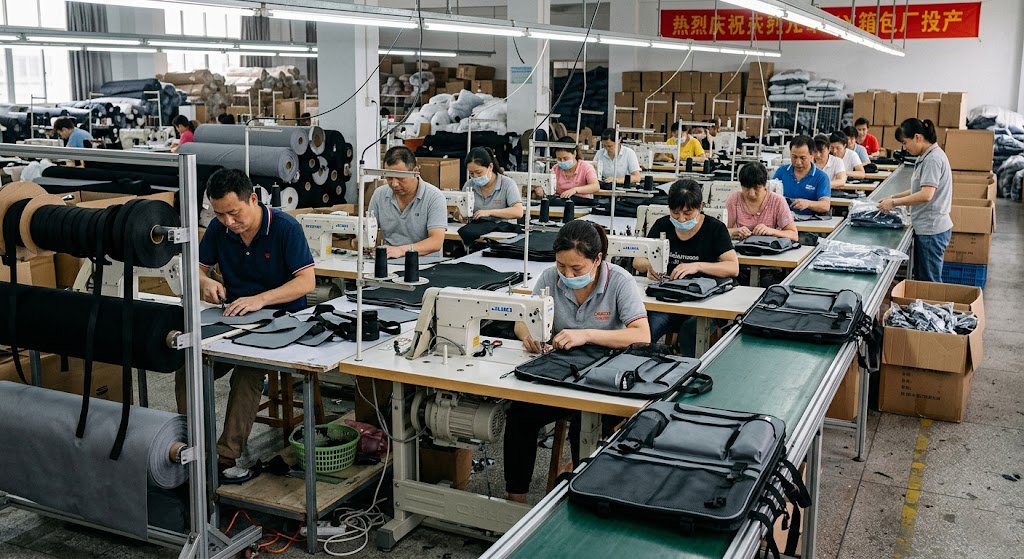
Forget the clean, five-step infographics you see on sourcing blogs. The real process is messier, longer, and has more decision points than anyone admits.
A fully custom car seat organizer order—from first contact to shipment—takes 35–60 days and involves seven distinct phases, each with potential delays that can add 1–3 weeks if not managed proactively.
The 7 Phases (What Actually Happens)
Phase 1: Requirement Gathering (Days 1–3)
- You send your design, reference images, or competitor product link
- We ask 15–20 clarifying questions (most buyers only answer half; this causes delays later)
- Critical: specify your target retail price now—it determines the entire material spec
Phase 2: Quotation & Material Proposal (Days 3–7)
- Factory provides FOB pricing per unit at different MOQ tiers
- Material swatches are selected (or custom-dyed if needed)
- Packaging options quoted separately (this catches people off guard—packaging can be 10–20% of unit cost)
Phase 3: Sample Development (Days 7–18)
- First sample (proto sample) takes 7–10 working days
- This is where 90% of delays happen. If your design sketch is vague, the sample won’t match your vision
- Expect 1–2 revisions. Budget for it.
Phase 4: Sample Approval & Pre-Production (Days 18–25)
- You approve the sample (or request revision—add 5–7 days per round)
- Factory orders bulk materials based on approved sample
- Fabric MOQ fulfilled; trims, zippers, elastic ordered
Phase 5: Bulk Production (Days 25–40)
- Cutting → Stitching → Assembly → QC → Packing
- A 2,000-piece order typically takes 12–15 production days
- In-line QC happens at three checkpoints: post-cutting, post-stitching, pre-packing
Phase 6: Final Inspection & Packing (Days 40–48)
- AQL 2.5 inspection (Major defects) per ISO 2859-1
- Packing per spec: individual polybag, retail box, or bulk carton
- Carton drop test and weight verification
Phase 7: Shipping & Logistics (Days 48–60)
- FOB, CIF, or DDP terms confirmed
- Sea freight: 25–35 days to U.S. West Coast
- Air freight: 5–7 days (but 4–6x the cost)
Why Timelines Slip: The Top 3 Reasons
| Delay Cause | Frequency | Time Added | How to Prevent It |
|---|---|---|---|
| Vague or incomplete design brief | Very common | 7–14 days | Use our design brief template or send a competitor sample |
| Custom color fabric not in stock | Common | 10–21 days | Choose from mill’s existing color card to save 2–3 weeks |
| Multiple sample revision rounds | Common | 5–7 days per round | Approve samples in person or via detailed video review |
🔧 Factory secret: Want to cut 10–15 days off your timeline? Send us a physical competitor sample instead of a sketch. We reverse-engineer it in 48 hours. A sketch takes a week of back-and-forth.
How Much Does It Really Cost — And Where Is the Money Going?
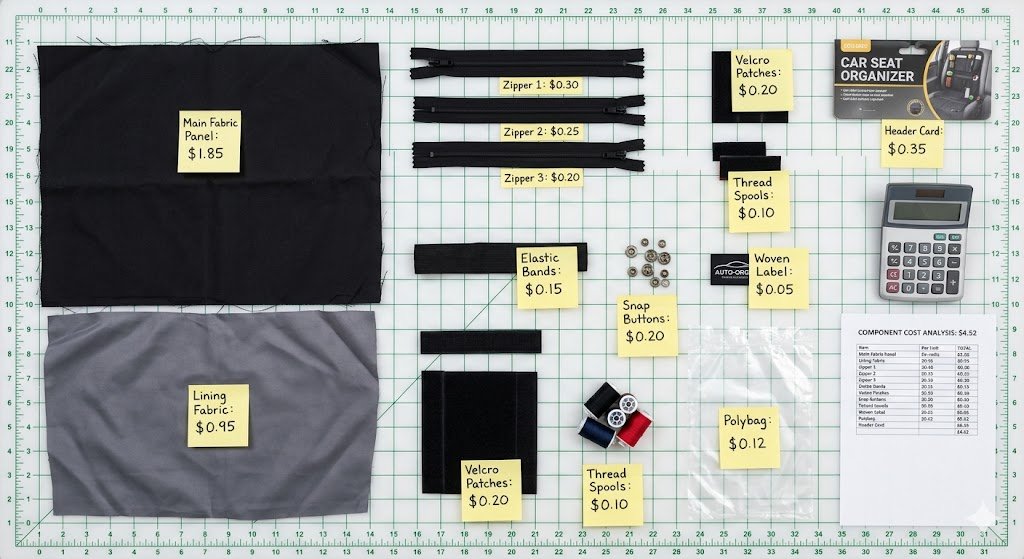
Every buyer asks "what’s the price?" But almost nobody asks "what’s in the price?" Let me break it down the way we calculate it internally.
The FOB cost of a custom car seat organizer typically ranges from $2.80 to $8.00 per unit, with materials accounting for 45–55% of cost, labor 20–25%, overheads 10–15%, and profit margin 8–12%.
Cost Breakdown: A Typical 2,000-Piece Order
This is a real-world example—a mid-range backseat organizer with 6 pockets, tablet holder, and kick mat panel, made in 1680D Oxford with PU coating:
| Cost Component | % of Total | Cost per Unit (USD) | Notes |
|---|---|---|---|
| Main fabric (1680D Oxford) | 28% | $1.26 | PU-coated, custom color |
| Lining fabric | 8% | $0.36 | 210D polyester |
| Trims (zippers, elastic, velcro) | 10% | $0.45 | YKK zippers add ~$0.20 vs generic |
| Stitching labor | 22% | $0.99 | ~25 minutes per piece at our factory |
| Cutting & prep | 5% | $0.23 | CNC cutting for consistency |
| QC & inspection | 3% | $0.14 | In-line + final AQL |
| Packaging | 9% | $0.41 | Individual polybag + retail header card |
| Factory overhead | 7% | $0.32 | Utilities, equipment, admin |
| Profit margin | 8% | $0.36 | Standard for repeat orders |
| Total FOB | 100% | $4.52 | Before shipping and duties |
Hidden Costs That Will Bite You
These rarely appear in the initial quote. Ask about them upfront:
- Sample fees: $50–$150 per sample (refundable against bulk order at most factories, including ours)
- Mold/die fees for custom hardware: $200–$800 if you need custom buckles, snap buttons, or branded zipper pulls
- Color matching fee: $0 if you pick from existing color cards; $100–$300 if you need Pantone-matched custom dyeing
- Packaging design: Some factories charge $50–$200 for retail box design; we include it free if order exceeds 1,000 pcs
- Inspection fees (third-party): $250–$400 per inspection if you hire SGS, Bureau Veritas, or TÜV
Price vs. Quality: The $0.50 Decision
Here’s a pattern I’ve seen hundreds of times:
A buyer gets three quotes. Factory A: $3.80. Factory B: $4.30. Factory C (us): $4.50.
They pick Factory A. Six months later, they’re at our door because:
- The elastic lost tension after 60 days
- The stitching unraveled at stress points
- Amazon reviews tanked to 3.2 stars
That $0.50/unit difference? It was the difference between 12-needle stitching and 8-needle stitching at stress points. It was the difference between proper bar-tacking and single-pass stitching at pocket anchors. Most buyers can’t see this in a photo. You see it in the return rate.
🔧 Factory tip: When comparing quotes, ask each supplier: "How many stitches per inch at load-bearing points?" The answer should be 7–9 SPI for car accessories. Below 6 SPI, the seams will fail under daily use. If the supplier doesn’t know what SPI means, run.
How Do You Verify a Supplier Won’t Waste Your Money?
This is the section I wish every buyer read before sending a deposit. I’ve seen people wire $15,000 to a "supplier" who turned out to be a middleman with a WeChat profile picture of someone else’s factory.
Verifying a car seat organizer supplier requires checking five non-negotiable factors: business license validity, actual production capability (not trading company status), material testing capacity, export history, and reference-checkable client list.
The 5-Point Supplier Verification Checklist
1. Business License & Legal Status
- Request their Chinese business license and verify it on National Enterprise Credit Information
- Check if they’re registered as a "manufacturing" company vs "trading" company
- A trading company isn’t automatically bad—but you need to know who’s actually making your product
2. Factory Audit (Virtual or On-Site)
- Ask for a live video tour. Not a polished promo video—a live, unscripted walk-through
- Look for: cutting tables, sewing lines with workers, material storage, QC area, packing stations
- Red flag: if they only show a "showroom" and never the production floor
3. Material Testing & Certifications
- Ask for existing test reports: REACH, CPSIA (for children’s products in the U.S.), California Prop 65
- Key certifications for automotive accessories:
- REACH (EU chemical safety)
- CPSIA (if marketed for children under 12)
- FMVSS 302 (flammability for motor vehicle interiors)
4. Export Track Record
- Check their customs export data on platforms like ImportGenius or Panjiva
- Ask for bill of lading references or shipping photos from past orders
- A factory that’s shipped to the U.S./EU consistently for 3+ years is a much safer bet
5. Sample Quality vs. Bulk Quality
- The golden rule: the sample is always better than bulk. Always.
- This is why third-party inspection during production matters
- Ask the factory: "Can I arrange a third-party inspection at AQL 2.5 before shipment?" If they hesitate, that’s your answer.
Red Flags I’ve Personally Seen
- Supplier won’t let you visit the factory ("we’re renovating")
- Price is 30%+ below every other quote (they’ll cut corners or switch materials in bulk)
- They agree to everything instantly (no pushback = no expertise)
- No questions about your design—a good factory asks you questions
🔧 Factory tip: Ask for a "production sample" pulled from the actual bulk run—not a "sales sample" (业务样) made by their best worker. The production sample tells you what your 2,000th piece will look like. The sales sample tells you nothing.
What Quality Control Steps Prevent Bulk Order Disasters?
QC isn’t a single checkpoint. It’s a system. And if your supplier treats it as a formality, you’ll find out the hard way—in your customer reviews.
Effective QC for bulk car seat organizers requires inspection at four stages: incoming material, in-line production, pre-packing, and pre-shipment—each targeting different defect types that compound if missed early.
Our 4-Stage QC Protocol
| Stage | When | What We Check | Defect Catch Rate |
|---|---|---|---|
| Incoming Material | Before production starts | Fabric weight, color consistency, coating adhesion, zipper functionality | Catches 30% of potential defects |
| In-Line (after stitching) | During production, every 100 pcs | Stitch count (SPI), seam alignment, pocket dimensions, elastic tension | Catches 45% of defects |
| Pre-Packing | After assembly, before packaging | Overall appearance, functionality test (load test on pockets), logo placement | Catches 20% of defects |
| Pre-Shipment (AQL) | After packing, before container loading | Random sampling per ISO 2859-1 AQL 2.5: Major 2.5, Minor 4.0 | Final gate — reject lot if failed |
The Tests Most Factories Skip
These are the tests we run that I’d estimate fewer than 20% of factories bother with for car accessories:
- Pocket load test: We hang 2 kg (4.4 lbs) from each pocket for 24 hours. If the stitching stretches more than 5mm, it fails. Your customer’s water bottle + iPad + phone case = easily 2 kg.
- Velcro cycle test: We attach and detach the headrest straps 500 times. Cheap velcro loses 40% grip by cycle 200. We spec ASTM D5169 Grade 3 minimum.
- Elastic recovery test: Stretch the elastic band to 150% for 48 hours, release, measure recovery. Good elastic returns to within 5% of original. Bad elastic stays stretched permanently.
- Wipe-clean test: We apply ketchup, coffee, and crayon to the kick mat surface. If it doesn’t clean with a damp cloth in 30 seconds, the coating is wrong.
🔧 Factory secret: Want a shortcut to judge factory quality? Ask them to show you their defect rate data from the last 3 months. A good factory tracks this obsessively and will share it. Their target should be below 2% major defect rate. If they don’t track it—or claim it’s "zero"—they’re not doing real QC.
How Should You Handle Branding, Packaging, and Compliance?
This phase is where your product goes from "generic factory output" to "my brand." And it’s where small decisions create big cost swings.
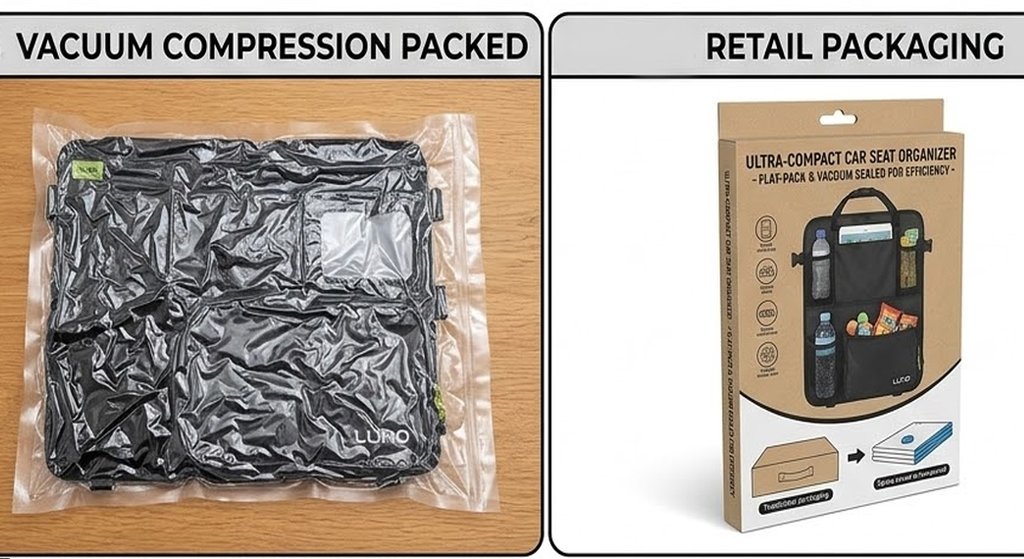
Branding a custom car seat organizer involves three layers: product-level branding (logos, labels, color), retail packaging (polybag, box, insert cards), and regulatory compliance (labeling laws, safety standards). But there’s a fourth layer most guides ignore entirely: transport packaging and CBM optimization—which can swing your shipping cost by 20–30%.
Branding Options & Cost Impact
| Branding Method | Setup Cost | Per-Unit Cost | Durability | Best For |
|---|---|---|---|---|
| Screen printing | $30–$80 per color | $0.05–$0.15 | Moderate (cracks after heavy use) | Simple logos, 1–2 colors |
| Heat transfer | $50–$120 for plate | $0.08–$0.20 | Good | Multi-color logos, gradients |
| Embroidery | $50–$100 for digitizing | $0.15–$0.40 | Excellent | Premium feel, small logos |
| Woven label | $80–$150 for die | $0.03–$0.08 | Excellent | Brand tags, care labels |
| Rubber/PVC patch | $150–$300 for mold | $0.10–$0.25 | Excellent | Outdoor/rugged brand look |
| Debossing | $100–$200 for die | $0.05–$0.10 | Permanent | Leather/PU materials only |
Retail Packaging: What Actually Sells on Shelf and Online
Don’t overthink this—but don’t skip it either. Your packaging has two jobs: protect the product in transit and convert the buyer at the listing page (or shelf).
- Polybag + header card (lowest cost): $0.08–$0.15/pc. Good enough for Amazon. Clean, shows the product. This is what 70% of our e-commerce clients choose.
- Retail color box: $0.30–$0.80/pc depending on size and print quality. Worth it if you’re selling in brick-and-mortar (auto parts stores, TJ Maxx, etc.) or running a premium listing.
- Hang tag + polybag combo: $0.12–$0.20/pc. Good middle ground—adds brand feel without box cost.
- Insert card (care instructions + brand story): $0.03–$0.05/pc. Cheap. Do it. It’s your one chance to build a relationship post-purchase.
Transport Packaging & CBM Optimization: The Cost Most Buyers Don’t See Until the Freight Invoice
Here’s the brutal truth about car seat organizers and kick mats: they’re "volumetric cargo" . Light weight, big volume. And ocean freight charges by CBM (cubic meter), not by kilogram.
This means your packing method can matter more than your FOB price. I’ve seen buyers negotiate $0.30 off the unit price, then lose $0.50+ per unit on inflated freight because nobody optimized the carton packing.
The Volumetric Problem, Quantified
A standard backseat organizer (unfolded) measures roughly 60 × 40 × 5 cm. If you pack them flat in a standard export carton without compression:
| Packing Method | Pieces per Carton | Carton Dims (cm) | CBM per Carton | CBM per 1,000 pcs | Est. Sea Freight per 1,000 pcs (to U.S. West Coast) |
|---|---|---|---|---|---|
| Flat-packed, no compression | 20 pcs | 62 × 42 × 52 | 0.135 | 6.75 CBM | ~$405 |
| Flat-packed + vacuum compressed | 35 pcs | 62 × 42 × 38 | 0.099 | 2.83 CBM | ~$170 |
| Roll-folded + vacuum compressed | 40 pcs | 62 × 42 × 32 | 0.083 | 2.08 CBM | ~$125 |
That’s a 67% freight cost reduction from the laziest packing method to the most optimized one. On a 2,000-piece order, that’s roughly $560 saved—more than the cost of the vacuum compression process itself.
Three Packing Methods We Use (And When to Choose Each)
1. Flat-Pack (Standard)
- Each piece folded flat, stacked in carton
- No special equipment needed
- Best for: retail-boxed products (you can’t vacuum-compress a box), small orders under 500 pcs where compression setup isn’t worth it
- CBM efficiency: ★★☆☆☆
2. Flat-Pack + Vacuum Compression
- Pieces stacked flat, then the entire stack is vacuum-sealed into a compressed brick
- Reduces carton height by 25–40%
- Adds $0.03–$0.06/pc for vacuum bag and labor
- Best for: polybag-packed products, mid to large orders
- CBM efficiency: ★★★★☆
3. Roll-Fold + Vacuum Compression
- Each piece is rolled (not folded), then batch vacuum-sealed
- Maximum volume reduction—up to 50–60% vs standard flat-pack
- Adds $0.05–$0.08/pc
- Caveat: only works for flexible materials. If your organizer has a rigid stiffener panel or built-in hardboard, rolling will crease or crack it. We tried this in 2022 with a stiffened tablet-holder organizer—the insert panel cracked along the fold line on 15% of pieces. Lesson learned: roll-fold is for soft-structure products only.
- CBM efficiency: ★★★★★
Compliance: Don’t Skip This
If you’re selling in the U.S. or EU, these aren’t optional:
-
U.S. market:
- Care labeling per 16 CFR 423 (FTC Textile Rules) — required if product contains textile
- Country of origin label — "Made in China" must be visible per 19 CFR 134
- CPSIA compliance if marketed for children under 12
- California Prop 65 warning if selling into CA (lead, phthalate testing required)
-
EU market:
- REACH compliance (chemical testing) — mandatory
- CE marking is NOT required for car organizers (common misconception) unless it has electronic components
- Textile labeling per EU Regulation 1007/2011 — fiber composition must be listed
🔧 Factory tip: We include country of origin labels and care labels in every order by default—some factories charge extra for this. Ask before you sign off.
Why Do Most First-Time Bulk Orders Go Wrong — And How Do You Avoid It?
I’m going to be honest. About 40% of first-time buyers we work with have already been burned by another supplier. The problems are almost always the same.
First-time bulk orders fail for three predictable reasons: unclear product specifications, skipped sample approval steps, and zero QC during production—all of which are preventable with basic process discipline.
The Top 5 Mistakes (And Fixes)
Mistake 1: Sending a Pinterest image as your "design brief"
- A photo tells us shape and color. It tells us nothing about material, thickness, pocket depth, strap length, or closure type.
- Fix: Include dimensions (in mm), material preference, Pantone color code, and a list of every pocket/feature with size specs.
Mistake 2: Approving the sample based on photos
- Phone cameras lie. Colors shift. Texture is invisible. Stitching quality can’t be judged from a JPEG.
- Fix: Get the physical sample shipped to you. Touch it. Pull the straps. Stuff the pockets. Try to break it. That’s your approval test.
Mistake 3: Choosing the cheapest quote without understanding why it’s cheapest
- Cheap usually means: thinner fabric, fewer stitches, no QC, generic trims, and a prayer.
- Fix: Ask for the cost breakdown (like the table I shared above). Compare line by line—not just the bottom number.
Mistake 4: Not specifying packaging in the original quote
- "I assumed it came with a retail box." No. Default factory packaging is a clear polybag. Everything else costs extra.
- Fix: Include packaging specs in your very first RFQ. Specify: individual polybag, retail box, hang tag, insert card, barcode label.
Mistake 5: No pre-shipment inspection
- You approved the sample. You trusted the factory. You receive 2,000 pieces with crooked logos and loose threads.
- Fix: Always arrange AQL inspection—either through your own agent or by asking the factory for their QC report + inspection photos/video.
🔧 Factory tip: At OSGW, we send a photo set of 15–20 images per order before shipment: overall product, close-up stitching, logo detail, pocket interiors, packaging, carton packing, and shipping marks. If your factory doesn’t offer this, require it. It takes 10 minutes and prevents 90% of disputes.
Ready to Source? Here’s Your Action Plan
You’ve read the insider details. Here’s exactly what to do next, step by step:
- Define your product type: Organizer, kick mat, or combo? Protection-focused or storage-focused?
- Pick your material tier: Budget (600D polyester), mid-range (900D), or premium (1680D Oxford)?
- Prepare your design brief: Dimensions, features, material, color (Pantone if possible), branding method, packaging spec
- Set your budget and MOQ: Know your target landed cost (FOB + shipping + duties) and order quantity
- Request quotes from 3–5 factories: Include your full design brief—not just "how much for a car organizer?"
- Order samples from top 2: Test them. Abuse them. Compare them side by side
- Arrange QC terms before deposit: Agree on AQL level, inspection stage, and who pays for third-party inspection
- Confirm shipping terms and timeline: FOB vs CIF vs DDP. Sea vs air. Buffer 2 weeks for delays.
Let’s Talk About Your Project
I wrote this guide because I’m tired of watching buyers waste time and money on avoidable mistakes. If you’re sourcing custom car seat organizers or kick mats in bulk, we’d rather help you get it right the first time than pick up the pieces after it goes wrong.
Here’s what working with OSGW Bag looks like:
- MOQ starting at 500 pcs for custom designs
- In-house material testing and QC lab
- Free design support and packaging consultation for orders over 1,000 pcs
- 10+ years of automotive accessory production experience
- Factory audit welcome—live video tour anytime, on-site visit by appointment
📩 Get a quote: — Send your design brief or a competitor sample link. We’ll respond with a detailed quote, material recommendations, and a realistic timeline within 48 hours.

Related Resources
Frequently Asked Questions
What is the minimum order quantity (MOQ) for custom car seat organizers?
For fully custom designs (your material, your pattern, your branding), realistic factory MOQ is 500–1,000 pieces. Anyone quoting “MOQ: 1 piece” for custom work is either a trading company adding 40–60% markup or using stock materials with a logo slapped on.
Here’s how MOQ actually breaks down:
Custom design + custom-dyed fabric: 1,000–2,000 pcs (the fabric mill sets this floor, not us)
Stock design, no changes: 100–300 pcs
Stock design + your logo: 300–500 pcs
Fully custom design: 500–1,000 pcs
How long does it take to produce a bulk order of custom kick mats?
Expect 35–60 days from first contact to shipment for a fully custom order. That includes sample development (7–10 days), sample revisions (5–7 days per round), material sourcing (5–15 days depending on stock vs custom color), bulk production (12–15 days for 2,000 pcs), and final QC + packing (3–5 days).
The biggest time killer? Vague design briefs. If you send us a Pinterest screenshot instead of a dimensioned spec sheet, add 1–2 weeks of back-and-forth before we even start the sample.
What’s the difference between a car seat organizer and a kick mat?
A kick mat is primarily a protective panel—it shields the seat back from scuffs and dirt. A car seat organizer adds storage: pockets, compartments, tablet holders. Many products combine both, but the manufacturing complexity (and cost) is significantly different.
Key differences that affect your order:
Kick mat FOB: $1.20–$3.00. Organizer FOB: $2.80–$6.50. Combo: $3.50–$8.00
Kick mats use 1–2 material layers, organizers use 2–4
Kick mat stitching is simple (perimeter + straps), organizer stitching is complex (multiple pockets, elastic, zippers)






