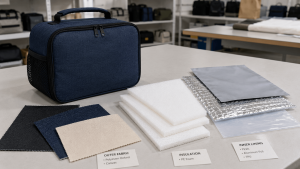
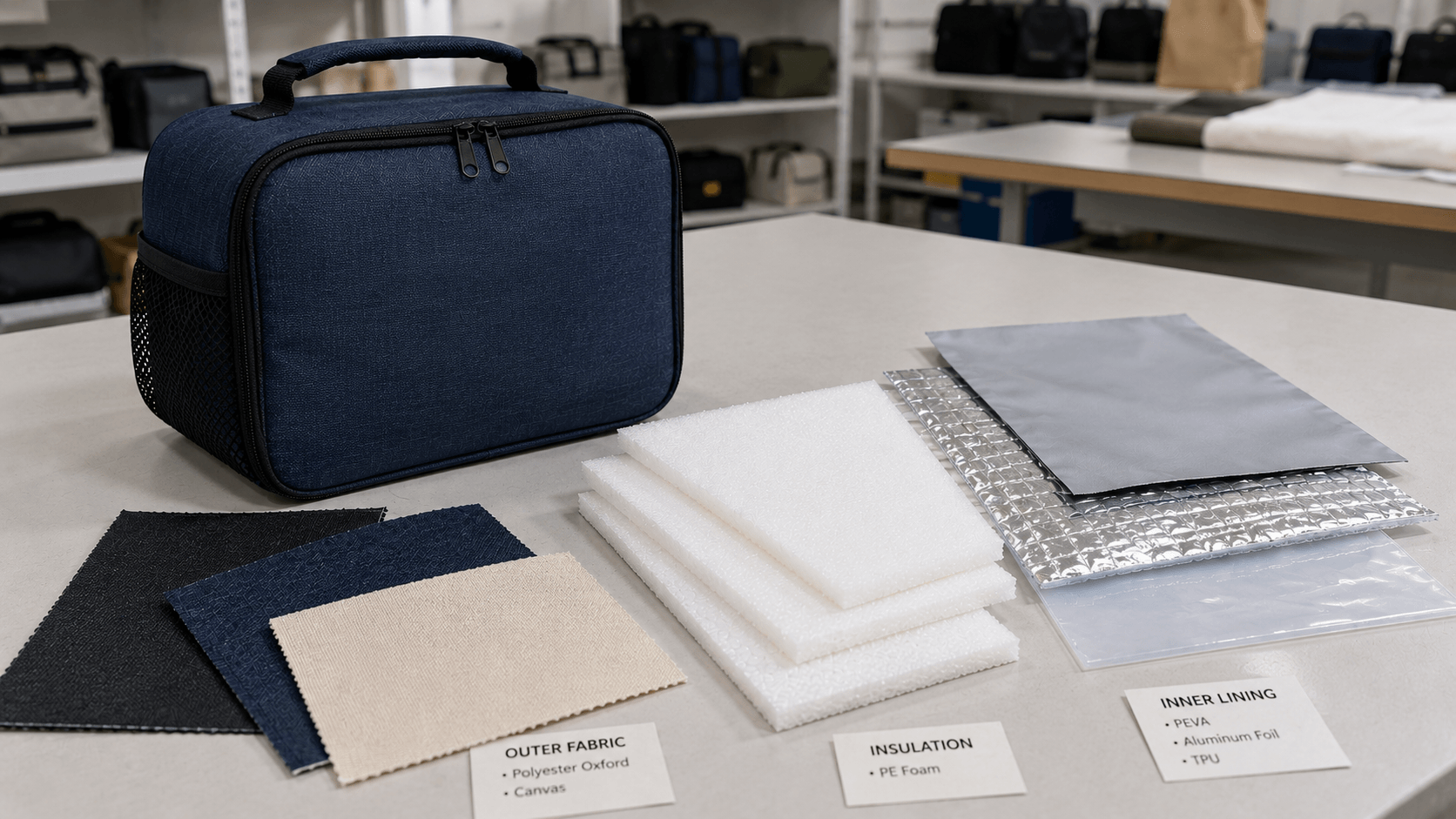
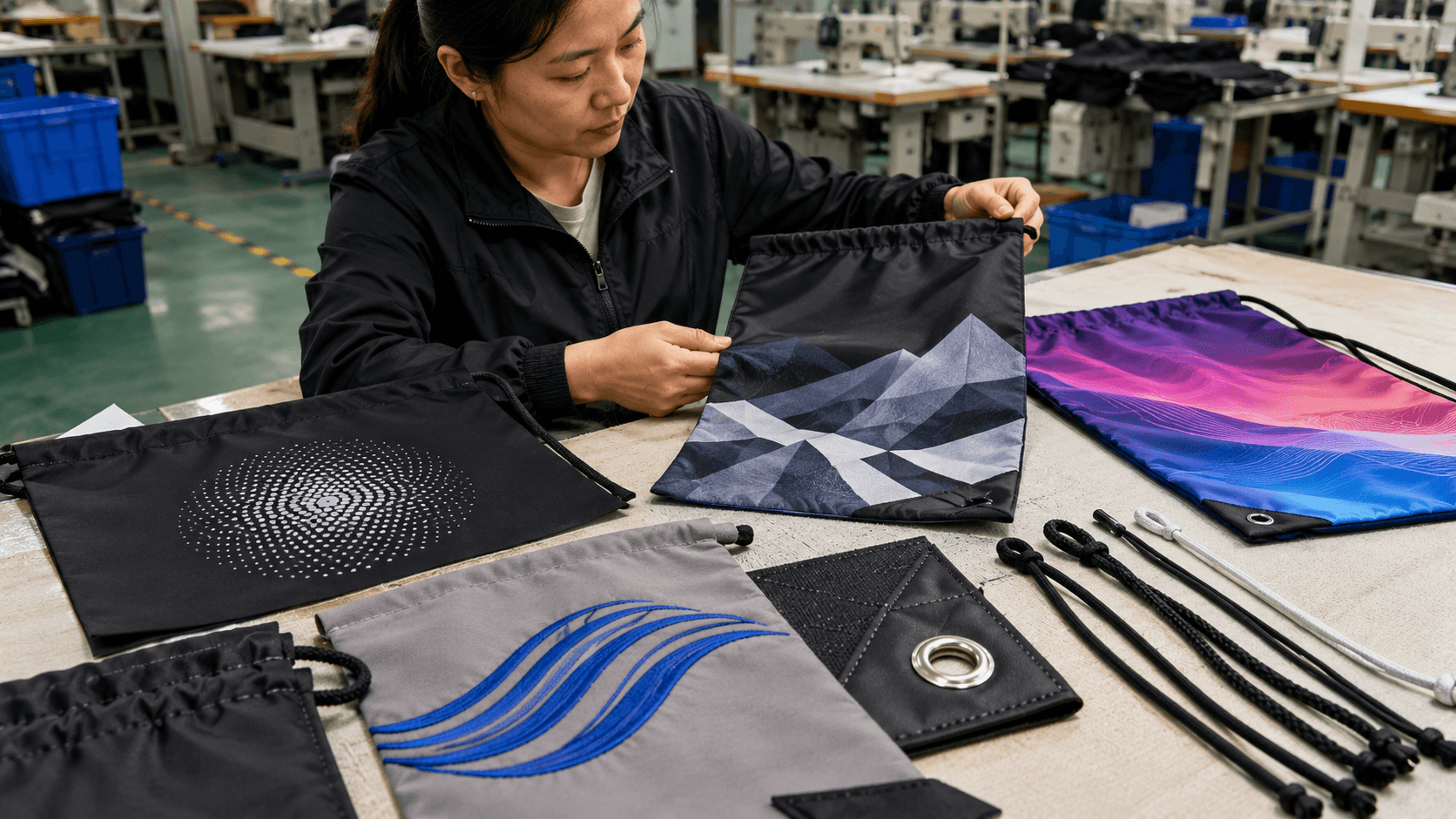
An insulated lunch bag normally has three main layers: an outer fabric, a foam insulation layer, and an inner lining. The outer fabric provides durability and appearance, the foam slows heat transfer, and the lining creates a cleanable, moisture-resistant interior. In most commercial lunch bags, the insulation layer—not the shiny lining—is responsible for most of the thermal performance.
But in manufacturing, simply specifying “polyester + EPE + PEVA” is not enough. Foam thickness, density, seam construction, zipper design, lamination method, and even how the bag is packed can affect the finished performance.
This is why two lunch bags described with exactly the same three materials can still feel different, hold their shape differently, and perform differently in actual use. From a factory-development perspective, the outer fabric, insulation, lining, and construction need to be evaluated as one system.
What Are the Three Main Layers Inside an Insulated Lunch Bag?
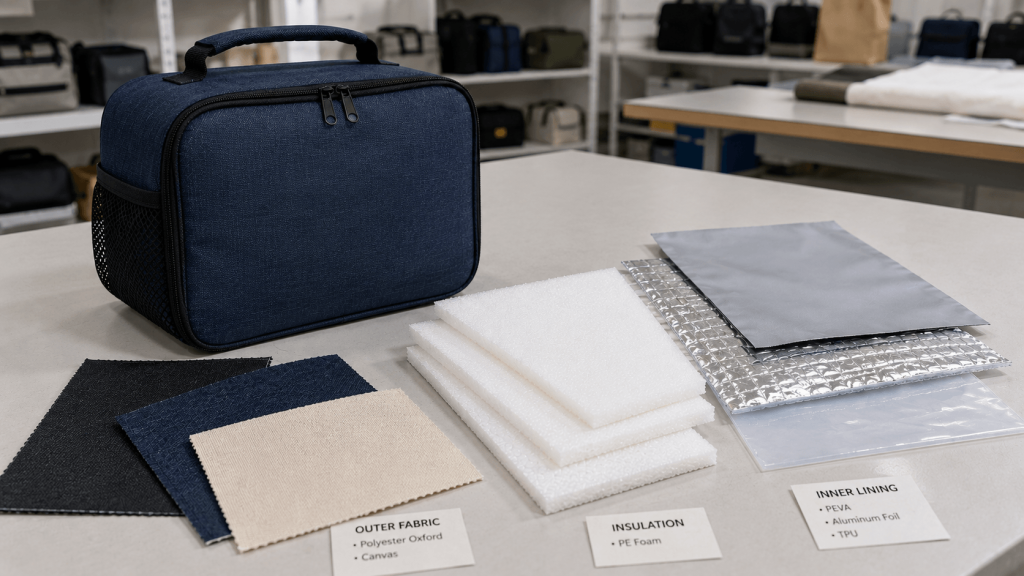
Most insulated lunch bags use a simple three-layer construction:
Outer Fabric → Foam Insulation → Inner Lining
Each layer has a different job.
| Layer | Common Materials | Main Function |
|---|---|---|
| Outer Fabric | Polyester, Oxford, RPET, Nylon, Cotton Canvas | Durability, appearance, structure |
| Insulation | EPE Foam, PE Foam, EVA, Sponge, IXPE | Slows heat transfer and adds body |
| Inner Lining | PEVA, Aluminum Foil, TPU | Moisture resistance, cleanability, interior finish |
The important point is that these layers work together. Changing one material can affect the structure, hand feel, sewing method, cost, and sometimes even the specification of the other two.
Outer Fabric
The outer shell is the most visible part of the lunch bag, but its role goes beyond color and branding.
Common options include:
- 210D / 300D polyester — lightweight and economical
- 600D Oxford polyester — firmer and more durable
- RPET polyester — used when recycled content is required
- Nylon — lightweight with a smoother, more technical feel
- Cotton canvas — heavier with a more natural appearance
- Coated or laminated fabrics — useful when additional water resistance or a specific surface finish is required
The shell also changes how much structure the foam needs to provide.
For example:
- 210D polyester + 3 mm EPE can create a soft, lightweight lunch tote.
- 600D Oxford + 5 mm EPE usually produces a firmer cooler-style bag.
- Cotton canvas already has more body, so the same visual structure may not require as much support from the foam.
The outer fabric does not provide most of the insulation, but it affects how much foam may be needed to achieve the desired structure.
Foam Insulation
The middle foam layer does most of the work in slowing heat transfer between the inside of the bag and the surrounding environment.
Common factory options include:
| Foam | Typical Use | Main Advantage | Main Consideration |
|---|---|---|---|
| EPE Foam | Mainstream lunch bags | Lightweight, economical | Can compress |
| PE Foam | General insulated bags | Light and flexible | Properties vary by grade |
| EVA Foam | Premium / structured bags | Better resilience and body | Higher cost |
| Sponge / PU Foam | Soft padded bags | Soft hand feel | Moisture behavior depends on construction |
| IXPE Foam | Higher-spec applications | Fine cell structure, stable | More expensive |
For many standard custom lunch bags, EPE is a practical starting point because it balances insulation, weight, structure, and cost.
Foam thickness also needs to match the product:
| Foam Thickness | Typical Application | Factory Consideration |
|---|---|---|
| 2–3 mm | Lightweight / promotional lunch bags | Lower cost, soft, compact |
| 4–5 mm | Standard insulated lunch bags | Good overall balance |
| 6–8 mm | Larger cooler-style bags | More body and insulation, but bulkier |
| 10 mm+ | Specialized cooler applications | Greater construction and packing difficulty |
Thicker is not automatically better. Increasing foam thickness can make zipper areas bulkier, seams harder to sew, corners more difficult to turn, and carton volume higher.
Inner Lining
The inner lining is the surface users see and clean, but it is usually not the main insulation layer.
Its main functions are:
- Moisture resistance
- Wipe-clean performance
- Protecting the insulation
- Interior durability
- Reflective appearance in some constructions
- Finished product appearance
The three common options have different positioning:
| Lining | Typical Positioning | Main Factory Consideration |
|---|---|---|
| PEVA | Everyday reusable lunch bags | Thickness, backing, seams |
| Aluminum Foil | Promotional / economical insulated bags | Creasing, puncture, lamination |
| TPU | Premium / performance-driven projects | Cost, construction, compliance requirements |
A shiny aluminum interior may look highly insulated, but the foam behind it is still responsible for most of the thermal resistance.
Reflective surfaces mainly reduce radiant heat transfer, while the foam layer provides the bulk insulation that slows other forms of heat flow.
The lining supports the insulation system; it does not replace it.
For a deeper comparison of these two lining options, see our guide to Aluminum Foil vs. PEVA Cooler Bag Lining.
Why “5 mm EPE Foam” Does Not Always Mean the Same Thing?
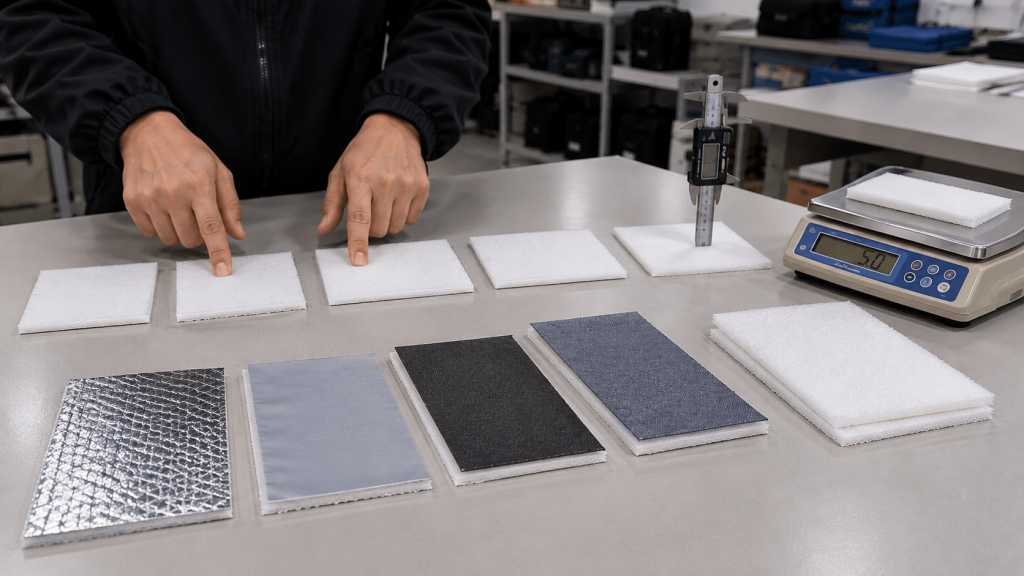
“5 mm EPE foam” sounds like a precise specification.
In production, it still leaves several variables open.
Two suppliers can both quote 5 mm EPE and produce lunch bags that feel noticeably different in thickness, firmness, resilience, and structure.
Foam Density
Thickness tells us the nominal thickness of the foam sheet. It does not fully describe how the material behaves.
A lower-density 5 mm foam may feel softer and compress more easily, while another 5 mm foam can feel firmer and recover better after pressure.
5 mm thickness does not automatically mean the same foam quality or finished feel.
This is one reason quotations based only on “5 mm EPE” are not always directly comparable.
For material-level quality control, flexible closed-cell olefin foams can also be evaluated using standardized test methods such as ASTM D3575.
Sewing, Lamination & Packing Compression
The original foam thickness also does not remain identical throughout the finished bag.
| Production Stage | What Can Happen |
|---|---|
| Sewing | Foam compresses around seams, binding, corners and zipper panels |
| Lamination | Heat, adhesive and pressure can change stiffness and hand feel |
| Turning / assembly | Corners and multi-layer areas become compressed |
| Packing | Flat packing can temporarily reduce loft and structure |
| Shipping / storage | Recovery depends partly on foam resilience and packing pressure |
This means measuring the foam sheet before production and measuring a sewn seam on the finished lunch bag can give very different results.
Lamination can also make two bags feel different even when the nominal foam thickness is the same. Adhesive, pressure, backing materials, and the materials being bonded all affect the finished hand feel.
Packing is another overlooked factor.
Insulated bags are often compressed or packed flat to reduce carton volume. A bag that looks firm immediately after sampling may arrive flatter after spending weeks under pressure during shipping.
For projects where structure or thermal performance matters, foam thickness, density, resilience, lamination, and the approved sample should be reviewed together.
Why Insulation Performance Depends on More Than Foam Thickness?
Increasing foam from 5 mm to 8 mm can improve thermal resistance, but it does not automatically create a better insulated lunch bag.
The whole construction matters.
Which Construction Details Affect Thermal Performance?
| Construction Detail | Why It Matters |
|---|---|
| Zipper & opening | Larger openings allow more air exchange |
| Lid / top panel | Fit and overlap affect how well the bag closes |
| Seams & corners | Sewing compresses insulation around these areas |
| Bag shape | Surface area and lid size affect heat transfer |
| Opening frequency | Every opening exchanges inside and outside air |
This is why two bags using:
600D polyester + 5 mm EPE + PEVA
can still perform differently.
The material list tells us what the bag is made from. It does not tell us exactly how the bag is constructed.
The Weakest Points Are Often Not the Side Panels
When a buyer asks:
“Can we change the foam from 5 mm to 8 mm to keep food cold longer?”
we may first look at the zipper, lid, seams, and corners.
Typical areas to check include:
- Zipper opening
- Lid fit
- Binding seams
- Bottom corners
- Handle attachment areas
- Areas with multiple rows of stitching
The center of the side panel may still contain almost the full foam thickness, while the insulation around a heavily sewn edge is much more compressed.
Before simply increasing foam thickness, it is worth checking where the thermal weak points actually are.
A well-designed 5 mm construction can sometimes be more practical than an 8 mm construction with a loose lid, oversized opening, or poorly controlled seams.
How Long Can an Insulated Lunch Bag Keep Food Cold?
There is no reliable universal answer such as 4 hours, 6 hours, or 8 hours.
The result depends heavily on the test conditions.
| Factor | Why It Matters |
|---|---|
| Ambient temperature | A hot car and an air-conditioned office are very different |
| Starting food temperature | Colder contents take longer to warm |
| Ice packs | Can significantly extend cooling time |
| Bag size | Internal air volume affects the result |
| Foam construction | Thickness, density and compression matter |
| Opening frequency | Every opening exchanges warm and cold air |
| Food-to-air ratio | A full bag behaves differently from an almost empty one |
For food safety, the bag itself is only part of the system. USDA recommends using an insulated lunch bag together with cold sources such as frozen gel packs when transporting perishable foods.
This is why we are cautious when evaluating a claim such as:
Keeps food cold for 8 hours
without knowing how the test was performed.
Without controlled test conditions, a cooling-time claim is more of a marketing statement than a meaningful technical specification.
If a brand wants to make a specific thermal-performance claim, a repeatable test protocol should define the ambient temperature, starting temperature, bag loading, ice packs, test duration, and opening conditions.
How Insulated Lunch Bag Layers Are Assembled in a Factory?
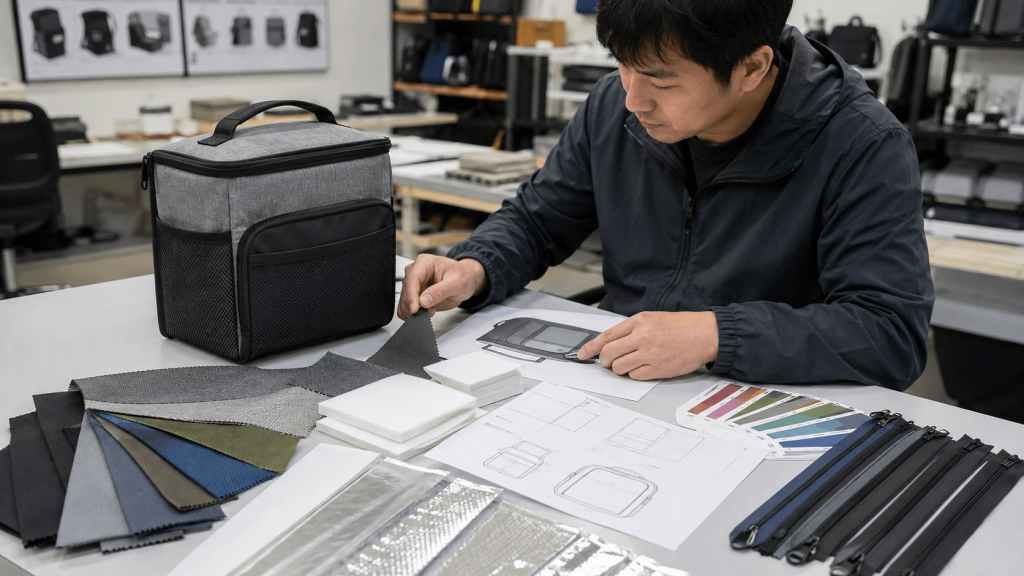
The outer fabric, foam, and lining do not always enter production as one pre-bonded sheet.
Depending on the bag structure and material combination, we may work with the layers separately or laminate some of them before cutting.
Separate-Layer vs. Laminated Construction
| Construction | How It Works | Main Advantage | Main Factory Concern |
|---|---|---|---|
| Separate Layers | Outer, foam and lining are cut separately and joined during sewing | Flexible for different panels and structures | Layer shifting, seam bulk, lining fit |
| Laminated Construction | Foam is bonded to the shell or lining before cutting | Easier handling and more consistent layers | Stiffness, hand feel, lamination quality, MOQ |
Separate-layer construction can make sense when different areas of the bag need different materials or foam thicknesses.
Laminated construction can make panels easier to handle, but the bonding process may change:
- Flexibility
- Stiffness
- Finished thickness
- Hand feel
- Material setup cost
Neither method is automatically better.
The right method depends on the bag shape, materials, quantity, required finish, and how structured the finished product needs to be.
Leakproof Is Not the Same as Waterproof Lining
This is another common specification misunderstanding.
PEVA or TPU material may be waterproof, but a sewn PEVA or TPU lining is not automatically a leakproof compartment.
Once the lining is stitched, needle holes and seams create potential leakage points.
A stronger leak-resistant or leakproof construction may require:
- Welded seams
- Heat sealing
- Seamless liner construction
- Special seam treatment
- Fewer stitched joints
So these two specifications are not the same:
Waterproof lining material
and
Leakproof finished compartment
If leakage performance matters, it should be stated clearly during development and confirmed during sampling.
How We Specify an Insulated Lunch Bag Before Sampling?
A useful lunch bag specification starts with the intended product—not simply with a list of materials.
The same construction should not automatically be used for a kids’ lunch bag, promotional giveaway, office lunch tote, and larger cooler.
Material Combinations by Product Type
| Product Type | Outer Fabric | Insulation | Lining | Typical Priority |
|---|---|---|---|---|
| Kids’ Lunch Bag | Polyester | 3–5 mm EPE | PEVA | Lightweight, easy cleaning |
| Office Lunch Tote | Polyester / RPET | 3–5 mm EPE | PEVA | Appearance + portability |
| Premium Lunch Cooler | 600D / coated fabric | 5–8 mm foam | PEVA / TPU | Structure + insulation |
| Promotional Lunch Bag | 210D / 300D polyester | 2–3 mm EPE | Aluminum foil | Cost + compact packing |
| Larger Cooler Bag | Heavy-duty polyester | 6–10 mm foam | PEVA / foil | Thermal performance + durability |
These are common starting points rather than fixed specifications.
The final construction should depend on product size, target price, intended use, required performance, and any testing requirements.
A Better RFQ Specification
An RFQ that says only:
Insulated lunch bag with PEVA lining
still leaves many important decisions open.
A more useful starting specification might be:
600D polyester outer
5 mm EPE insulation
PEVA inner lining
Approx. 8 L capacity
Zipper closure
Wipe-clean interior
Leak-resistant construction
Designed for everyday lunch storage
Buyers should also provide, where available:
- Overall dimensions or target capacity
- Intended use
- Target market
- Expected order quantity
- Required compliance
- Target price range
- Logo artwork and decoration method
- Thermal or leakage requirements
The buyer does not need to arrive with every technical detail already decided.
In many projects, the intended use, dimensions, quantity, target price, and a reference design are enough for us to recommend a practical material construction before sampling.
What the Approval Sample Must Confirm
For an insulated lunch bag, an approval sample should confirm more than color, logo, and dimensions.
It should also lock down the insulation construction.
Before mass production, we normally want the approved sample to confirm:
- Outer fabric
- Foam type
- Foam thickness
- Foam feel and resilience
- Inner lining
- Zipper construction
- Seam structure
- Bag shape
- Interior finish
- Leak-resistance expectation
This is especially important when the first prototype uses available sample-room materials.
If bulk production later uses another foam that is nominally the same thickness but behaves differently, the finished bags may feel noticeably different.
The approved sample should represent the construction standard—not just the visual appearance of the bag.
Frequently Asked Questions
Is PEVA food safe for lunch bags?
PEVA is widely used as an inner lining material in reusable lunch bags, but compliance should not be assumed from the material name alone. If the project has specific food-contact, chemical, or destination-market requirements, buyers should confirm which regulations apply and request the appropriate material test reports.
Can insulated lunch bags be machine washed?
Usually, machine washing is not ideal for a multi-layer insulated bag. Repeated soaking, agitation, and heat can affect foam, lamination, coatings, seams, and overall bag shape. A wipe-clean interior is normally more practical. If machine washability is a product requirement, it should be considered during material and construction development.
Does aluminum foil lining make a lunch bag colder?
Aluminum foil provides a reflective interior surface, but it is usually not the main insulation layer. The foam behind the lining contributes much more to the bag’s thermal resistance. Foil should therefore be evaluated together with foam thickness, seam construction, opening design, and the rest of the insulation system.
Can lunch bag foam lose thickness after shipping?
Yes. Insulated lunch bags are often packed flat or compressed to reduce carton volume. Some foams recover quickly after unpacking, while others may remain temporarily compressed. Foam density, resilience, lamination, packing pressure, storage time, and carton loading can all influence how the finished bag recovers.
Is PEVA an insulation material?
No. PEVA is mainly used as an inner lining material, not as the primary insulation layer.
Its main roles are to provide a moisture-resistant, wipe-clean interior and protect the foam underneath. In most insulated lunch bags, materials such as EPE, PE foam, EVA, or sponge provide most of the actual thermal insulation.
A PEVA lining can be part of an insulated construction, but PEVA alone does not make a lunch bag well insulated.
There Is No Single “Best” Lunch Bag Insulation
A practical construction starts with:
Product Use → Target Performance → Structure → Materials → Cost
At Osgoodway, when we develop a custom insulated lunch bag, we review the outer fabric, foam type and thickness, lining, opening structure, and intended use together rather than selecting each material independently.
If you are developing a custom insulated lunch bag and already have a drawing, reference sample, target dimensions, or basic performance requirement, those details are usually enough for us to recommend a suitable material construction and prepare an initial quotation.