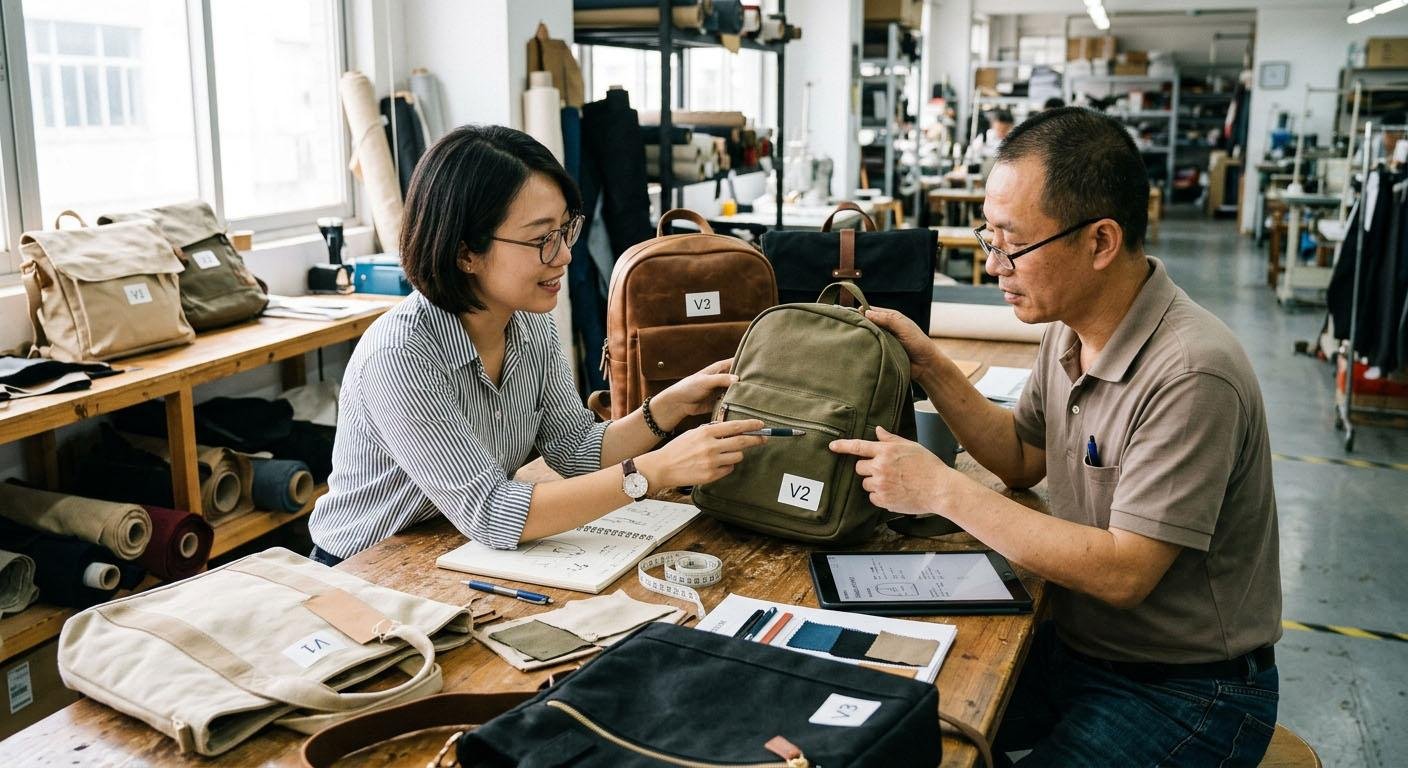
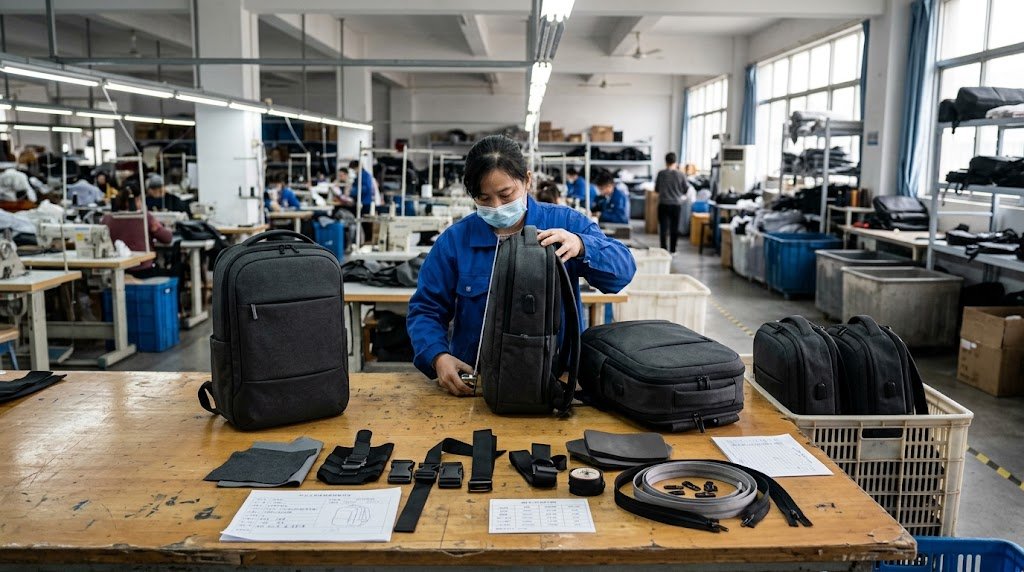
When a buyer sends us a kids backpack brief, one of the first things we check is not the fabric or the artwork. It is the target age group.
A backpack for a four-year-old and one for a ten-year-old may use similar materials, but the torso length, shoulder width, bag depth, buckle size and usable capacity should not be developed in the same way.
Safety, comfort and durability are also more connected than they first appear. Wider shoulder straps are not automatically more comfortable. A thicker back panel does not correct poor fit. A stronger shell fabric will not prevent failure if the shoulder-strap root or top handle is weak.
This guide looks at the decisions that matter during product development and bulk production: how to size a kids backpack around the child rather than an adult pattern, how to keep the load close to the body, what makes hardware practical for smaller hands, where school backpacks usually wear out, and what should be checked before a sample is approved.
Why a Kids Backpack Should Not Be a Smaller Adult Backpack?
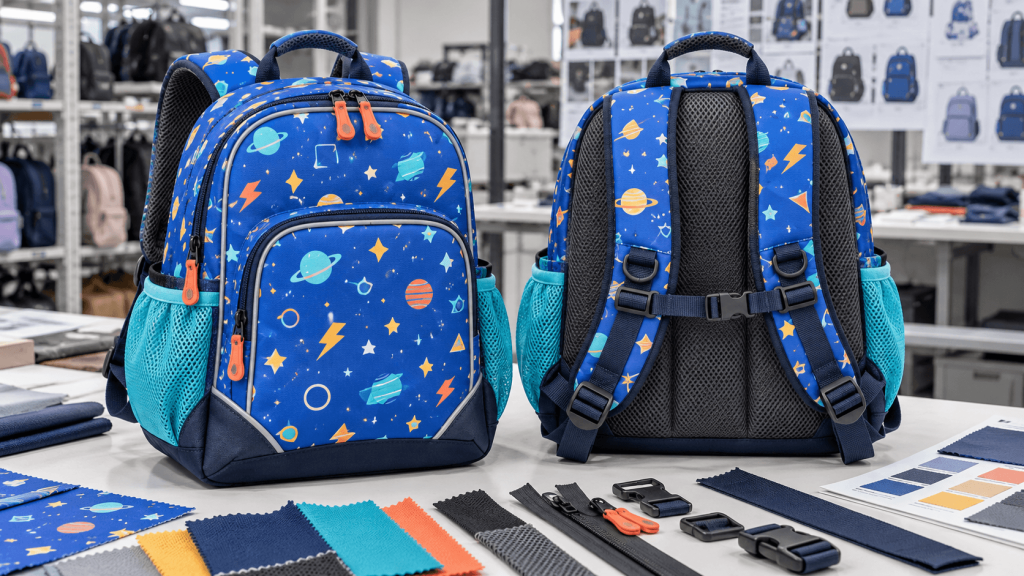
A kids backpack should be designed around the child’s body size, age group and intended load—not simply scaled down from an adult pattern. Shoulder width, torso length, strap spacing, bag depth, zipper reach and hardware size all need to be reconsidered.
A preschool backpack and a backpack for an older primary-school child may look similar, but the proportions should not be the same.
Age Group, Body Proportions and Capacity
For development, “kids backpack” is too broad. We normally need to know:
- Target age group
- Approximate body size
- Intended contents
- Target capacity
These details affect shoulder-strap spacing, padded length, adjustment range, zipper reach and buckle size.
Capacity also needs to match the child. A larger bag is not automatically more useful because extra volume can encourage overpacking and make the backpack too deep for a smaller body. For a more detailed age-based reference, see our school backpack capacity guide.
Liters describe volume, not fit.
Bag Height, Depth and Load Position
Bag depth is easy to overlook.
A deeper backpack places books and other heavy contents farther away from the back, while a better-proportioned shape can keep the load closer to the body.
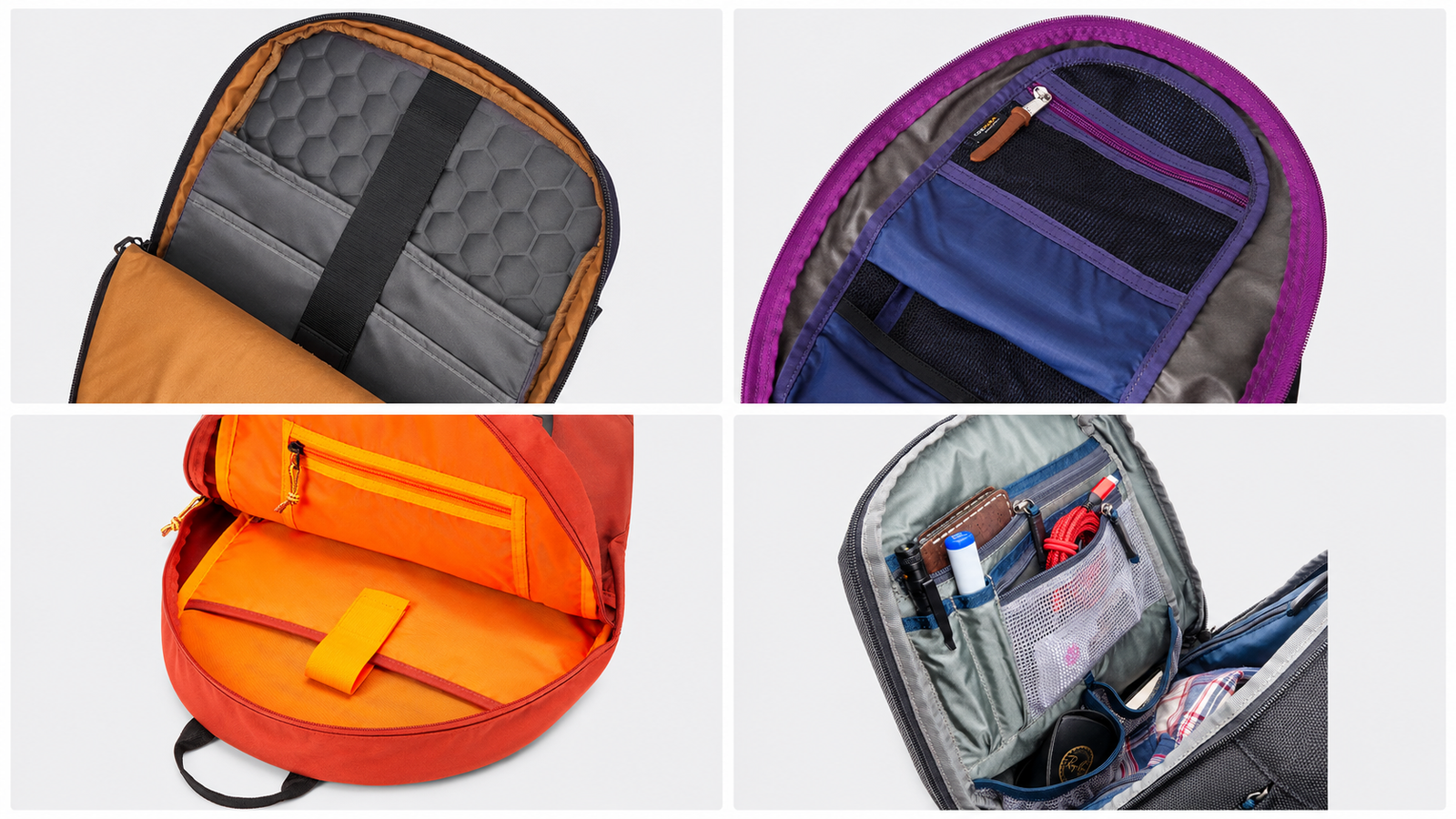
Internal layout matters for the same reason. Books, folders and tablets are usually better positioned close to the back panel, with lighter items placed farther outward.
For sampling, we therefore review the bag dimensions and compartment layout together rather than judging capacity alone.
The same principle applies when developing other children’s bag categories. If your project is for sports, travel or overnight use rather than a school backpack, our kids duffle bag guide covers that product format in more detail.
What Makes a Kids Backpack Comfortable?
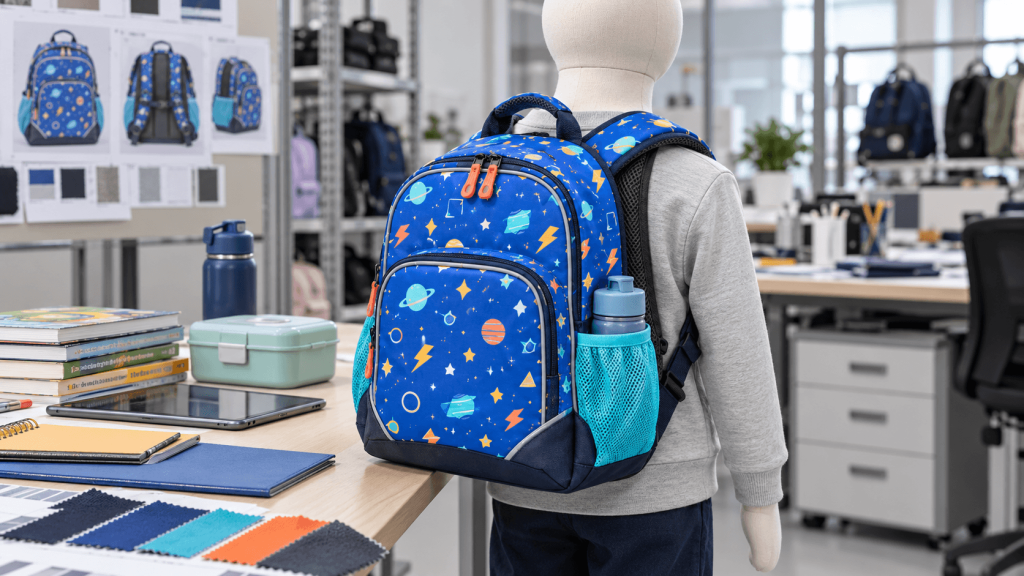
A comfortable kids backpack should fit the child’s body, keep the load close to the back and remain stable during movement. Strap geometry, adjustment and load position usually matter more than simply adding thicker padding.
Shoulder-Strap Geometry and Padding
Wide padded straps can help distribute pressure, but the proportions still need to match the child.
| Check | Why It Matters |
|---|---|
| Strap spacing | Too narrow may press near the neck; too wide may encourage slipping |
| Strap width | Should suit narrower shoulders rather than copying an adult strap |
| Padded length | Padding should cover the useful contact area without making the strap bulky |
| Strap curve | An adult S-curve may not sit correctly on a smaller body |
| Adjustment range | The buckle should allow useful adjustment for the target age group |
More foam cannot correct poor strap placement. We normally check how the straps sit on the shoulders before increasing padding thickness.
Back Panel and Stability
For most school and kids daypacks, the back panel does not need heavy outdoor-pack construction.
During development, we usually look for:
- Enough padding to prevent hard contents pressing directly against the back
- Enough structure to control the loaded shape
- Reasonable ventilation
- Low unnecessary weight
- Flexibility appropriate for the bag size
A sternum strap can help keep shoulder straps from spreading outward, but the buckle size, height and adjustment range should still suit the child.
A thicker back panel is not automatically more comfortable. Foam density, coverage and the loaded shape of the backpack matter as much as thickness.
Internal Layout and Weight Distribution
Compartment layout affects how the backpack carries once it is loaded.
Better positions for heavier items:
- Books close to the back panel
- Tablet or device sleeve near the back
- Dense school supplies in the inner part of the main compartment
Better positions for lighter items:
- Front organizer
- Outer accessory pockets
- Small personal items
A large water bottle on only one side can also create noticeable imbalance on a small backpack.
These issues should ultimately be checked with the backpack loaded, because an empty sample can hide poor balance and strap positioning.
What Safety Details Should Buyers Check?
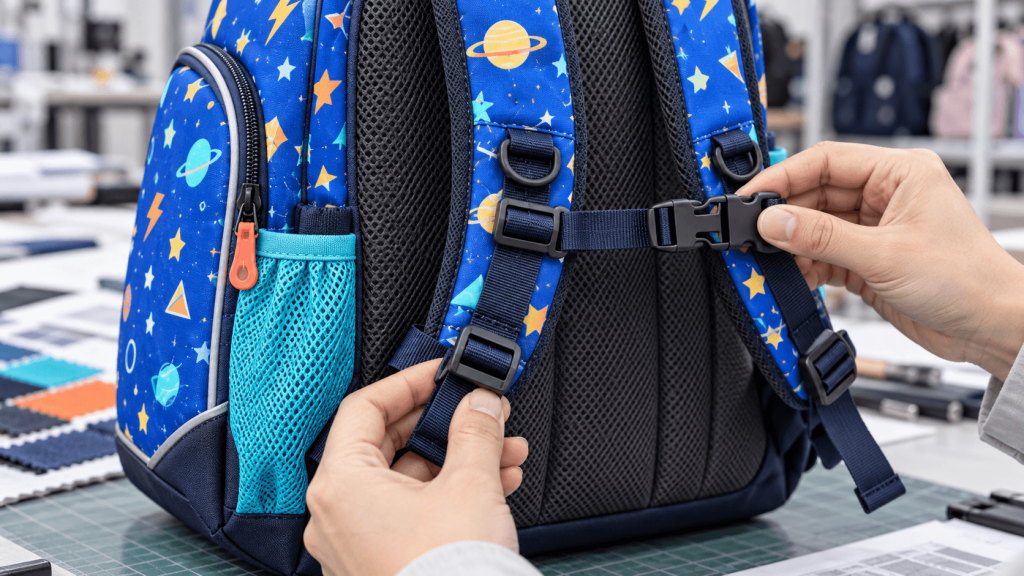
For a kids backpack, safety review includes more than fabric and padding. During sampling, we also check whether the child can operate the buckles and zippers easily, whether straps or pullers create unnecessary snag points, and whether exposed edges, hard components or small accessories are appropriate for the target age group.
Child-Friendly Buckles, Zippers and Pullers
Hardware needs to work for smaller hands, not only pass a strength check.
| Part | What We Check |
|---|---|
| Side-release buckle | Finger space, opening force and whether the child can release it comfortably |
| Strap adjuster | Easy adjustment without slipping during use |
| Zipper slider | Smooth operation without sharp edges |
| Zipper pull | Large enough to grip, but not unnecessarily long or heavy |
| Rubber or loop puller | Easy to hold without creating an oversized dangling loop |
A buckle that feels normal to an adult may be difficult for a younger child to open. The opposite problem also matters: hardware should not release too easily during normal use.
Zipper pulls need the same balance. A larger grip can help children, but very long cords or oversized loops add unnecessary dangling length and can catch on surrounding objects.
Watch the Small Snag and Edge Details
Long webbing tails are common around adjustable shoulder straps and sternum straps, but excessive loose length is rarely useful.
Depending on the design, it can be controlled with:
- Elastic webbing keepers
- Sensible adjustment length
- Folded and stitched webbing ends
- Shorter exposed cords and loops
Although U.S. CPSC drawstring requirements apply to children’s upper outerwear rather than backpacks, the documented snag and entanglement hazards are a useful reminder to avoid unnecessary trailing cords and oversized loops in children’s products.
We also inspect details that are easy to miss in a drawing:
- Flash or rough edges on molded plastic buckles
- Sharp zipper-slider or metal-puller edges
- Hard label corners
- Exposed piping ends
- Reinforcement boards pressing through the lining
These are normally simple corrections during sampling, but they are much harder to address once materials and construction have been approved.
Reflective Visibility and Small Components
Reflective material is useful only when it remains visible from the directions that matter in real use.
For a school backpack, possible positions include the front panel, side panels and shoulder straps. Placement should also account for pockets, hanging straps or other features that may cover the reflective area when the bag is worn.
Bright fabric and reflective material are not the same feature. Bright colors mainly improve daytime conspicuity, while retroreflective materials are designed to return light toward its source in low-light conditions.
For preschool and younger age groups, removable decorations also deserve closer review. Charms, beads, detachable badges and similar accessories should be assessed according to the target age and destination market rather than added only for appearance.
Applicable product-safety requirements can vary by market and age group, so they should be confirmed for the actual project rather than assumed from a general “kids backpack” specification.
What Makes a Kids Backpack Durable?
A durable kids backpack depends on reinforced load-bearing points, protected bottom and corners, reliable zippers and seams, and construction that holds up under realistic packed use. Fabric denier matters, but it cannot compensate for weak strap attachments, poor seam construction or unreinforced high-wear areas.
Shoulder-Strap and Top-Handle Reinforcement
The shoulder straps carry most of the load, so their attachment to the bag body deserves more attention than simply choosing thicker webbing or padding.
| Area | What We Look For |
|---|---|
| Shoulder-strap root | Sufficient overlap, reinforcement and secure stitching |
| Upper back seam | Support where the strap load transfers into the bag body |
| Top handle | Webbing extension and reinforcement inside the seam |
| Bartacks | Correct placement at actual stress points |
Children may also lift the backpack by the top handle, pull it from the floor or hang it from a desk or hook. The handle should therefore be treated as a real load-bearing component rather than decoration.
Bottom and Corner Protection
The bottom and lower corners often receive more abrasion and impact than the upper panels.
Instead of increasing fabric weight across the entire backpack, it can be more effective to reinforce the areas that are actually dragged, dropped or placed on rough surfaces:
- Stronger or double-layer bottom panel
- Reinforced lower corners
- Well-positioned bottom seams
- Protective piping or edge construction where appropriate
This can improve durability without making the whole backpack unnecessarily heavy. If the shell material is still being selected, our 600D vs 900D polyester comparison for school backpacks looks more closely at the trade-off between fabric weight, cost and durability.
Zippers and High-Stress Seams
Zipper durability depends on more than zipper gauge.
A tight opening curve, narrow seam allowance or overfilled compartment can place additional stress on the zipper even when a heavier zipper is used.
We also look at:
- Zipper tape support
- End-stop construction
- Slider movement
- Seam support around the opening
- Pressure on the zipper when the bag is fully packed
High-stress seams around the shoulder straps, handles, side pockets and base need the same attention. Strong shell fabric cannot compensate for a weak seam or poor load transfer.
What We Check Before Approving a Kids Backpack Sample?
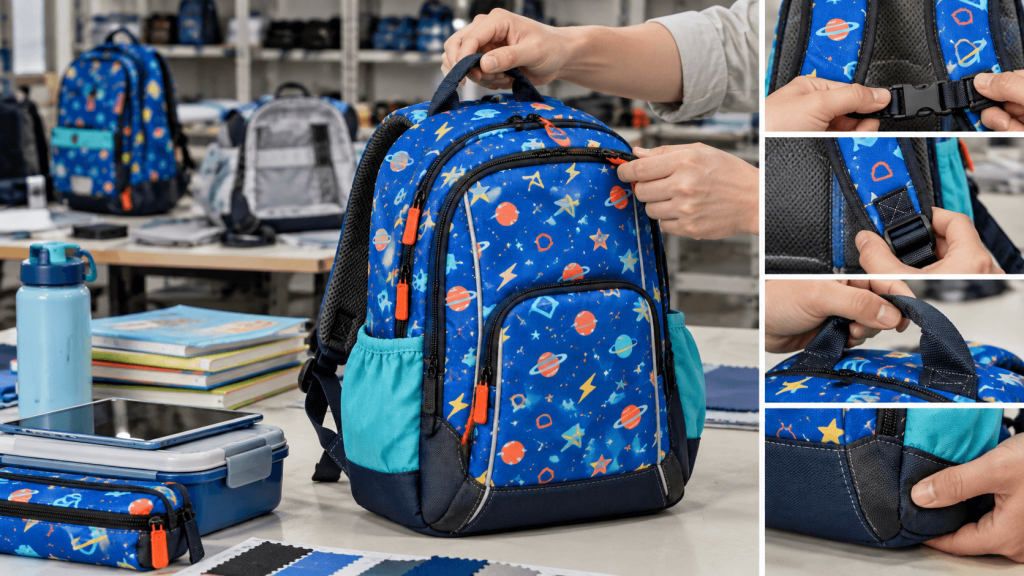
A kids backpack should not be approved only because the stitching looks clean and the dimensions match the drawing. Before approval, we want to see how the sample behaves when it is packed, adjusted and handled in the way the product is expected to be used.
Loaded Fit and Balance
We evaluate the sample with realistic contents rather than relying on an empty fit check.
Depending on the project, the load may include:
- Books and folders
- Water bottle
- Lunch box
- Tablet or small laptop
- Pencil case and other daily items
We then look at how the complete bag behaves.
Typical problems include:
- Shoulder straps slipping outward
- Excessive backward pull
- Uneven left-to-right balance
- Hard contents pressing through the back panel
- Excessive bag depth when packed
- Body panels collapsing or deforming under load
This is often where a proportion or compartment problem that looked acceptable on the drawing becomes obvious.
Hardware Usability
Hardware that looks suitable on a specification sheet still needs to work on the finished sample.
We operate the main zippers with the bag both empty and packed, check whether buckles require excessive finger force, and confirm that strap adjusters remain secure after adjustment.
Pullers and webbing tails are also checked in their actual fitted positions, where excessive length, awkward placement or interference with other components is easier to see.
The purpose here is not to select the hardware again, but to confirm that it works properly once assembled into the backpack.
Stress Points and Wear Areas
Once the construction is assembled, we check how the main stress areas behave rather than judging them only by appearance.
Depending on the backpack and intended load, development checks may include:
- Loaded pulling at the shoulder straps
- Top-handle pull checks
- Repeated zipper operation
- Loaded drops
- Bottom and lower-corner abrasion checks
- Buckle cycling where relevant
After testing, we look for seam opening, fabric distortion, reinforcement movement, zipper problems or permanent deformation.
If a weakness appears at this stage, simply changing from 600D to a heavier shell fabric may not solve it. The reinforcement position, seam construction or load path may need to be changed before bulk production.
Once the sample is approved, the critical construction details should also be fixed for production. Reinforcement size and position, hardware specifications, strap adjustment range, zipper construction and other approved details need to remain consistent rather than being left to visual interpretation on the production line.
Frequently Asked Questions
How heavy should a kids backpack be when packed?
Good backpack construction can improve fit, stability and load position, but it cannot compensate for excessive weight.
The American Academy of Pediatrics advises that a packed school backpack should generally not weigh more than about 15% of the child’s body weight.
This is a carrying guideline rather than something the backpack structure itself can guarantee, so capacity should still be matched to the target age and intended contents.
Is a large U-shaped opening always better for a kids backpack?
Not necessarily.
A wide opening can make packing easier, but for younger children it can also allow contents to spill out more easily and create a longer zipper path to manage.
The opening size and shape should match the target age, intended contents and how independently the child is expected to use the bag.
How can a kids backpack protect a tablet from bottom impact?
Keeping a tablet or small laptop close to the back helps with load position, but the device should also avoid sitting directly against the bottom impact area.
Depending on the design, a suspended sleeve, additional base padding or false-bottom construction can create clearance when the backpack is dropped or placed down heavily.
Does every kids backpack need a waist belt?
No.
A waist belt can add stability for some larger or more heavily loaded backpacks, but it is unnecessary for many small school and preschool bags.
Whether to include one should depend on the target age, backpack size, expected load and use case. Adding a belt simply because it appears “more ergonomic” can also add weight, cost and another buckle for the child to manage.
Where should a name label be placed on a kids backpack?
An internal name-label area is usually more discreet than displaying personal information prominently on the outside of the backpack.
It should still be easy for a parent, teacher or child to find, without creating a hard edge or interfering with the contents.
Final Words
A successful kids backpack starts with the intended child and the actual load, not with an adult pattern reduced to a smaller size.
Fit, strap geometry, load position, child-friendly hardware and reinforcement all need to work together. The physical sample then needs to confirm that those decisions still make sense once the backpack is packed and used realistically.
For a custom kids backpack project, share your target age group, intended use, expected contents, reference design or tech pack, target dimensions and order quantity. We can review the construction, materials and sample details before moving into bulk production.