


Last year I watched a first-time Amazon seller do everything "right." Great keyword research. Professional photography. Optimized listing. One problem: his trunk organizer used grey cardboard inserts. Three months in, Arizona trunks turned his product into soggy boxes. Return rate hit 22%. Listing killed.
He didn’t have a branding problem. He had a manufacturing knowledge gap. And no YouTube guru selling a $997 course warned him about board insert material.
Launching a private label car organizer on Amazon requires 5 non-negotiable steps: choosing the right subcategory, specifying factory-level materials, modeling true landed costs, setting up compliance (CPSIA, Prop 65, REACH), and building a differentiated listing. Most sellers fail at steps 1 and 2 — they pick a saturated subcategory and let their factory choose the materials. This guide covers what your Alibaba supplier won’t tell you.
This isn’t "how to start an Amazon business." There are 10,000 blogs for that. This is the factory-side playbook — the decisions that happen before your product exists, where 80% of your success or failure is already locked in.
What Types of Car Organizers Can You Private Label?
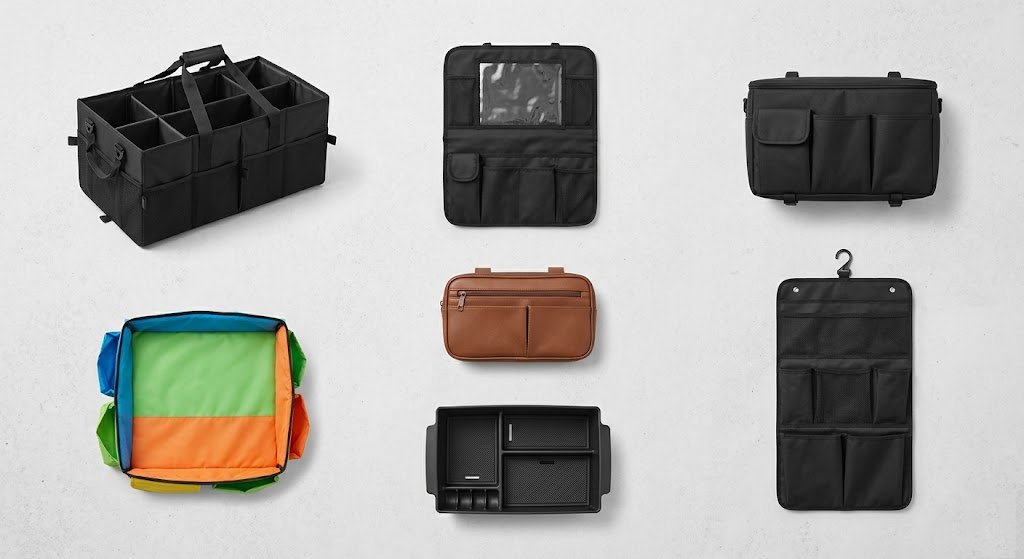
Most first-timers think "car organizer" means a collapsible trunk box. That’s one subcategory out of seven. Each has different materials, manufacturing complexity, competition levels, and margin profiles. Pick the wrong one and you’re fighting 4,000 listings for crumbs.
The car organizer category includes 7 distinct product types: trunk & cargo organizers, backseat organizers (kick mats), front seat organizers, kids’ car organizers, visor organizers, hanging organizers,, and console/gap organizers. Each requires different factory capabilities, materials, and price-point strategies.
The 7 Subcategories — From the Factory Floor
| # | Subcategory | What It Is | Typical Retail Price | Amazon Competition | Key Manufacturing Challenge |
|---|---|---|---|---|---|
| 1 | Trunk & Cargo Organizers | Collapsible/rigid boxes for trunk storage | $20–$55 | Brutal (4,000+ listings) | Board insert material + folding mechanism alignment |
| 2 | Backseat Organizers (Kick Mats) | Seatback-mounted panels with pockets + tablet holder | $12–$30 | High | Strap tension must handle 5kg+ without tearing headrest loop |
| 3 | Front Seat Organizers | Passenger-seat bags for mobile professionals (laptops, files) | $25–$45 | Medium | Structural rigidity with laptop-safe padding |
| 4 | Kids’ Car Organizers | Travel trays, snack holders, activity stations for car seats | $15–$30 | High | CPSIA mandatory (children’s product), non-toxic materials |
| 5 | Visor Organizers | Sun visor-mounted pouches for sunglasses, cards, documents | $8–$18 | Medium-Low | Slim profile + universal clip mechanism compatibility |
| 6 | Hanging Organizers, | Headrest-mounted or seatback hanging storage bags for groceries, purses, trash | $6–$15 | High | Strap load-bearing + bag shape retention under weight |
| 7 | Console & Gap Organizers | Seat gap fillers, console trays, armrest inserts | $10–$25 | Medium (vehicle-specific = low) | Vehicle-specific fitment data — different for every car model |
Which Subcategory Should You Pick?
I’ll give you my honest take, not the diplomatic answer:
- Avoid: Generic trunk organizers and headrest hooks. Saturated beyond rescue. You’ll spend $3,000+/month on PPC just to stay visible.
- Good for beginners: Backseat organizers with a twist (better tablet holder, added food tray), visor organizers (low MOQ, fast to iterate).
- Best margin opportunity: Vehicle-specific console organizers (Tesla, RAV4, CR-V), front seat organizers for mobile professionals, kids’ travel tray systems.
- Sleeper opportunity: Fleet/B2B versions of any subcategory — rideshare companies, rental car agencies, delivery fleets buy 500–5,000 at a time and reorder quarterly. Zero Amazon competition.
Factory truth: We once had a client insist on "1680D everywhere" on a backseat organizer, including internal pockets nobody sees. The finished product weighed 4.2 lbs. Amazon return rate spiked — customers said it was "too bulky." We re-engineered: 1680D exterior, 420D interior panels. Weight dropped to 2.6 lbs. Returns dropped 60%. More denier ≠ better product. Every subcategory has its own material sweet spot.
What Makes a Car Organizer "Private Label" vs. "Custom OEM"?
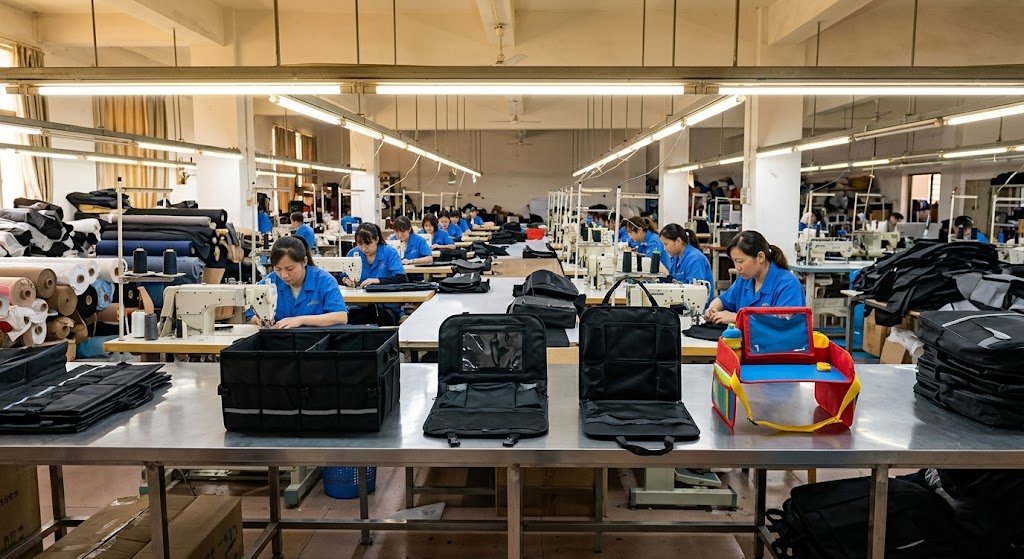
Most sellers use these terms interchangeably. They’re not the same. And the distinction determines your cost, timeline, and competitive moat.
Private label means adding your branding (logo, colors, packaging) to an existing product design. ODM means the factory designs it for you based on your brief. OEM means you provide the complete design and specs. Each model has dramatically different MOQs, costs, and defensibility against copycats.
| Model | What You Control | What the Factory Controls | MOQ | Lead Time | Competitive Moat |
|---|---|---|---|---|---|
| Private Label | Logo, color, packaging | Design, materials, construction | 200–300 pcs | 15–25 days | Low — competitors copy in 30 days |
| ODM | Brief + approval | Engineering, materials, pattern | 500–1,000 pcs | 30–45 days | Medium — some design differentiation |
| OEM | Everything — CAD, specs, BOM | Manufacturing only | 1,000–3,000 pcs | 45–75 days | High — proprietary, hard to replicate |
My Honest Recommendation for New Sellers
Start with private label or ODM. Not OEM.
I’ve watched first-time buyers burn $15,000–$20,000 on fully custom OEM designs that flopped because they didn’t understand real-world ergonomics. One designed a trunk organizer with compartments that looked great on paper but didn’t fit standard grocery bags. Another created a backseat organizer with a tablet pocket too small for an iPad with a case. These mistakes only surface after you’ve committed to tooling.
Start private label. Get 300–500 units into the market. Read every review. Then invest in custom engineering based on real customer feedback.
The exception: Vehicle-specific products (Tesla Model Y frunk organizer, Cybertruck bed organizer, RAV4 console tray) should be ODM from day one. Generic "universal fit" in these niches is already dead. Custom fit is your differentiation.
How Much Does It Actually Cost to Launch?
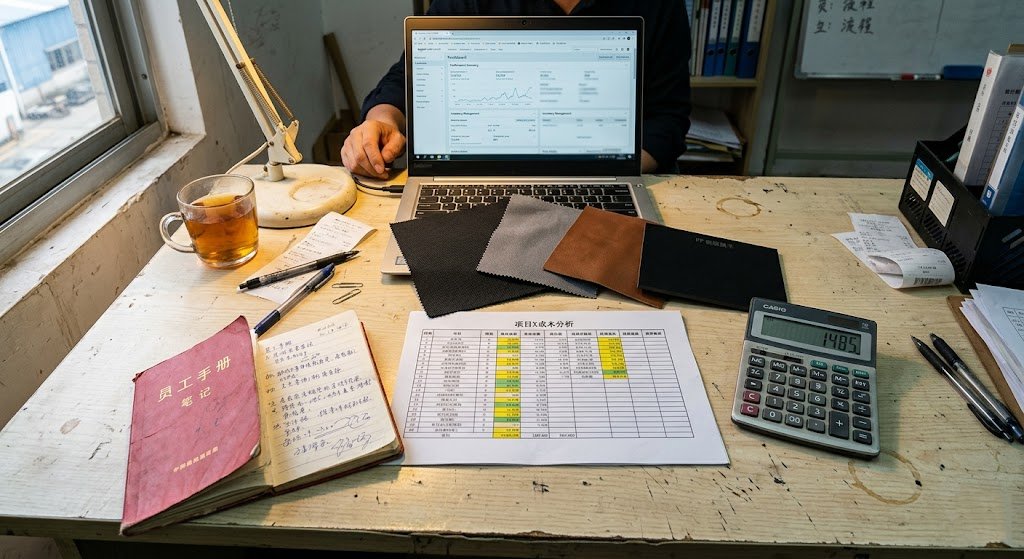
Every blog says "you can start for $2,000!" That’s fantasy. Here are real numbers from our 2025–2026 production runs.
A realistic all-in budget for launching a private label car organizer on Amazon is $8,000–$18,000 for your first order. The range depends on product complexity — a visor organizer launch costs roughly half of a trunk organizer launch. This includes product cost, shipping, duties, photography, initial PPC, and Amazon fees.
Cost Comparison Across Subcategories (500-Unit First Order)
| Cost Component | Visor Organizer | Backseat Organizer | Trunk Organizer | Front Seat Pro Organizer |
|---|---|---|---|---|
| FOB unit cost | $1.50–$3.00 | $3.50–$6.00 | $6.00–$10.00 | $5.00–$8.00 |
| Product total (500 pcs) | $750–$1,500 | $1,750–$3,000 | $3,000–$5,000 | $2,500–$4,000 |
| Shipping + Duty | $300–$600 | $600–$1,000 | $800–$1,500 | $700–$1,200 |
| Photography | $200–$400 | $300–$600 | $300–$800 | $300–$600 |
| Initial PPC (60 days) | $800–$1,500 | $1,200–$2,500 | $1,500–$3,000 | $1,000–$2,000 |
| Packaging + Brand Registry | $400–$800 | $500–$900 | $600–$1,100 | $500–$900 |
| Total Launch Budget | $2,450–$4,800 | $4,350–$8,000 | $6,200–$11,400 | $5,000–$8,700 |
The Unit Economics That Decide Everything
| Line Item | Backseat Organizer ($19.99) | Trunk Organizer ($34.99) | Vehicle-Specific Console ($42.99) |
|---|---|---|---|
| Landed COGS | $6.50 | $9.50 | $8.00 |
| Amazon Referral Fee (15%) | $3.00 | $5.25 | $6.45 |
| FBA Fulfillment Fee | $4.20 | $5.50 | $4.80 |
| PPC (est. $1.50/unit) | $1.50 | $1.50 | $1.50 |
| Net Profit/Unit | $4.79 (24%) | $13.24 (38%) | $22.24 (52%) |
The takeaway: Vehicle-specific products at $35+ retail are where real margins live. But even a backseat organizer at $19.99 can hit 24% margin — if your materials are specified correctly.
Factory secret: The sellers who consistently hit 25%+ margins aren’t negotiating $0.50 off their FOB price. They’re engineering products at a $30+ price point with features that budget competitors can’t easily copy. Competing on price in this category is a death sentence.
How Do You Choose a Product That Won’t Die on Page 47?
This is where 90% of new sellers get it wrong. They search "car organizer," see products selling well, and think: "I’ll make that, but with my logo." That’s not a strategy. That’s a suicide mission.
The winning strategy for 2026 is niching down: vehicle-specific organizers, function-specific designs (insulated trunk + cooler hybrid, MOLLE-compatible, backseat with foldable food tray), or audience-specific products (kids, rideshare drivers, mobile professionals). Generic "universal fit" anything is a commodity slugfest.
Where the Money Actually Is (From Our Order Book)
| Niche | Competition | Avg. Retail | Margin | Our Order Trend (YoY) |
|---|---|---|---|---|
| Generic collapsible trunk organizer | Brutal | $18–$28 | 10–18% | Flat to -5% |
| Vehicle-specific (Tesla, Rivian, RAV4) | Low-Medium | $39–$65 | 25–40% | +40–60% |
| Backseat organizer w/ foldable food tray | Medium | $18–$30 | 20–28% | +20% |
| Kids’ travel tray / activity organizer | Medium | $15–$28 | 18–25% | +15% |
| Front seat organizer for professionals | Low | $28–$45 | 25–35% | +25% |
| MOLLE-compatible trunk/cargo | Low | $35–$55 | 25–35% | New, growing fast |
| Fleet / B2B (any subcategory) | Very Low | $5–$15 (bulk) | 30–45% (volume) | +25% |
| Visor organizer (premium leather-look) | Medium-Low | $12–$20 | 20–30% | +10% |
The 4-Question Niche Selection Framework
Before you contact a single factory:
- Can I sell this for $25+? Below $20, Amazon fees + PPC eat your margins alive. The only exception is ultra-lightweight items (visor organizers, hooks) with very low FBA fulfillment fees.
- Does my product solve a problem that existing listings don’t? "Fits a Tesla Model Y frunk perfectly" solves a problem. "Collapsible trunk organizer in navy blue" doesn’t.
- Can a competitor copy this in 30 days? If yes, you need a deeper moat — proprietary dimensions, unique features, or bundled accessories.
- Which channel am I selling to? Amazon shoppers care about listing photos and reviews. Fleet buyers care about durability specs and bulk pricing. Different playbook entirely.
My strongest recommendation for 2026: Vehicle-specific organizers — console trays, frunk organizers, sub-trunk storage. A Tesla Model Y frunk organizer sells for $45–$65 using the same base materials as a $25 generic. Tesla refreshes dimensions almost annually — each refresh creates a new accessory market. First movers own these niches.
What Material Specs Should You Demand From Your Factory?
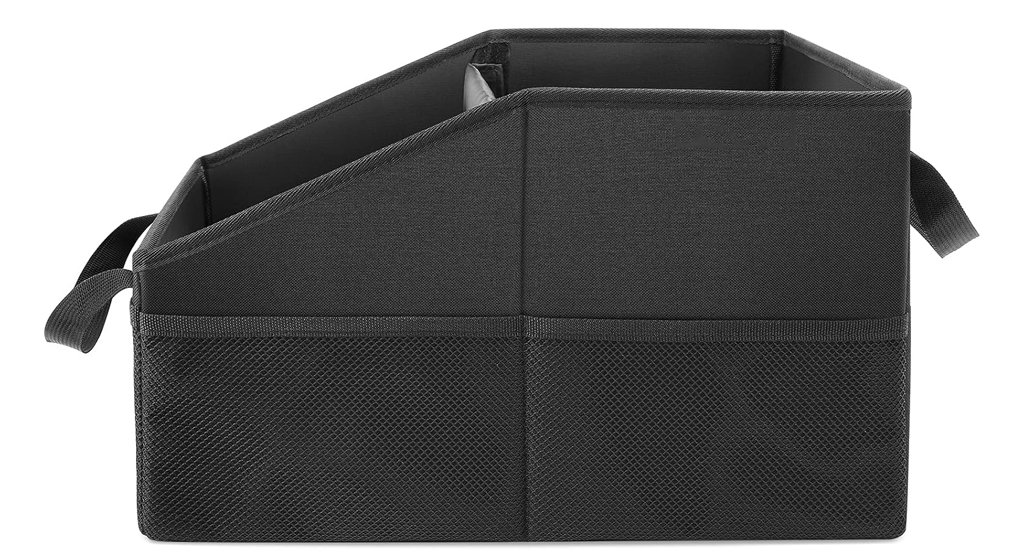
Here’s where "factory floor" knowledge becomes your competitive edge. Most sellers pick materials from a dropdown menu on Alibaba. That’s how you end up with a product that looks fine in photos and falls apart in real life.
For any car organizer subcategory, specify these in writing: fabric type and GSM weight (not just denier), structural material and thickness, backing/coating type, and thread type for structural seams. If your factory can’t confirm all four in their quotation, find another factory.
Material Specs by Subcategory
| Subcategory | Recommended Fabric | Structure / Stiffener | Critical Spec | Common Failure Point |
|---|---|---|---|---|
| Trunk organizer | 600D Oxford (basketweave), PU-coated | 2mm PP sheet inserts | Board insert thickness ≥1.5mm | Grey cardboard → wet = destroyed |
| Backseat organizer | 600D–1680D polyester, PVC-backed | Stiffened pocket panels | Headrest strap pull-test ≥5kg | Strap tears at loop within 2 months |
| Front seat organizer | 600D Oxford or PU leather | Semi-rigid PE foam lining | Laptop compartment padding | No padding → cracked screen returns |
| Kids’ organizer | 600D polyester, PEVA lining for snack areas | Lightweight PE board | CPSIA testing mandatory (children’s product) | Skip CPSIA → customs seizure |
| Visor organizer | PU leather or 600D polyester | Slim PP board (0.8–1mm) | Universal clip spring tension | Cheap clips slip off thin visors |
| Hanging organizers | 600D polyester or PU leather | Lightweight PE foam or PP board stiffener | Strap pull-test ≥5kg, bag shape retention | Thin straps cut into headrest post under load |
| Console organizer | ABS plastic or TPE rubber + flocking | Injection molded or die-cut | Vehicle-specific dimension tolerance ±1mm | "Universal" = fits nothing well |
The Three Material Mistakes That Kill Listings (Across All Subcategories)
Mistake 1: Accepting "600D polyester" without asking "Oxford weave or plain weave?"
Oxford is a basketweave — thicker hand-feel, better abrasion resistance. Plain weave polyester is cheaper and weaker. Same denier number, totally different product. If your supplier can’t answer this question, walk away.
Mistake 2: Cheap PVC backing in any product that sits in a hot car.
Low-grade PVC off-gasses VOCs when temperatures hit 140°F+. Result: "toxic chemical smell" reviews. This applies to trunk organizers, backseat organizers, visor pouches — anything in a car interior. Use PU or TPE backing. Ask for a VDA 278 test report. If they don’t know what VDA 278 is, they’re not controlling chemical off-gassing.
Mistake 3: Skipping structural testing for the specific use case.
A trunk organizer needs board-insert heat testing. A backseat organizer needs strap pull-testing. A headrest hook needs metal fatigue cycling. Different products, different failure modes. The factory should be testing for the actual abuse pattern of each product type — not just checking if it looks nice on a table.
What to tell your factory: "I need a quotation specifying: fabric type (Oxford or plain weave?), GSM weight (not just denier), structural material and thickness, backing/coating type, thread type for structural seams, and your test report for [relevant test — Martindale for abrasion, pull-test for straps, cycle test for hooks]." That one email separates you from 95% of buyers.
→ For the full technical fabric comparison — including our 90-day trunk simulation test data — read our Car Organizer Fabrics Compared.
How Do You Find and Vet a Car Organizer Factory?
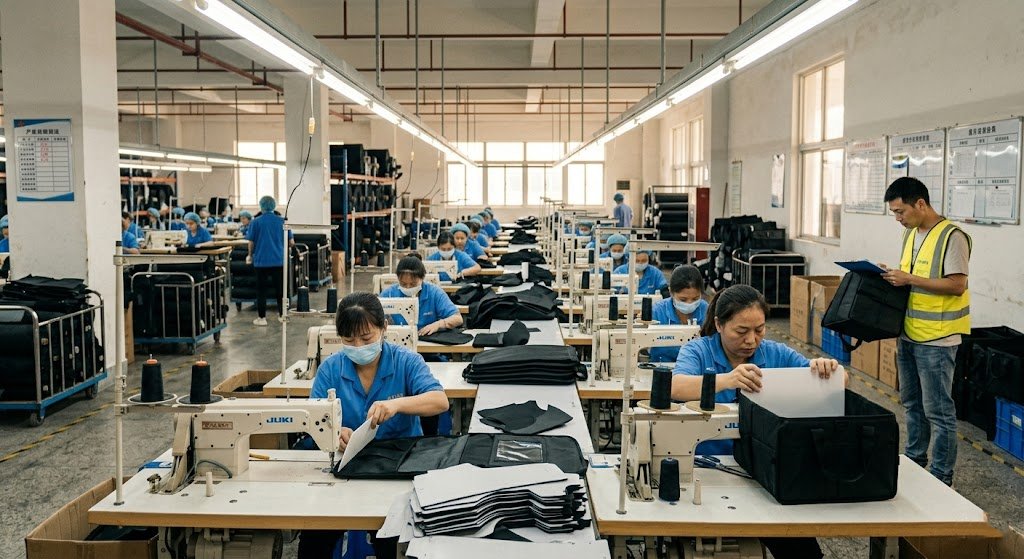
Most "find a supplier" guides say: search Alibaba. That’s step zero. Here’s what happens after.
The fastest way to identify a real factory versus a trading company: ask for a live video call showing their cutting room and sewing floor. Trading companies stall or show a showroom. Factories show you noisy machines, messy floors, and workers mid-production.
The 5-Question Factory Vetting Script
| Question | Good Answer | Red Flag |
|---|---|---|
| "What thread type do you use for load-bearing seams?" | "Tex 70–90 bonded nylon" (immediate answer) | Can’t answer, or says "polyester thread" |
| "Show me a cross-section of your board insert." | Sends clear photo of PP sheet with consistent thickness | Sends finished product photos only |
| "What’s your QC rejection rate?" | "3–5% normal, under 2% for repeat orders" | "Zero defects" |
| "Can you provide a VDA 278 VOC test report?" | "Yes, here’s our latest report" | "What’s VDA 278?" |
| "What’s your actual daily output for this product type?" | "40–80 units per line" for complex organizers | "500/day easy" — physically impossible for quality |
Does Your Factory Need Different Capabilities for Different Subcategories?
Yes. This is something most buyers don’t realize.
| Subcategory | Factory Must Have | Nice to Have |
|---|---|---|
| Trunk / backseat / front seat organizers | Sewing lines, die-cutting, board insert fabrication | In-house printing/embossing |
| Kids’ car organizers | CPSIA-compliant material sourcing, child-safe testing | PEVA welding capability for snack trays |
| Visor organizers | PU leather processing, precision cutting | Spring clip sourcing relationships |
| Hanging organizers | Sewing lines, strap reinforcement capability | Load-bearing test equipment |
| Console organizers (ABS/TPE) | Injection molding capability | 3D scanning for vehicle fitment data |
A factory that makes great trunk organizers might be terrible at console trays. Trunk organizers are sewn products. Console organizers are injection-molded plastic products. Completely different equipment and expertise. Ask: "Have you made this specific type of car organizer before? Show me samples."
Hard-learned rule: Visit the factory. Or pay $250–$350 for a third-party inspection through QIMA or V-Trust. That’s insurance against a $10,000+ container of defective goods.
→ For our complete 7-question factory audit and the 5 manufacturing hubs compared, see our Complete Guide to Car Trunk Organizer Manufacturing.
What Compliance Do You Need Before Selling?
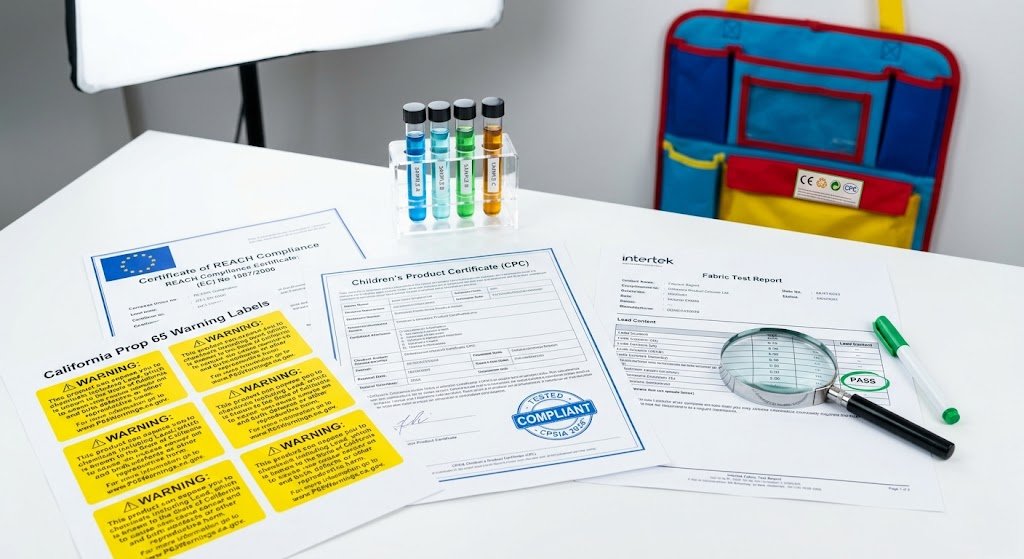
This is the section nobody reads until customs holds their container.
For the US market, car organizers need California Prop 65 compliance (lead and phthalate limits). Kids’ car organizers are legally classified as children’s products under CPSIA — testing is mandatory, not optional. For the EU, REACH (EC 1907/2006) compliance covers 200+ restricted substances. Skip any of these and your container sits at port while you bleed demurrage fees.
Compliance Requirements by Subcategory
| Requirement | Trunk / Backseat / Front Seat / Visor | Kids’ Organizers | Hooks (Metal) | Console (Plastic) |
|---|---|---|---|---|
| California Prop 65 | Required | Required | Required | Required |
| CPSIA (lead, phthalates) | Smart to have; Walmart/Target require it | Mandatory — legally a children’s product | Usually not applicable | Usually not applicable |
| REACH (EU) | Required for EU sales | Required for EU sales | Required for EU sales | Required for EU sales |
| GRS Certificate | Only if making recycled material claims | Only if making recycled material claims | N/A | N/A |
| Food-contact safety | N/A | Required if snack tray included | N/A | N/A |
| Approximate test cost | $200–$500 | $500–$1,200 | $150–$300 | $200–$500 |
The Kids’ Organizer Compliance Trap
If your car organizer is marketed to children — travel trays, activity organizers, kick mats with cartoon prints — it’s legally a children’s product under CPSIA. That means:
- Third-party testing at a CPSC-accepted lab is required (not optional)
- Lead content limits: 100 ppm total lead in substrate
- Phthalate limits for any accessible component
- Tracking labels on every unit
- Children’s Product Certificate (CPC) must be on file
I’ve seen two sellers get their entire Amazon account suspended for selling kids’ organizers without a CPC. Not their listing — their account. Don’t skip this.
How we handle it: At Osgoodway, we use Azo-free dyes and PFC-free coatings by default for all orders. For kids’ products specifically, we source CPSIA-compliant materials pre-verified at the fabric mill level — not just tested after production. Prevention costs less than remediation.
How Do You Build a Listing That Converts Across Subcategories?
You’ve got the product right. Now the listing needs to sell it. I’ve seen 200+ listings built for products leaving our factory. Here’s what works versus what dies.
The highest-converting car organizer listings share three elements: lifestyle photography showing the product in a real car (not a studio), a clear material or feature callout that addresses the #1 complaint in that subcategory, and vehicle compatibility information (even for "universal" products).
The #1 Customer Complaint by Subcategory (And How to Counter It in Your Listing)
| Subcategory | #1 Complaint | What to Say in Your Listing | Photo to Include |
|---|---|---|---|
| Trunk organizer | "Collapses when loaded" | "Reinforced with 2mm PP board inserts — stays upright under 15+ lbs" | Product loaded with groceries, standing upright |
| Backseat organizer | "Tablet pocket too small / touch screen doesn’t work through plastic" | "Fits iPads up to 12.9" with case — touch-responsive clear window" | Kid using tablet through the pocket |
| Front seat organizer | "Doesn’t stay upright on the seat" | "Anti-slide base + adjustable straps secure to headrest" | Product on passenger seat with laptop visible |
| Kids’ organizer | "Snack tray spills everywhere" | "Raised-edge silicone snack well — tip-resistant design" | Child using tray in actual car seat |
| Visor organizer | "Clip doesn’t fit my visor" | "Spring-loaded clip fits visors 0.5"–1.5" thick — tested on 30+ vehicles" | Close-up of clip mechanism on different visor sizes |
| Hanging organizer | "Strap ripped / bag sags" | "Reinforced double-stitch straps, tested to hold 10 lbs" | Organizer hanging from headrest loaded with items |
| Console organizer | "Doesn’t fit / wrong size" | Exact vehicle compatibility list with year ranges | Product installed in the specific vehicle |
The Listing Formula That Works Across All Subcategories
Your 7 bullet points should follow this sequence:
- Anti-complaint claim — Directly counter the #1 complaint (see table above)
- Material specification — Fabric type, denier, coating. Buyers who research care about this.
- Safety / odor assurance — "VOC-tested" or "CPSIA-certified" depending on subcategory
- Size + vehicle compatibility — Exact dimensions. Specific car models if applicable.
- Differentiating feature — Whatever makes your product not-another-generic-organizer
- Durability proof — "Handles tested to 15kg" / "1,000-cycle hook test" / specific test standard
- Social proof or guarantee — Fleet customer testimonial, satisfaction guarantee
The photo that sells: Put the organizer in a real car, loaded with real items. Trunk organizers with groceries and tools. Backseat organizers with a kid’s tablet and snacks. Visor organizers with sunglasses and parking cards. Buyers need to see their life in your product photo. Our top-performing client invests $600–$800 in photography per SKU. Conversion rate: 2x category average.
What’s Your First 90-Day Launch Plan?
Theory without a timeline is useless. Here’s the sequence I walk first-time clients through.
Days 1–15: product spec + factory selection. Days 15–30: sampling + revision. Days 30–40: approve sample + place order. Days 40–80: production + shipping. Days 80–90: listing live + PPC launch. Most delays happen at sampling — budget 2–3 revision rounds.
The 90-Day Timeline
| Phase | Days | What’s Happening | Your Action Items |
|---|---|---|---|
| Research + Spec | 1–15 | Define subcategory and niche, write material spec, contact 3–5 factories | Send spec email (fabric, backing, thread, structure), request quotes |
| Sampling | 15–30 | Factory produces first sample | Test in actual vehicle, request revisions (1–2 rounds typical) |
| Order + Production | 30–70 | Approve PPS, place 30% deposit, bulk production | File trademark, set up Seller Central, begin photography |
| QC + Shipping | 70–85 | Third-party inspection, sea freight to FBA | Create listing draft, prepare PPC keywords |
| Launch | 85–90 | Product arrives at Amazon FBA, listing goes live | Launch PPC, activate Vine reviews program |
Three Things That Delay Every First Order
-
Sample revisions. First sample always needs changes. Budget 2–3 rounds (5–7 days each). If a factory sends a "perfect" first sample with no revision discussion — either they’ve made this exact product 50 times for other clients (zero differentiation for you), or they’re not actually making it to your spec.
-
Fabric procurement for non-stock colors/materials. Specialty fabric (rPET, 1680D, custom Pantone color) needs to be ordered from the mill. Add 10–15 days.
-
Chinese holidays. Chinese New Year (Jan/Feb): 2–4 week shutdown. Golden Week (October): 7 days. If you need product for Q4 Amazon sales, place your order by June.
Factory tip: We run ~3,000 units/day across 4 production lines. A 500-unit order of backseat organizers takes 2–3 production days once materials are in. The bottleneck is never sewing — it’s material procurement and sample approval.

How Do You Scale Beyond Your First Order?
Your first 300–500 units are a test. If they sell, here’s how to grow without blowing up.
Scale by expanding within your subcategory first (color variants, feature upgrades, vehicle-specific versions), then into adjacent subcategories. Your second order should fix every problem your first-order reviews revealed.
The Scaling Playbook
| Stage | Volume | Strategy |
|---|---|---|
| Test (Order 1) | 200–500 units | One subcategory, one color, private label |
| Optimize (Order 2) | 500–1,000 units | Fix review complaints, upgrade materials |
| Expand (Order 3+) | 1,000–3,000 units | Add variants: vehicle-specific, new colors, feature upgrades |
| Line Extension (Order 5+) | 3,000+ units | Enter adjacent subcategory (e.g., trunk → backseat → kids) |
| Multi-Channel | 5,000+ units | B2B fleet sales, dealership wholesale, DTC website |
The Adjacent Subcategory Expansion Path
Once you’ve nailed one subcategory, here are the natural expansion paths. Each arrow represents a logical product line extension that leverages your existing factory relationship, brand equity, and customer base:
- Trunk organizer → Backseat hanging organizer → Cargo net system → Vehicle-specific trunk tray
- Backseat organizer → Kids’ travel tray → Front seat organizer → Headrest hook bundle
- Console organizer → Gap filler → Visor organizer → Full "interior organization kit" bundle
- Vehicle-specific anything → Full accessory set for that vehicle (organizer + mat + net + hooks)
The bundle play: Our fastest-growing product format is the "complete car organization kit" — trunk organizer + backseat organizer + headrest hooks + visor pouch as a matched set. Higher AOV (average order value), lower PPC cost per product, and the listing looks more premium than any single product.
Margin improvement trick: Your biggest cost drop comes on order 2, not order 1. Die-cut templates exist. Worker training is done. You negotiate from proven volume. Our most loyal clients have dropped per-unit cost 20–25% between order 1 and order 5.
The 7 Mistakes I’ve Watched Amazon Sellers Make (Repeatedly)
I’ve shipped organizers to 200+ brands. These mistakes repeat like clockwork.
| # | Mistake | What Happens | The Fix |
|---|---|---|---|
| 1 | Choosing the lowest FOB quote | $5.50 organizer uses 420D polyester, grey cardboard, generic thread. Falls apart in 60 days. | Minimum viable FOB: $3.50 for backseat, $7 for trunk. Below that, critical components are downgraded. |
| 2 | Entering the generic trunk organizer market in 2026 | 4,000+ listings. Page 1 dominated by brands with 10,000+ reviews. $3,000+/month PPC just to stay visible. | Pick a subcategory or niche where you can be on page 1 within 90 days. |
| 3 | Skipping the pre-production sample | Fabric dye lots changed, board thickness shifted. New batch doesn’t match existing inventory. | Always approve a PPS made with actual production materials. |
| 4 | Not specifying Pantone PMS colors in writing | "Dark blue" means something different to every factory. Reorder doesn’t match first order. | Pantone code. In writing. Every time. |
| 5 | No third-party inspection | Factory QC catches 92–95% of defects. The 5–8% that slip through become your 1-star reviews. | Spend $250–$350 on a QIMA pre-shipment inspection. Best ROI in your supply chain. |
| 6 | Selling kids’ organizers without CPSIA testing | Amazon account suspension. Not listing suspension — account suspension. | Test at a CPSC-accepted lab before your first unit ships. |
| 7 | Building cost model on FOB price only | FOB is 40–60% of your actual landed cost. Duty (HTS 4202.92 ~17.6% + Section 301), freight, FBA fees, PPC — these are the real costs. | Build full landed cost model before committing to a product or price point. |
Ready to Build Your Private Label Car Organizer?
You’ve now read the factory-side playbook that most Amazon sellers never get access to. The gap between a successful launch and a $10,000 lesson usually comes down to material specs decided in a rushed Alibaba chat.
At Osgoodway, we produce car organizers across all subcategories — trunk, backseat, front seat, kids, visor, and more — with full in-house testing for abrasion (ISO 12947-2), seam strength (ASTM D1683), and VOC emissions (VDA 278). We don’t push the most expensive option — we push the right one for your subcategory, price point, and target market.
What We Offer Private Label Sellers
- Low MOQ: 500units for private label, 1000 for ODM
- Free fabric swatches: Oxford, polyester (PVC/PU/TPE backing options), PU leather, and non-woven samples
- Side-by-side cost comparison based on your specific subcategory, design, and target retail price
- The hybrid build recommendation: Which fabric goes where for maximum value
- CPSIA and Prop 65 compliance support — we source pre-verified materials for kids’ products
Your next step: Contact our product team with your product concept — even a rough sketch, a competitor link, or just "I want to launch a backseat organizer for the $25 price point." We’ll send back a technical proposal within 48 hours: materials recommendation, estimated cost range, and timeline.
No hard sell. Just factory-floor honesty from people who’ve built 100,000+ car organizers.

Frequently Asked Questions
How many units should I order for my first private label car organizer?
200–500 units. Below 200, per-unit cost kills your margins. Above 500, you’re risking too much on an unproven product. Start with 300 units in one color, validate with real sales data, then scale.
Which car organizer subcategory has the lowest barrier to entry?
Visor organizers and headrest hooks — lowest MOQ (100–200 units), simplest manufacturing, fastest turnaround (15–20 days). But margins are thinner and competition on hooks is extreme. For better margins with moderate complexity, backseat organizers are the sweet spot.
Can I sell the same private label organizer across multiple subcategories?
No. A trunk organizer and a backseat organizer are completely different products requiring different materials, construction, and listings. However, you can bundle complementary subcategories (trunk organizer + headrest hooks) as a single listing for higher AOV.
What’s the difference between a $6 and a $12 FOB car organizer?
Components. The $6 version uses plain-weave polyester, thin PP board or cardboard, generic thread, and minimal QC. The $12 version uses PU-coated Oxford cloth, 2mm+ PP board, branded hardware (SBS zippers minimum), bonded nylon thread, and passes a 4-point inspection. The difference shows up in your return rate 60 days after launch.
Do I need to visit the factory in China?
Not required, but recommended for orders above $10,000. If you can’t visit, hire a third-party inspector. QIMA charges $250–$350 per inspection — the best $300 you’ll spend.
What tariffs apply to car organizers imported from China in 2026?
HTS 4202.92 carries ~17.6% base duty. Section 301 tariffs remain in effect, plus a 10% Section 122 global surcharge as of February 2026. Net effective rate is approximately 30% above MFN. Always consult a licensed customs broker for your specific product classification — textile-based storage vs. "travel goods" classification can mean a significant duty difference.
Related Resources
| Article | Focus |
|---|---|
| Car Organizer Fabrics Compared: Oxford Cloth vs Polyester vs PP Non-Woven | Material science deep dive with 90-day trunk simulation test data |
| The Complete Guide to Car Trunk Organizer Manufacturing | Full factory process, 8-component anatomy, cost breakdowns with real FOB numbers |
| Car Trunk Organizer Market Trends 2026 | Industry analysis, EV opportunity, tariff impact |
This guide reflects our direct manufacturing experience at Osgoodway as of April 2026. Material prices, shipping rates, and duty rates fluctuate — verify current numbers before making purchasing decisions. All testing standards referenced are linked to their respective ISO or industry body pages for independent verification.






