


I’ve sat across the negotiation table from hundreds of brand owners. The rookies always get stuck on terminology. They ask for "White Label" when they actually need a custom mold, or they ask for "Private Label" when they only have the budget for 50 units.
White Label bags are pre-manufactured, generic products where you simply add your logo to existing factory designs. Private Label bags are custom-manufactured products built to your specific technical packs, dimensions, and material specifications, allowing for total brand exclusivity and design control.
In this guide, I’m cutting through the textbook definitions. I’ll walk you through the gritty reality of the factory floor—the real costs, the minimums (MOQs) we actually enforce, and the production headaches you won’t read about in a marketing brochure. This is how we actually build your bags.
What Is the Core Manufacturing Difference?
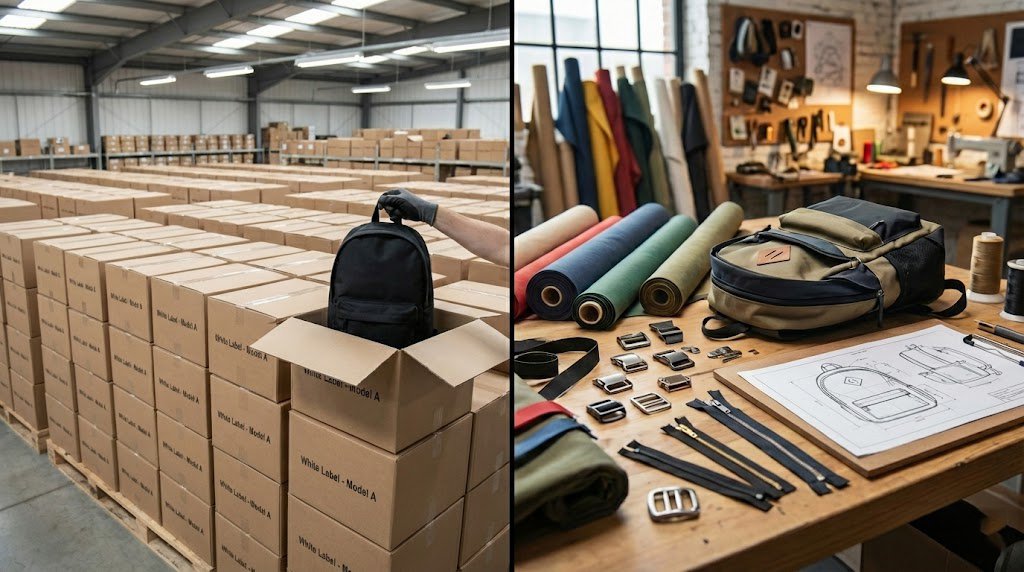
White Label means "buying what we have," while Private Label means "making what you want." With White Label, you are selecting from my factory’s existing catalog (ODM[^1])—the molds and patterns already exist. Private Label (OEM) requires us to build the bag from scratch based on your unique design.
In White Label, I own the Intellectual Property (IP) and the design; you just rent the rights to put your logo on it. In Private Label, you own the IP. The manufacturing process is completely different: White Label skips the R&D and prototyping phase entirely, whereas Private Label requires creating new paper patterns, sourcing specific BOM (Bill of Materials) components, and cutting new molds.
Factory Reality: We had a client try to "tweak" a White Label backpack by changing the zipper placement. I had to explain that moving a zipper 1 inch requires re-doing the entire sewing pattern. That instantly turned it into a Private Label job with a $500 sample fee.
Does the factory own the IP or do I?
- White Label: The factory (me) owns the design rights. If your competitor calls me next week and wants the exact same backpack in blue, I can legally sell it to them. You have zero exclusivity.
- Private Label: You own the IP. We sign an NNN1(Non-Disclosure, Non-Use, Non-Circumvention) agreement. I cannot sell your custom mold or pattern to anyone else.
Which model fits your business stage?
- Choose White Label if: You need to test a market quickly with low risk.
- Choose Private Label if: You are building a brand asset and need unique features (like specific magnetic buckles or proprietary fabrics).
Actionable Tip: If you choose White Label, do not try to sue a competitor for selling "your" bag. You are both selling my bag. If you need exclusivity, you must pay for the Private Label tooling.
Which Option Requires Higher Minimum Order Quantities (MOQs)?
MOQs aren’t arbitrary numbers we make up to annoy you; they are dictated by fabric mills and production line efficiency.
Private Label MOQs are strictly higher (usually 500-1,000+ pcs) because we must purchase raw materials specifically for your order. Fabric mills rarely sell us custom colors or high-end technical fabrics2 in batches smaller than 1,000 yards. White Label MOQs are lower (50-100 pcs) because the goods are often finished, semi-finished or the material is already in our warehouse stock.
MOQ & Cost Impact Table
| Feature | White Label (Stock) | Private Label (Custom) |
|---|---|---|
| Typical MOQ | 50 – 200 pcs | 500 – 1,000+ pcs |
| Setup Fees | Low ($50-$100 for logo plate) | High ($500+ for molds/samples) |
| Material Flexibility | None (Stock only) | High (Custom dyeing/sourcing) |
| Unit Price | Higher (per unit) | Lower (at volume) |
Action: Check your warehouse space before asking for Private Label. 1,000 backpacks is roughly 15-20 CBM (cubic meters). Can you store that?
—
Can I Customize Materials or design on a White Label Bag?
This is the most common question I get from startups who want "unique" products without the investment.
Generally, no. You cannot change the main fabric (e.g., swapping Polyester for Nylon) on a White Label product.you can only customize the branding elements, such as the logo type (screen print, embroidery, rubber patch), hangtags, and packaging.
White Label inventory is often already cut or fully sewn, sitting on shelves waiting for a logo. Even if it isn’t sewn, the patterns are strictly nested for specific fabric widths. Altering a pocket size or fabric type changes shrinkage rates and assembly logic, forcing a full restart.
What Modifications Are Actually Allowed?
| Modification Request | White Label (Stock) | Private Label (Custom) |
|---|---|---|
| Add/Change Logo | ✅ Allowed (Print/Sew) | ✅ Allowed |
| Change Fabric Color | ❌ NO (Stock only) | ✅ Allowed |
| Move a Pocket | ❌ NO (Requires new pattern) | ✅ Allowed |
| Change Zipper Puller | ⚠️ Maybe (If detachable) | ✅ Allowed |
| Add Inner Padding | ❌ NO (Requires re-sewing) | ✅ Allowed |
Action: If you need specific features or fabrics, stop looking at "Ready to Ship." Send us a reference sample and request a custom OEM quote instead.
Which Model Offers Better Profit Margins?
If you are playing the long game, there is only one winner here.
Private Label offers 30-50% higher potential margins because you possess pricing power. With White Label, you are selling the exact same bag as ten other competitors on Amazon, forcing you into a "race to the bottom" price war. Private Label creates a unique value proposition that allows you to charge a premium.
While Private Label requires higher upfront capital for molds (tooling) and inventory, the unit cost (FOB price) is often lower than White Label because we strip out the inventory holding costs we charge for stock items. You control the input costs—if you want to save $0.50 by using a #5 nylon zipper instead of a #8, you can make that choice.
Profitability Checklist
- White Label: Low risk, fast cash flow, low margin cap.
- Private Label: High risk, slow cash flow, high margin cap.
- Brand Equity: Only built through Private Label.
Action: Calculate your "Landed Cost" vs. Competitor Retail Price. If the margin isn’t above 60%, don’t source it.
How Long Does Production Take for Each?
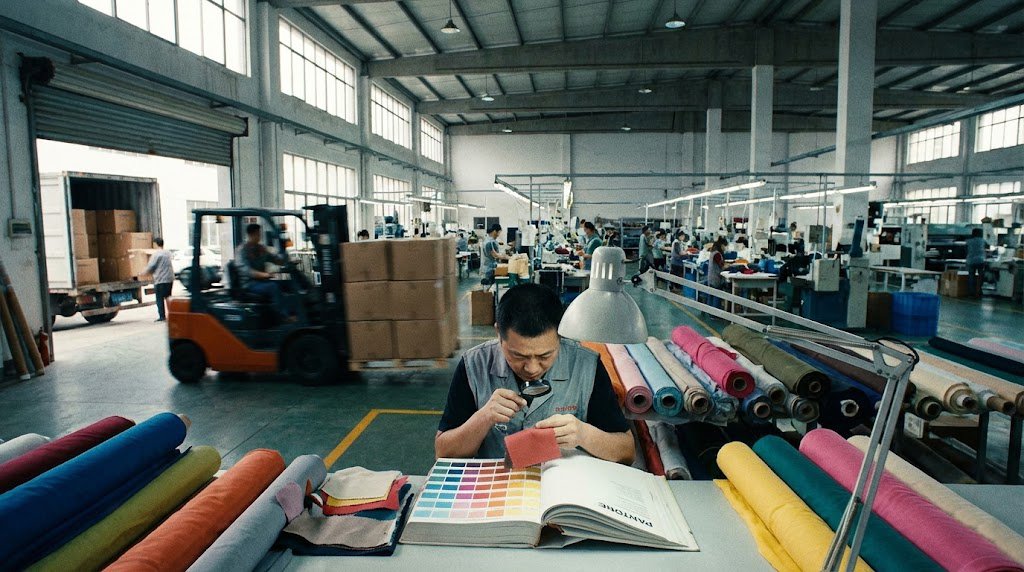
Time is the one resource you can’t buy, but you can plan for it.
White Label orders typically ship in 2-3 weeks, primarily for logo application and packing. Private Label orders take 60-90 days(or more) to account for prototyping, raw material sourcing, and mass production.
The massive time gap exists because of the "Critical Path" of materials. In White Label, the critical path is just printing your logo. In Private Label, we are at the mercy of the supply chain—waiting for fabric mills to weave and dye your specific fabric, or waiting for custom hardware molds to be cast and polished.
Factory Timeline Reality: I recently managed a Private Label order where we lost 25 days just waiting for a specific magnetic buckle (Fidlock) to arrive from the supplier. We couldn’t start sewing because that buckle was part of the main body panel. With White Label, that bag would have shipped before the buckle even arrived at our dock.
Production Lead Time Breakdown
| Phase | White Label Timeline | Private Label Timeline |
|---|---|---|
| Design & Prototyping | 1 – 3 Days (Digital mockup only) | 14 – 30 Days (2-3 physical sample rounds) |
| Material Sourcing | 0 Days (In stock) | 15 – 20 Days (Fabric weaving & dyeing) |
| Mass Production | 7 – 10 Days (Logo application) | 30 – 45 Days (Cutting, Sewing, QC) |
| Total Lead Time | 2~3 Weeks | ~60 to 90 days |
Actionable Tip: Never plan a Private Label Christmas launch in October. You are already too late. You need to sign off on your Golden Sample (Pre-production sample) by July to guarantee the goods are on the boat before the rush.
Conclusion
Don’t overcomplicate this. If you are an influencer or a startup with under $5,000, start with White Label. Speed is your friend. If you are an established brand or have a unique design that solves a specific pain point, invest in Private Label. Differentiation is your only defense. Pick a lane, and let’s get to work.
Ready to start? Stop guessing. Contact our team at Osgoodway and tell me: "Stock" or "Custom." We’ll know exactly what to do.

FAQ: Questions Buyers Are Scared to Ask
1. Can I switch from White Label to Private Label later?
Absolutely. This is the smartest way to scale. Start by selling our stock bags to validate your customer base. Once you’re moving 500 units a month, bring us a Tech Pack to customize that bag. We see this transition succeed constantly.
2. Will you sell my Private Label design to other clients?
If you pay for the molds, no. We sign an NDA and an NNN agreement. However, if you use our "open molds" (generic parts) and just change the fabric, the design isn’t fully yours. To be safe, own the tooling.
3. Why is your White Label sample so expensive?
It shouldn’t be. White label samples should be near 2x the FOB price or free if you return it. If a factory charges you $200 for a stock bag sample, they are ripping you off. Private label samples, however, should cost $100-$300 because we are stopping a production line to make one piece.
4. Can I provide my own labels/tags for White Label bags?
Yes. This is the standard procedure. You send us the woven labels, hang tags, and polybag artwork. We sew them on. This is the cheapest way to make a stock bag look like a brand.
5. What if I want a "White Label" bag but in a specific Pantone color?
That is a trap. As soon as you say "Pantone," you trigger the fabric dying process. That implies a minimum of 1,000 yards of fabric. You have just accidentally requested a Private Label order with high MOQs. Stick to stock black, grey, or navy if you want low MOQs.






