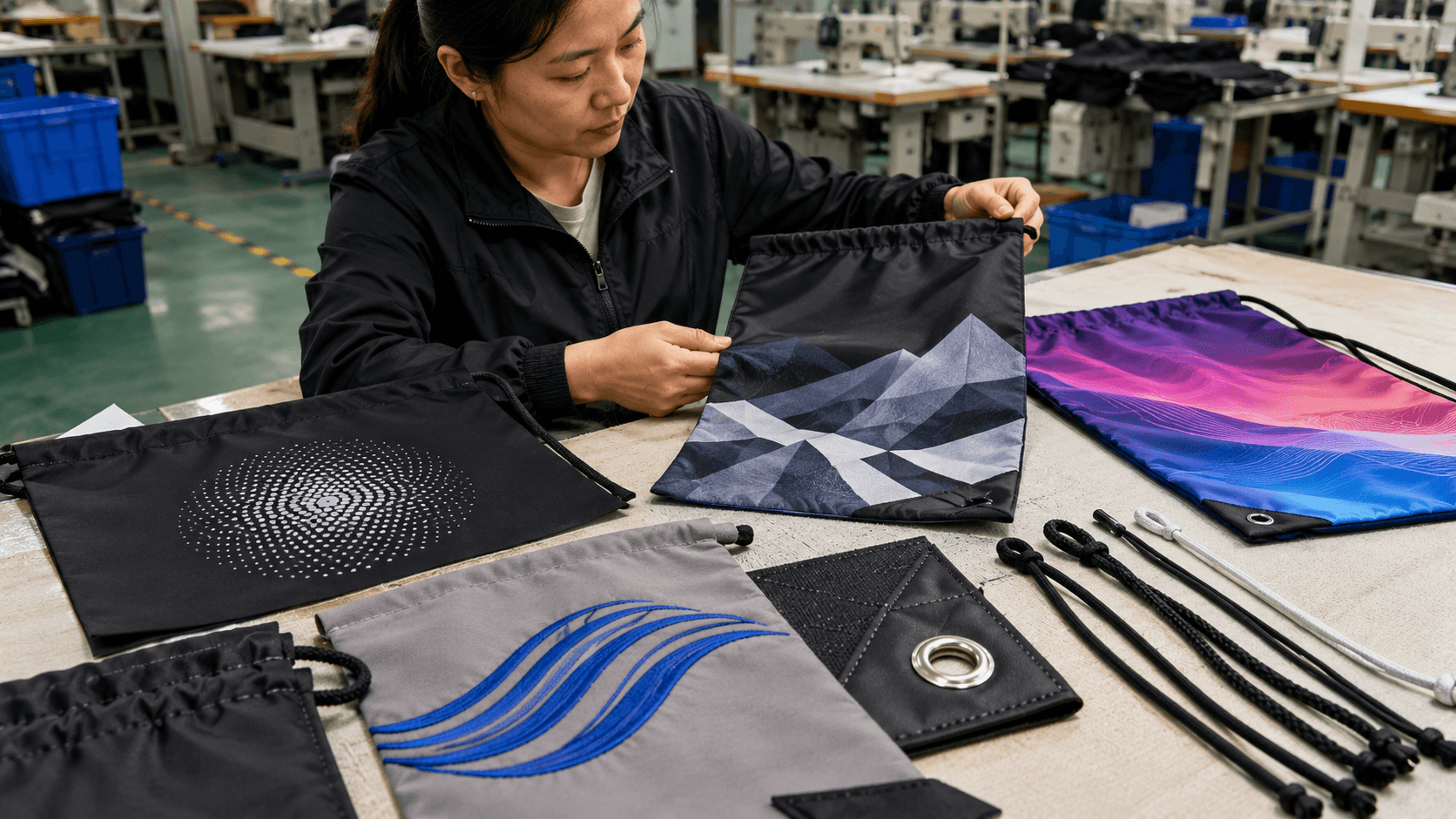
Clear PVC sheet and polyester can both be good bag materials, but they solve very different product problems.
Clear PVC is usually more suitable when transparency, a wipe-clean surface, or plastic-sheet construction is essential. Polyester is generally more practical for backpacks, duffle bags, school bags, and other sewn products that need flexibility, pockets, padding, reinforcement, and complex textile construction.
But there is one important sourcing detail that many comparisons miss:
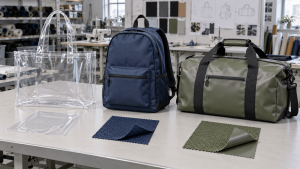
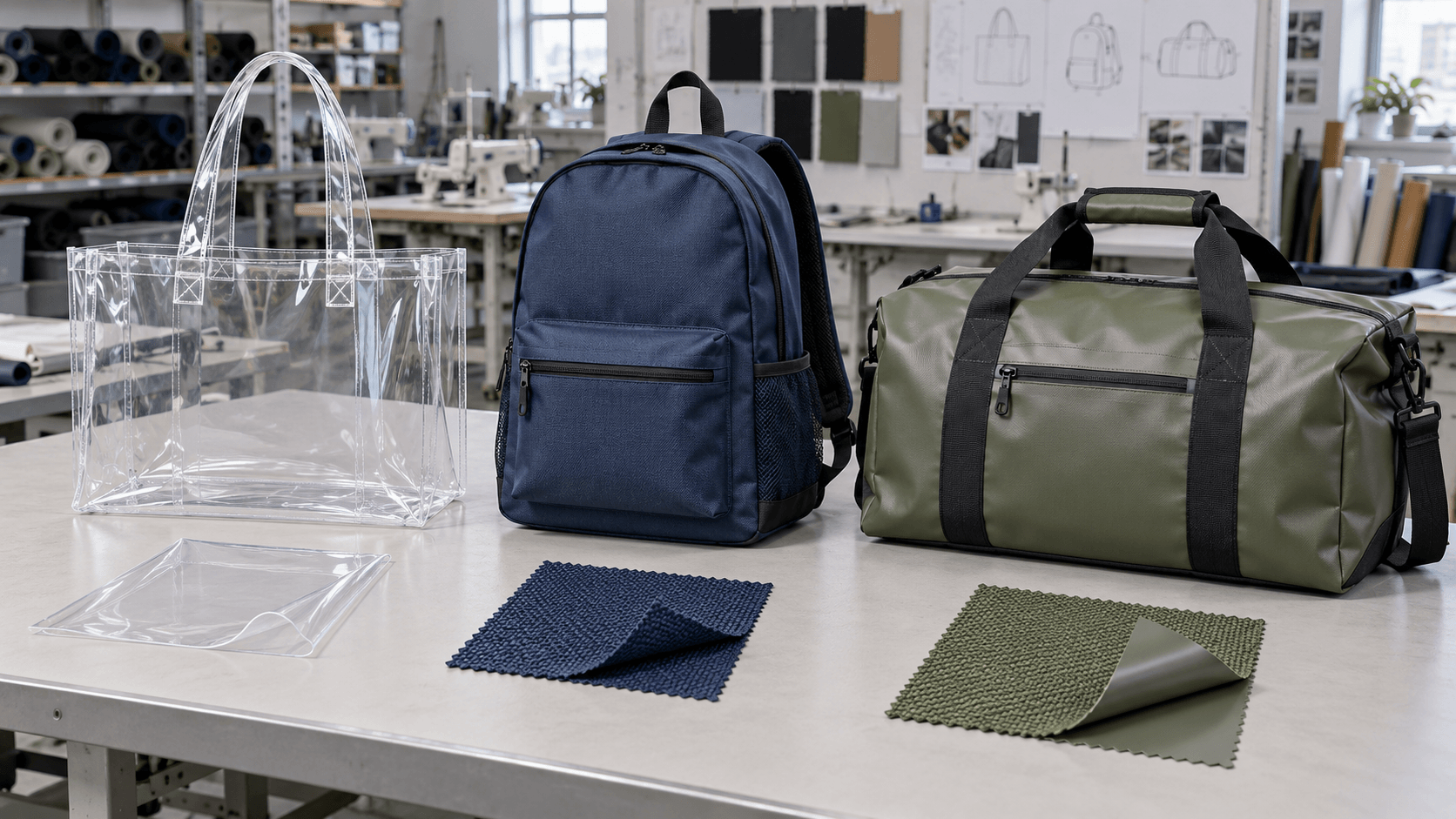
A clear PVC tote, a 600D polyester backpack and a PVC-coated polyester gear bag are three very different constructions—even though all may appear in a search for “PVC vs polyester bags.”
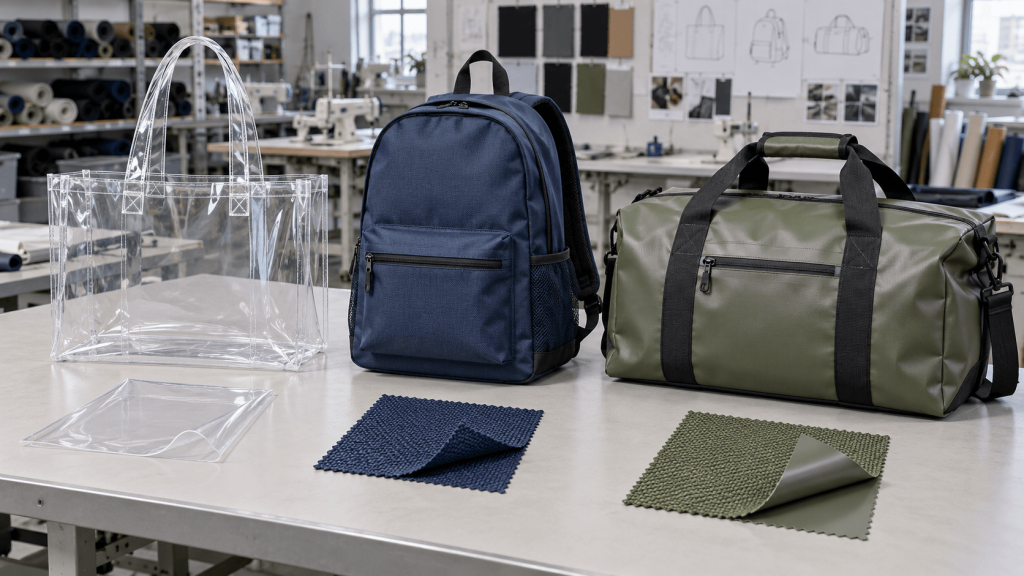
| Material | Actual Construction | Typical Bag Applications |
|---|---|---|
| Clear PVC | Flexible plastic sheet or film | Clear totes, stadium bags, cosmetic pouches |
| Polyester | Woven synthetic textile | Backpacks, school bags, duffles, laptop bags |
| PVC-coated polyester | Woven polyester base + PVC coating or backing | Gear bags, heavy-duty panels, water-resistant applications |
This is why “PVC” and “polyester” are not always two completely separate choices. PVC-coated polyester contains both.
So the better product-development question is not simply: “Which material is better?”
It is: “What does the bag need the material to do?”
For some products, the best solution is not PVC or polyester at all. It is a hybrid construction that uses each material where it performs best.
PVC vs Polyester: What Is the Real Difference?
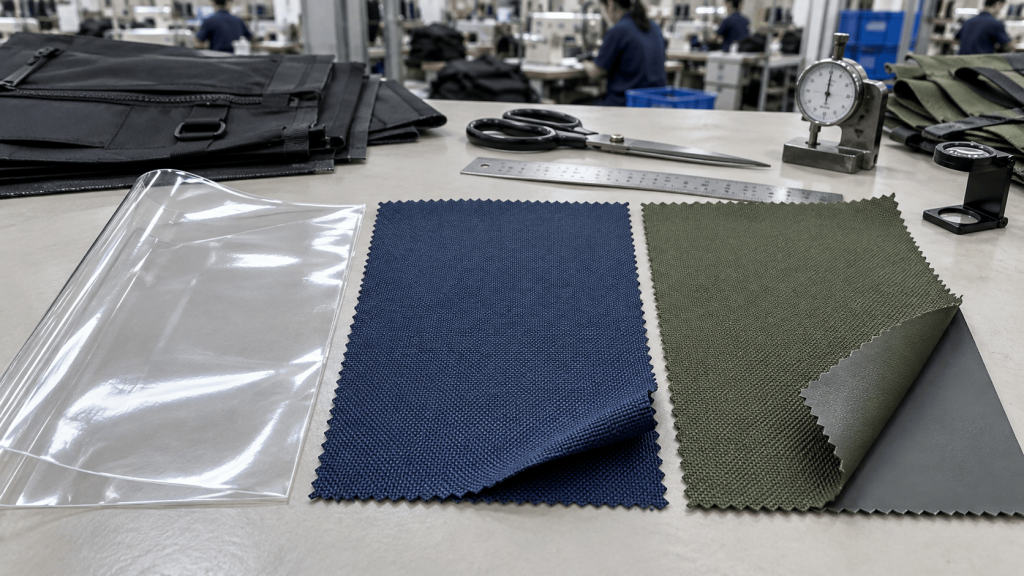
The biggest difference is not simply that PVC is “plastic” and polyester is “fabric.”
In bag manufacturing, the first step is to define which PVC construction and which polyester construction we are actually comparing.
“PVC” may refer to clear film, colored sheet, frosted PVC, or another flexible PVC panel. “Polyester” may refer to 210D, 420D, 600D, Oxford, ripstop, or coated polyester.
That is why “PVC” and “polyester” are not complete bag material specifications.
Clear PVC Film
Clear PVC is a flexible plastic sheet used directly as part of the bag panel.
It is commonly chosen when the product needs:
- Transparency
- Easy content inspection
- A wipe-clean surface
- A smooth plastic appearance
- Visible product presentation
Typical applications include clear totes, stadium bags, cosmetic pouches, toiletry bags, and retail packaging.
PVC sheet is commonly specified by thickness, such as:
- 0.20 mm
- 0.30 mm
- 0.50 mm
Thickness can affect:
- Stiffness
- Weight
- Folding behavior
- Seam bulk
- Sewing difficulty
- Overall hand feel
But thickness should always be considered together with the finished bag size and construction.
Polyester Fabric
Polyester used for bags is normally a woven textile, not a plastic sheet.
Common specifications include:
- 210D polyester
- 420D polyester
- 600D polyester
- Oxford polyester
- Ripstop polyester
- PU- or PVC-backed polyester
A 600D specification primarily describes the yarn’s linear density (denier). It does not by itself define the finished fabric weight, weave, coating, backing, surface finish, or overall durability.
If 600D is one of the materials you are considering, our factory guide to 600D polyester bag fabric explains how denier, weave, fabric weight and backing affect the finished material.
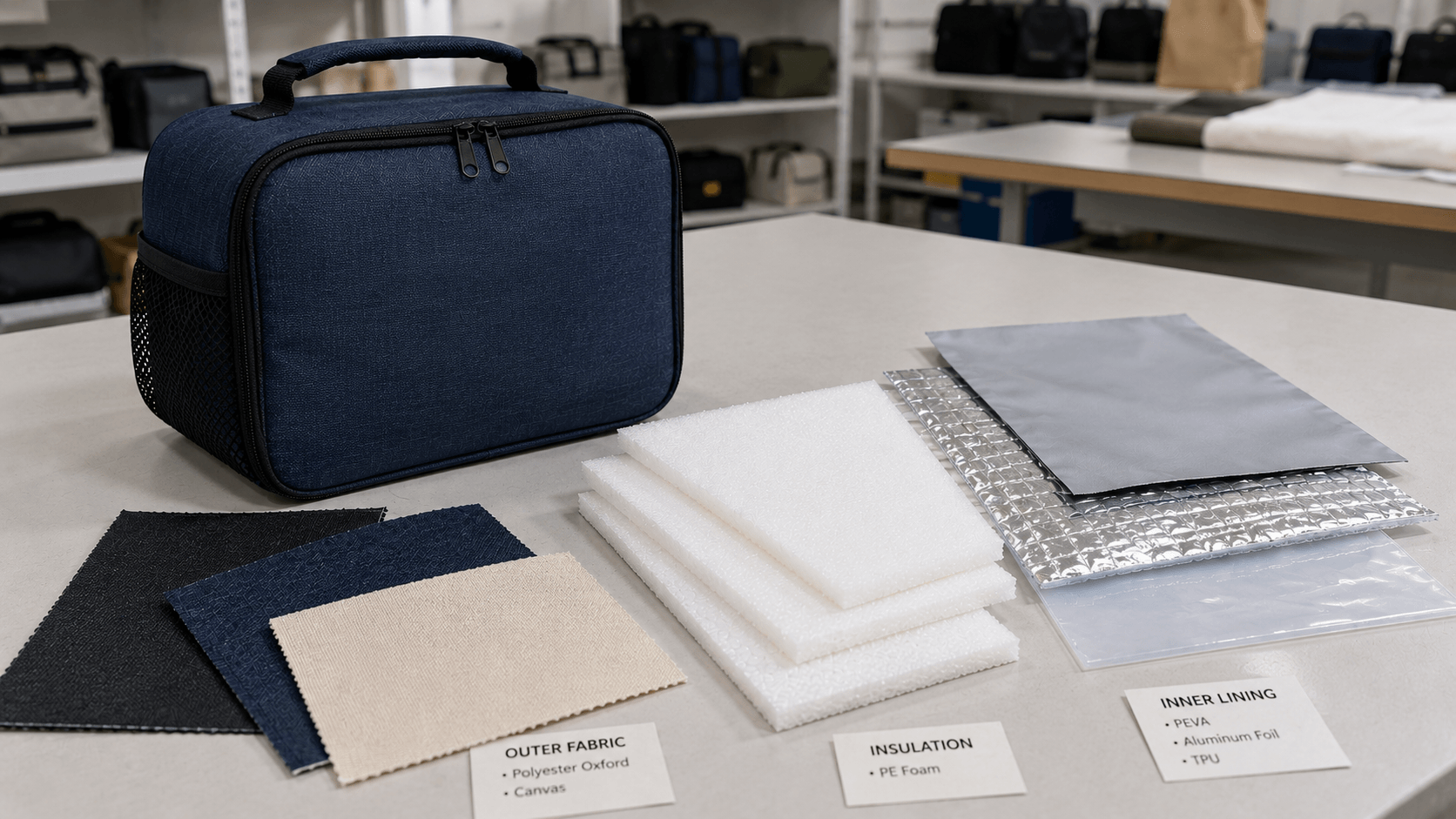
Polyester is especially useful for complex sewn bags because it works easily with lining, foam, webbing, pockets, mesh, and reinforcement.
This is one reason backpacks, school bags, laptop bags, and duffle bags are commonly developed around textile construction.
What Is PVC-Coated Polyester?
This is where many sourcing discussions become confusing.
PVC-coated polyester is not the same material as clear PVC film.
It normally consists of:Woven polyester base fabric + PVC coating or backing
The polyester provides the textile structure, while the PVC layer can add body, surface protection, stiffness, and water resistance depending on the construction.
So a specification such as: 600D polyester with PVC backing
contains both polyester and PVC.
Clear PVC sheet is used as the bag panel itself. PVC-coated polyester uses woven polyester as the structural base and PVC as a coating or backing.
For sourcing, these should be treated as different material constructions—not grouped together simply because both contain PVC.
How PVC and Polyester Perform in Bag Manufacturing?
Choosing between PVC and polyester becomes much easier once we stop asking which material is “better” in general and look at how each behaves during actual bag construction.
Weight, Flexibility and Structure
Clear PVC behaves like a flexible sheet. Polyester behaves like a woven textile.
That difference affects almost every step of development.
PVC thickness influences:
- Stiffness
- Weight
- Folding behavior
- Seam bulk
- Opening flexibility
- Sewing around corners
Polyester gives us a much wider construction platform. It can be combined with foam, lining, webbing, mesh, binding, elastic, piping, and reinforcement while retaining the flexibility of a textile bag.
This is why polyester is often more practical for multi-panel backpacks and duffle bags.
For complex sewn bags, polyester is often chosen not because one fabric property is superior, but because it integrates more easily with the rest of the bag construction.
Water Resistance vs Waterproof Construction
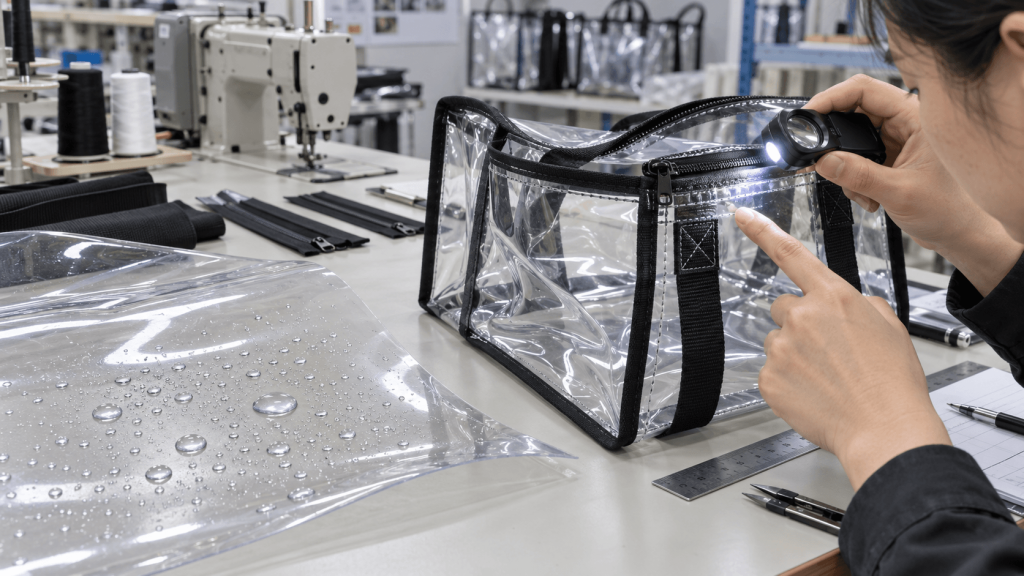
One of the most common oversimplifications is: “PVC is waterproof. Polyester is only water-resistant.”
That comparison describes the material too broadly and says very little about the finished bag.
A PVC sheet itself can stop water from passing directly through the material. But if the bag is sewn normally, water may still enter through:
- Stitch holes
- Seams
- Zippers
- Top openings
- Binding
- Handle attachment points
Polyester works differently.
A standard woven polyester fabric is not automatically waterproof, but its water-resistance performance can be changed through coatings and construction methods such as:
- PU or PVC backing
- Suitable surface treatments
- Seam sealing
- Welded construction when using compatible coated or laminated materials
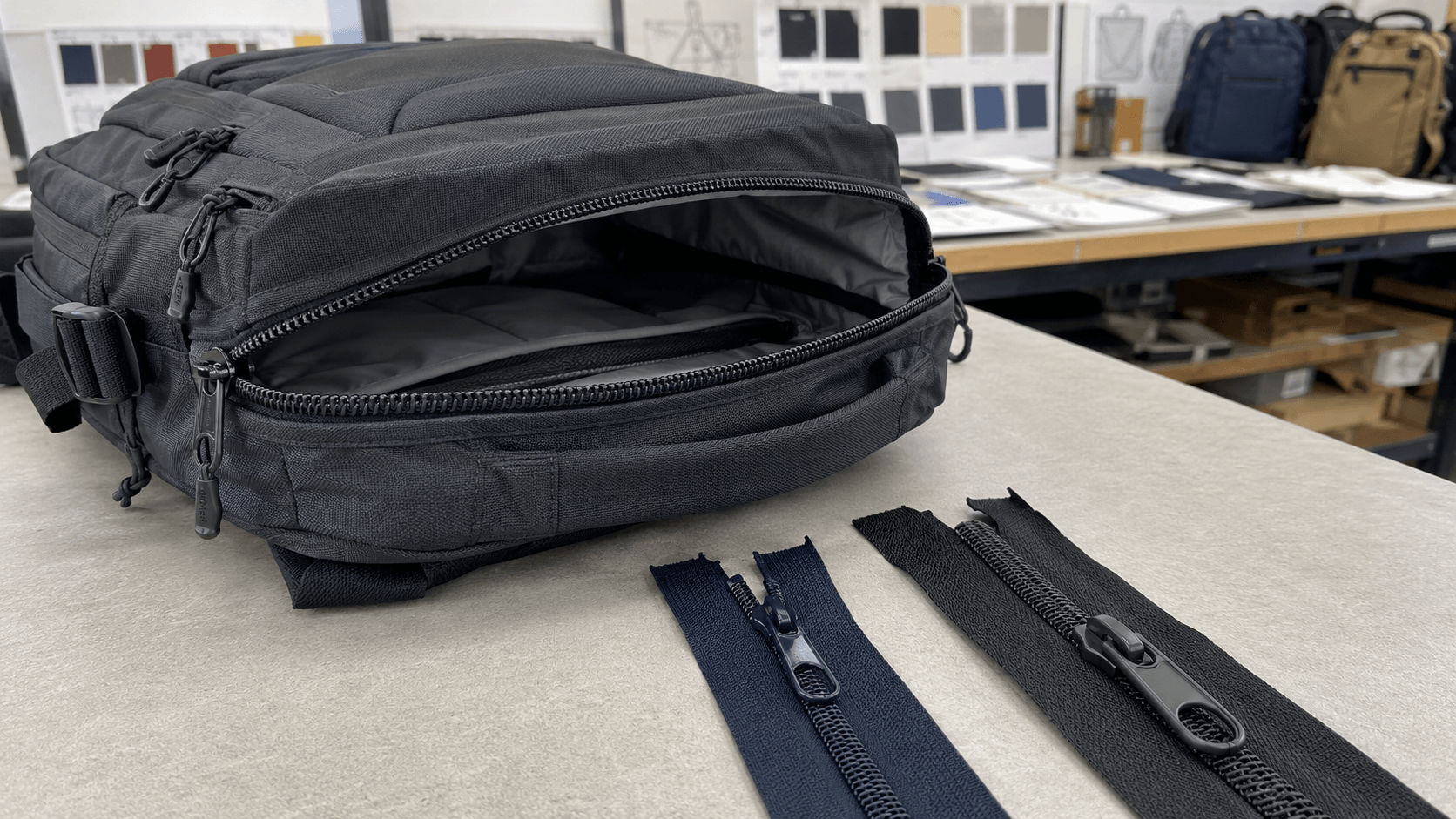
- Water-resistant or waterproof zippers
So:
A waterproof sheet does not automatically make a waterproof bag.
The complete bag construction determines how well the finished product protects its contents.
Transparency and Product Presentation
For many PVC products, transparency is more important than water resistance.
Consider products such as:
- Stadium bags
- Security bags
- Clear cosmetic pouches
- Toiletry bags
- Promotional totes
- Retail display packaging
In these cases, seeing the contents is part of the product function.
If visibility is the reason the product exists, clear PVC can solve a function that woven polyester simply cannot.
But transparency also creates a different quality expectation.
Scratches, haze, fold marks, surface contamination, and creases are much more noticeable on a clear panel than on most woven fabrics.
For premium clear bags, we therefore need to evaluate not only Will the material tear?
but also How will the material look after production, packing, shipping and repeated handling?
Durability Means More Than “Which Is Stronger?”
“PVC is more durable” or “polyester is more durable” is not a useful sourcing conclusion by itself.
Durability can mean very different things:
| Durability Area | What We Are Actually Evaluating |
|---|---|
| Tear resistance | How easily damage spreads from a cut or stitch area |
| Puncture resistance | How the material reacts to sharp pressure |
| Abrasion | Surface wear from rubbing |
| Seam strength | How well the sewn construction carries load |
| Flexing | How the material handles repeated bending |
| Surface appearance | Scratching, haze, creasing or marks |
| Load bearing | How handles and attachment points transfer weight |
For coated fabrics, durability is also evaluated through separate test properties rather than one universal “strength” number. ASTM D751, for example, includes methods for breaking strength, puncture resistance, tearing strength, hydrostatic resistance, coating adhesion, low-temperature behavior and seam strength.
A clear PVC panel may offer an excellent wipe-clean surface but show scratches or creases more visibly.
Many standard woven polyester fabrics are more forgiving of repeated folding and complex sewn construction, but they may require a suitable coating when surface water resistance is important.
If you are developing a transparent backpack, our guide to how long a clear PVC backpack lasts explains how formulation, repeated bending, temperature, seams and strap attachments affect its usable life.
Which Material Is Better for Different Types of Bags?
The product type usually tells us more than the material name.
Clear Tote, Stadium and Cosmetic Bags
Clear PVC is often the logical starting point when transparency is a key requirement.
For stadium products, transparency can be a functional requirement rather than simply a visual choice. The NFL clear bag policy, for example, permits certain clear plastic, vinyl or PVC bags subject to its size and design restrictions.
Typical examples include:
- Clear stadium totes
- Security bags
- Cosmetic pouches
- Toiletry bags
- Transparent promotional bags
- Product-display packaging
For these products, we normally consider PVC thickness together with:
- Finished bag size
- Panel stiffness
- Zipper construction
- Handle reinforcement
- Folding requirements
- Packing method
A small clear cosmetic pouch and a large transparent tote should not automatically use the same PVC thickness just because both are “PVC bags.”
Backpacks, School Bags and Duffle Bags
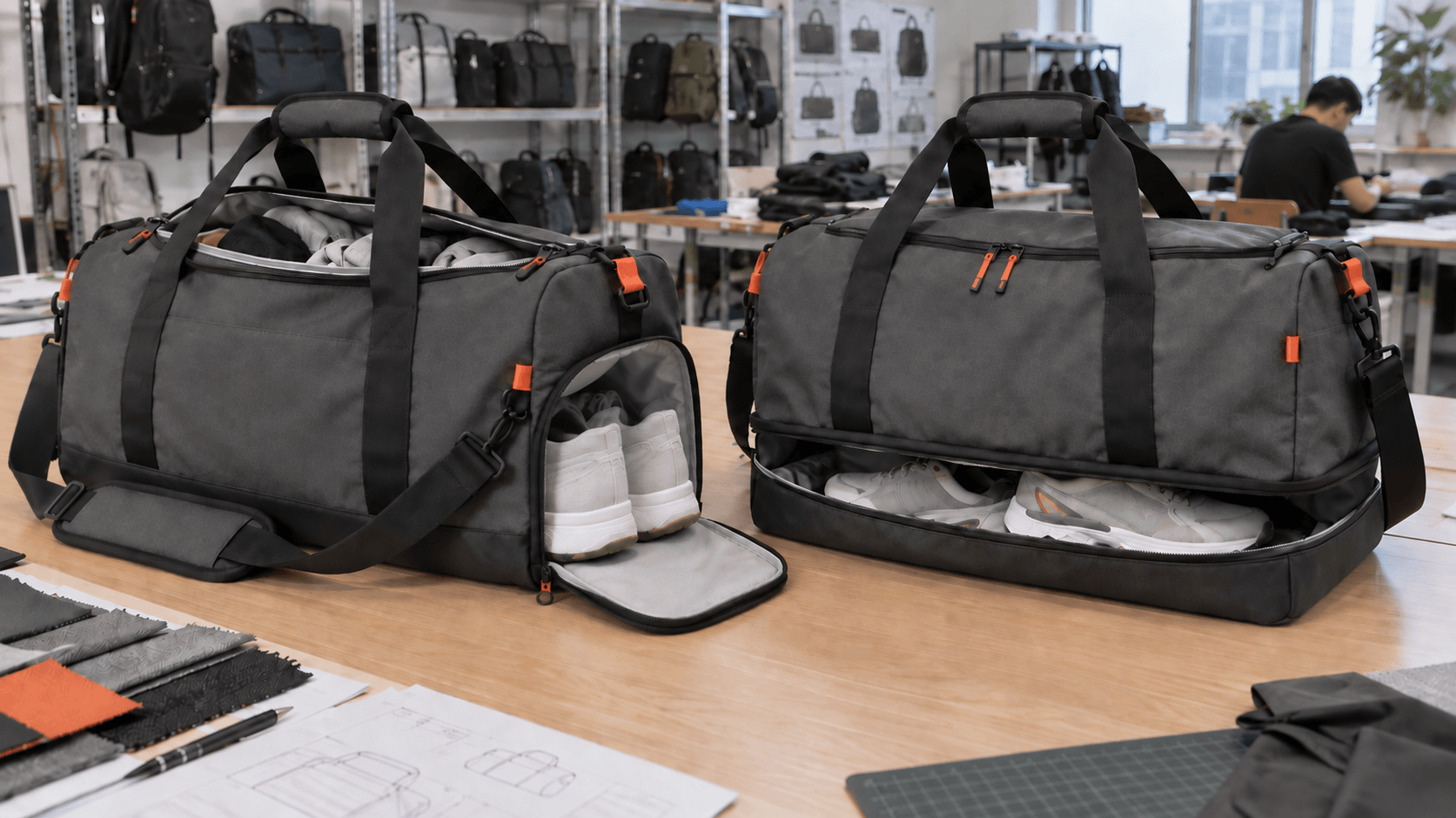
For most conventional backpacks and duffle bags, polyester is usually more practical.
These products commonly require:
- Multiple sewn panels
- Lining
- Padding
- Shoulder straps
- Webbing
- Pockets
- Mesh
- Bartacks
- Binding
- Reinforced stress points
Polyester works naturally with these components.
That does not mean PVC cannot be used on a backpack. It means a full clear-PVC construction often becomes less practical when the product needs complex textile engineering and comfortable repeated carrying.
For many everyday backpacks:
Material compatibility with sewing, reinforcement and padding matters more than simply choosing the most water-resistant surface.
Packaging and Retail Bags
Both materials can work well here, depending on the purpose.
Clear PVC is useful when the package needs to:
- Display the product inside
- Be wiped clean easily
- Create a glossy or transparent presentation
- Function as reusable clear packaging
Polyester may be preferable when the bag needs:
- Repeated carrying
- Soft folding
- A textile appearance
- More complex branding options
- Drawstrings, pockets, straps, or reinforcement
The decision should follow the packaging experience you want the customer to have.
Outdoor, Heavy-Duty and Gear Bags
This category often creates confusion because buyers may assume the choice must be clear PVC or woven polyester.
For heavy-duty applications, PVC-coated polyester may be more relevant than clear PVC because it combines a woven textile base with a protective coating or backing.
Depending on the material construction, this can provide:
- More body
- Surface protection
- Water resistance
- Additional stiffness
- Higher material weight
For a technical or heavy-duty bag, we still need to consider the complete load path, seams, webbing attachment, reinforcement, and opening design.
A heavy material alone does not create a heavy-duty bag.
When PVC + Polyester Hybrid Construction Is Better
Some products should not be forced into a PVC-versus-polyester decision.
A hybrid construction can use each material where it performs best.
For example:
Clear stadium backpack
- Main transparent panels → clear PVC
- Binding → polyester
- Shoulder straps → polyester webbing + foam
- Reinforcement → woven polyester
Cosmetic bag
- Transparent window → clear PVC
- Main body → polyester fabric
Tool or gear bag
- Bottom or high-exposure panel → PVC-coated polyester
- Upper body → woven polyester
The best solution is sometimes not choosing one material—it is assigning each material to the part of the bag where it performs best.
The Factory Issues Buyers Often Miss
Material selection affects much more than appearance and price.
It can change sewing, reinforcement, packing, branding, and even the way a finished product needs to be shipped.
PVC Thickness vs Polyester Denier Cannot Be Compared Directly
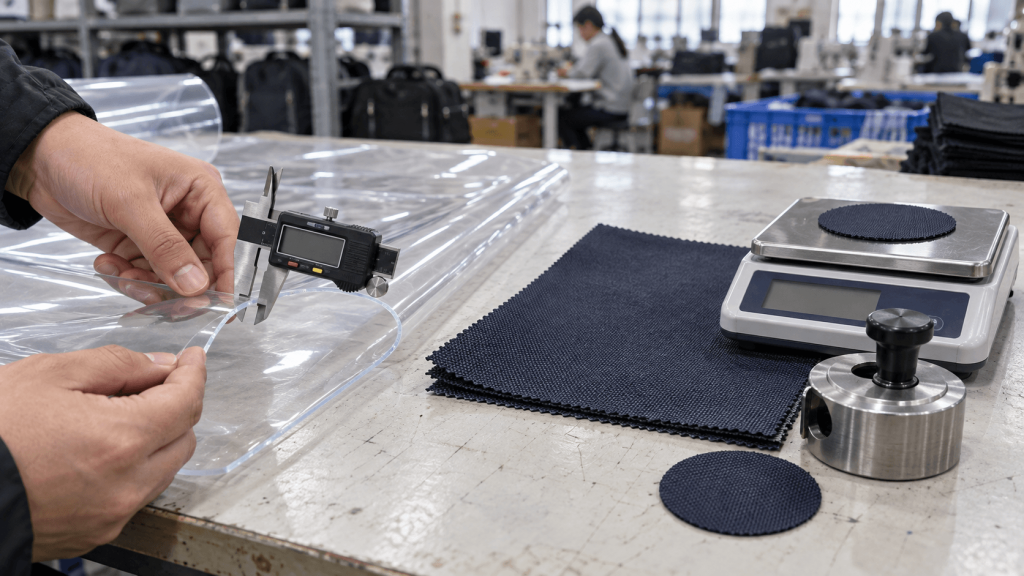
A customer may compare 0.50 mm PVC with 600D polyester.
and assume the thicker-looking specification must be stronger.
These specifications describe different things.
PVC sheet is commonly discussed by thickness.
Polyester fabric is commonly described using factors such as:
- Yarn denier
- Fabric weight
- Weave
- Coating
- Backing
- Surface finish
So 0.50 mm PVC and 600D polyester are not equivalent material grades. One describes sheet thickness; the other describes yarn linear density.
A 600D polyester specification is still incomplete if we do not know the weave, fabric weight, and coating.
Thicker PVC Is Not Automatically Better
When buyers want a PVC bag to feel more premium, one of the first requests is often: “Can you make the PVC thicker?”
Sometimes that makes sense.
But moving from 0.30 mm to 0.50 mm can also create:
- More weight
- Higher material cost
- Less foldability
- A stiffer opening
- Bulkier seams
- More difficult turning during sewing
- More difficult packing
The correct thickness depends on the product dimensions and structure.
The same PVC thickness can feel firm on a small pouch and surprisingly soft on a large tote.
Large panels also behave differently because sagging, panel deformation, and handle stress increase as the product size changes.
The goal is not to specify the thickest PVC available.
It is to specify enough body for the actual product.
Handle and Seam Reinforcement
This is one of the most important construction issues in both PVC and polyester bags.
Imagine a clear PVC tote carrying a heavy load through two webbing handles.
The load path is approximately:
Bag Contents → PVC Panel → Reinforcement / Stitching → Webbing Handle
If the attachment area is too small, stress can concentrate around the stitch holes.
Simply increasing PVC thickness may not solve the problem.
We also need to consider:
- Reinforcement patch size
- Webbing width
- Stitching pattern
- Handle overlap
- Load distribution
- Distance from the panel edge
The same principle applies to polyester bags.
A 600D polyester tote can still fail if the webbing overlap is too short, the sewing area is too small, or the reinforcement is poorly designed.
Bag durability comes from the material + load path + reinforcement—not the material name alone.
Fold Marks, Packing and Surface Appearance
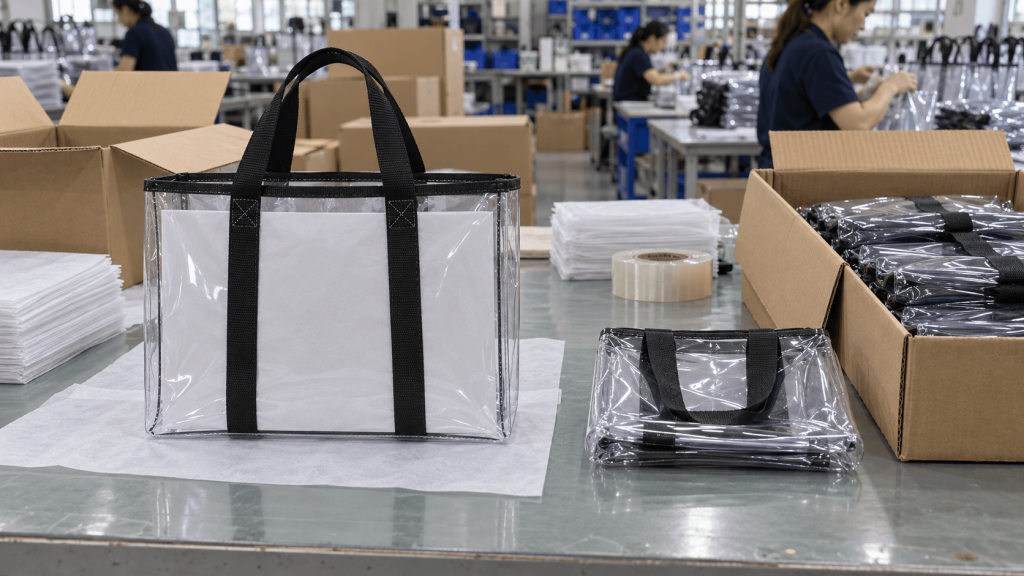
PVC bags are often folded before shipping.
That sounds like a packaging detail, but it can become a product-quality issue.
Thicker or stiffer clear PVC may show:
- Fold marks
- Creases
- Panel distortion
- Pressure marks
These defects are especially noticeable when clarity is part of the product value.
For premium transparent products, the packing method may need to be discussed during development:
- Flat packing
- Folded packing
- Paper or foam inserts
- Individual protection
- Carton pressure
- Number of units per carton
Many standard woven polyester fabrics are generally more forgiving when folded for shipment.
This is a good example of why:
Material choice can change the packing method.
Printing, Odor and Compliance
Branding should also be considered before material approval.
Clear PVC and polyester do not offer exactly the same logo options.
| Material | Common Branding Directions |
|---|---|
| Clear PVC | Screen printing, compatible surface printing, sewn patches, printed inserts, branding on trims |
| Polyester | Screen printing, heat transfer, sublimation where suitable, embroidery, woven patches, rubber badges |
On clear PVC, logo size and placement can also affect the product’s main visual feature: transparency.
Surface compatibility matters as well. Printing should be checked for adhesion, scratching, and appearance during sampling.
Odor is another issue buyers sometimes reduce to: “Does PVC smell?”
A better sourcing approach is to treat odor as a material formulation and quality requirement, rather than assuming every PVC material will behave the same way.
Material formulation matters because flexible PVC can contain plasticisers and other additives. ECHA notes that phthalates are commonly used as softeners to make plastics such as PVC more flexible and durable.
For products such as cosmetic bags, indoor storage products, or premium retail packaging, odor acceptance should be confirmed during sampling rather than after bulk production.
Chemical compliance also needs more detail than simply writing: PVC — REACH compliant
The requirements can depend on:
- Selling market
- Product category
- Intended user
- Child-related use
- Skin contact
- Restricted-substance requirements
- Customer-specific chemical standards
“REACH-compliant PVC” is not a complete material specification.
For EU projects, buyers should define the product and restricted-substance requirements before testing. REACH Annex XVII, for example, contains specific restrictions covering phthalates including DEHP, DBP, BBP and DIBP.
For regulated projects, the required chemical criteria should be defined before material approval and testing.
How to Specify PVC or Polyester in an RFQ?
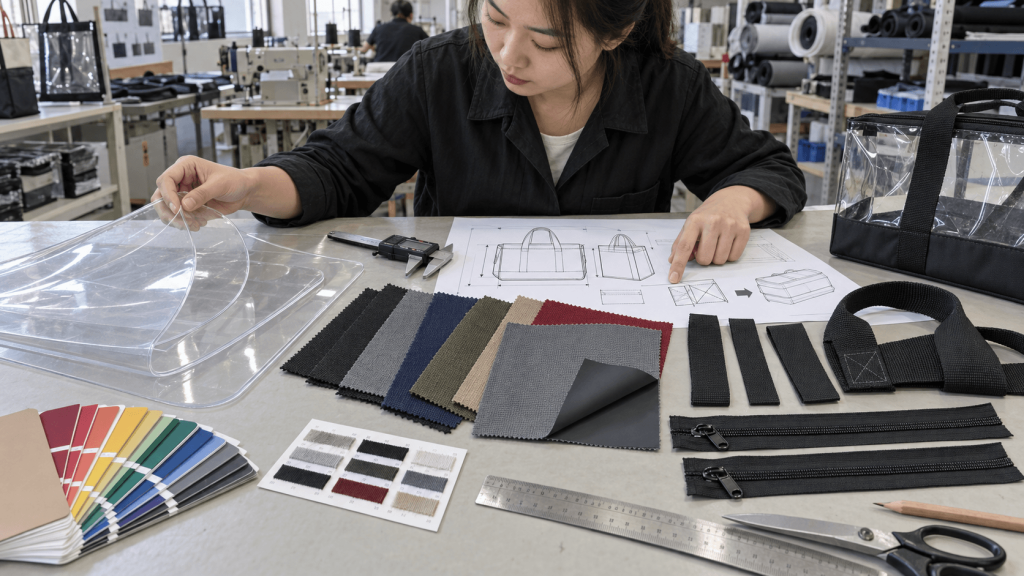
One of the easiest ways to receive inconsistent quotations is to ask several factories for: “PVC bag” or “600D polyester bag”
without defining the actual material construction.
Different factories may quote very different materials while using the same general name.
If you are building a complete sourcing document, our guide to bag tech packs explains how to turn material, construction and component requirements into a production-ready specification.
PVC Specification
For a clear PVC product, try to define:
| RFQ Item | Example |
|---|---|
| PVC type | Clear flexible PVC |
| Thickness | 0.30 mm |
| Finish | Clear / frosted / colored |
| Bag size | Finished dimensions |
| Structure | Sewn / bound / welded where applicable |
| Handle construction | Webbing type and reinforcement |
| Logo | Printing method and size |
| Packing | Flat or folded |
| Special requirement | Odor, low-temperature, or chemical requirements if applicable |
Do not choose PVC thickness without considering the finished bag dimensions.
A useful RFQ might read:
0.30 mm clear flexible PVC for a 30 × 25 × 10 cm tote, polyester webbing handles with reinforced attachment patches, screen-printed logo, individual flat packing.
That gives the factory far more useful information than PVC tote bag.
Polyester Specification
“600D polyester” is also incomplete.
A better specification may include:
| RFQ Item | What to Define |
|---|---|
| Fiber | Polyester |
| Denier | 210D / 420D / 600D / etc. |
| Fabric type | Oxford / ripstop / other weave |
| Fabric weight | GSM if controlled |
| Backing / coating | PU, PVC, or other requirement |
| Color | Pantone or approved swatch |
| Surface finish | As required |
| Intended use | Backpack, tote, duffle, etc. |
| Performance | Water resistance, abrasion, or other required testing |
A bag made from 600D polyester with PU backing may perform very differently from one made from another 600D fabric with a different weave, weight, or coating.
PVC-Coated Polyester Specification
This material should be described as its own construction.
Instead of writing PVC fabric consider something more precise 600D woven polyester with PVC backing
or another specification based on the actual approved material.
Also confirm:
- Polyester base construction
- Fabric weight
- PVC coating or backing
- Surface finish
- Required stiffness
- Color
- Intended bag panel
- Water-resistance requirement
- Any chemical or market-specific requirements
Clear PVC, polyester fabric, and PVC-coated polyester should never be treated as interchangeable RFQ terms.
The more accurately the material is described, the easier it is to compare factory quotations on the same basis.
Frequently Asked Questions
Is PVC or polyester better for bags?
Neither is universally better.
Clear PVC is usually more suitable when transparency, wipe-clean surfaces, or plastic-sheet construction are important. Polyester is generally more practical for backpacks, duffle bags, and other sewn products that need flexibility, padding, pockets, and reinforcement.
The intended product should determine the material.
Are PVC bags waterproof?
PVC sheet itself can prevent water from passing directly through the material, but a sewn PVC bag is not automatically waterproof.
Water can still enter through stitch holes, seams, zippers, bindings, and openings unless the complete bag construction is designed and sealed for waterproof performance.
What is PVC-coated polyester?
PVC-coated polyester uses a woven polyester base fabric with a PVC coating or backing.
It is different from clear PVC film. The polyester provides the textile structure, while the PVC layer changes properties such as stiffness, surface protection, body, and water resistance.
Should PVC Thickness Change With the Size of the Bag?
Potentially, yes.
The same PVC thickness can behave very differently on different panel sizes. A thickness that gives enough body to a small cosmetic pouch may feel too soft on a large tote because the larger panel has more area to sag and deform.
PVC thickness should therefore be selected together with the bag dimensions, panel size, opening construction, and expected load.
Is PVC cheaper than polyester for bags?
There is no fixed answer. Cost depends on PVC thickness, polyester denier/GSM, coating, bag size, reinforcement, logo process, quantity, and packing method. A simple clear PVC pouch may cost less than a complex polyester bag, while thick reinforced PVC can cost more.
Is polyester better than PVC for backpacks?
For most everyday backpacks, polyester is usually more practical because it works well with padding, lining, webbing, pockets, reinforcement, and complex sewn construction. Clear PVC is more useful when transparency or a wipe-clean plastic surface is an important part of the design.
Final Words
There is no universal winner in the PVC vs polyester comparison.
Clear PVC is valuable when transparency, easy cleaning, and plastic-sheet construction are central to the product.
Polyester is usually more versatile for complex sewn bags, padding, pockets, reinforcement, and repeated carrying.
PVC-coated polyester provides another option for products that need a woven textile structure together with a protective coating or backing.
The most useful factory principle is:
Bag durability comes from the material + load path + reinforcement—not the material name alone.
And sometimes the best product is not PVC versus polyester.
It is PVC plus polyester.
If you already have a product concept, tech pack, or reference sample, you do not need to decide the material first. Send us your product specifications, and we can review the bag size, structure, transparency requirements, expected load, packing method, and target market before recommending the most practical material construction.