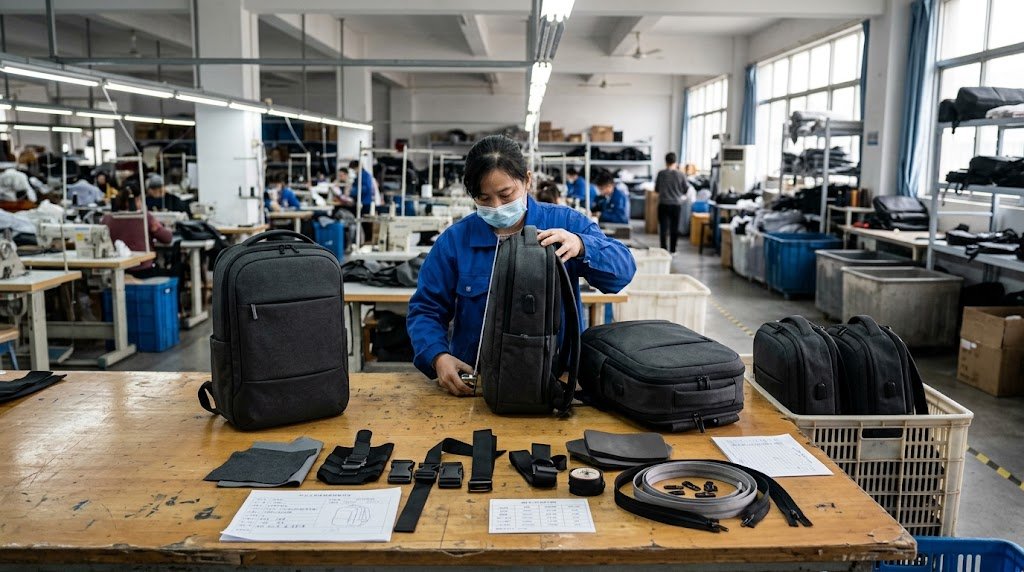
I’ve spent 12+ years inside bag factories — started on the QC floor checking stitching tension on sport duffel bags, now I run product development and OEM programs at Osgoodway.
Our factory has shipped over 100,000 car trunk organizers to Amazon sellers, fleet companies, and retail brands across 6+ countries. I’ve personally signed off on 200+ custom organizer SKUs. I know what fails at the seam, what melts in a Texas trunk, and what gets returned on Amazon within 48 hours. This article is the guide I wish someone had handed me on day one.
If you’re a consumer looking for "best trunk organizer on Amazon" — this isn’t that article. Close the tab.
This guide is for:
- Amazon FBA sellers planning a private-label car organizer line
- Brand owners evaluating OEM/ODM manufacturers in China
- Procurement managers sourcing bulk organizers for fleet vehicles, rental cars, or rideshare programs
- Product designers who need to understand manufacturing constraints before drawing the first sketch
I’m going to walk you through exactly how we build these products at our factory. Not theory. Not "top 10 tips." The actual process, with real costs, real failures, and real trade-offs.
Why Car Trunk Organizers Are a $2B+ Category Nobody Talks About
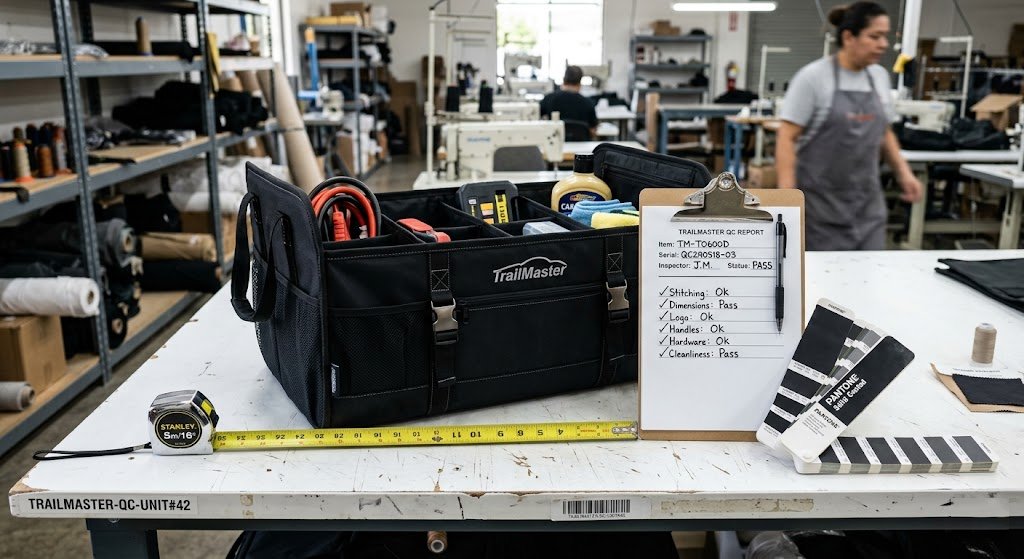
Most people underestimate this category. I did too, back in 2016, when a client asked us to develop our first collapsible organizer. I thought it was a niche side project.
The global automotive accessories market — which includes car organizers — is projected to surpass $2 billion by 2026, fueled by SUV dominance, Amazon FBA growth, and fleet/rideshare demand (sources: Grand View Research, Allied Market Research).
But the headline number isn’t what matters. Here’s what I’m seeing from the orders hitting our production line:
- SUVs and crossovers now outsell sedans in most markets. Bigger cargo areas = bigger organizers = higher average selling price. A sedan organizer retails for $20–$30. An SUV-specific organizer with insulated compartments? $45–$65.
- Amazon FBA sellers are the fastest-growing buyer segment for us. Low barrier to entry means more private-label brands launching every month — and every one of them needs a factory.
- Rideshare and fleet companies are the sleeper opportunity. Uber drivers, rental car agencies, delivery fleets — when they buy, they buy 500–5,000 at a time and they reorder.
- EV trunk designs (frunks, sub-trunks, flat cargo floors) are creating form factors nobody has nailed yet. First movers here will own the niche.
My take: If you’re still thinking about launching "another black collapsible box," you’re 3 years late. The margin is in specialized designs — insulated hybrids, backseat organizers with tablet holders, fleet-spec builds. That’s where 40%+ margins live, not the 15% slugfest on page 1 of Amazon.
→ Full market analysis: Car Trunk Organizer Market Trends 2026: What Brands and Sellers Need to Know
What Are the Main Types of Car Trunk Organizers?
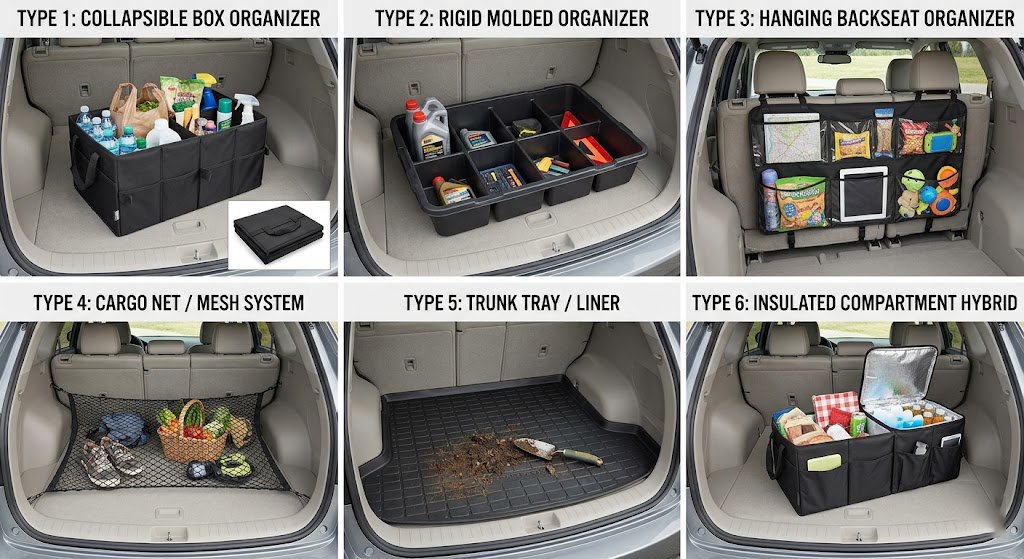
Walk into most factories and ask them to categorize their car organizer line. You’ll get a blank stare and a product catalog sorted by size. That’s not helpful when you’re making a production decision.
From a manufacturing standpoint, car trunk organizers break into 7 distinct types — each requiring different materials, tooling, sewing processes, and MOQs. Picking the wrong type is the most expensive mistake you can make because it locks you into a cost structure you can’t escape.
To help you navigate these choices, we have put together a comprehensive breakdown in our Types of Car Trunk Organizers: Factory Expert Sourcing Guide (2026), which explores the structural differences in deep detail.
The 7 Factory-Floor Categories
| # | Type | Structure | Typical Materials | Key Manufacturing Challenge | MOQ Range |
|---|---|---|---|---|---|
| 1 | Collapsible box organizer | Foldable walls with internal stiffeners | 600D Oxford + PP board inserts | Stiffener alignment during folding — 1mm off and it won’t fold flat | 500–1,000 |
| 2 | Rigid molded organizer | Hard-shell or semi-rigid ABS/PP frame | ABS injection + fabric wrap | Mold cost ($3,000–$8,000); long lead time | 1,000–3,000 |
| 3 | Hanging backseat organizer | Seatback-mounted with pockets & straps | 1680D polyester + PVC backing | Strap tension must handle 5kg+ without tearing headrest loop | 300–500 |
| 4 | Cargo net / mesh system | Elastic mesh or bungee-style | Nylon webbing + elastic cord + hooks | Hook compatibility across 50+ car models | 500–1,000 |
| 5 | Trunk tray / liner | Flat or shallow-rim tray | TPO/TPE rubber or EVA | Must be vehicle-specific (laser-measured fitment data) | 200–500 per model |
| 6 | Insulated compartment hybrid | Organizer with built-in cooler section | Oxford outer + TPU/PEVA inner lining | Seam-sealing the insulated zone without compromising the organizer structure | 500–1,000 |
| 7 | Multi-function combo | Organizer + lid (doubles as table/seat) | 600D–1680D Oxford + MDF/PP lid | Load-bearing testing — our first attempt failed at 30kg; now rated 80kg | 500–1,000 |
The mistake I see most often: New sellers pick Type 1 (collapsible box) because "it’s the easiest." Sure, the MOQ is low. But there are 10,000 identical listings on Amazon. Unless you’re differentiating on material, compartment design, or branding — you’re walking into a knife fight.
Collapsible vs. Rigid: Which Should You Manufacture?
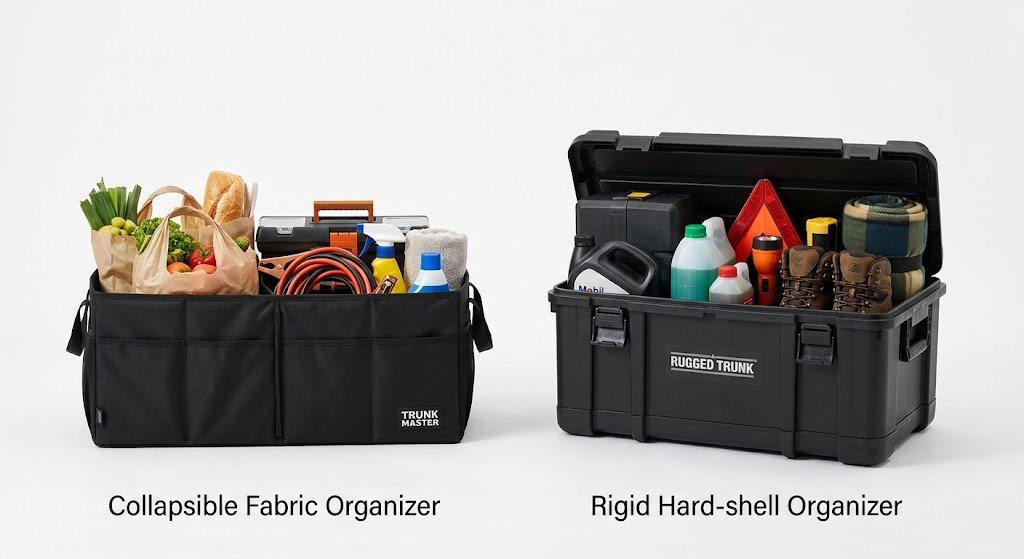
This is the first question on every discovery call I take. Let me save you 30 minutes.
Collapsible organizers cost 40–60% less per unit and ship 3x more efficiently per container. Rigid organizers last 3x longer, command higher retail prices, and generate near-zero returns. Your choice depends on whether you’re optimizing for cash flow or brand equity.
Head-to-Head: The Numbers That Matter
| Factor | Collapsible | Rigid (Molded) |
|---|---|---|
| Unit cost (1,000 pcs) | $4.50–$9.00 | $8.00–$18.00 |
| Tooling/mold cost | $0–$500 (die-cut templates) | $3,000–$8,000 (injection mold) |
| Shipping cost per unit | Low (folds flat, 60–70% less volume) | High (can’t compress) |
| Durability | Moderate — stiffeners degrade after 18–24 months | High — 5+ year lifespan |
| Perceived value (consumer) | "Meh, another collapsible box" | "This feels premium" |
| Lead time (first order) | 25–35 days | 45–60 days (mold fabrication adds 15–25 days) |
The Story I Tell Every New Client
We had a seller insist on ultra-thin PP board inserts — 0.8mm instead of our standard 1.5mm — to save $0.30/unit on a collapsible design. I pushed back. He insisted. His call.
Three months later, 6,000 units in Arizona trunks. The boards warped. Every single one. Full recall. The "$0.30 savings" cost him $45,000 in refunds and destroyed inventory.
We now have a hard rule: no PP board below 1.5mm for any collapsible organizer shipped to hot climates. Period. I don’t care what your budget says.
Factory secret: If you want the economics of collapsible with the feel of rigid, there’s a middle path — semi-rigid. We use 2.5mm PP board with reinforced corner stitching. It doesn’t fold fully flat (adds ~40% to shipping volume vs. true collapsible), but it holds shape for 3+ years. Unit cost is $6–$10. I’ve been pushing this option hard for two years and every client who’s taken it has reordered.
Anatomy of a Premium Trunk Organizer: 8 Components, 8 Failure Points
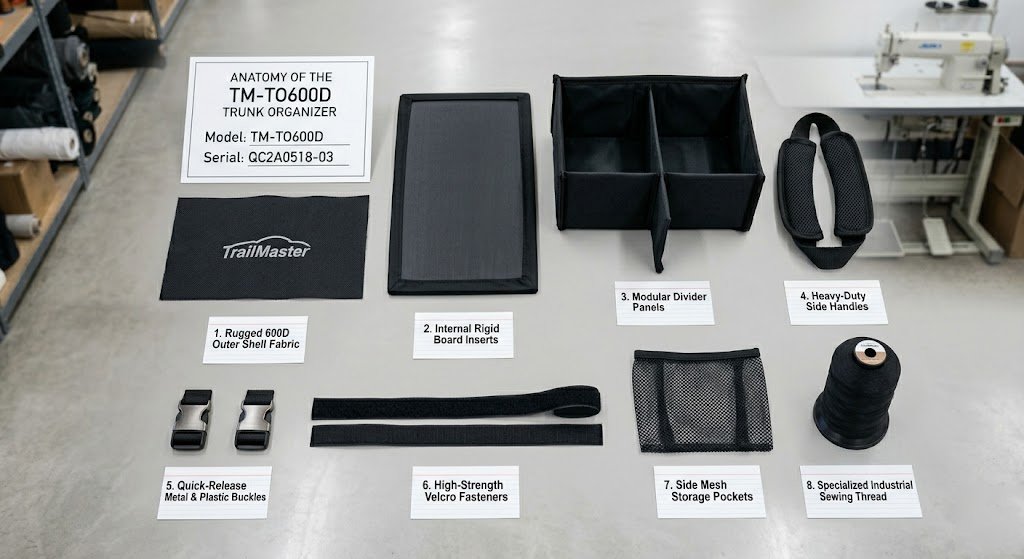
Before we talk materials and factories, you need to understand what you’re actually buying. A trunk organizer looks simple. It’s not. There are 8 distinct components, and each one is a potential point of failure that cheap factories love to cut corners on.
Here’s how we break it down on our production floor:
| # | Component | What It Does | Where Cheap Factories Cut Corners |
|---|---|---|---|
| 1 | Outer Fabric (600D*600D Oxford + PVC backing) | The armor. Takes abrasion from groceries, tools, sports gear sliding around your trunk. | Downgrade to 420D with no backing. Looks identical in photos. Falls apart in 90 days. |
| 2 | Board Insert (PP plastic sheet, 2-3mm) | The skeleton. Gives the organizer its shape and load-bearing capacity. | Swap to grey cardboard. Saves $0.40/unit. Destroys your reviews when it gets wet. |
| 3 | Divider Walls | Create compartments. Must be perfectly perpendicular or items slide and the organizer looks sloppy. | Use grey cardboard is fine to save cost, Sew dividers at slight angles to save alignment time. You won’t notice until you load it. |
| 4 | Carry Handle | Lets you lift a loaded organizer (often 10kg+) without ripping. | Single-stitch attachment. Rips under load in 2–3 months. We use double box-X stitching. |
| 5 | Box-X Stitching (Tex 90 bonded nylon) | Structural reinforcement at every stress point — handles, straps, divider junctions. | Use generic polyester thread. Cheaper, but degrades under UV exposure inside hot trunks. |
| 6 | Mesh Pockets (calibrated elastic) | Hold small items (phones, bottles, cables) without sagging. | Use random elastic with no tension spec. Pockets sag after 2 weeks. Looks terrible. |
| 7 | Velcro Base | Keeps the organizer from sliding around your trunk. | Use cheap hook-and-loop that loses grip after ~50 open/close cycles. |
| 8 | Side Buckle + Strap | Collapse system for foldable designs. Also secures expanded shape. | Use undersized buckles that snap under lateral pressure. |
Why this matters for sourcing: When a factory quotes you $5.50 vs. $9.50 FOB, the difference isn’t "margin." The difference is which of these 8 components they’re downgrading. A $5.50 organizer typically cuts corners on 3–4 of them. You won’t see it in the sample — you’ll see it in your return rate 60 days after launch.
I always tell new buyers: don’t ask "how much?" first. Ask "show me a cross-section of your board insert and a close-up of your handle stitching." That one question filters out 70% of factories that can’t deliver.
Materials Deep Dive: What Actually Goes Into a Car Trunk Organizer
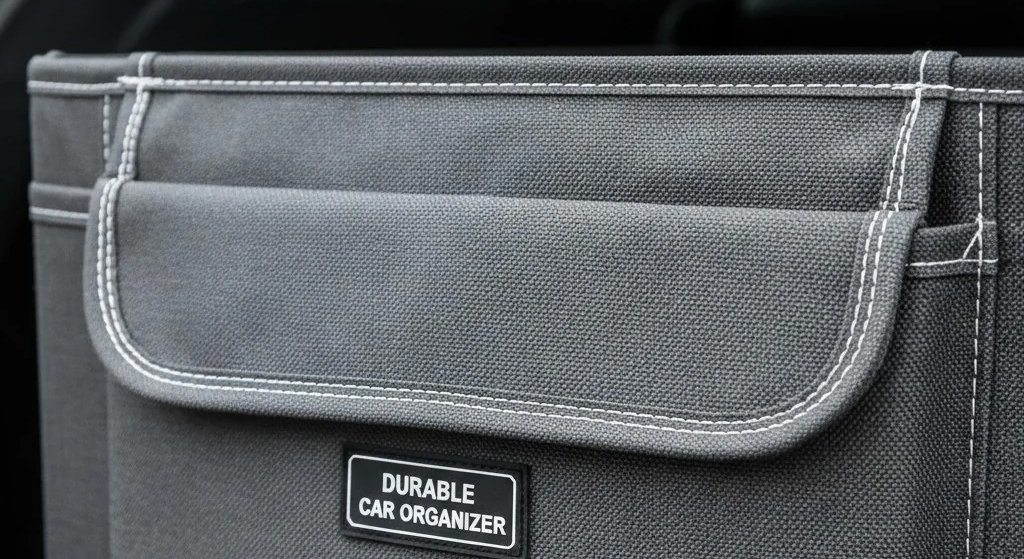
Most blogs list "materials" like they’re reading a grocery receipt. Here’s what actually matters — and what will make or break your product reviews.
The Board Insert: Your Organizer’s Skeleton
This is the single most important component, and it’s the one buyers screw up most often.
| Board Type | Thickness | Pros | Cons | Our Verdict |
|---|---|---|---|---|
| PP Honeycomb Board | 3–5mm | Lightweight, foldable, cheap | Weak lateral rigidity, warps in heat (60°C+) | Fine for sub-$15 retail products. That’s it. |
| Grey Cardboard | 2–3mm | Cheap, easy to wrap | Dies the first time it gets wet. Period. | We refuse to use it for main structure. Acceptable only for divider walls. |
| MDF Board | 3–5mm | Rigid, premium feel | Heavy, adds shipping cost, no folding | Use only for luxury/fixed-install organizers or combo lids |
| PE Foam Board | 4–6mm | Light, some water resistance | Dents under sustained load | Acceptable mid-range option |
| PP Plastic Sheet | 1.5–3mm | Waterproof, consistent | Less rigid than MDF, can feel "cheap" if thin | Our go-to for 70% of orders. Best cost-to-performance ratio. |
Hard-learned lesson: In 2019, a US Amazon seller insisted on grey cardboard inserts to save $0.40/unit. Three months after launch, returns hit 22%. Water from grocery bags seeped in, the board swelled, and the organizer became a soggy box. We now refuse grey cardboard orders for structural components unless the client signs a written quality waiver. That $0.40 savings cost that seller roughly $35,000 in returns and tanked their listing.
Another one: A different seller insisted on ultra-thin PP board — 0.8mm instead of our standard 1.5mm — to save $0.30/unit on a collapsible design. I pushed back. He insisted. Three months later, 6,000 units in Arizona trunks. The boards warped. Every single one. Full recall. We now have a hard rule: no PP board below 1.5mm for any collapsible organizer shipped to hot climates. Period.
Outer Fabric: The Face of Your Product
Here’s something half the Alibaba suppliers won’t tell you: 600D Oxford and 600D polyester are not the same thing. Oxford is a specific weave pattern — basketweave — that creates a thicker hand-feel and better abrasion resistance than plain-weave polyester at the same denier. When a supplier says "600D polyester," ask: "Oxford weave or plain weave?" If they can’t answer, walk away.
| Fabric | Denier / Weight | Abrasion Resistance (Martindale Cycles) | Water Resistance | Best For | Cost Index |
|---|---|---|---|---|---|
| 600D Polyester (plain weave) | 150D–600D / 180–220 g/m² | 15,000–20,000 cycles | Moderate (with PU coating) | Budget Amazon listings, promo giveaways | $ |
| 600D Oxford with PVC Backing | 200–250 g/m² | 20,000–30,000 cycles | High | Best all-around choice — our recommendation | $$ |
| 1680D Ballistic Nylon / Cordura-type | 300–400 g/m² | 40,000+ cycles | High | Premium/tactical positioning, military/high-end | $$$ |
| Faux Leather (PU) | 0.8–1.2mm | Varies wildly by grade | Excellent | Luxury aesthetic, but scratches easily | $$ |
| PP Non-woven | 70–120 GSM | 5,000–8,000 cycles | Poor | Disposable/event giveaways, ultra-low-cost | ¢ |
| Canvas (cotton-poly blend) | Measured in oz | Moderate | Low (unless waxed) | Vintage/lifestyle branding | $$ |
Abrasion testing reference: Martindale method per ISO 12947-2. If your factory can’t cite this standard by name, that’s a red flag.
We always recommend PU or PVC coating on the backside of Oxford cloth for car organizers. Trunks get wet. Groceries leak. Kids spill. Without coating, the fabric wicks moisture into the stiffening boards and you get mold in 3 months. The coating adds $0.15–$0.25/unit. Skip it and you’ll pay thousands in returns.
What I actually recommend: 600D Oxford with PVC backing. Every time. It handles grocery bags, tool kits, dog crates, and road trip chaos. The 1680D ballistic nylon is overkill for 90% of use cases — you’re paying for a spec sheet number, not real-world performance.
→ Lab-tested fabric comparisons: Car Organizer Fabrics Compared — Oxford Cloth vs Polyester vs PP Non-Woven
Hardware: The Part Everyone Ignores Until It Breaks
People obsess over fabric and ignore hardware. That’s backwards. Hardware fails first.
- Handles: Box-stitch (X-pattern) with bonded nylon thread. Single-line stitching rips. We pull-test every handle at 15kg. Non-negotiable.
- Buckles: Duraflex over generic POM. 60% cheaper than YKK, 95% as durable. We stopped using generic POM buckles after a batch cracked in cold weather (-10°C) in 2021.
- Zippers: SBS #5 minimum. I’ve rejected three zipper suppliers in two years for inconsistent pull strength. A #3 coil saves you $0.08 and gets you a 1-star review. YKK zippers add $0.30–$0.50 vs. SBS — worth it only for premium positioning.
- Base plate: PP corrugated board. Never cardboard. Cardboard in a humid trunk is a death sentence. I won’t quote a project that specs cardboard.
- Velcro: Industrial-grade hook-and-loop rated for 1,000+ cycles. For vehicles with plastic trunk liners (common in EVs), high-friction silicone pads are the better choice.
The Manufacturing Process: How We Actually Build These
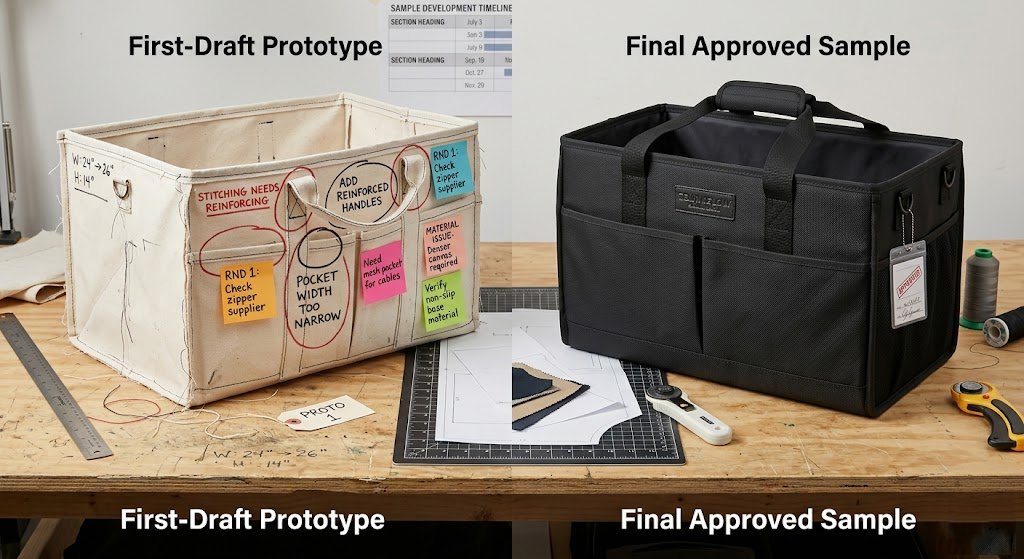
I’m not going to give you a textbook flowchart. Here’s the actual process I oversee every week, with real pain points and production bottlenecks that nobody else mentions.
A custom car trunk organizer goes through 4 stages — design/sampling (15 days), pre-production (10 days), mass production (20 days), and inspection/shipping (10 days). Total lead time: 45–70 days from approved brief to loaded container. Anyone promising 30 days for a new product is cutting corners.
Stage 1: Design & Sampling (Days 1–15)
You send us a sketch, a reference product photo, or an Amazon listing you want to improve. We get on a call. Then:
- Our pattern team draws a 2D technical layout in CAD software — not by hand-tracing old samples
- Every compartment gets a load-bearing simulation — will a 5kg bag of rice crush the divider? If yes, we reinforce
- Foldable designs require hinge-point stress testing — the fold line is always the first failure point
- First sample gets cut and sewn by hand in our sample room. This is a shape/function check, not a beauty contest
- Revisions. 90% of first samples need changes. Average: 2–3 rounds
- Pre-production sample (PPS) — made with actual production materials. This is your "golden seal"
Red flag: If a factory sends you a "pattern" that’s just a photo of a similar product with your logo Photoshopped on — run. And if your factory sends a "perfect" first sample with no discussion about revisions, be suspicious. Either they’ve made this exact product 50 times before (for other clients — meaning zero differentiation for you), or they’re cutting corners that’ll show up in bulk.
Stage 2: Pre-Production & Material Sourcing (Days 15–25)
- We test every fabric roll with a GSM cutter — if the supplier spec says 600D/250gsm and our cutter reads 210gsm, the roll goes back
- Board inserts are measured for consistent thickness across the entire sheet — cheap boards vary ±1mm, which causes assembly fit issues
- Thread check: We only use Tex 90 bonded nylon thread for structural seams. Polyester thread breaks down under UV exposure in car trunks
- Die-cut templates and jigs fabricated
- Production line setup. Worker briefing
- Inline QC checkpoints defined per ISO 2859-1
Stage 3: Mass Production — Cutting, Sewing & Assembly (Days 25–50)
Cutting (1–2 days):
- Die-cutting for orders over 500 units — consistent, fast, clean edges
- Laser cutting for complex shapes or very small runs
- Manual cutting only for samples — and even then, our cutters have 5+ years experience
Sewing & assembly — the bottleneck (60% of lead time):
This is where skilled labor earns its cost. Here’s the actual assembly sequence with time-per-unit:
| Step | Time/Unit | Skill Level | What We’re Checking |
|---|---|---|---|
| Fabric cutting (die-cut) | 30 sec | Low | Pattern alignment, no fraying |
| Stiffener insertion | 20 sec | Low | Board dimensions ±1mm |
| Base panel sewing | 8–12 min | Mid | Uneven seam allowances → wobbly base |
| Divider attachment | 10–15 min | High | Dividers not perpendicular → items slide |
| Lining attachment | 2–3 min | Mid | Seam seal integrity |
| Handle/strap install | 5–8 min | High | Under-reinforced → handles rip under 10kg |
| Buckle/velcro attachment | 3–5 min | Mid | Wrong velcro grade → loses grip after 50 cycles |
| Elastic mesh pockets | 6–10 min | High | Elastic tension inconsistent → pockets sag |
| Final board insertion & assembly | 3–5 min | Low | Board edges visible through fabric → looks cheap |
| QC inspection | 1–2 min | High | AQL 2.5, Level II per ISO 2859-1 |
| Packing | 30 sec | Low | SKU match, barcode, poly bag seal |
Total touch time per unit: 12–20 minutes for simple models, 35–55 minutes for complex multi-compartment designs. Any factory quoting you 20 minutes for a complex organizer is either lying or skipping steps. Our factory runs ~3,000 units/day across 4 production lines.
Our biggest trial-and-error: We spent 4 months in 2021 trying to automate divider attachment with a jig system. Failed. The angle variations between different organizer models made the jig useless after every SKU change. Skilled hands still beat machines for this step. We went back to experienced sewers and haven’t looked back.
Stage 4: Quality Control & Shipping (Days 50–60)
We don’t do "random inspection." Every single unit goes through our 4-point QC system:
- Visual check — fabric surface, stitching straightness, logo placement (±3mm tolerance). Stitch density: 7–9 stitches/inch per ISO 4915.
- Structural check — load test each compartment with 5kg weight for 30 seconds. Handle pull-test: 15kg static load.
- Fold test (if applicable) — fold/unfold 20 times, check hinge integrity
- Fit test — place in a standard trunk mock-up (we keep 4 trunk templates: sedan, SUV, hatchback, pickup)
Defect rate we consider acceptable: Under 2%. Industry average from trading companies is 5–8%. That gap is where your one-star reviews come from.
Third-party inspection available on request — we work with SGS, Bureau Veritas, and TÜV.
What Fails First — And How Do We Catch It?
After QC-checking hundreds of thousands of car organizers, I can tell you exactly where things break. The failure pattern is remarkably consistent.
The top 3 failure points on car trunk organizers are handle detachment (weak stitching), stiffener board warping (thin PP in hot climates), and zipper failure (cheap sliders). Together, these account for roughly 80% of all defects and returns we’ve tracked over the past 5 years.
Our Failure Heat Map
| Rank | What Breaks | Why It Breaks | How We Kill It |
|---|---|---|---|
| 1 | Handle detachment | Single-line stitching + cheap thread | Box-stitch with bonded nylon. 15kg pull-test on 100% of units. |
| 2 | Stiffener warping | PP board <1.2mm + trunk heat | 1.5mm minimum. Heat-chamber test at 60°C for 4 hours. |
| 3 | Zipper failure | Low-quality slider, misaligned teeth | SBS brand minimum. 500-cycle test on samples. |
| 4 | Lining delamination | Bad adhesive on waterproof models | RF-welded seams (TPU) or heat-tape (PEVA). |
| 5 | Color fading | No UV stabilizer in dye | AATCC 16.3 test, 40-hour minimum. Grade 4+ or we reject the fabric. |
The Standards We Follow (With Links So You Can Verify)
I’m linking every standard because I’ve seen too many factory blogs throw around "ISO certified" without saying which ISO or what it tests. If your supplier can’t point you to the actual document, they’re not following it.
- ISO 2859-1 — Acceptance sampling framework. This is "AQL." For a 3,200-unit order: inspect 200 units, accept ≤10 defects. If your supplier can’t recite this, they’re not doing real QC.
- ISO 4915 — Stitch classification and measurement. When I say "7–9 SPI," this is how we measure it.
- AATCC 16.3 — Colorfastness to light (xenon-arc). We require Grade 4/5. Grade 3 fades visibly after one summer in a trunk.
- REACH (EC 1907/2006) — EU restricted substances. 200+ chemicals. Miss one and customs holds your container.
- CPSIA — US lead/phthalate limits. Technically for children’s products, but Walmart and Target require it for all soft goods.
What Can You Actually Customize?
I get this question daily, and the answer is always: "More than you think — but less than you want at 300 pieces."
OEM vs. ODM vs. Private Label: Cut the Confusion
| Model | What It Actually Means | Who It’s For | Typical MOQ |
|---|---|---|---|
| OEM | You provide the complete design, specs, materials list. We manufacture exactly to your blueprint. | Established brands with in-house product teams | 1,000 units |
| ODM | We design and engineer the product. You put your brand on it. | Sellers who want speed to market without R&D cost | 500 units |
| Private Label | You pick from our existing models, add your logo/colors/packaging. Minimal customization. | Amazon sellers, startup brands testing the market | 200–300 units |
My honest take: If you’re new to this category, start with private label or ODM. I’ve seen too many first-time buyers burn $20K+ on a fully custom OEM design that flopped because they didn’t understand trunk organizer ergonomics. Get market feedback first. Iterate later.
The Four Levels of Customization
| Level | What You Get | MOQ | Lead Time | Added Cost |
|---|---|---|---|---|
| 1 — Logo only | Your logo printed/embroidered on our existing product | 100–300 | 15–20 days | +$0.30–$0.80/unit |
| 2 — Color + logo | Custom fabric color, your logo, existing structure | 300–500 | 25–30 days | +$1.00–$2.00/unit |
| 3 — Semi-custom | Modified dimensions, changed compartments, custom hardware | 500–1,000 | 30–40 days | +$2.00–$5.00/unit |
| 4 — Full OEM/ODM | Ground-up design from your sketches or CAD files | 1,000–3,000 | 45–75 days | +tooling $500–$8,000 |
How We Actually Brand Products
Heat transfer is what I push for 80% of Amazon sellers. Full-color logos, decent durability, $0.25–$0.60/unit, MOQ 100. It’s the sweet spot.
- Screen printing ($0.15–$0.40/unit) — fine for simple 1–3 color logos. Fades after 50+ washes. Okay for promo items, not for brands you’re building.
- Embroidery ($0.50–$1.50/unit) — lasts forever, feels expensive. But only works for small logos under ~8cm. Large embroidery puckers soft fabric and looks amateur.
- Rubber PVC patches ($0.40–$1.00/unit + ~$200 mold) — trending hard in tactical/outdoor. Waterproof, 3D, indestructible. If you sell to Jeep/overlanding customers, this is the move.
- Woven labels ($0.08–$0.20/unit) — cheap finishing touch. Side labels, brand tags. Small investment, outsized perception of quality.
The Color Trap
"I want Pantone 2728C blue." Great. But fabric dyeing has a tolerance of ±5% in batch production. Your reorder might not match your first order exactly. We mitigate this by keeping dye-lot records and running a lab-dip sample before every bulk run. But you need to know this limitation exists. No factory on Earth can guarantee zero color variation across batches. Anyone who promises that is lying.
Pro tip: Always specify Pantone PMS references in writing. "Make it dark blue" means something different to every factory. We’ve had orders delayed 2 weeks over color disputes that a $0 Pantone code would have prevented.
Here’s an approximate cost structure for a mid-range, foldable, 3-compartment trunk organizer in 600D Oxford with PU coating. These are real numbers from our 2025–2026 production runs at 1,000-unit order volume.
| Cost Component | % of FOB Price | Typical Range (USD) | Notes |
|---|---|---|---|
| Outer fabric (600D Oxford PVC/PU) | 20–28% | $1.70–$3.00 | Biggest variable — fabric quality swings cost heavily |
| Board inserts (PP sheet, 1.5mm+) | 10–15% | $0.75–$1.50 | Die-cut, pre-scored for folding |
| Hardware (buckles, velcro, zippers, handles) | 5–10% | $0.50–$0.80 | YKK zippers add $0.30–$0.50 vs. SBS |
| Inner lining (waterproof/basic) | 5–8% | $0.30–$0.50 | Insulated PEVA lining adds $1.50 |
| Thread + binding tape | 2–3% | $0.15–$0.25 | Don’t cheap out here. Ever. |
| Direct labor (cut, sew, assemble, QC) | 25–30% | $1.80–$3.50 | Skilled labor is the biggest cost driver |
| QC + rework | 3–5% | $0.30–$0.50 | Higher for new SKUs, drops after 2nd production run |
| Packaging (poly bag + carton) | 3–5% | $0.30–$0.60 | Custom retail box adds $0.80–$1.50 |
| Factory overhead + margin | 10–20% | $0.45–$2.50 | — |
| Total FOB (China port) | 100% | $6.00–$12.50 | Scale: ~$6 at 1,000+ pcs basic / ~$10–12.50 at 500 pcs with upgrades |
What Moves the Needle on Cost
- 1680D Oxford instead of 600D: +$1.20/unit
- PEVA insulated compartment: +$1.50/unit
- Rigid ABS frame instead of PP board: +$3.00–$6.00/unit (plus $3K–$8K mold cost)
- Full-color heat-transfer logo: +$0.40/unit
- Custom retail box: +$0.80–$1.50/unit
Shipping Reality Check (2025–2026 Rates)
This is the hidden cost nobody mentions until it’s too late.
- Sea freight to US West Coast: $0.80–$1.50/unit (in a full container with other goods)
- Dedicated 20ft container: ~$2,500–$3,800 (fits roughly 2,000–3,000 collapsible organizers depending on size)
- 40ft container: ~8,000 collapsible units vs. ~2,500 rigid units — that’s 3x the per-unit shipping cost for rigid
- Air freight: $4–$6/kg — only makes sense for urgent small batches
I’ve had clients finalize a rigid design, get the FOB price, celebrate — and then see the freight quote and panic. Factor shipping into your cost model before you commit to a product type. Not after.
Import duty (US): Trunk organizers typically fall under HTS 4202.92 — duty rate around 17.6%. Factor this in. Many first-time importers forget and get sticker shock at customs.
How to Evaluate a Factory (From Someone Who IS the Factory)
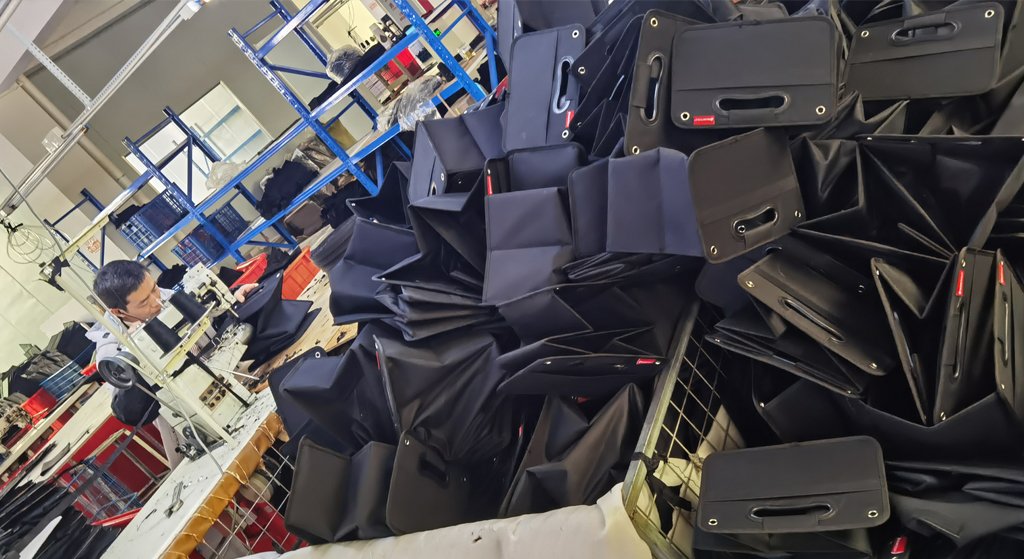
I’m about to tell you how to evaluate factories like mine. Yes, this might be used against us. I don’t care — it filters out tire-kickers and brings us serious buyers.
The 7 Questions That Separate Real Factories from Trading Companies
-
"Can you show me your cutting room and sewing floor on a live video call?"
Trading companies will stall. Factories will show you — messy floor, noisy machines, and all. -
"What thread type and weight do you use for load-bearing seams?"
If they can’t answer immediately (Tex 70–90 bonded nylon or polyester), they don’t control production. -
"What’s your defect classification system?"
Real answer: "We use a critical/major/minor system based on AQL 2.5." Fake answer: "We check everything very carefully." -
"Can you send me a cross-section photo of your board insert?"
This reveals material quality instantly. Cheap factories use recycled board with visible contamination. -
"What’s your actual production capacity per day for this product type?"
Honest answer: "40–80 units per line, depending on complexity." Inflated answer: "We can do 500 a day easy." (That’s physically impossible for a quality trunk organizer.) -
"Do you do in-house printing/embossing or outsource it?"
Outsourced logo work adds 3–5 days and a quality control blind spot. -
"Show me a failed QC report."
Any factory that claims zero defects is lying. We share our QC rejection data because it proves we actually inspect.
The Five Manufacturing Hubs (And What Each Is Good For)
If you’re comparing suppliers across regions, here’s the landscape:
Quanzhou, Fujian (China) — where we are. Largest bag-making cluster in the world. Our fabric suppliers are 30 minutes away. That means 3-day material procurement, not 3-week. Downside: quality varies wildly. There are 2,000+ bag factories here. Maybe 200 are worth your time.
Dongguan, Guangdong (China) — the premium tier. Decades of experience with Western brands. Higher labor costs (20–30% above Quanzhou), and fabric sourcing takes longer because the textile mills aren’t local. If budget isn’t your constraint, Dongguan is solid.
Baoding, Hebei (China) — strong in automotive accessories specifically, close to OEM car plants. Less experienced with lifestyle branding. Good for fleet/functional products.
Vietnam — the tariff play. Lower US duties on some bag categories. But the supply chain is thin — most raw materials still come from China, adding 2–3 weeks. Expertise in car organizers specifically is still shallow.
India — lowest labor cost, period. But material variety is limited and QC consistency requires substantially more oversight. Fine for basic, high-volume, simple-construction products.
Red Flags to Watch For
- No factory tour available. "We’re a trading company partnered with factories" = markup with no QC control.
- MOQ below 100. They’re subcontracting to tiny workshops or lying.
- "We can do everything." Bags, shoes, hats, electronics, furniture? They excel at nothing.
- No certifications displayed. Not having ISO isn’t disqualifying. Refusing to get audited is.
- Sample takes 3+ weeks. They don’t have a sample room, or they’re deprioritizing you.
- Price is 30%+ below everyone else. They’re cutting something you can’t see yet. You’ll find it in month 3 when the returns start.
Common Sourcing Mistakes (I’ve Watched Buyers Make Every Single One)
Mistake #1: Choosing the lowest quote.
The $5.50 FOB quote uses 420D polyester, grey cardboard, and generic thread. Your product will look fine in photos and fall apart in 60 days. I guarantee it.
Mistake #2: Skipping the pre-production sample.
"Just use the same as last time" — except the fabric supplier changed dye lots, the board supplier switched thickness, and now your new batch looks noticeably different from your existing inventory.
Mistake #3: Not specifying Pantone colors in writing.
"Make it dark blue" means something different to every factory. Pantone PMS references eliminate arguments.
Mistake #4: Ignoring packaging until the end.
Packaging affects carton dimensions, shipping costs, and warehouse storage. Design it in parallel with the product, not as an afterthought.
Mistake #5: Not testing in an actual car trunk.
We keep trunk templates in our factory for a reason. Your organizer might look great on a table and not fit behind a spare tire well. We test fit every new design. Ask if your factory does the same.
Mistake #6: Ignoring shipping economics when choosing product type.
As covered in the cost section — rigid organizers ship at 3x the per-unit cost of collapsible. Build your landed cost model before you commit to a design direction, not after you’ve approved the sample.
Our Actual Production Timeline (Honest Numbers)
| Phase | Duration | What’s Happening |
|---|---|---|
| Initial consultation + quote | 2–3 days | We review your design files, material preferences, quantities |
| Sample development | 7–12 days | Pattern engineering, material sourcing, first prototype |
| Sample revision (if needed) | 5–7 days | Typical: 1–2 rounds of revision |
| Sample approval + deposit | 1–3 days | 30% deposit standard in the industry |
| Bulk material procurement | 10–15 days | Fabric, board, hardware — this is the hidden delay |
| Bulk production | 15–25 days | Depends on quantity and complexity |
| Final QC + packing | 3–5 days | Our 4-point inspection system |
| Total (sample to shipment) | 45–70 days | Anyone promising 30 days for a new product is cutting corners |
First-time orders with tooling (rigid molds, custom die-cut templates) add 10–15 days to the front end.
What Makes Osgoodway Different? (The Pitch, But Honest)
I’m not going to pretend we’re the cheapest. We’re not. Here’s what you actually get:
- We’re a factory, not a trading company. You talk to the people who cut, sew, and inspect your product. Same building. Same team.
- Dedicated trunk/car organizer production line. This isn’t a side hustle for us — we’ve made organizers for automotive accessory brands across 15+ countries, shipping 100,000+ units.
- In-house logo application. Screen printing, heat transfer, embossing, woven labels — all done on-site. No outsourcing, no quality gaps.
- Transparent QC reporting. You get photos, measurements, and defect data for every production run. Not just the pretty ones.
- Real MOQs for real businesses. 200 units for private label. 500 for ODM. 1,000 for OEM. We don’t play the "MOQ 1,000 but actually we want 5,000" game.
What we won’t do:
- We won’t match a $5 FOB quote from a factory using recycled materials. If you want that, we’re not your factory.
- We won’t skip the pre-production sample to save time. It exists for a reason.
- We won’t tell you "yes" to every request. If your design has a structural flaw, we’ll tell you — and propose a fix.

Ready to Talk?
If you’ve read this far, you’re serious about sourcing. Here’s how to start a conversation that doesn’t waste your time or ours:
Send us:
- Your product concept (sketch, reference photo, or competitor link)
- Target retail price point
- Estimated annual quantity
- Target market (US, EU, other — affects compliance requirements)
What happens next:
- We send back a technical proposal within 48 hours — materials recommendation, estimated cost range, timeline
- Sample in 7–12 days — you see and touch the product before committing a cent to production
- You decide. No pressure. We’d rather you pick the right factory than the fastest one.
Contact Osgoodway Today
— We respond within 24 hours on business days. If we don’t — follow up. We’re in a factory, not a call center.
Frequently Asked Questions
How do I determine the right size for a universal-fit organizer?
Standard "universal" sizes typically range from 21" to 36" in length. We recommend a modular design with adjustable dividers, allowing the product to fit everything from compact sedans to large SUVs. We keep 4 trunk templates (sedan, SUV, hatchback, pickup) in-factory for fit testing.
Can I customize the internal layout of the trunk organizer?
Yes. Our OEM/ODM services let you specify compartment count, add mesh side pockets, include insulated cooler sections, or add non-slip Velcro/silicone strips on the bottom. Customization level depends on MOQ — see the four-level framework above.
How are trunk organizers shipped to reduce costs?
Collapsible organizers are shipped flat-packed or vacuum-sealed, significantly reducing volumetric weight. A 40ft container fits ~8,000 collapsible units vs. ~2,500 rigid units. We optimize carton dimensions during the packaging design phase to maximize container utilization.
How do you prevent the organizer from sliding during driving?
Two primary solutions: anti-slip rubber bottom stripping or industrial-grade Velcro strips. For vehicles with plastic trunk liners (common in EVs), high-friction silicone pads are the preferred choice.
What’s the difference between a $6 and a $12 FOB organizer?
Components. A $6 organizer uses basic 600D polyester, thinner PP board, generic hardware, and minimal QC. A $12 organizer uses PVC-backed Oxford cloth, 2mm+ PP board, branded buckles/zippers, bonded nylon thread, and passes a 4-point inspection. The difference shows up in your return rate 60 days after launch.
Related Resources
| # | Article | Focus |
|---|---|---|
| 1 | Car Organizer Fabrics Compared: Oxford Cloth vs Polyester vs PP Non-Woven | Material science deep dive |
| 2 | Car Trunk Organizer Market Trends 2026: What Brands and Sellers Need to Know | Industry analysis |
| 3 | The Complete Guide to Car Trunk Organizer Manufacturing | Standard industry SOPs |
This guide reflects our direct manufacturing experience as of April 2026. Material prices, shipping rates, and duty rates fluctuate — verify current numbers before making purchasing decisions. All testing standards referenced are linked to their respective ISO or industry body pages for independent verification.