


Last Updated: April 14, 2026
Quick Answer
Sports bags fall into seven main categories— duffels, gym backpacks, gym totes, sport-specific bags (tennis/basketball/soccer), rolling sports bags, drawstring bags and waist packs. The right choice depends on three factors: activity type, gear volume (measured in liters), and carry method (shoulder, hand, back, or wheels).
As a China-based OEM factory producing 500,000+ sports bags annually, we’ve broken down every type below with real capacity data, fabric specs (denier, GSM), MOQ guidance, and cost indicators — so whether you’re a buyer, brand owner, or end-user, you’ll know exactly what to spec.
Want this quality without the guesswork? If after reading you’d like to custom-manufacture any of these bag types under your own brand, contact Osgoodway directly — MOQ from 500 pcs, samples in 7–10 days.
Struggling to find the right sports bag for your brand? The wrong choice can lead to frustrated customers and a garage full of unsold inventory. It’s a common problem for e-commerce sellers.
Choosing the right bag is about more than just looks; it’s about function. In my 15+ years working with brands from startup DTC labels to household sportswear names, I’ve seen how a thoughtful design can turn a bag into a brand’s best-selling SKU — and how a bad spec sheet can sink an entire launch. Let’s break down the essentials so you can make an informed choice.
What Are the Common Types of Sport Bags and Their Ideal Uses?
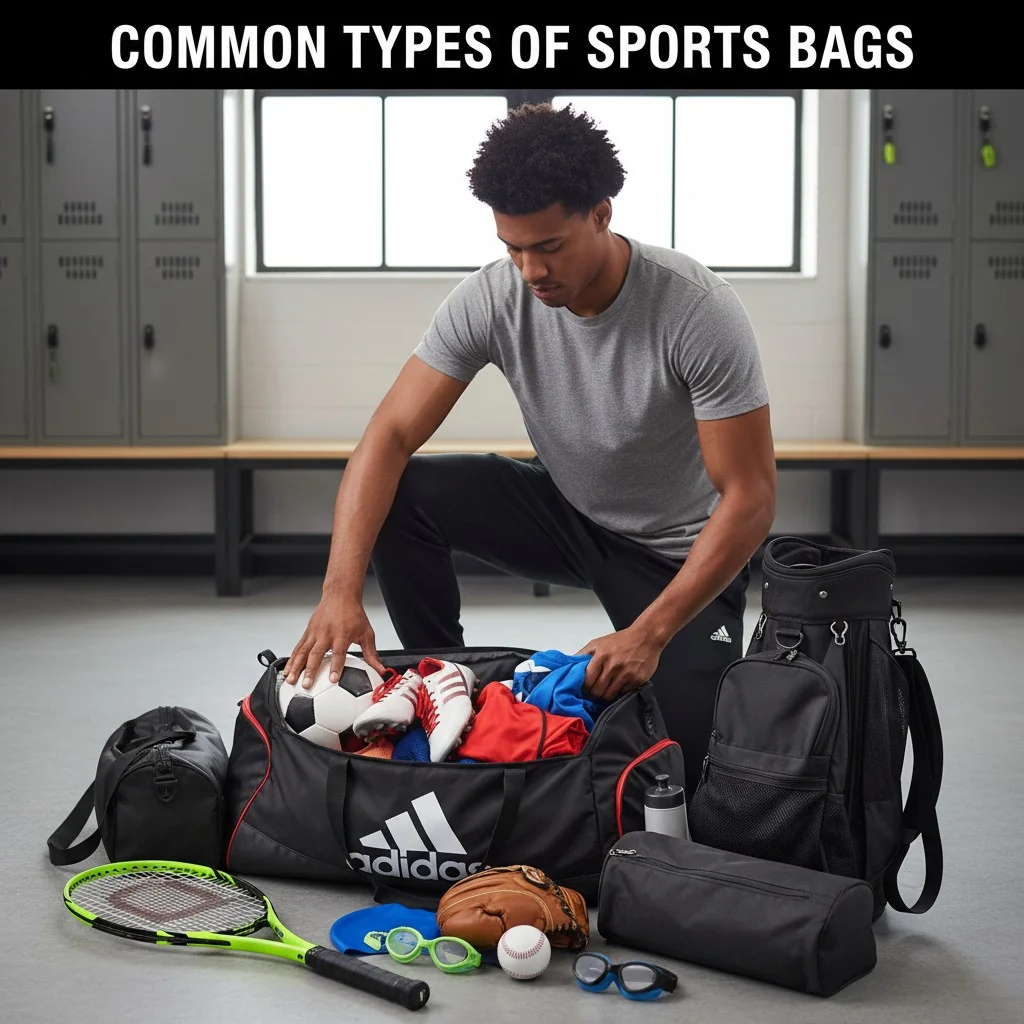
Your customers are active, but are you offering a bag for every sport? A one-size-fits-all approach limits your market reach. Let’s match the bag to the game.
Common sports bags include duffels for team sports, backpacks for hiking or gym commuting, totes for yoga, and specialized bags for tennis or basketball. Matching the bag type to the activity ensures your customers get the right capacity and features for their specific gear.
1. Duffel Bag
- Typical Capacity (Liters): 30 – 100L+
- Best For: Team sports, gym, weekend travel
- Typical Factory Cost (FOB China): US$4.50–12.00/pc at 500 pcs MOQ
- Description: Duffel bags are large, versatile bags that are widely used in sports for carrying multiple pieces of gear. These bags are especially popular among athletes who need to pack a variety of equipment such as clothes, shoes, and accessories. Their spacious design accommodates everything from gym gear to travel essentials, making them an essential bag for team sports like football or basketball.
| Advantages | Disadvantages |
|---|---|
| Large capacity for bulky gear | Can be heavy and cumbersome when fully packed |
| Durable construction | Lack of structure makes it hard to access smaller items |
| Multiple compartments for organization | Not ideal for those needing just a small amount of gear |
For a deeper breakdown of gym-specific duffels — including wet/dry separation and YKK vs. SBS zippers — see our Gym Bag Buying Guide: Factory Truth About Zippers, Materials & Wet-Dry Separation.
2. Gym Backpack
- Typical Capacity (Liters): 20 – 40L
- Best For: Gym commuting, hiking, daily use
- Typical Factory Cost (FOB China): US$5.80–15.00/pc at 500 pcs MOQ
- Description: Backpacks are a popular choice for athletes who need a hands-free bag to carry their gym or hiking gear. These bags are commonly used by people who commute to the gym or go on outdoor activities like hiking. They offer convenience and comfort by distributing weight evenly on the shoulders, making them ideal for everyday use while providing enough space for essentials like a water bottle, towel, and gym shoes.
| Advantages | Disadvantages |
|---|---|
| Hands-free carrying | Limited space for bulky or larger items |
| Compact yet spacious for essentials | Can cause shoulder discomfort if overloaded |
| Versatile for different activities | Items may shift around without proper organization |
3. Gym Tote
- Typical Capacity (Liters): 15 – 30L
- Best For: Yoga, pilates, quick gym trips
- Typical Factory Cost (FOB China): US$3.80–9.00/pc at 500 pcs MOQ
- Description: A gym tote is a stylish and practical bag used primarily for light workouts like yoga and pilates. These bags are perfect for athletes who need to carry just the essentials such as a yoga mat, a change of clothes, and a water bottle. While they lack the heavy-duty structure of other sports bags, they are perfect for individuals who prefer a simple, easy-to-carry solution for their workout routine.
| Advantages | Disadvantages |
|---|---|
| Lightweight and easy to carry | Lack of organization for smaller items |
| Stylish and minimalistic design | Limited capacity for bulkier gear |
| Spacious enough for essentials | Not as secure due to the open-top design |

4. Sport-Specific Bag (Tennis / Basketball / Soccer / Pickleball)
- Typical Capacity (Liters): Varies — tennis bags 35–75L, soccer 30–50L
- Best For: Racket sports, ball sports, equipment-heavy disciplines
- Typical Factory Cost (FOB China): US$6.50–18.00/pc depending on sport at 500 pcs MOQ
- Description: Sports-specific bags such as Tennis Bags, Basketball Bags, and Soccer Bags are designed to carry the specialized equipment needed for each sport. These bags often feature long compartments to hold rackets or balls and additional storage for shoes, clothes, and accessories. They provide a customized solution for athletes, ensuring that all equipment is securely stored and easily accessible.
| Advantages | Disadvantages |
|---|---|
| Custom compartments for sport-specific gear | Limited versatility for non-sport-related gear |
| Protection for rackets, balls, and other equipment | Smaller capacity for other items |
| Often includes extra pockets for personal items | Best suited only for specific sports |
Planning a racket-sport bag line? Read our detailed comparison: Pickleball Bag vs. Tennis Bag (2026): Why a "One-Size-Fits-All" Fails Your Brand.
5. Rolling Sports Bag
- Typical Capacity (Liters): 60 – 120L+
- Best For: Tournaments, team travel, hockey, fencing
- Typical Factory Cost (FOB China): US$18.00–40.00/pc — wheels & telescoping handle drive cost up
- Description: Rolling sports bags are designed for athletes traveling to tournaments or competitions. With the ability to carry large amounts of gear with ease, these bags feature wheels and a retractable handle, making them easy to maneuver even when packed to the brim. These bags are ideal for team athletes who need to pack uniforms, shoes, and other equipment for away games or tournaments.
| Advantages | Disadvantages |
|---|---|
| Easy to transport with wheels and handle | Bulky and heavy, making it harder to maneuver in tight spaces |
| Large capacity for multiple gear items | Too large for casual use |
| Perfect for team travel and tournaments | Difficult to store in tight spaces |
6. Waist Pack / Running Belt
- Typical Capacity (Liters): 2 – 5L
- Best For: Running, short walks, race-day essentials
- Typical Factory Cost (FOB China): US$2.20–5.50/pc at 500 pcs MOQ
- Description: Waist packs, also known as fanny packs, are small, compact bags designed for short runs or walks. Athletes who prefer to run or walk light can store small items such as keys, a phone, and an energy bar in these handy packs. They are ideal for individuals who need a minimalistic, hands-free solution for short distances.
| Advantages | Disadvantages |
|---|---|
| Compact and lightweight for short distances | Limited capacity for carrying larger gear |
| Hands-free convenience | Not suitable for longer runs or activities |
| Comfortable for short runs or walks | Lack of versatility for other activities |
7. Drawstring Bag (Cinch Sack)
- Typical Capacity (Liters): 5 – 25L
- Best For: Promotional giveaways, gym kits, school sports, and lightweight day trips
- Typical Factory Cost (FOB China): US$0.65–2.50/pc at 1,000 pcs MOQ
- Description: Drawstring bags are lightweight, minimalist carriers characterized by a simple cinch-top closure that doubles as shoulder straps. These bags are a staple in the promotional industry due to their high visibility and low production cost. Usually manufactured from 210D or 420D polyester—or sometimes cotton canvas for a premium feel—they are designed for portability and ease of storage. They are ideal for carrying essentials like a pair of shoes, a change of clothes, or event merchandise without the bulk of a structured backpack.
| Advantages | Disadvantages |
|---|---|
| Extremely lightweight and highly packable | Thin cord straps can dig into shoulders under heavy loads |
| Most cost-effective bag for large-scale promos | Minimal protection for fragile items or electronics |
| Quick and easy access to the main compartment | Lack of internal organization and structural support |
Sports Bag Types Comparison Table — At a Glance
| Bag Type | Capacity | Carry Method | Best User | Recommended Fabric | Avg. Weight | Typical MOQ |
|---|---|---|---|---|---|---|
| Duffel | 30–100L | Shoulder strap / handles | Team sports, travel | 600D–900D Polyester | 0.8–1.5 kg | 500 pcs |
| Gym Backpack | 20–40L | Back (dual straps) | Commuters, hikers | 420D–600D Nylon | 0.6–1.1 kg | 500 pcs |
| Gym Tote | 15–30L | Shoulder / hand | Yoga, light fitness | Canvas or 300D Polyester | 0.3–0.7 kg | 500 pcs |
| Sport-Specific | 35–75L | Shoulder / crossbody | Racket & ball sports | 600D Polyester + PE board | 0.9–1.4 kg | 500 pcs |
| Rolling Sports Bag | 60–120L+ | Wheels + handle | Tournament athletes | 900D–1680D Polyester | 2.5–4.0 kg | 500 pcs |
| Waist Pack | 2–5L | Waist belt | Runners, walkers | Ripstop Nylon / Spandex | 0.1–0.2 kg | 500 pcs |
| Drawstring Bag | 5–25L | Cord shoulder straps | Promos, gym, students | 210D–420D Polyester | 0.05–0.15 kg | 1,000 pcs |
What Are the Key Features to Consider When Choosing a Sport Bag?
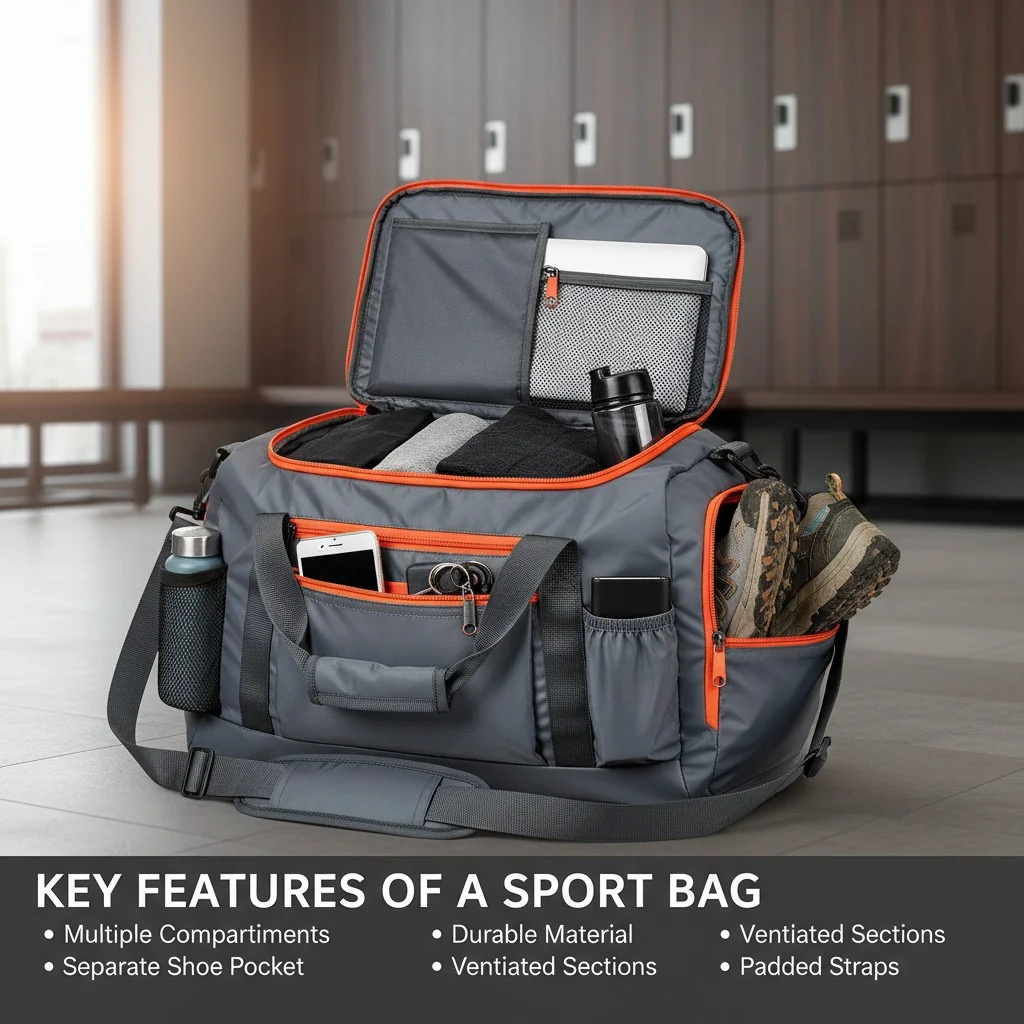
A bag is more than a container. Without the right features, it’s uncomfortable, disorganized, and fails under load.
Key features include durable, water-resistant materials, ventilated compartments for shoes or wet clothes, padded straps for comfort, and multiple pockets for organization.
The 7 Non-Negotiable Features We Spec for Every Sports Bag
- Ventilated shoe compartment — mesh panel or grommet ventilation keeps odor/bacteria down.
- Wet/dry separation pocket — TPU-lined, seam-taped pouch for sweaty kit or wet swimwear.
- YKK or SBS zippers — never unbranded zippers; they fail at the 6-month mark.
- Padded, adjustable shoulder strap — minimum 38mm wide with EVA foam (not cheap PU foam).
- Reinforced bar-tack stitching at strap anchor points — our standard is 8–10 stitches per attachment.
- Bottom reinforcement panel — 1680D polyester or PE board to prevent sag and abrasion.
- Quick-access exterior pocket — for phone, keys, and ID without opening the main zip.
Feature Checklist Before You Place an Order
- Does the bag have a dedicated shoe/wet compartment?
- Are zippers YKK, SBS, or equivalent branded quality?
- Is stitching reinforced at all four strap attachment points?
- Is the base reinforced against abrasion?
- Are padded straps adjustable and removable (for duffels)?
- Is hardware (D-rings, buckles) metal or acetal — not generic plastic?
- Does the lining wipe clean with a damp cloth?
What Are the Differences in Materials and Their Impact?
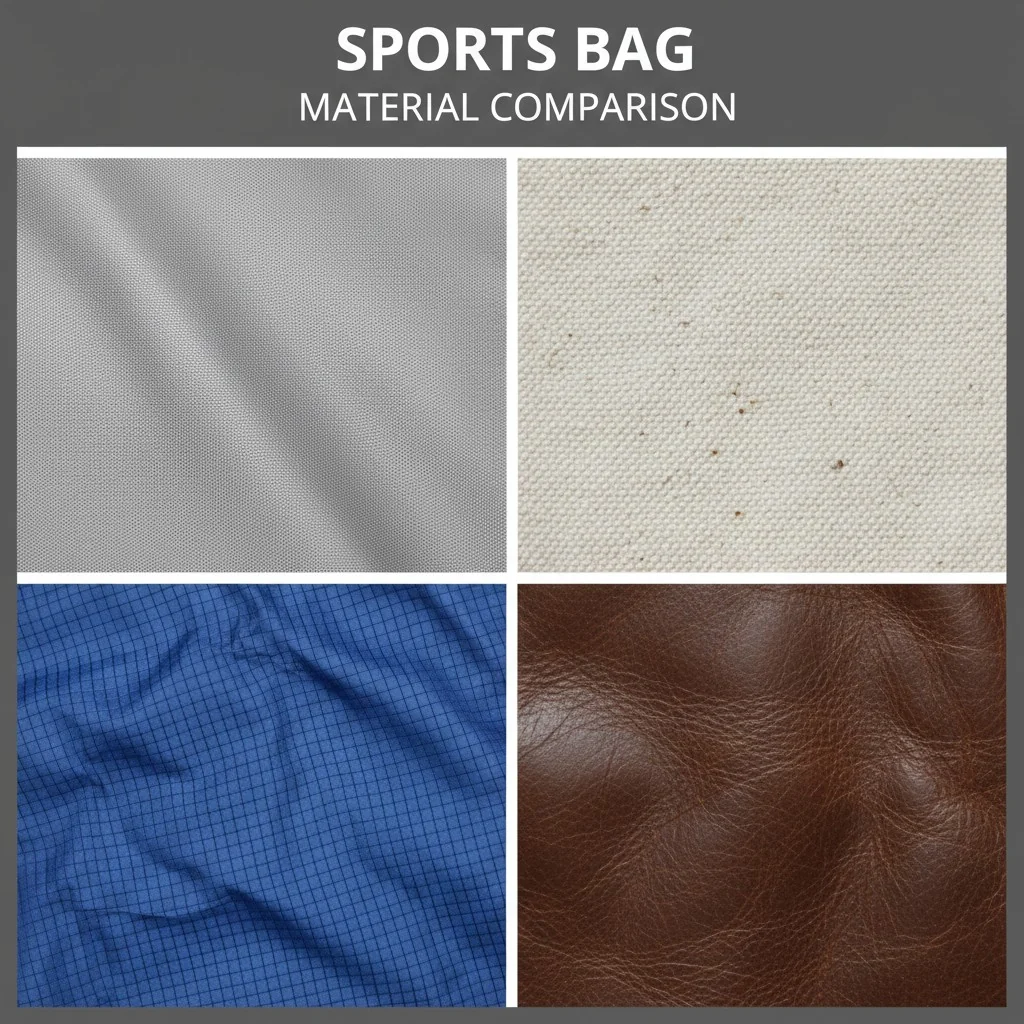
The material of a bag determines its lifespan, look, and performance. Choosing the wrong one can lead to premature wear and unhappy customers. Let’s explore the best materials for durability and function.
Materials like polyester and nylon offer excellent durability and water resistance, making them ideal for most sports. Canvas provides a classic, rugged look but is heavier, while leather offers premium style but requires more care. The choice impacts weight, longevity, and weather protection.
| Material | Durability | Water Resistance | Weight | Style | Maintenance |
|---|---|---|---|---|---|
| Polyester (600D–1680D) | Very durable, abrasion-resistant | Naturally water-resistant; can be PU-coated | Lightweight | Practical, modern | Low |
| Nylon (420D–1000D) | Highest strength-to-weight | Naturally water-resistant; coatable | Lightweight | Modern, soft hand | Low |
| Canvas (10–16 oz) | Strong, rugged | Absorbs water unless waxed | Heavy | Heritage, rugged | Requires waxing |
| Leather (full-grain / PU) | Premium, durable | Low, needs treatment | Heavy | Luxurious | High |
| RPET (Recycled Polyester) | Comparable to virgin polyester | PU-coatable, water-resistant | Lightweight | Eco-conscious | Low |
| TPU-coated 420D | Excellent, waterproof | Fully waterproof when seam-taped | Mid-weight | Technical, modern | Low |
Which Material Matches Which Brand Positioning?
- Value / mainstream retail: 600D Polyester with PU backing — best cost/performance ratio.
- Premium performance: 420D or 500D Cordura Nylon — higher tear strength, softer feel.
- Sustainable / eco-brand: RPET made from recycled PET bottles — our factory is GRS-certified.
- Heritage / fashion-forward: Waxed cotton canvas or 16 oz twill canvas.
- Outdoor / expedition: TPU-coated fabric with RF-welded seams (fully waterproof, not just resistant).
Want to dive deeper into fabric selection? Our knowledge hub on Bag Fabric Knowledges covers denier counts, coatings, and certifications in detail.
How Do You Match Bag Size and Capacity to Your Gear?
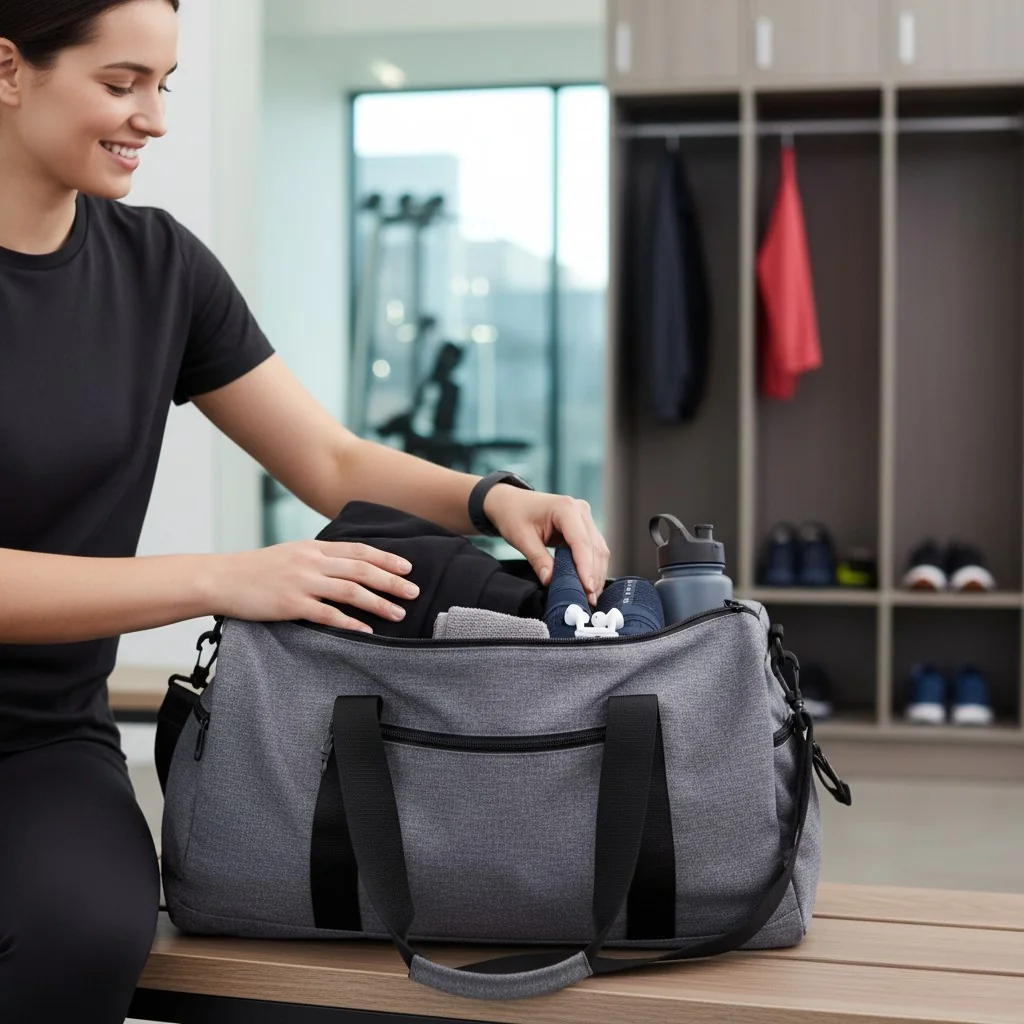
A bag that’s too big is clumsy, while one that’s too small is useless. Guessing the right size for your product line is a business risk. Let’s get specific with capacity to avoid that.
Match bag size to gear by considering the activity. A 20-30 liter bag is great for a quick gym session with just the essentials. For team sports or tournaments, a 40-60L+ bag is needed to hold uniforms, equipment, and more. Always check the volume in liters.
Compact / Daily Carry (20–40 L)
This size is perfect for minimalist athletes and those transitioning directly from work or school to the gym:
- Capacity: 20-40L
- What it holds:
- Standard gym outfit, a single pair of shoes, a water bottle, and personal tech (laptop/tablet)
- Weight: 5-7 kg (11-15 lbs)
- Ideal for:
- Daily gym sessions
- Yoga or Pilates classes
- Under-seat airplane carry-ons
The All-Rounder (40-60 Liters)
This size suits team sports and serious gym enthusiasts:
- Capacity: 40-60L
- What it holds:
- Essentials plus extra gear (e.g., basketball, shin guards, extra clothes)
- Ideal for:
- Versatile, flagship sports bags
- Weekend tournaments
- Daily practices
- Weight: Depends on packed gear
- Packing tip:
- Place heavier items (e.g., shoes) at the bottom for balance
Tournament / Travel (60–120 L+):
This size is engineered for high-volume storage, making it the go-to choice for competitive athletes and extended travel:
- Capacity: 60–120 L+
- What it holds:
- Complete sets of professional equipment (e.g., helmets, multiple balls, protective pads) and apparel for 3–7 days
- Ideal for:
- Multi-day regional tournaments
- Equipment-intensive sports (e.g., hockey, lacrosse, or football)
- International sports travel
- Weight: Substantial; typically requires high-denier fabrics and reinforced stitching to manage the load
- Packing tip:
- Utilize dedicated end-compartments for footwear and wet gear to keep the main compartment balanced and clean uniforms isolated
How Can You Customize a Sport Bag?
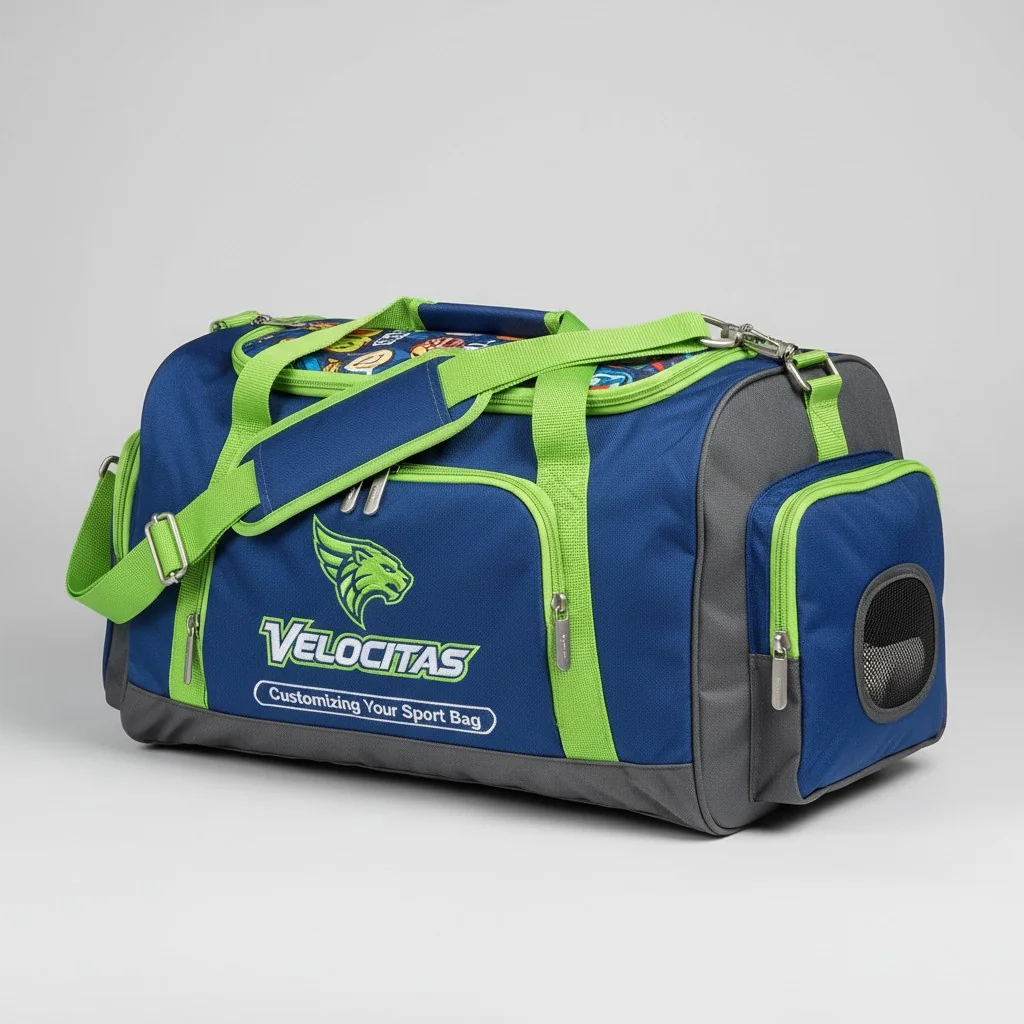
A generic bag doesn’t build a brand. You need products that stand out and connect with your audience. customization is the key to creating a unique identity and a product people love.
5 Levels of Customization (Lowest to Highest Investment)
- Logo-only (OEM stock model): Add your logo to an existing mold. MOQ: 300–500 pcs. Lead time: 25–30 days.
- Color customization: Stock model in your Pantone color. MOQ: 500 pcs. Lead time: 30–40 days.
- Feature modification: Add pockets, adjust straps, swap fabric. MOQ: 500–1,000 pcs. Lead time: 40–50 days.
- ODM (Osgoodway design + your brand): We design from your brief using our patterns. MOQ: 500 pcs. Lead time: 45–60 days.
- Full OEM (your tech pack, our production): Ground-up custom. MOQ: 500–1,000 pcs. Lead time: 60–75 days incl. sampling.
Logo Application Methods Compared
| Method | Best For | Durability | Cost Index | Min. Logo Size |
|---|---|---|---|---|
| Screen print | Large, bold graphics | High | $ | 30 × 30 mm |
| Embroidery | Premium feel, text/logos | Very high | $$ | 20 × 20 mm |
| Heat transfer | Photo-quality, full color | Medium | $ | Any |
| Woven label | Heritage/fashion look | Very high | $$ | 25 × 10 mm |
| Silicone 3D patch | Athletic / technical look | Very high | $$$ | 30 × 30 mm |
| Laser-etched leather patch | Luxury lifestyle | High | $$ | 40 × 20 mm |
Ready to build your custom sports bag line? At Osgoodway, we’ve produced bags for over 200 brands — from Kickstarter startups to Fortune 500 promotional programs. Explore our OEM/ODM services or request a free quote and sample directly. We respond within 12 hours.

Why Source Sports Bags From a Chinese Factory Like Osgoodway?
As a factory based in Quanzhou, Fujian — one of China’s two major bag manufacturing clusters (alongside Baigou, Hebei) — here’s what you should know about sourcing:
- Supply chain density: Within 50 km of our factory, we can source fabric mills, zipper suppliers (YKK/SBS authorized), hardware, foam, and printing services — cutting lead time by 30–40%.
- Experienced labor pool: Quanzhou has 30+ years of bag-making heritage; skilled operators are abundant.
- Flexible MOQs: Compared to Vietnam (usually 3,000+ pcs) or India (1,000+ pcs), Chinese factories like ours routinely accept 500-pc MOQs for new brands.
- Certifications readily available: BSCI, Sedex, GRS (recycled content), REACH, CPSIA, ISO 9001 — all standard for established factories.
- Sample speed: Physical samples in 7–10 working days; digital 3D renders in 48 hours.
Red Flags When Vetting Any Bag Factory
- Won’t share physical factory address or video tour
- Prices significantly below market (often means fake fabric denier or non-branded zippers)
- No written QC protocol or inspection reports
- Can’t provide recent testing certificates (REACH, CPSIA, etc.)
- Pushes only one fabric option regardless of your brief
6 Common Mistakes Brands Make When Ordering Sports Bags
- Specifying by denier alone — 600D from one mill is not equal to 600D from another. Always request fabric weight (GSM) and coating spec.
- Skipping pre-production samples — a $50 sample prevents a $50,000 production mistake.
- Ignoring hardware brand — "YKK-style" is not YKK. Request YKK or SBS with stamped logo on every slider.
- Underestimating stitch density — under 6 stitches per inch on load-bearing seams will fail.
- Forgetting sun/UV testing — colors fade on outdoor-use bags; ask for AATCC 16 UV test results.
- Mis-sizing for shipping — a 2 cm overflow can push your bag from a small carton to a medium, raising freight cost 15%.
Conclusion
Choosing the right sports bag means matching type, features, material, and size to the activity — and then selecting a manufacturing partner who understands all four. Whether you’re launching a new DTC gym brand or expanding a sportswear line, the difference between a so-so product and a repeat-purchase bestseller comes down to the details: fabric denier, zipper brand, stitching density, and the right customization partner.
If you’ve read this far, you already think like a product person. When you’re ready to turn a spec into a sample, Osgoodway has been the manufacturing partner behind 200+ sports-bag brands since 2014. From a single custom-embroidered duffel to a full tournament-bag collection, we make it easy.
👉 Request a free quote and sample — reply within 12 hours.
👉 Browse our Sports Bag product range or our Duffel & Gym Bag catalog.
Frequently Asked Questions
What’s the difference between a gym bag and a duffel bag?
Often used interchangeably. A "gym bag" is typically a smaller duffel (20–40L) with a shoe compartment. "Duffel bag" covers a wider size range, including large travel duffels up to 120L.
How do I clean my sports bag?
For polyester or nylon bags, spot clean with a damp cloth and mild soap. For a deeper clean, hand-wash in cool water and air-dry completely. Avoid machine washing — it damages structure, coatings, and foam padding.
Is a waterproof sports bag necessary?
For most people, water-resistant is enough. Fully waterproof (seam-taped, TPU-coated) is only needed for kayaking, open-water swimming, or prolonged heavy rain exposure.
What is the most durable material for a sports bag?
For balance of durability, weight, and cost: 600D–900D Polyester for mainstream bags; Cordura Nylon or 1680D Ballistic Polyester for premium or tournament use.
What is the typical MOQ for custom sports bags from a Chinese factory?
Most reputable Chinese factories (including Osgoodway) accept 500 pcs per style/color as a starting MOQ. Some stock-model customizations (logo only) can drop to 300 pcs. Lead times are 30–60 days depending on complexity.
How long does it take to develop a custom sports bag from scratch?
A typical full-OEM timeline from tech pack to delivered goods:
- Sampling: 10–14 days
- Sample revisions: 7–10 days per round (usually 1–2 rounds)
- Bulk production: 35–45 days after sample approval
- Shipping (sea, China → US/EU): 25–35 days
- Total: approximately 75–100 days door to door.
Can I mix different sports bag types in one order to meet MOQ?
Yes. Most factories allow mixed styles to hit the total MOQ, as long as each style meets a minimum (usually 200–300 pcs per SKU) and shares core materials or production processes.
What certifications should I ask my sports bag supplier for?
At minimum: BSCI or Sedex (social compliance), REACH (EU chemical safety), CPSIA (US, if selling to children), and ISO 9001 (quality management). For sustainable positioning, add GRS (recycled content) or Bluesign.






