Choosing thicker shoulder straps or adding a breathable back panel does not automatically make a backpack more ergonomic.
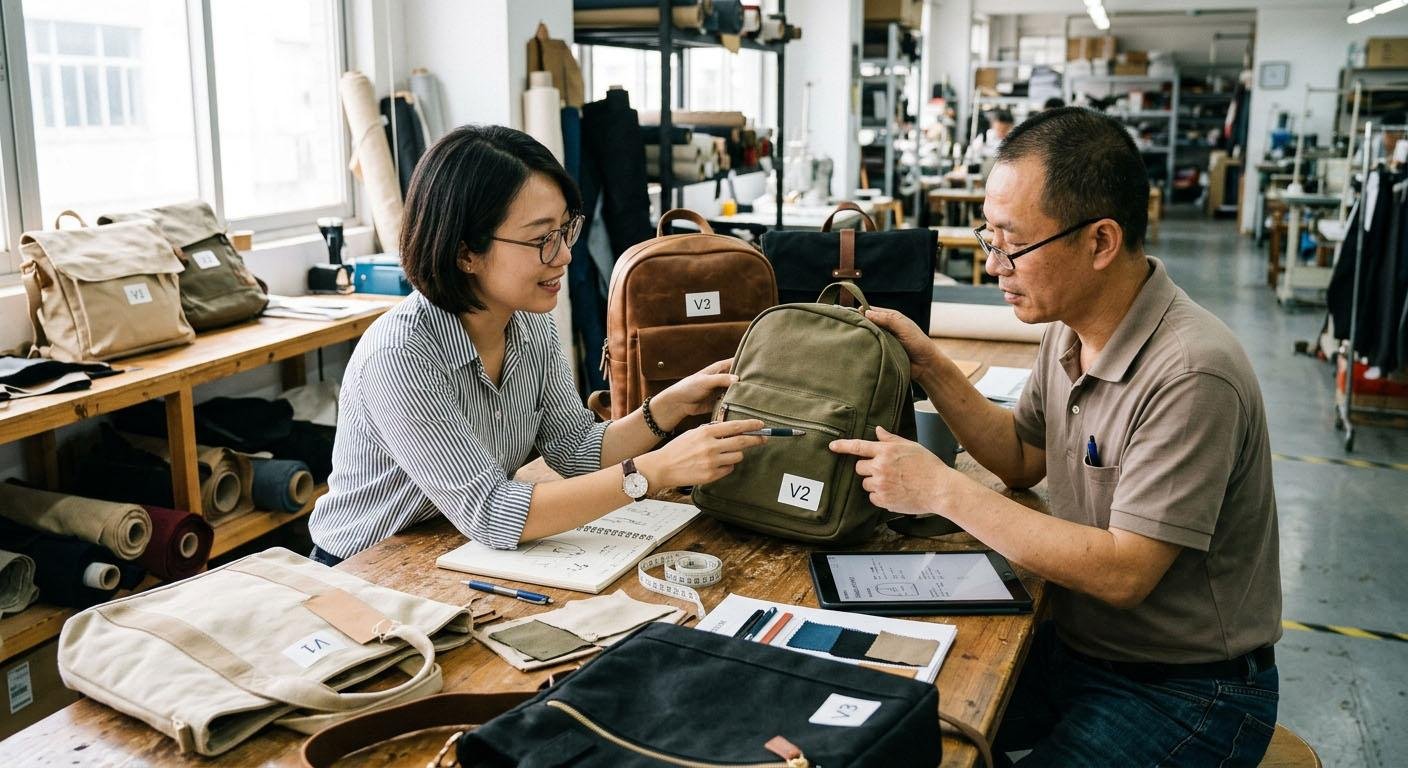
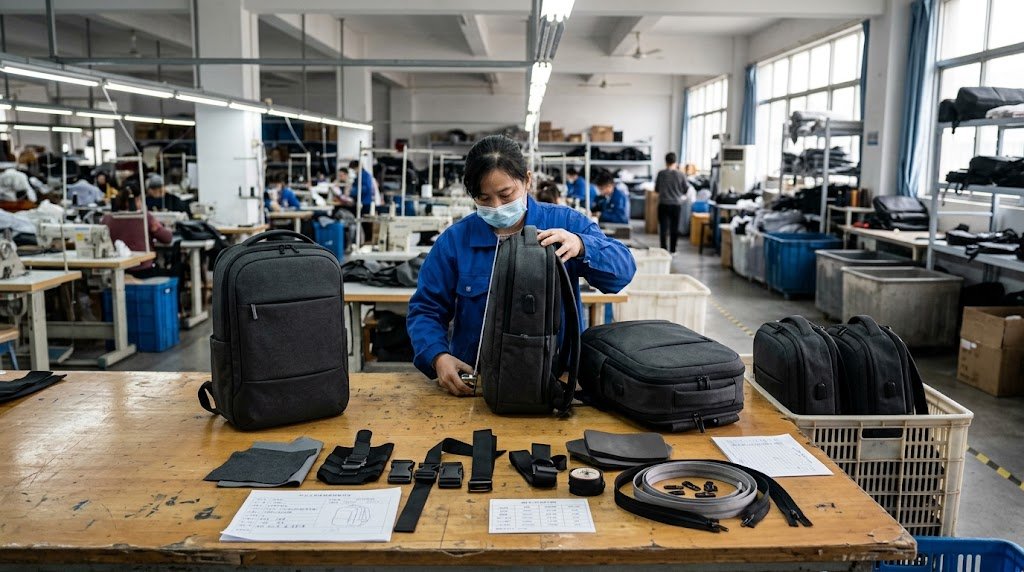
After developing backpack samples for OEM brands over the past 12 years, I’ve found that most carrying problems come from one issue:the load-carrying system was never designed around the actual load.
An ergonomic backpack is not a collection of premium features. It’s a system where the shoulder straps, back panel, support structure, hip belt, and weight distribution work together for a specific carrying task.
Whether the backpack is designed for daily commuting, business travel, hiking, photography, or heavy-duty outdoor use, the design process always starts with the same question:
What will this backpack carry, who will wear it, and how long will they carry it?
Answering these questions before sampling helps brands avoid unnecessary features, extra production costs, and repeated prototype revisions.
The 6 Backpack Features That Actually Reduce Back Strain
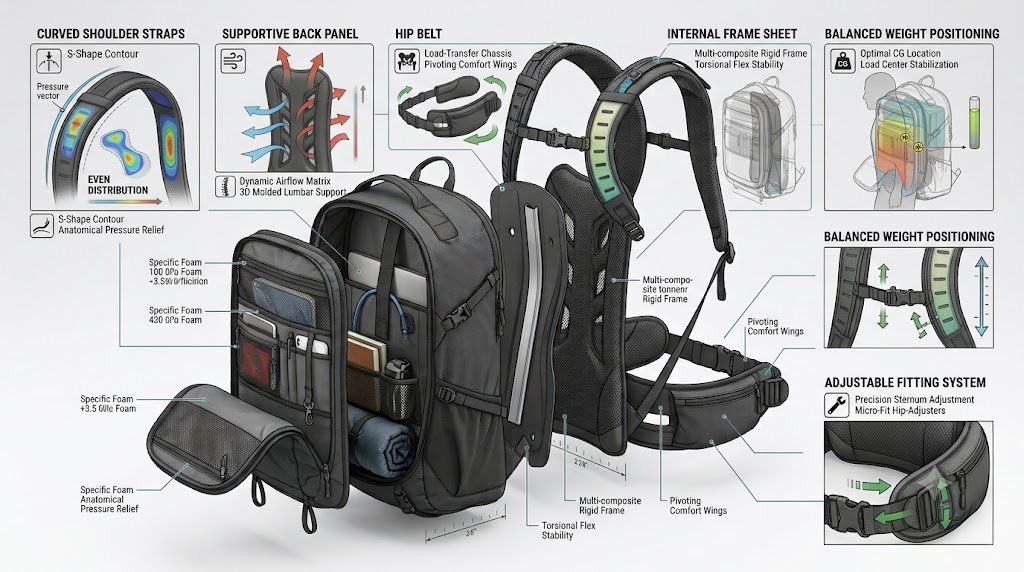
If you only need the short answer, these are the six backpack features that have the biggest impact on carrying comfort:
| Ergonomic Feature | What It Does | Common Applications |
|---|---|---|
| Contoured shoulder straps | Spread pressure and improve shoulder fit | Daily backpacks, travel packs, outdoor packs |
| Supportive back panel | Keeps the load closer to the body | Laptop backpacks, travel bags, hiking packs |
| Hip belt | Transfers part of the load to the hips | Medium and heavy-load backpacks |
| Internal support frame | Maintains structure and prevents collapse | Hiking and expedition packs |
| Proper weight positioning | Reduces backward pulling force | Laptop and business backpacks |
| Adjustable fit system | Matches different body sizes | Global market products |
These features do not work independently.
A backpack with thick shoulder straps can still feel heavy if the load sits too far away from the back. A backpack with a hip belt may provide little benefit if the internal structure cannot transfer weight into the belt.
The best ergonomic backpack designs treat comfort as a complete load-carrying system, not a checklist of individual components.
Why "Ergonomic" on a Tech Pack Means Nothing Without a Load Number
Adding the word "ergonomic" to a backpack tech pack does not give a factory enough information to build a comfortable product.
From our OEM sampling experience, the biggest reason ergonomic backpacks fail is simple: the design specifies features, but never defines the load those features are meant to support.
Without an expected carrying weight, factories have to estimate the required support, foam, reinforcement, and structure. That often leads to unnecessary sample revisions because the backpack is engineered around assumptions instead of real use.
A Backpack Is a Load-Carrying System, Not a Feature List
We don’t review ergonomic features one by one.
Instead, we evaluate how every structural component works together under the intended load.
| Component | Primary Job | Common Buyer Mistake |
|---|---|---|
| Shoulder straps | Support upper-body load | Choosing thickness over shape |
| Back panel | Keep weight close to the body | Prioritizing airflow over support |
| Hip belt | Transfer weight to the hips | Adding one to lightweight backpacks |
| Internal support | Maintain structure | Increasing stiffness without defining load |
A premium shoulder strap cannot compensate for poor weight distribution, just as a padded hip belt cannot work if the backpack has no structure to transfer weight into it.
For this reason, the first specification we ask every buyer for is expected carrying weight. Once that number is clear, every other ergonomic decision becomes much easier.

The 4 Questions We Ask Before We Quote Any Ergonomic Backpack
Once the expected load is defined, the next step is gathering the information needed to build the right carrying system.
Over the years, we’ve found that most sampling problems can be traced back to one issue: important product requirements were never discussed before development began.
Before recommending shoulder straps, back panels, foam, or support structures, we always ask buyers these four questions.
1. How Much Weight Will the Backpack Carry?
Expected carrying weight determines the level of support the backpack needs.
For a lightweight commuter backpack, comfort usually comes from good strap geometry, balanced weight distribution, and a stable laptop compartment. For heavier travel or outdoor packs, structural support becomes much more important.
| Expected Load | Typical Structure | Design Priority |
|---|---|---|
| Under 6 kg | Soft or semi-structured | Lightweight comfort |
| 6–12 kg | Semi-structured with PE board | Better load distribution |
| Over 12 kg | Frame sheet or aluminum stays | Weight transfer and stability |
2. How Long Will Users Wear the Backpack?
Wearing time affects how pressure builds up over time.
A backpack carried for a 20-minute commute can use softer foam and a simpler structure. A backpack designed for several hours of continuous use needs more durable foam, better pressure distribution, and improved load stability.
This is why we always ask about average wearing duration, not just total carrying weight.
3. What Is the Primary Use Scenario?
Different activities create completely different movement patterns.
A business backpack spends most of its time walking between offices or public transport. A hiking backpack experiences constant movement on uneven terrain. A cycling backpack must remain stable even when the rider changes body position.
Knowing how the backpack will be used helps us determine whether features like compression straps, sternum straps, load lifters, or support frames are actually necessary.
4. Who Is the Target User?
A backpack that fits one user well may feel uncomfortable for another.
Before sampling, we ask buyers about the intended user group, including torso size, body proportions, and whether the backpack is designed for a broad international market or a specific customer segment.
This information helps determine:
- Shoulder strap length
- Adjustment range
- Back panel height
- Hip belt position
- Overall carrying fit
Why These Four Answers Save Time During Sampling
Many tech packs describe a backpack as "ergonomic" but leave these four questions unanswered.
When that happens, factories have to make assumptions about the carrying system, often leading to additional prototype revisions.
Providing these details at the beginning allows the sampling team to make better engineering decisions from the first prototype, reducing development time and helping brands reach production more efficiently.
Factory Tip: When sending a tech pack, include the expected load, average wearing time, primary use scenario, and target user profile. These four details usually improve the accuracy of the first sample far more than adding another page of reference photos.
Do Thick Shoulder Straps Actually Reduce Back Strain? (Not by Themselves.)
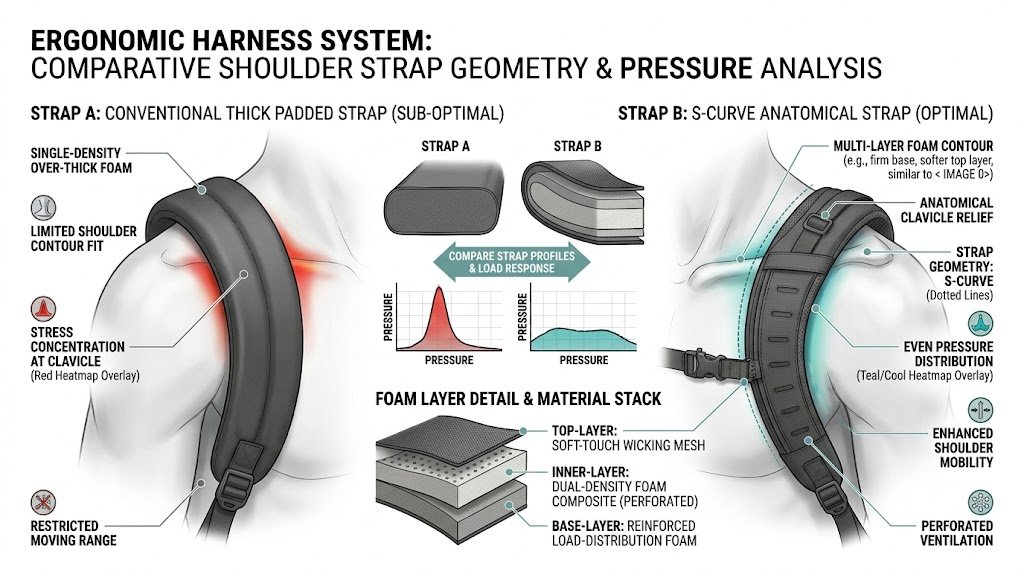
One of the biggest misconceptions in backpack design is that thicker shoulder straps automatically make a backpack more comfortable.
From our sampling experience, we’ve tested backpacks with heavily padded straps that still felt unstable, pulled backward, or created pressure points after only a short period of use.
The reason is simple:
Shoulder straps support the load—they don’t correct poor load distribution.
Strap Geometry Matters More Than Foam Thickness
Before discussing foam thickness, we look at the shape and position of the strap itself.
A well-designed shoulder strap should follow the natural contour of the user’s shoulders while keeping the backpack close to the body.
The factors we review most often include:
| Design Element | Why It Matters |
|---|---|
| Top attachment angle | Controls how the backpack pulls against the shoulders |
| S-curve or J-curve shape | Improves fit across different body types |
| Strap width | Matches pressure distribution to the expected load |
| Foam density | Maintains support under repeated loading |
| Adjustment range | Allows users to position the backpack correctly |
A backpack with correctly shaped shoulder straps often feels more comfortable than one with thicker padding but poor geometry.
Foam Density Is More Important Than Foam Thickness
Many buyers specify strap thickness in their tech packs but never define the foam itself.
In reality, 10 mm of low-density foam may provide less support than 8 mm of higher-density EVA foam.
During sampling, we sometimes compare multiple foam densities using the same strap pattern because identical thicknesses can perform very differently after stitching, binding, and repeated loading.
The goal isn’t to create the softest strap—it’s to maintain consistent support throughout the backpack’s expected service life.
Shoulder Straps Cannot Fix Poor Weight Distribution
Even the best shoulder straps cannot compensate for a poorly balanced backpack.
If heavy items sit too far away from the back panel, the backpack creates a longer leverage arm that pulls backward on the user’s shoulders.
That’s why we evaluate the entire load layout before approving a shoulder strap design.
Our review typically includes:
- Laptop sleeve position
- Main compartment depth
- Bottom panel stiffness
- Compression straps
- Overall center of gravity
Often, improving the backpack’s internal weight distribution has a greater impact on carrying comfort than adding thicker shoulder straps.
Factory Tip: Instead of specifying "extra-thick padded shoulder straps" in your tech pack, define the expected carrying weight first. Once the load is clear, it’s much easier to select the right strap shape, foam density, and construction for the intended use.
When Does a Hip Belt or Support Frame Actually Make Sense?
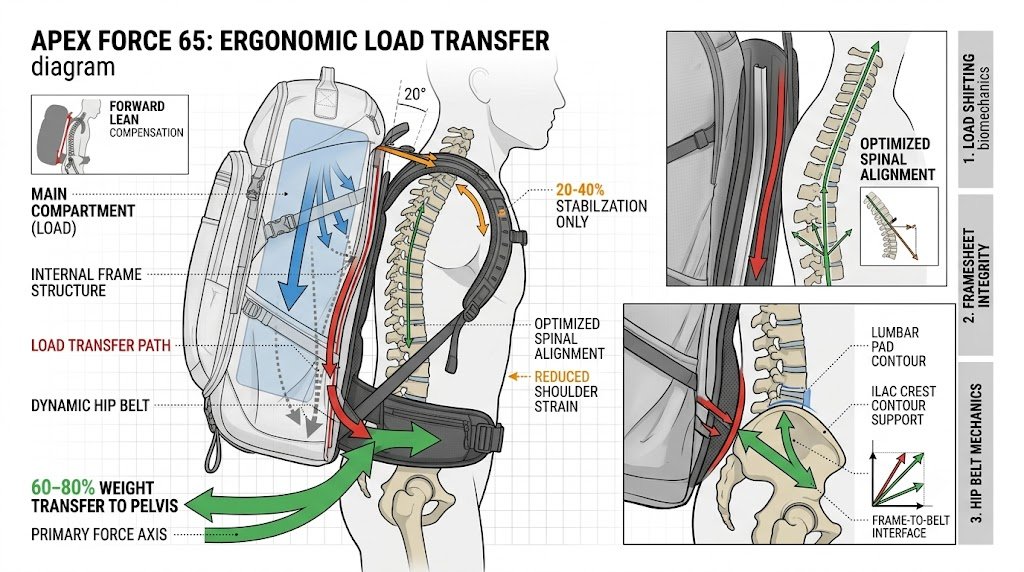
A hip belt or support frame only improves carrying comfort when the backpack is designed to transfer weight through its structure.
Adding these features to every backpack may increase cost and complexity without improving the user experience.
That’s why we always evaluate the intended load before recommending either one.
Not Every Backpack Needs a Hip Belt
A waist belt on a lightweight daypack may look technical, but it often contributes very little to carrying comfort.
For smaller backpacks, a simple webbing strap may be enough to reduce movement during walking or cycling. A fully padded hip belt becomes valuable only when the backpack is heavy enough for weight transfer to make a noticeable difference.
| Backpack Type | Hip Belt Recommendation | Primary Purpose |
|---|---|---|
| Daily commuter (under 20L) | Usually unnecessary | Keep the pack stable during movement |
| Travel (20–35L) | Optional | Improve balance when carrying heavier loads |
| Day hiking (25–40L) | Recommended | Increase stability and reduce shoulder fatigue |
| Multi-day hiking (40L+) | Essential | Transfer a significant portion of the load to the hips |
The goal isn’t to add more features—it’s to choose the right level of support for the backpack’s intended use.
Support Frames Help the Backpack Hold Its Shape
As carrying weight increases, maintaining the backpack’s structure becomes just as important as padding.
Without adequate internal support, the bag may sag, shift, or pull away from the user’s back, making even a well-designed shoulder strap less effective.
Depending on the target load, we typically evaluate different support options.
| Support Structure | Typical Application |
|---|---|
| PE board | Daily and business backpacks |
| Frame sheet | Travel and light hiking backpacks |
| Aluminum stays | Heavy-load hiking and outdoor packs |
Rather than selecting the stiffest structure available, we match the level of support to the backpack’s expected carrying weight and target price point.
A Hip Belt Only Works If the Load Can Reach It
One of the most common issues we see during sample reviews is a backpack with a well-made hip belt but no effective load transfer.
If the back panel flexes too much or the internal structure isn’t strong enough, the hip belt simply wraps around the user’s waist without carrying much weight.
For framed backpacks, we always check whether the load follows a continuous path:
Main compartment → Support structure → Hip belt → User’s hips
When this load path is properly designed, the backpack feels more stable and places less demand on the shoulders during extended wear.
Factory Tip: If your backpack is expected to carry less than 8–10 kg, investing in better shoulder strap geometry and balanced weight distribution often delivers greater comfort than adding a padded hip belt. For heavier loads, however, the hip belt, back panel, and support frame should always be designed as one integrated system.
How Should You Design a Backpack Back Panel for Both Support and Ventilation?
A backpack back panel should do more than improve airflow. Its primary job is to help keep the load stable, maintain the bag’s shape, and support comfortable carrying throughout the intended use.
During OEM development, we often see buyers focus on breathable mesh or molded foam because these features look premium in product photos. However, once the backpack is loaded, support and weight distribution usually have a greater impact on carrying comfort than ventilation alone.
The best back panel is not the one with the most airflow—it’s the one that balances support, ventilation, weight, manufacturing complexity, and the backpack’s intended load.
Support and Ventilation Should Work Together
Ventilation and structural support solve different problems, so they should be designed together rather than treated as competing features.
| Design Goal | Typical Construction | What We Review During Sampling |
|---|---|---|
| Improve airflow | Raised foam channels or suspended mesh | Distance between the load and the back |
| Improve pressure comfort | Multi-density EVA foam | Pressure distribution after loading |
| Maintain backpack shape | PE board or frame sheet | Panel stiffness under target load |
| Improve carrying stability | Compression system and internal support | Load movement while walking |
For example, a suspended mesh back panel can significantly improve airflow in hot environments. However, increasing the gap between the backpack and the user’s back also moves the center of gravity farther away from the body. On heavier backpacks, this can reduce stability even though ventilation improves.
That’s why we don’t recommend choosing a back panel based on appearance alone. The structure should always match the backpack’s capacity, expected load, and carrying scenario.
How We Evaluate a Back Panel During Sample Development
A back panel should be tested under real carrying conditions—not while the backpack is empty.
During sample development, we load the backpack to its intended carrying weight and evaluate how the entire carrying system performs instead of judging the back panel in isolation.
Our review typically includes:
- Whether the back panel maintains its shape under load
- Whether the backpack stays close to the user’s back
- Whether the bottom begins to sag after loading
- Whether the load shifts during walking or movement
- Whether different foam densities or reinforcement materials improve stability
These tests often reveal problems that are impossible to identify through appearance alone. A back panel may feel comfortable in a showroom, but only real loading tests show whether it can support the backpack’s intended use over time.
How Do We Turn Ergonomic Requirements Into a Buildable Tech Pack?
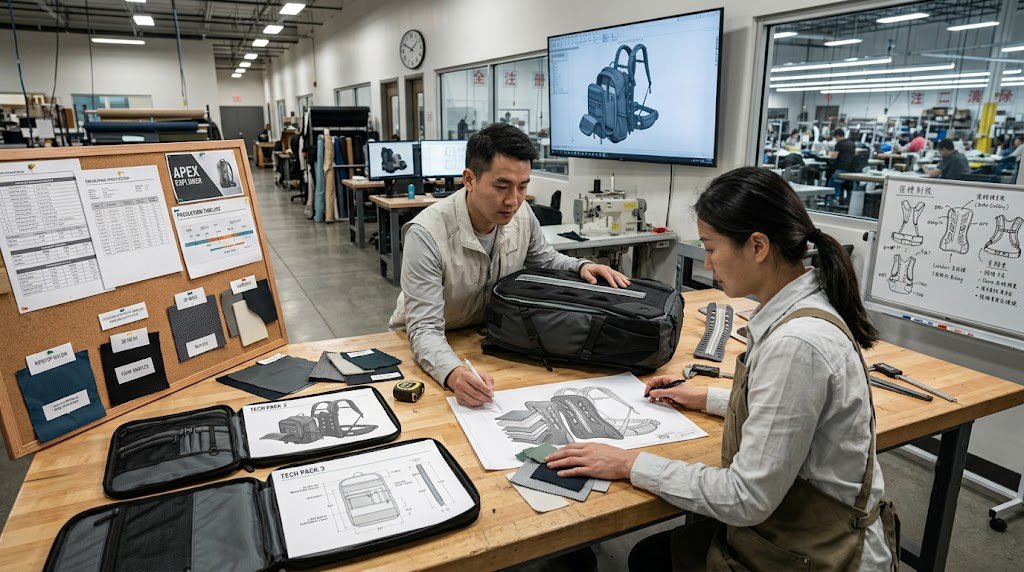
An ergonomic backpack idea is only valuable if a factory can translate it into a repeatable production process.
During OEM development, we often receive tech packs with notes such as "comfortable shoulder straps," "ergonomic back panel," or "premium carrying system." While these descriptions communicate the design goal, they don’t provide enough information for pattern makers or sample technicians to build the backpack consistently.
The more measurable the specification, the more accurate the first sample is likely to be.
Replace Marketing Language With Production Specifications
Instead of describing how the backpack should feel, define how it should be built.
Small changes in wording can eliminate unnecessary assumptions during sampling and significantly reduce development time.
| Tech Pack Item | Vague Requirement | Production-Ready Specification |
|---|---|---|
| Shoulder straps | Comfortable padded straps | S-curve straps, 55 mm width, medium-density EVA foam |
| Back panel | Breathable back panel | Foam air channels with 2 mm PE reinforcement |
| Hip belt | Add waist belt | Removable webbing belt or padded load-transfer belt |
| Carrying load | Daily use | Designed for 8 kg carrying load |
| User fit | One size | Fits torso length 40–46 cm with adjustable shoulder straps |
Whenever possible, we also recommend adding reference photos with annotations. Rather than simply attaching an image, highlight the exact feature to copy—such as the shoulder strap angle, foam layout, back panel profile, or hip belt shape. This helps reduce interpretation differences during sampling.
The Information That Helps Us Build a Better First Sample
Before quoting an ergonomic backpack project, we normally review four pieces of information together:
- Expected carrying weight
- Average wearing duration
- Primary use scenario
- Target user size range
Once these requirements are clear, we can recommend appropriate materials, support structures, reinforcement methods, and construction details based on the product’s intended performance—not just its appearance.
This approach also makes prototype reviews much more efficient. Instead of discussing whether a backpack "feels ergonomic," both the buyer and the factory can evaluate the sample against clear design objectives established before development began.
Common Ergonomic Backpack Mistakes We See During OEM Development
Most ergonomic backpack problems don’t come from poor manufacturing—they start much earlier, during product planning and tech pack development.
Over the years, we’ve reviewed backpack projects ranging from everyday laptop bags to heavy-load outdoor packs. While every product is different, the same design mistakes appear surprisingly often.
Avoiding these issues early usually leads to a better first sample, fewer development revisions, and a more efficient production process.
Four Mistakes That Often Lead to Uncomfortable Backpacks
| Common Mistake | Why It Causes Problems | Better Approach |
|---|---|---|
| Designing features before defining the load | The carrying system is built on assumptions instead of real requirements. | Define the target carrying weight before selecting ergonomic features. |
| Choosing thicker padding instead of better structure | Extra foam cannot compensate for poor weight distribution. | Improve load balance and structural support first. |
| Prioritizing ventilation over stability | Moving the load farther from the back may reduce carrying stability. | Balance airflow with proper load positioning. |
| Using "ergonomic" as a specification | Factories interpret vague requirements differently, leading to inconsistent samples. | Use measurable specifications for load, fit, and construction. |
These mistakes are rarely caused by a lack of product ideas. More often, they happen because important design decisions are left open to interpretation during sampling.
The Best Ergonomic Backpacks Start With Better Specifications
One of the biggest differences between a smooth development process and multiple sample revisions is the quality of the information provided before production begins.
When buyers clearly define the expected load, wearing duration, use scenario, and target user, it’s much easier for the factory to recommend the right materials, support structure, and construction methods.
Instead of asking, "How can we make this backpack more ergonomic?", we prefer to ask:
"What carrying problem is this backpack designed to solve?"
That question usually leads to more practical design decisions—and ultimately, a backpack that performs better in real-world use.
Factory Tip: Good ergonomic design isn’t created by adding more features. It’s created by making every structural component work toward the same carrying objective.
Final Thoughts
Every ergonomic backpack starts with the same question: what is the backpack expected to carry?
From our experience, this is the only variable that really matters. Thicker straps, breathable panels, hip belts — none of it compensates for a carrying system that was never designed around an actual load. Ergonomics isn’t a material spec. It’s a decision made before materials are chosen.
If your tech pack already includes ergonomic requirements but you’re unsure whether they’re specific enough for sampling, we’d be happy to review them before development begins.