


A backpack tote bag is a hybrid carry bag designed to function as both a tote bag and a backpack. Unlike a standard tote with added shoulder straps, a true backpack tote incorporates load-bearing strap anchors, reinforced panels, and a structural carry system that supports both carrying modes.
That distinction is what many buyers miss. And missing it often leads to inaccurate quotes, failed samples, and unnecessary revision rounds.
After years of developing backpack totes for brands and importers, I’ve learned that most sourcing mistakes come from one misunderstanding: buyers treat them like tote bags instead of dual-carry products.
Quick Answer: What Separates a Backpack Tote From a Regular Tote?
| Feature | Standard Tote | Backpack Tote |
|---|---|---|
| Handle attachment | Two short seams near the opening | Full-length strap anchors at top and base |
| Back panel | Flat, unpadded, decorative | Load-bearing — needs rigidity or padding |
| Base reinforcement | Light — cosmetic only | Structural — carries the load path |
| Material at anchor zones | Whatever the shell uses | Heavier denier, often a different material |
| Stitching at stress points | Basic seams | Bar-tack or box-X required |
| Typical sampling rounds | 1–2 | 2–4 — the carry system always needs tuning |
| Correct price benchmark | Canvas tote | Light-duty backpack with aesthetic constraints |
Price it like a tote, and you’ll get a quote that doesn’t match what you need to build.
Why a Backpack Tote Requires Different Construction Than a Standard Tote
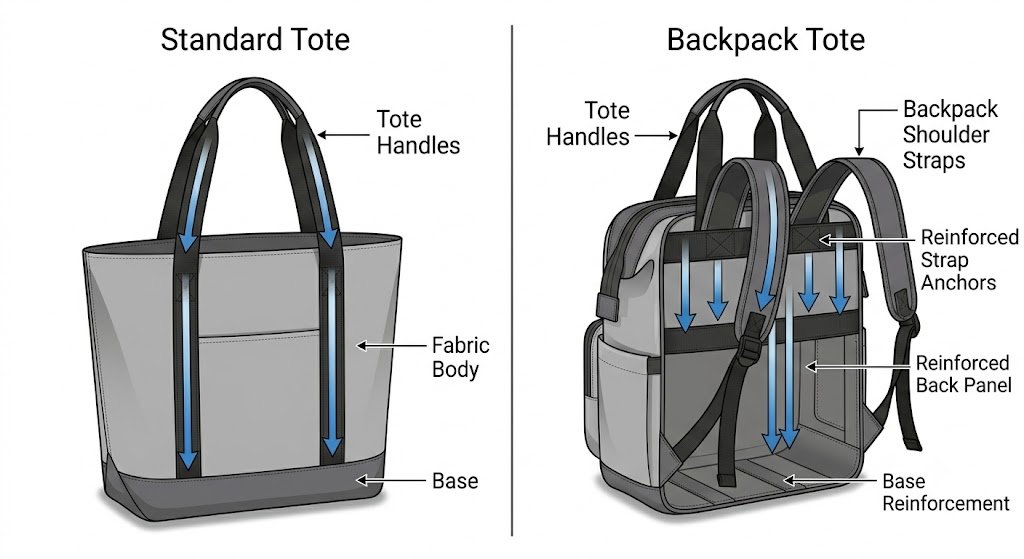
At first glance, a backpack tote and a tote bag can look remarkably similar.
Both may have the same overall shape. Both may use similar fabrics. Both may feature top carry handles.
The difference appears when the bag is actually loaded and carried.
A standard tote is designed around a simple carrying system. The weight of the contents is transferred directly from the bag body to the handles and then to the user’s hand or shoulder.
A backpack tote has a more complex requirement.
The bag must function in two carrying modes:
- As a tote carried by the top handles
- As a backpack carried by shoulder straps
This means the structure must support multiple load paths instead of just one.
When used as a backpack, the force generated by the carried weight is transferred through the shoulder straps, into the anchor points, across the body panels, and ultimately into the base of the bag. Those forces are different from the forces created when the bag is carried as a tote.
Because of this, backpack totes often require additional reinforcement in areas that a standard tote may not.
Key Areas That Usually Require Additional Engineering
| Component | Standard Tote | Backpack Tote |
|---|---|---|
| Handle Attachment | Supports tote carry only | Must coexist with the backpack carry system |
| Strap Anchors | Not required | Critical load-bearing component |
| Back Panel | Often decorative or unstructured | Frequently reinforced for stability and comfort |
| Base Structure | Supports vertical load from handles | Helps distribute load from multiple carry modes |
| Stress-Point Stitching | Basic seam construction | Often reinforced with bar-tack or Box-X stitching |
The level of reinforcement varies depending on the intended use.
A lightweight fashion-oriented backpack tote may use minimal structure and carry only a few kilograms comfortably. A travel-focused backpack tote designed for laptops, clothing, and daily transit loads may require padded straps, reinforced anchors, and a more supportive back panel.
This is why two backpack totes that look similar in photos can have very different manufacturing costs, material requirements, and development timelines.
The visual design may be similar.
The engineering behind the product often is not.
Why Reference Images Rarely Provide Enough Information?
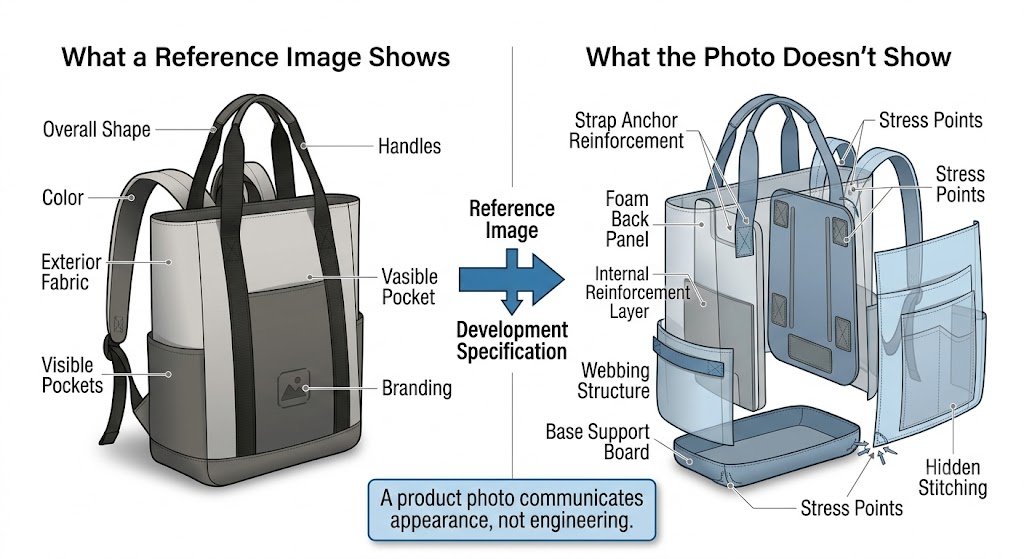
Most backpack tote projects begin with a reference image.
That image may come from Pinterest, Instagram, Amazon, a competitor’s website, or an existing product the buyer likes.
Reference images are useful because they communicate visual direction quickly. They help define:
- Overall shape
- Style and proportions
- Material appearance
- Color and branding direction
The challenge is that product photos rarely provide enough information for development and costing.
A photo can show what a bag looks like.
It usually cannot show how the bag is built.
Important details are often hidden, including:
- Strap anchor construction
- Reinforcement layers
- Foam thickness
- Back-panel structure
- Internal organization
- Hardware attachment methods
As a result, two backpack totes can appear nearly identical in a product photo while using completely different construction methods.
Those construction differences affect:
- Manufacturing cost
- Carrying comfort
- Load capacity
- Sampling complexity
- Long-term durability
This is why reference images are most useful as visual guidance rather than production specifications.
The Questions a Reference Image Cannot Answer
Before development begins, several decisions still need to be defined:
- Is the backpack mode the primary carry method or a secondary feature?
- How much weight is the bag expected to carry?
- Are the shoulder straps permanent, detachable, or stowable?
- What level of carrying comfort is required?
- How will the product actually be used?
A commuter bag, a gym bag, and a travel bag may look similar in photos, but they often require different materials, reinforcement methods, and carry systems.
For that reason, a reference image should be treated as the starting point of a conversation—not the specification itself.
Use Case Determines the Entire Spec – Three Use Cases
One reference image, three completely different products. The brief that doesn’t define the use case produces a sample that’s wrong for the actual buyer.
The end-use scenario determines the structural requirements. A commuter bag, a gym-to-office bag, and a travel carry-on alternative all fall under the backpack tote label — but they require different structures, zipper types, strap systems, and interior layouts.
This is not a subjective design preference. The use case directly drives the spec. Here is how that plays out across three common buyer scenarios we see in our development work:
Use Case 1: Fashion Brand Commuter Bag
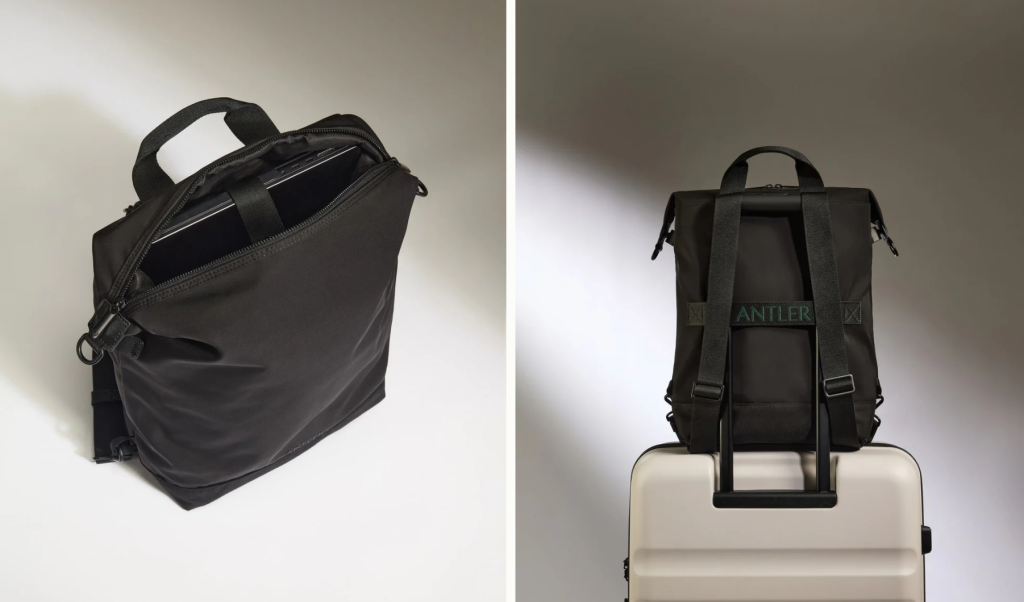
The backpack function exists but can’t be visible. Hidden or stowable straps, semi-rigid back panel that lies flat, structured front that holds shape on a desk. Aesthetic control is the primary spec. The carry system is compressed to serve that goal.
Market Example: Antler Icon 2-in-1 Tote Backpack
What this means structurally:
- Stowaway strap pocket on the back panel
- Thinner foam construction
- Cleaner exterior appearance
What it costs:
- Add $0.80–1.20 for the strap storage channel
- Add one more pattern piece
- Add one more sample review to confirm the straps actually stow cleanly
This category prioritizes visual simplicity and brand aesthetics over carrying performance. Products like the Antler Icon demonstrate how much engineering is required to hide the backpack function while maintaining a clean tote silhouette.
Use Case 2: Gym-to-Office Hybrid
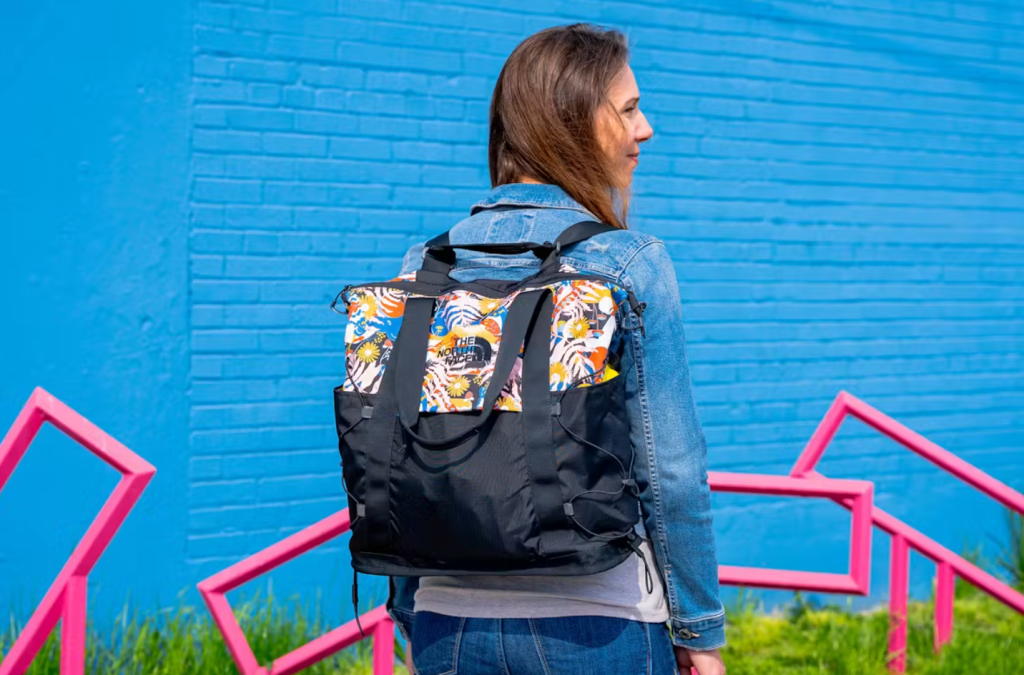
Real carrying comfort because this bag loads daily — laptop, clothes, shoes, charger. Backpack function is primary. Padded straps with wide profile, ventilated back panel, laptop compartment positioned close to the spine, heavy-duty zipper pulls that work one-handed. Load performance beats aesthetics here.
Market Example: The North Face Borealis Tote
What this means structurally:
- 38–45mm padded shoulder straps
- EVA foam back panel with ventilation channel
- Bar-tack reinforcement at all four anchor points
Different spec sheet from Use Case 1. Different cost. Different timeline.
Products in this category are expected to carry meaningful weight every day. Comfort, durability, and organization matter more than maintaining a perfectly clean exterior profile.
Use Case 3: Travel Carry-On Alternative
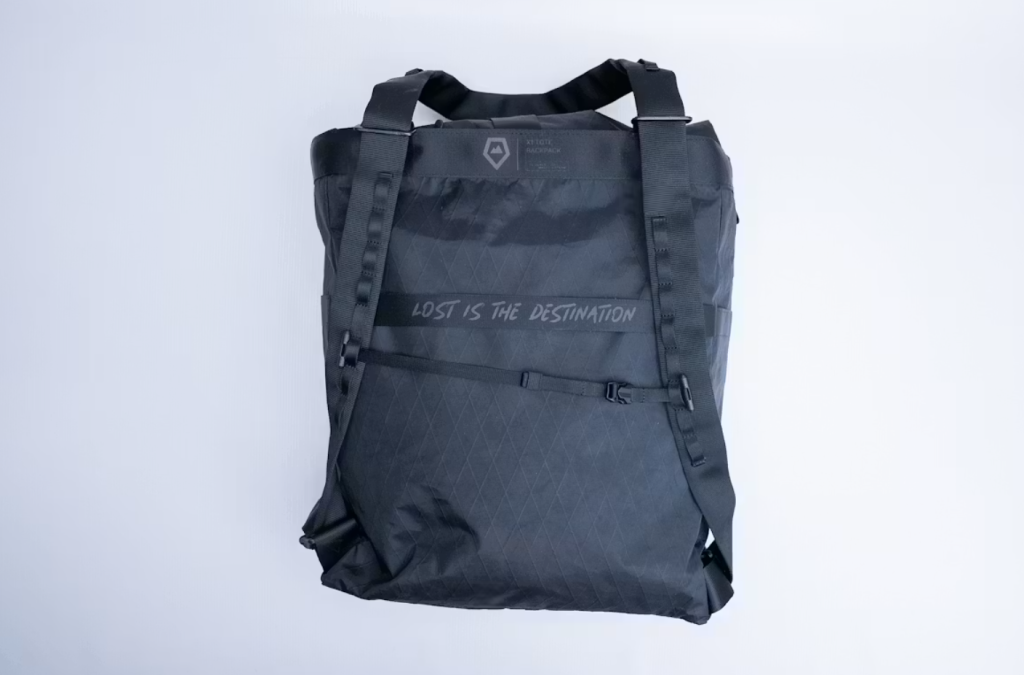
Fits under an airline seat. Converts between modes in transit. Clamshell or wide-mouth opening. No hardware that snags on security conveyor belts. The carry system must handle full travel load — 8–10kg — without anchor failure.
That range isn’t arbitrary. IATA’s passenger baggage guidance notes that under-seat and cabin items commonly carry airline-imposed weight limits starting around 5kg, and many international carriers cap cabin bags at 7–10kg. A strap and anchor system built for less than that will fail in real use, not just on paper.
Market Example: WANDRD Tote Backpack
What this means structurally:
- Load-rated strap system
- Reinforced base board
- Triglide adjusters with smooth finish
- Compression straps or panel side access
These products all fall under the "backpack tote" category, but their structures are completely different. The Antler Icon prioritizes hidden straps and visual cleanliness, the Borealis Tote prioritizes daily carrying comfort, and the WANDRD Tote Backpack is engineered around travel load and capacity. Looking at them side-by-side makes it clear why a reference image alone is not enough to define a backpack tote specification.
Same Category, Different Specifications
These products all fall under the "backpack tote" category, but their structures are completely different.
| Use Case | Market Example | Primary Design Goal |
|---|---|---|
| Fashion Commuter | Antler Icon 2-in-1 Tote Backpack | Clean appearance and hidden functionality |
| Gym-to-Office | The North Face Borealis Tote | Daily carrying comfort and organization |
| Travel Carry-On | WANDRD Tote Backpack | Load performance and travel versatility |
Looking at these products side-by-side makes one thing clear: a reference image alone is not enough to define a backpack tote specification.
The Antler Icon prioritizes hidden straps and visual cleanliness. The Borealis Tote prioritizes carrying comfort and daily functionality. The WANDRD Tote Backpack is engineered around travel load and capacity.
All three are backpack totes. All three require different materials, reinforcements, strap systems, and construction methods.
That is why the use case comes before the quote.
How Size Affects Backpack Tote Design
Size is one of the most requested specifications in a backpack tote project.
Buyers often begin with a target dimension:
"I need a backpack tote for a 15-inch laptop."
or
"Can we make this around 40cm tall?"
The challenge is that size cannot be defined in isolation.
A backpack tote’s dimensions affect:
- Carrying comfort
- Load distribution
- Strap design
- Back-panel construction
- Internal organization
- Airline compatibility
For that reason, dimensions are usually determined after the intended use case and load requirements have been defined.
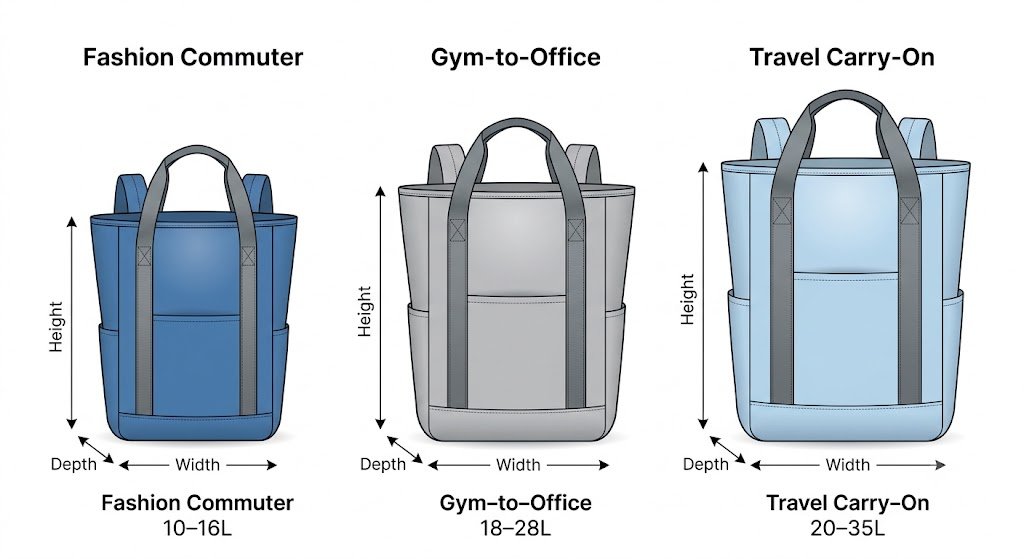
Typical Size Ranges by Use Case
While there is no universal standard, most backpack totes fall into one of three general categories:
| Use Case | Typical Dimensions (W × H × D) | Approximate Capacity |
|---|---|---|
| Fashion Commuter | 30–36cm × 28–34cm × 10–14cm | 10–16L |
| Gym-to-Office Hybrid | 32–40cm × 40–48cm × 14–20cm | 18–28L |
| Travel Carry-On | 34–42cm × 42–52cm × 16–24cm | 20–35L |
These ranges are intended as planning references rather than fixed specifications.
Final dimensions depend on factors such as laptop size, pocket layout, opening style, and carrying requirements.
Why Two Bags With the Same Dimensions Can Require Different Construction
Dimensions alone do not determine how a backpack tote should be built.
For example, two bags may both measure 35cm × 40cm.
One is designed to carry a tablet, notebook, and daily essentials.
The other is designed to carry a laptop, travel accessories, and several kilograms of gear.
Although the external dimensions are identical, the second bag may require:
- Wider shoulder straps
- Additional reinforcement
- Stronger anchor points
- More supportive back-panel construction
The footprint stays the same.
The engineering does not.
Travel Sizing and Airline Considerations
When a backpack tote is intended for travel, dimensions become more than a design preference.
Many airlines impose restrictions on personal-item and cabin baggage sizes, although exact limits vary by carrier.
For that reason, travel-oriented backpack totes are often designed around common under-seat and carry-on requirements rather than maximum storage volume alone.
Confirming airline requirements during development is generally easier and less expensive than redesigning dimensions after the first sample has been produced.
Why Do Backpack Tote Bags Cost More Than Buyers Expect?
Many buyers compare a backpack tote to a standard tote because the products look similar.
From a manufacturing perspective, that comparison is usually misleading.
A backpack tote is typically closer to a lightweight backpack than to a conventional tote bag. The reason is not appearance. The reason is function.
A standard tote only needs to perform well in one carry mode.
A backpack tote must perform in two.
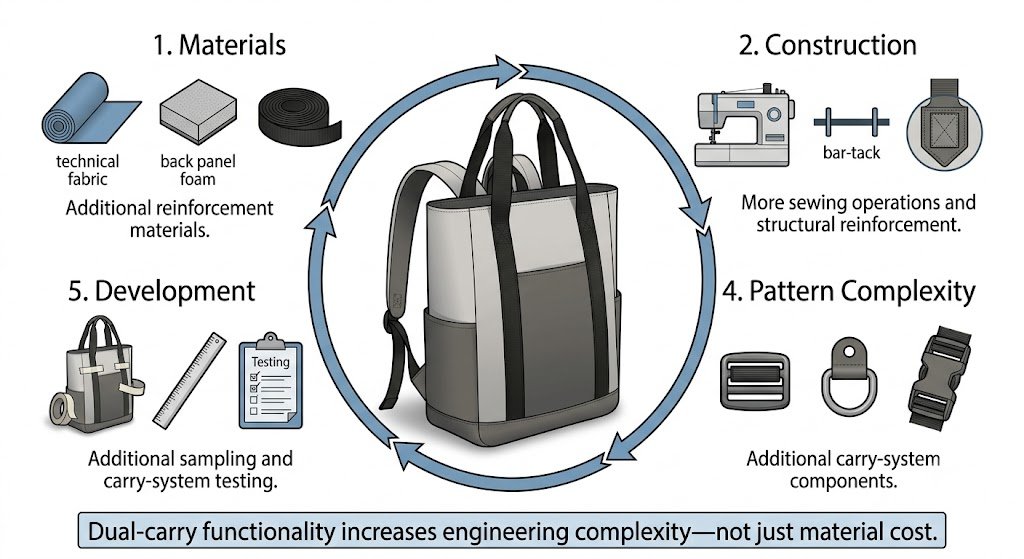
Supporting both carry modes introduces additional structural requirements that affect materials, construction methods, hardware selection, and development time.
As a result, the cost difference is usually driven by engineering rather than aesthetics.
Why Function Drives Cost
The visual differences between a tote and a backpack tote can be relatively small.
The structural differences are not.
To support dual-carry functionality, manufacturers often need to add:
- Reinforced strap anchors
- Additional back-panel support
- Stronger stress-point stitching
- Adjustable strap systems
- More complex pattern construction
Each of those decisions adds material, labor, or development complexity.
Where the Additional Cost Comes From
Reinforcement and Structural Support
Backpack totes frequently require reinforcement in areas that standard totes do not.
Examples include:
- Anchor tabs
- Back-panel reinforcement
- Base support structures
- Stress-point stitching
These features increase labor time and often require additional materials.
Hardware Components
Many backpack totes include components such as:
- Triglide adjusters
- D-rings
- Swivel hooks
- Webbing systems
- Strap adjustment hardware
While each component may be relatively inexpensive on its own, the combined impact can be significant compared with a basic tote construction.
Pattern and Assembly Complexity
A standard tote is typically built from a relatively simple pattern.
A backpack tote may include:
- Strap assemblies
- Reinforcement panels
- Anchor tabs
- Back-panel components
- Strap storage features
More components generally mean more cutting operations, more sewing steps, and more quality-control checkpoints.
Development and Sampling
The carry system itself often requires additional testing during development.
Unlike a standard tote, comfort, load distribution, strap positioning, and anchor placement may need to be evaluated using physical samples.
For this reason, backpack tote projects often require more sample revisions than conventional tote bags.

Cost Comparison at a Glance
| Cost Driver | Standard Tote | Backpack Tote |
|---|---|---|
| Carry System | Tote handles only | Tote handles + backpack straps |
| Reinforcement | Minimal | Additional structural support |
| Hardware | Basic | Adjustable carry hardware |
| Pattern Complexity | Relatively simple | More components and assemblies |
| Development Complexity | Lower | Higher due to carry-system testing |
This is why two bags that appear similar in a product photo can receive very different quotations from a factory.
The visual design may look comparable.
The amount of engineering behind the product often is not.
Why Accurate Specifications Matter
One of the most common causes of inaccurate pricing is an incomplete product brief.
A reference image can communicate appearance, but it rarely defines:
- Load requirements
- Carrying comfort expectations
- Reinforcement level
- Strap configuration
- Structural requirements
Without those details, suppliers are forced to make assumptions.
The more clearly the intended use case is defined, the more accurate the quotation is likely to be.
What Should a Buyer Know Before Starting a Backpack Tote Sample?
Buyers who go into a backpack tote sample round without preparation waste budget. The first sample round surfaces structural questions that should have been answered before the sample was ordered.
Before ordering a backpack tote sample, a buyer should confirm: the primary carry mode, the target load weight, whether straps are permanent or detachable, the back panel comfort requirement, and the interior layout priority. These decisions drive the structure. Without them, the sample is a guess.
In our development process, we use a short intake brief before sampling this category. It is not bureaucratic. It is practical. Here is the kind of information that changes the sample outcome:
| Decision | Why It Can’t Wait | What Happens If Left Open |
|---|---|---|
| Primary carry mode | Determines strap spec, back panel, and anchor placement | First sample will be wrong for the actual use case |
| Target load weight | Determines strap width, anchor reinforcement, base support | Under-built sample fails under real load |
| Strap permanence | Changes anchor design and hardware entirely | Can’t be changed without restarting the anchor pattern |
| Back panel type | Drives material, thickness, and cost — and it affects the silhouette | Panel rebuilt in round two |
| Opening type | Top structure affects the whole bag posture and carry physics | Opening redesign after sampling = full revision round |
We work with buyers at all stages of product readiness. Some come with a full tech pack. Some come with a reference image and a use case description. Both are workable starting points — but the second type requires more upfront conversation before sampling starts. That conversation is not a delay. It is the work.
📎 Related: How to Write a Bag Sampling Brief That Gets the Right First Sample (update with your live URL)
Why Two Similar Backpack Totes Can Have Very Different Prices
One of the most common sourcing mistakes is comparing backpack totes based only on appearance.
Two bags may look almost identical in photos.
One may cost $8 to manufacture.
Another may cost $15.
The difference often comes from details that are invisible from the outside:
- Strap construction
- Reinforcement layers
- Back-panel materials
- Hardware quality
- Internal organization
- Sampling requirements
This is why a reference image alone is rarely enough to obtain an accurate quotation.
Bottom Line
A backpack tote is not a tote bag with straps. It is a dual-carry product with structural commitments that run through the entire pattern — anchor points, back panel, base reinforcement, and load path.
Buyers who understand this before sampling save two rounds and six weeks. Buyers who discover it mid-sampling pay for the education in sample costs and timeline.
The decisions that matter most — strap permanence, opening type, back panel thickness, and target load — cost nothing to make at brief stage. They cost real money to change after sampling starts.
If you know what you need, we can build it efficiently. If you’re still working out the spec, we’ll ask the right questions first. Either way, the conversation starts with the use case — not the reference photo.
Already have a reference image?
Send it to us together with your target load weight and intended use case. We’ll tell you whether the design is feasible before you spend money on sampling.
→ Get a Backpack Tote Feasibility Review

FAQ
Are backpack tote bags comfortable to carry?
Comfort depends less on appearance and more on strap width, anchor placement, and back-panel construction. A backpack tote designed for occasional use may feel uncomfortable under heavier loads, while a properly engineered dual-carry design can remain comfortable even when carrying laptops, travel gear, or daily essentials.
What is the difference between a backpack tote and a convertible bag?
The terms overlap, but I use them differently. A backpack tote is designed so both carry modes are equal — the tote handles and the backpack straps are both built into the primary structure. A convertible bag often treats one mode as primary and the other as a secondary option — typically a backpack that adds tote handles, or a tote with strap attachments. The structural difference is significant: a true backpack tote needs a full strap anchor system and a load-rated back panel for both carry modes.
Why does a backpack tote need 2–4 sample rounds instead of 1–2?
The carry system requires physical testing under load that a standard tote doesn’t. Strap anchor placement, back panel rigidity, and load distribution all interact. You can spec them correctly on paper and still find that the bag pulls away from the back or that the strap runs press uncomfortably under 4kg. That only shows up in a physical sample. Most carry system adjustments require a pattern change — which means a new sample. Two rounds minimum. Four is realistic for a carry system with real load requirements.
Can I add backpack straps to an existing tote design I already have?
Rarely as cleanly as buyers expect. Adding backpack straps to an existing tote means: redesigning the anchor points (which affects the top handle placement), adding back panel reinforcement (which adds thickness and may change the silhouette), and adding base load support (which may require a base board insert). All of those changes touch the pattern. In most cases, it’s faster to use the existing tote as a reference and develop the backpack tote as a new pattern than to retrofit the straps into the original design.
Is a detachable strap system worth the extra cost?
Usually not. Detachable straps add $1.20–1.80 in connector hardware per bag, require a different anchor tab design, and add at least one sample round for the release mechanism. Most end users detach the straps once and stop. A stowaway strap system — permanent straps that fold into a back panel pocket — achieves the same clean tote look without the hardware cost or the extra development time. I recommend this to most buyers who request detachable. Some still want detachable for specific use cases. That’s fine — but it should be a deliberate decision, not a default assumption.
What load weight should a backpack tote be designed for?
There is no universal load rating for backpack totes.
The appropriate specification depends on how the product will be used.
A fashion-oriented commuter bag may only need to carry daily essentials. A travel-focused backpack tote may need to support a laptop, clothing, chargers, and other gear for extended periods.
For that reason, defining the expected load before sampling is one of the most important decisions in the development process. The carry requirement influences strap design, anchor reinforcement, back-panel construction, and overall material selection.
How are backpack tote bags classified for US customs?
Most fabric backpack tote bags fall under HTS Heading 4202 (backpacks and similar containers), with subheadings by outer surface material. Verify applicable duty rates at the USITC Harmonized Tariff Schedule before you price your landed cost. The correct subheading depends on whether the outer surface is textile (polyester, nylon, canvas) or another material — and each carries a different rate.






