


For decades, if you needed to carry gear, you had two main options: a bulky backpack or a formal briefcase. Today, the sling bag has emerged as the dominant "third option" for modern life.
It sits perfectly in the gap between "too much" and "not enough." But is it just a trendy fashion statement, or a genuinely superior tool for your daily carry?
This guide provides an authoritative breakdown of what makes a sling bag unique, its key ergonomic advantages1 (and disadvantages), and exactly when it’s the smarter choice over a traditional backpack.
What Is a Sling Bag, and How Does It Differ from Crossbody Bags and Backpacks?
A sling bag2 is a single-strap pack designed to be worn snugly across the chest or back. It is a hybrid that is more technical and structured than a casual crossbody purse, but smaller and more agile than a traditional backpack.
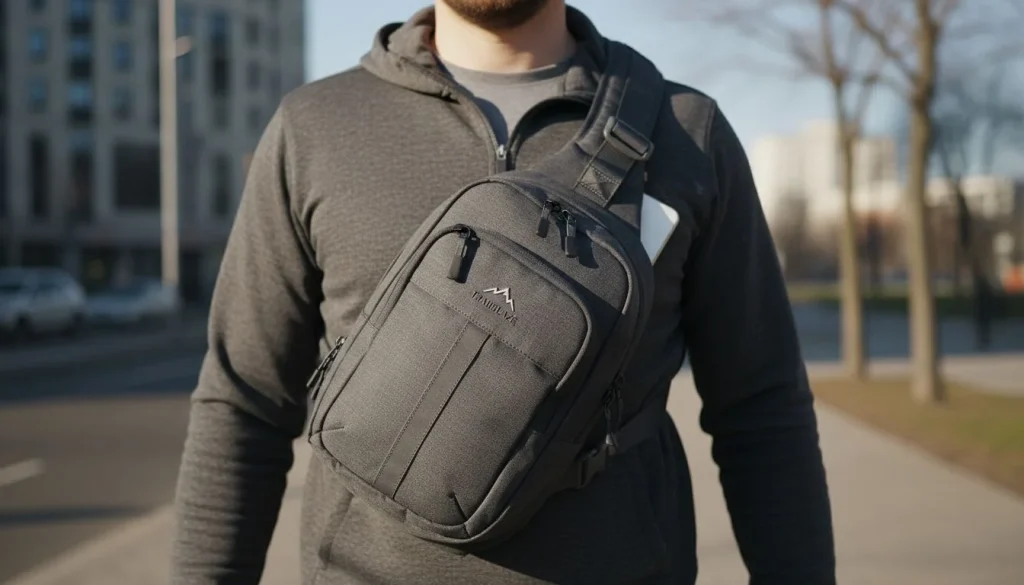
The key differentiator is the strap mechanism. While a backpack uses two straps for load-bearing on both shoulders, a sling uses one diagonal strap. This design prioritizes quick access and mobility3 over heavy-load capacity.
It’s important not to confuse a sling with other common bags. Each serves a distinct purpose based on its design:
How Do These Common Bags Compare at a Glance?
Use this table to understand the core differences between these popular styles.
| Feature | Sling Bag | Backpack | Fanny Pack / Crossbody |
|---|---|---|---|
| Strap Design | 1 Diagonal Strap (Tight) | 2 Shoulder Straps | 1 Waist/Shoulder Strap (Loose) |
| Typical Capacity | 5L – 10L (Tablet size) | 15L – 30L+ (Laptop size) | 1L – 3L (Phone/Wallet size) |
| Primary Benefit | Quick "swing" access | Ergonomic comfort for heavy loads | Minimalist "pocket relief" |
| Wear Position | Tight against Back or Chest | Back only | Waist or loose across chest |
| Ideal Scenario | City exploring, quick commutes, photography | All-day work, school, hiking, heavy carrying | Quick errands, light travel, outdoor activities. |
Actionable Tip: If you need to carry a laptop every day, stick with a backpack. If you only need a tablet, wallet, and keys, a sling is the far more comfortable and agile choice.
What Are the Different Types of Sling Bags?
Sling bags have diversified significantly over the last decade. It’s no longer just one generic style; they are now purpose-built for specific lifestyles, ranging from high-fashion runways to rugged hiking trails.
The market is generally divided into four primary categories based on their intended use and capacity: Minimalist EDC Sling Bags (for "pocket relief"), Tech/Commuter Sling Bags (for mobile work), Tactical Sling Bags (for rugged utility), and Fashion Sling Bags (for aesthetics). Knowing these categories ensures you don’t buy a bulky tactical bag when you only needed a slim fashion piece.
Summary Comparison: Which Sling Type Fits Your Lifestyle?
Choosing the right sling ensures you don’t end up with too much bulk or not enough protection. Use this at-a-glance table to match the sling category to your specific daily requirements.
| Sling Type | Typical Capacity | Best For | Key Signature Features |
|---|---|---|---|
| Minimalist (EDC) Sling Bags | 1L – 4L | "Pocket Relief" (Phone, wallet, keys) | Slim profile, lightweight, worn under jackets |
| Tech / Commuter Sling Bags | 5L – 10L | Mobile Office (iPad, camera, notebook) | Padded tablet sleeves, admin panels, weather-resistant materials |
| Tactical / Outdoor Sling Bags | 6L – 15L+ | Rugged Utility, Hiking, CCW | MOLLE webbing, heavy-duty buckles, 1000D nylon durability |
| Fashion / Streetwear Sling Bags | 1L – 5L | Aesthetics, Festivals, Urban Style | Bold logos, unique fabrics (PVC/Leather), worn high on chest |
How Do Tactical and Fashion Slings Differ in Purpose?
These two categories sit at opposite ends of the spectrum. One is engineered for survival and utility, while the other is designed strictly for visual impact.
- Tactical & Outdoor Slings: Built for rugged environments, often using heavy 1000D nylon.
- Key Features: MOLLE webbing for attaching extra gear, CCW (concealed carry weapon) compartments, and heavy-duty buckles.
- Best For: Hikers, law enforcement, and outdoor adventurers.
- Fashion & Streetwear Slings: Built as a statement accessory, often worn high and tight across the chest.
- Key Features: Bold logos, unique materials (like clear PVC or luxury leather), and minimal internal organization.
- Best For: Urban style, festivals, and complementing a specific outfit rather than hauling gear.
How Do You Choose the Right Size Sling Bag?
Choosing the wrong size is the most common mistake first-time sling buyers make. It’s difficult to visualize volume online, and a bag that looks compact in a photo might actually be huge and unwieldy on your back.
The perfect size depends entirely on your "anchor item"—the largest single object you must carry daily. For most users, the "Goldilocks zone" is between 6L and 9L. This size range is large enough to be useful (fitting a tablet and water bottle) but small enough to remain comfortable on one shoulder.
The Liter (L) Guide: Matching Capacity to Your Gear
Don’t guess based on pictures; use the liter rating to determine if your gear will fit. Use this table to find your required capacity based on your specific "anchor item."
| If Your Largest Item Is… | You Need a Sling in This Range: | Typical Category |
|---|---|---|
| Phone & Wallet | 1L – 3L | Minimalist / Waist Pack |
| Nintendo Switch / Kindle | 4L – 6L | Small EDC Sling |
| 11" iPad Pro / A5 Notebook | 7L – 9L | Standard Commuter Sling |
| 13" Laptop / A4 Documents | 10L – 15L+ | Large Laptop Sling* |
Note: We generally recommend switching to a backpack once you reach the 13" laptop tier for better ergonomics.
Why Bigger Isn’t Always Better with Sling Bags?
It is tempting to buy a larger bag "just in case" you need the extra space, but with slings, this often leads to regret.
- The "Sag" Effect: Large, partially empty slings often sag and look sloppy, unlike backpacks which hold their shape better when empty.
- The Overpacking Trap: If you have the space, you will fill it. A 12L sling encourages you to carry heavy items you don’t need, quickly leading to the shoulder strain discussed earlier.
- Loss of Agility: A bulky sling is harder to "swing" quickly to your front, defeating the bag’s primary purpose of being agile and unobtrusive.
What Are the Key Features of a Good Sling Bag?
Not all slings are created equal. Many cheap versions are just oddly shaped sacks that are uncomfortable to wear. A good sling is defined by its specialized hardware and smart, user-focused design.
When shopping for a high-quality sling, look beyond just the style. The best slings incorporate features that make them comfortable and functional for all-day use.
What Features Should You Look For in a Premium Sling?
- Ambidextrous Strap: A detachable buckle at the bottom that lets you switch the strap to either the left or right shoulder. This is crucial for preventing muscle fatigue on long days.
- Quick-Adjust Buckle: A mechanism that lets you instantly tighten the strap for active movement (like cycling) or loosen it to swing it forward.
- Smart Organization: Look for a soft-lined pocket (for sunglasses/phone) and a dedicated, padded tablet sleeve.
Actionable Tip: Always check for an "ambidextrous" strap system. Being able to switch shoulders halfway through the day can save you from serious neck strain.
How Does Material Choice Impact a Sling Bag’s Performance?
The fabric defines not just the look, but the lifespan and weather resistance of the bag. A sling made of cheap polyester will fray quickly under daily abuse, whereas technical fabrics can last a decade.
Use this table to choose the right material for your environment:
| Material | Durability | Weather Resistance | Best For |
|---|---|---|---|
| Ballistic Nylon (1050D/1680D) | ⭐⭐⭐⭐⭐ (Extreme) | ⭐⭐⭐⭐ (High) | Urban commuters, "buy it for life" durability |
| Technical Sailcloth (X-Pac™) | ⭐⭐⭐⭐⭐ (Extreme) | ⭐⭐⭐⭐⭐ (Waterproof) | Techwear enthusiasts, photographers, rainy climates |
| Standard Polyester (600D) | ⭐⭐ (Moderate) | ⭐⭐ (Low) | Casual use, budget-friendly promotional items |
| Full-Grain Leather | ⭐⭐⭐⭐ (High) | ⭐⭐⭐ (Moderate) | Business casual environments, premium style |

Are Single-Strap Bags Bad for Your Back?
While slings are convenient, they have an inherent ergonomic flaw that users must be honest about.
Yes, they can be bad for your back if misused. Physiotherapists agree that asymmetrical (one-sided) loads are a primary cause of muscle strain, neck tension, and shoulder imbalances. A backpack is always ergonomically superior because it distributes weight evenly across both shoulders and the spine.
Use this table to understand how different bags physically stress your body during daily use:
Physical Impact Comparison: Sling vs. Backpack
| Body Area | Sling Bag Impact (One Strap) | Backpack Impact (Two Straps) |
|---|---|---|
| Shoulders | High, uneven strain on one trapezius muscle | Balanced load across both shoulders |
| Spine Alignment | Tends to cause lateral (sideways) leaning | Maintains straighter alignment (if not overloaded) |
| Neck Tension | High, often pulling the neck to one side | Moderate, usually only if overloaded |
| Core Engagement | Uneven compensation to stay balanced | Even engagement for stabilization |
What Is the Safe Weight Limit for a Sling Bag?
Slings are ergonomically safe only for light loads.
- Safe Zone (< 10 lbs): Carrying a tablet, wallet, phone, and a small water bottle is perfectly fine for most healthy adults.
- Danger Zone (> 10 lbs): If you overload a sling with a heavy laptop, textbooks, or dense gear, you will eventually cause strain to your neck and spine.
What Is the "Correct" Way to Wear a Sling?
One of the sling’s best features is its versatility. There is no single "correct" way to wear it; you change the position based on what you are doing.
The two main functional positions are "Back Carry" for comfort and "Front Carry" for security.
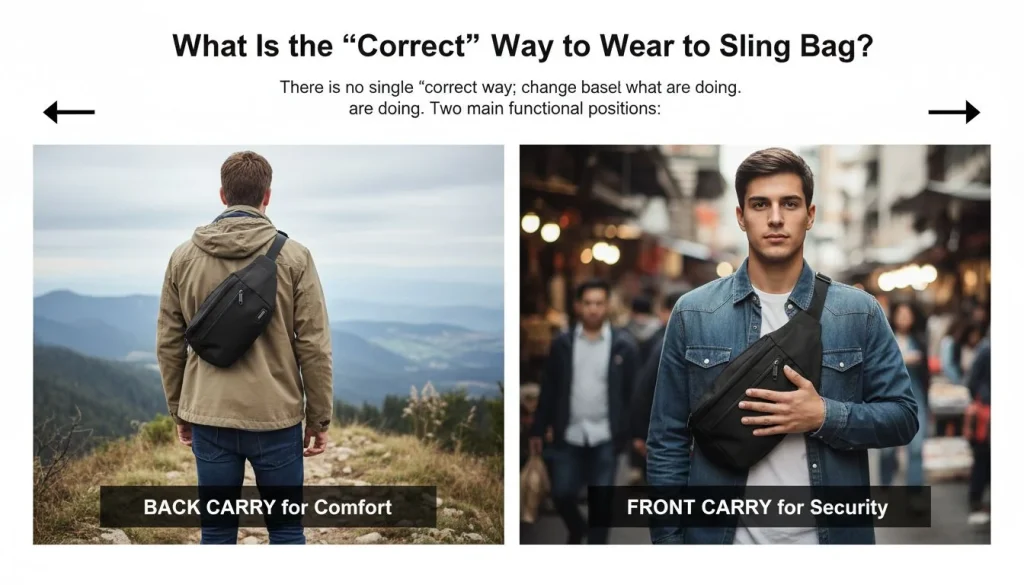
When Should You Use "Back Carry" Mode?
This is the most common and comfortable position for general use.
- Best For: Walking, hiking, cycling.
- Why: It keeps the bag snug against your back and out of your way, leaving your arms completely free and unobstructed.
When Should You Use "Front Carry" Mode?
This positions the bag tightly across your chest, often called "high-security mode."
- Best For: Crowded markets, concerts, public transit.
- Why: It puts your valuables directly under your chin and in your line of sight, making it nearly impossible for a thief to access them without you noticing.
How to Style a Sling Bag for Different Occasions?
The sling has evolved from a purely functional niche item into a major mainstream fashion accessory, adaptable to almost any look.
Whether you are dressing for a casual weekend or a smart-casual office, there is a sling that fits. It’s all about choosing the right material and profile.
How Can You Style a Sling for Any Event?
- Streetwear/Casual: Bold colors, large logos, or tactical-looking nylon slings worn high on the chest are staples of modern streetwear.
- Business Casual: A minimalist, structured sling in premium black ballistic nylon or leather can look sharp and professional, replacing a bulky briefcase for essential meetings.
- Travel: A slim, low-profile sling worn under a jacket acts as a modern, secure alternative to the old-fashioned "money belt."
Actionable Tip: For maximum versatility, choose a sling in a neutral color like black, gray, or navy with minimal branding. It will seamlessly transition from a weekend hike to a casual office setting.
Why Are Sling Bags Considered the Ultimate "Airport Personal Item"?
Experienced travelers have a secret weapon for flying: the "Two-Bag System."
By using a sling bag as your designated "personal item," you gain a massive advantage in comfort and convenience during flights. It is small enough to always count as a personal item, regardless of how strict the airline is.
How Does the "Two-Bag System" Work for Travel?
- The Overhead Bag: Your main carry-on (roller or large backpack) goes into the overhead bin and stays there.
- The Seat Bag (Sling): Your sling stays on your body. It holds your passport, boarding pass, phone, noise-canceling headphones, tablet, and hand sanitizer.
- The Benefit: You have instant access to all your in-flight essentials without ever having to stand up, open the overhead bin, or dig under the seat in front of you.
Actionable Tip: Before boarding, make sure your sling is packed with everything you need for the flight. Once you sit down, you won’t need to get up again until you land.

Answers to Common Questions About Sling Bags
What is the difference between a sling bag and a fanny pack?
A fanny pack (or waist pack) is primarily designed to be worn around the waist and is smaller (1L-3L). A sling bag is designed to be worn cross-body (back/chest) and is larger (5L-10L) with more technical organization.
Can a sling bag hold a water bottle?
Some larger slings (8L+) are specifically designed with external or internal water bottle pockets, but most compact slings (under 6L) cannot fit one.
Can a sling bag hold a laptop?
Almost never. Most slings are designed for a tablet (e.g., iPad Mini or 11" iPad Pro). Only very large "laptop slings" (10L+) can fit a 13" ultrabook, but this is not recommended as the weight is uncomfortable and ergonomically poor on a single strap. If you carry a laptop daily, use a backpack.






