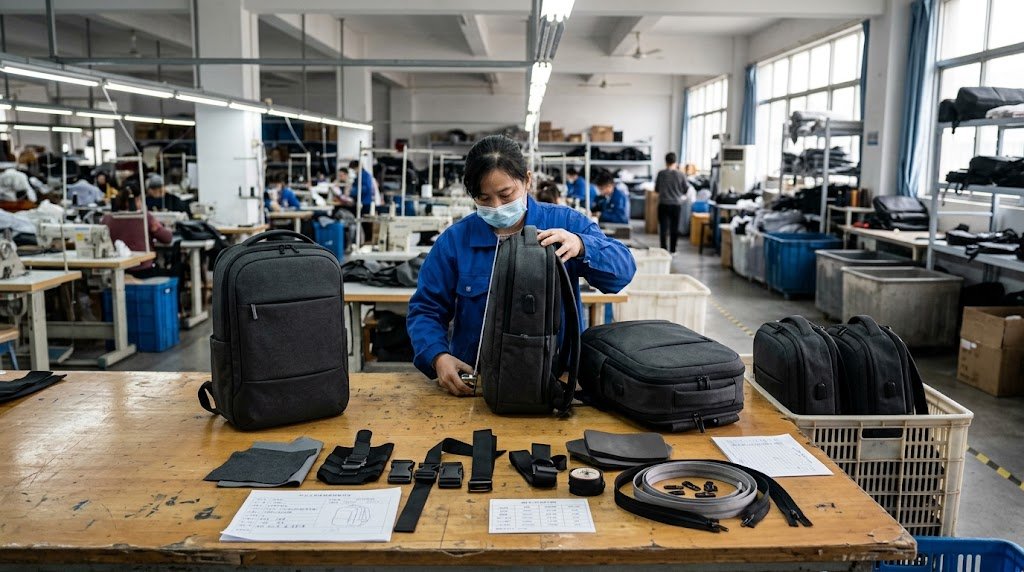
To be honest, I spend more time overseeing the production of Weekend Bags on the factory floor than I actually get to enjoy weekends.
A lot of customers, when they first send inquiries, mention ‘Duffel Bag’ in the notes, but the reference images they attach show a well-structured Weekender. To consumers, these two items might seem similar, but in terms of our factory’s material planning and cost accounting, the difference is huge.
Key Takeaways: What defines a Weekend Bag?
A weekend bag is a soft-sided luggage1 piece specifically designed for short trips lasting 2-3 days. Typically ranging from 30 to 50 liters in capacity with a length of approximately 50cm, it bridges the gap between a gym duffel and a hard-shell suitcase. Unlike standard duffels, a quality weekend bag features structured materials (like canvas or leather), reinforced handles, and organizational pockets (often including a shoe compartment) to combine style with travel functionality.
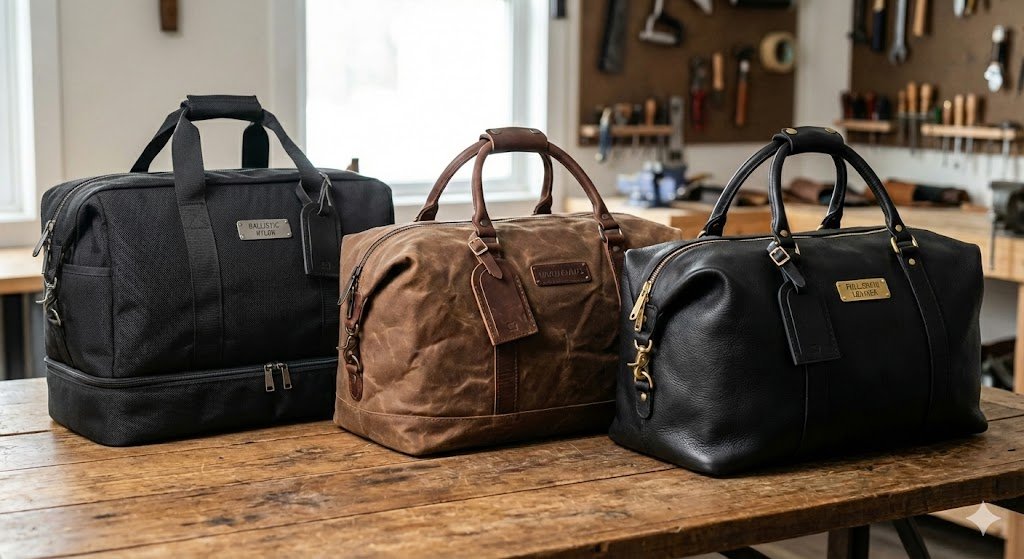
In this guide, I’m going to skip the marketing fluff and tell you exactly what makes a weekend bag work—from the "bones" inside the lining to the specific nylon density that prevents tearing.
What Exactly Distinguishes a Weekend Bag from a Gym Duffel?
Many buyers confuse the two, but from a manufacturing standpoint, they are built completely differently.
A weekend bag is a structured, soft-sided travel bag designed for 2-3 day trips, typically prioritizing aesthetics and compartmentalization over pure volume. Unlike a unstructured gym duffel which is often a single layer of nylon meant to collapse, a weekend bag usually features reinforced bottoms, rigid piping, and specialized materials (like waxed canvas2 or ballistic nylon) to maintain its shape even when empty.
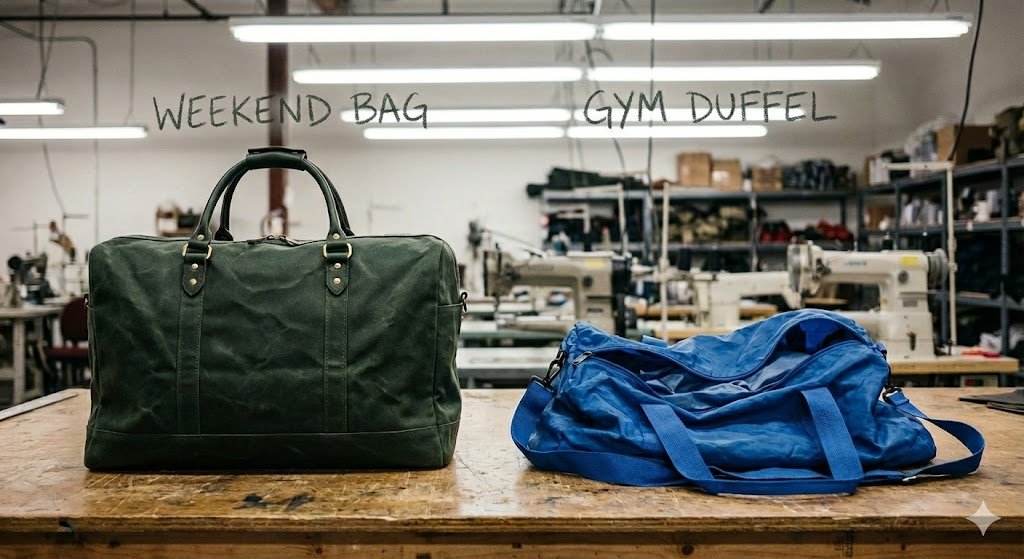
Comparison: Weekend Bag vs. Gym Duffel
When we spec these out for production, the bill of materials looks very different. Here is how they stack up on the factory floor:
| Feature | Weekend Bag (The Traveler) | Gym Duffel (The Utility) |
|---|---|---|
| Structure | Rigid/Semi-Rigid. Uses PE board in the bottom and piping in seams. Sits upright when empty. | Collapsible. Often just a single layer of fabric. Sags or folds flat when empty. |
| Primary Material | Heavy Duty. Canvas (16oz+), Leather, or high-denier Ballistic Nylon. Focus is on abrasion resistance. | Lightweight. Thin Polyester (600D) or Ripstop Nylon. Focus is on breathability and weight. |
| Hardware | Metal. Brass, Stainless Steel, or Zinc Alloy. Built for heavy loads and aesthetics. | Plastic. POM or Nylon buckles. Built to be sweat-proof and light. |
| Organization | Complex. Dedicated laptop sleeves, waterproof toiletry pockets, and jewelry/watch pouches. | Simple. Usually one large "black hole" cavity and maybe one side mesh pocket for a bottle. |
| Price Perception | High Value. Seen as "Luggage" or a fashion accessory. | Commodity. Seen as "Gear" or a disposable utility item. |
Why Structure Matters More Than You Think
I once had a European client insist on removing the PE (polyethylene) board from the bottom of their design to save $0.80 per unit. They wanted a "slouchy, relaxed look."
It was a disaster.
When we filled the sample with clothes, it looked fine. But the moment we put a pair of heavy boots in, the bottom sagged like a sack of potatoes. It looked cheap. A true weekend bag needs "bones." We usually sew a 2mm EVA foam or PE board between the lining and the shell. You can’t see it, but it’s the difference between a bag that sits proudly in a hotel lobby and one that looks like dirty laundry.
Deep read: Real Difference Between Weekender and Duffle Bag?
What Is the Ideal Size and Volume for a Weekend Bag?
If you make a bag too small, it’s just a glorified briefcase. If you make it too big, the airline gate agent will force your customer to check it, and they will hate you for it.
As a manufacturer, I have seen clients obsessed with "maximizing value" by creating massive 60L monsters, only to find they don’t sell because they are too heavy to carry comfortably.
The ideal weekend bag size is approximately 50cm x 28cm x 28cm (roughly 19.5 x 11 x 11 inches), offering a volume of 40 to 45 Liters. This specific dimension is the "sweet spot" because it maximizes packing space for two days of clothes, a toiletry kit, and a pair of shoes, while remaining compliant with strictly enforced domestic and international airline carry-on restrictions3.
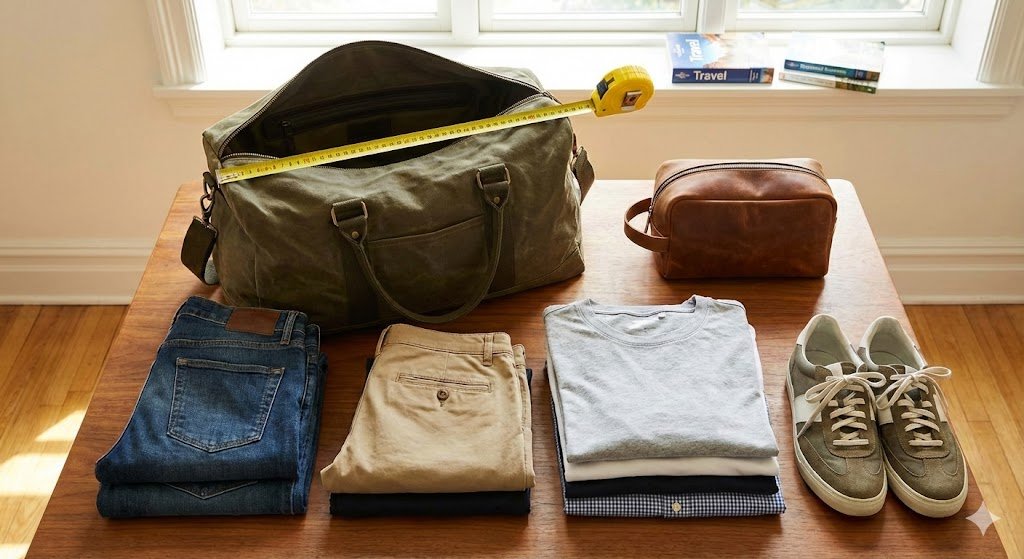
Does a Weekend Bag Count as a Carry-On?
Yes, and it actually has a secret advantage over suitcases.
Hard-shell suitcases are unforgiving. If the wheels stick out 1cm too far, they won’t fit the airline’s metal sizer frame. Weekend bags have what we in the industry call the "Squish Factor."
Because we manufacture these using soft materials like canvas or nylon, the bag can physically compress to fit into overhead bins or under seats, even if it is technically a few centimeters over the limit. However, this only works if the bag is designed correctly.
- Avoid Rigid Frames: We use flexible PE sheets in the bottom, not rigid metal frames, to allow for compression.
- Compression Straps: I always advise adding side buckles. They take the strain off the main zipper and let the user cinch the bag down if the gate agent looks strict.
- Low-Profile Hardware: We keep the zipper pullers and handles streamlined so they don’t snag on the sizer cage.
What Are the Standard Manufacturing Dimensions?
When we create tech packs for a new production run, we don’t guess. We use data based on sales volume and return rates. Here is the breakdown of the three industry-standard sizes we produce:
| Category | Typical Dimensions | Volume | Best Use Case | Manufacturing Insight |
|---|---|---|---|---|
| The Overnighter (Compact) | 45 x 25 x 25 cm | ~28L | 1 Night / Gym | Lowest Cost. Uses less fabric and fits perfectly under any airplane seat. |
| The Weekender (Standard) | 50 x 28 x 28 cm | ~40L | 2-3 Days | The Best Seller. The most versatile size. We often reinforce the handle stitching here because loads get heavier (8kg+). |
| The Long-Haul (Oversized) | 55 x 30 x 30 cm | ~50L | 4+ Days / Winter | High Risk. If fully packed, this often exceeds carry-on weight limits, leading to customer frustration. |
Expert Tip: Did you see that Standard size? If you’re developing a brand for the first time, go with this one. A 50cm length is the golden ratio—it can fit two sets of clothes and an extra pair of shoes, while still being small enough that your customers won’t get stopped by airport staff for weighing.
Which Fabric Should I Choose: Canvas, Leather, or Nylon?
This isn’t just about style; it’s about abrasion resistance. A weekend bag spends its life being dragged across airport floors and tossed into trunks.
For the optimal balance of durability, weight, and weather resistance, Ballistic Nylon (1050D or 1680D) is the superior choice for functional travel. Heavy Waxed Canvas (16oz) is the best option for heritage aesthetics, as it develops a personalized patina over time. Full-Grain Leather4 is the most durable material but is often too heavy (2kg+ empty) for modern carry-on limits, making it best suited for handles, trim, and reinforcement points rather than the entire body.
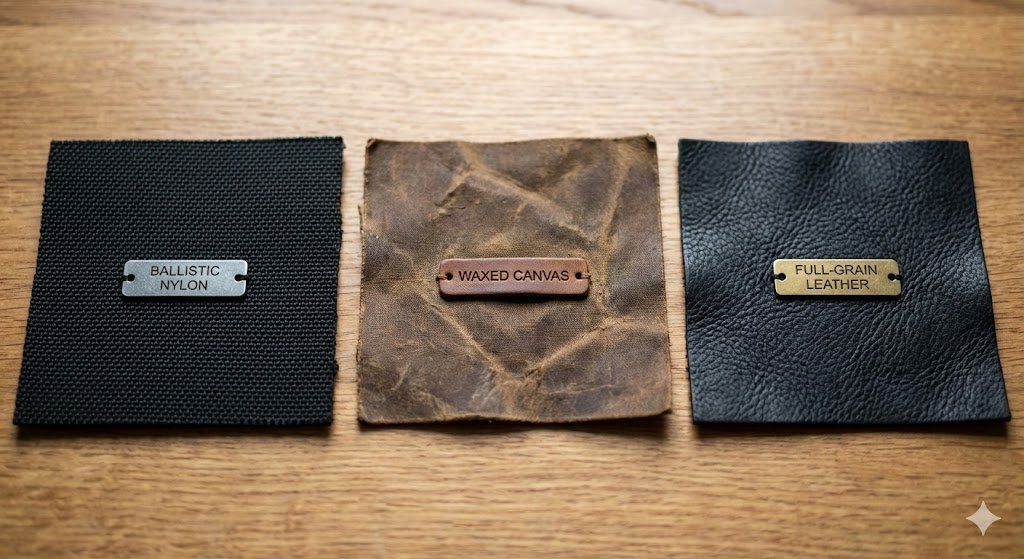
Why Is "Ballistic" Nylon the Industry Gold Standard?
It is virtually indestructible, but it is a nightmare to sew.
When we sew 1680D Ballistic Nylon on the production line, we have to change needles twice as often as we do with standard polyester. The fabric is so dense and slippery that it fights the machine. But that density is exactly why I recommend it for B2B clients targeting frequent travelers.
- Tensile Strength: It was originally developed for flak jackets. It doesn’t tear.
- The "Slide" Factor: Unlike canvas, which has friction, nylon slides over asphalt. If you drop your bag and kick it, it won’t fray immediately.
- Water Resistance: We usually back-coat our nylon with PU (Polyurethane). This makes the fabric waterproof, even if the zipper isn’t.
Comparison: How Do These Materials Age?
A weekend bag is an investment. Here is the reality of how these three materials look after one year of heavy use, based on our customer feedback data:
| Material | Durability Rating | Weight (Empty) | The "1-Year" Reality | Manufacturing Cost |
|---|---|---|---|---|
| Ballistic Nylon | ★★★★★ (High) | Light | Looks almost new. Resists stains and scratches perfectly. | Medium |
| Waxed Canvas | ★★★★☆ (High) | Medium | Develops Patina. It will show scratches and creases ("marbling"), which many users love. | Medium-High |
| Genuine Leather | ★★★★★ (High) | Heavy | Softens. It gets better with age, but requires conditioning to prevent cracking. | Very High |
| PU / Faux Leather | ★★☆☆☆ (Low) | Light | Peels. Specifically at the bottom corners. We strictly advise against using this for main body panels. | Low |
Actionable Tip: If you choose canvas, ensure your manufacturer uses "Wet Wax" treatment rather than dry wax. We once shipped a container of dry-wax bags through the tropics; the heat caused the wax to bloom and look like mold. Wet wax penetrates the fiber deeper and avoids this issue.
How Important Are Compartments and Pockets?
Five years ago, a shoe compartment was a luxury. Today, if you try to sell a weekend bag without one, you are fighting a losing battle.
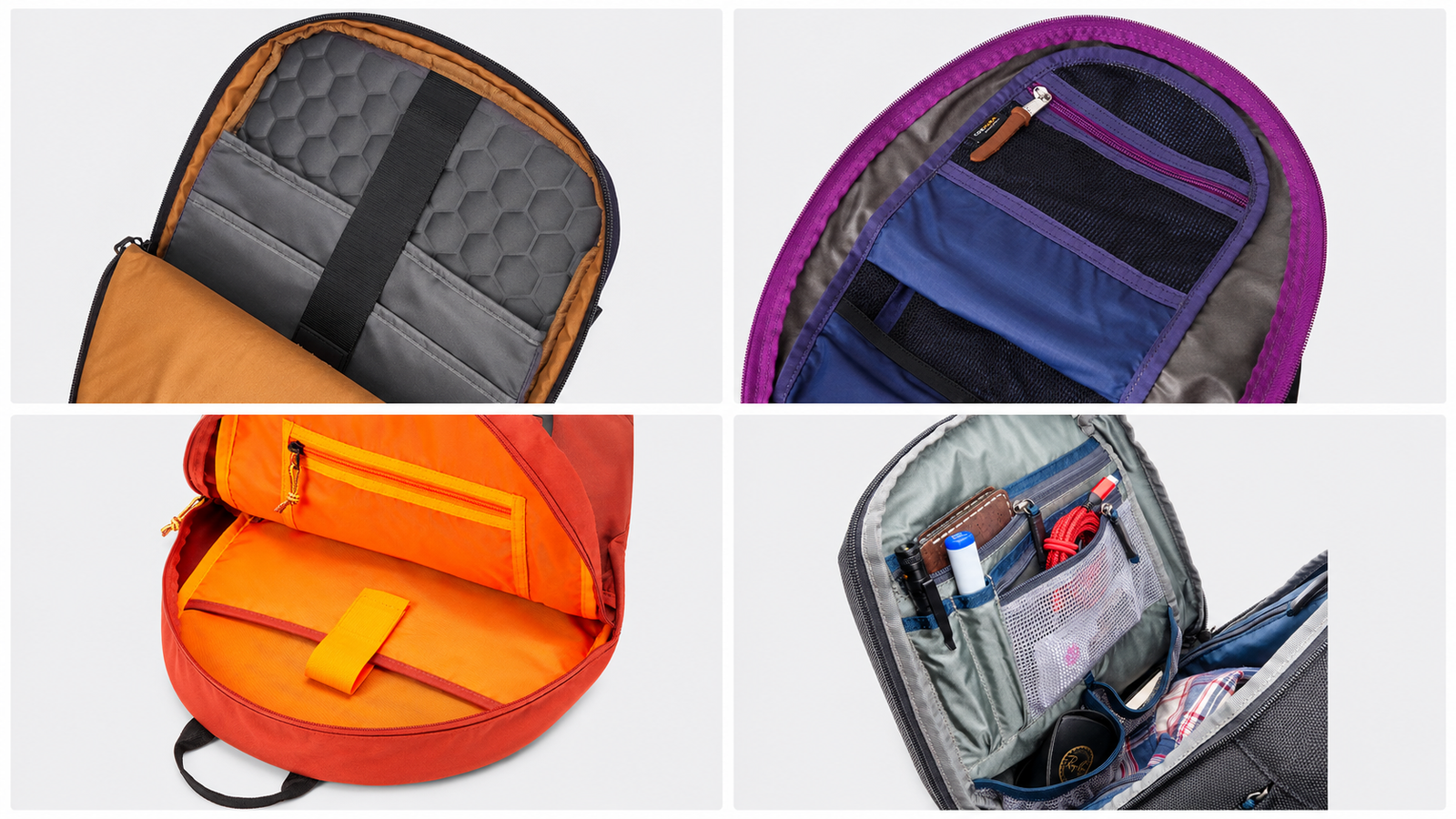
A modern, competitive weekend bag requires a ventilated shoe compartment5 to separate dirty footwear from clean clothes, a floating laptop sleeve (essential for "bleisure" travel), and a the "wet" pocket. These features increase manufacturing complexity but significantly reduce end-user friction.
The "Must-Have" Manufacturing Checklist
-
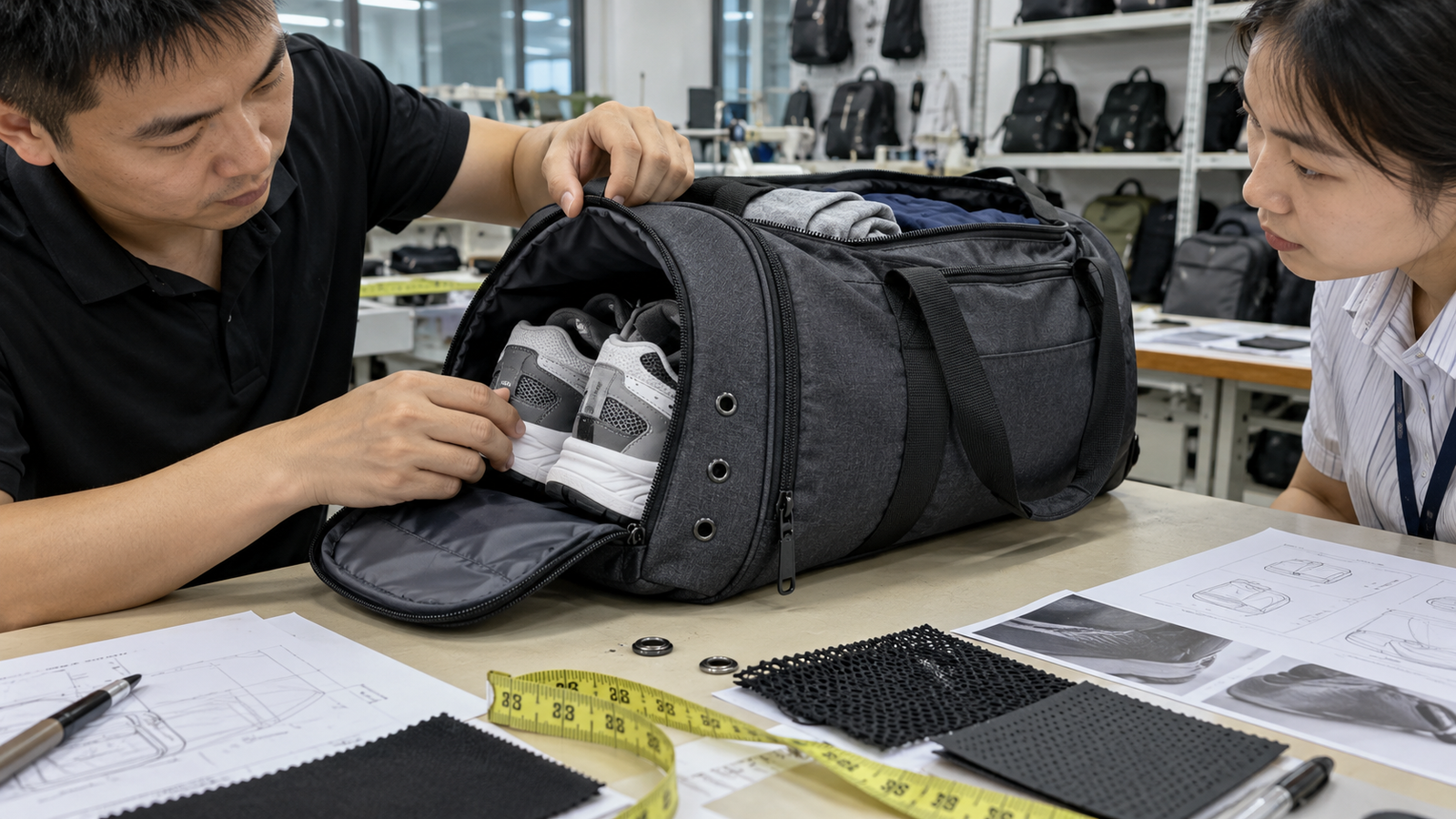
Ventilated Shoe Compartment: The #1 requested feature.
- Insider Tip: We use stiff 210D Oxford cloth for the internal pouch. Thin lining fabric gets sucked into the zipper and causes jams.
-
Floating Laptop Sleeve: Essential for business travel.
- Insider Tip: The sleeve must be sewn 1 inch above the bottom panel. This "suspension" ensures the laptop doesn’t crack if the bag is dropped on concrete.
-
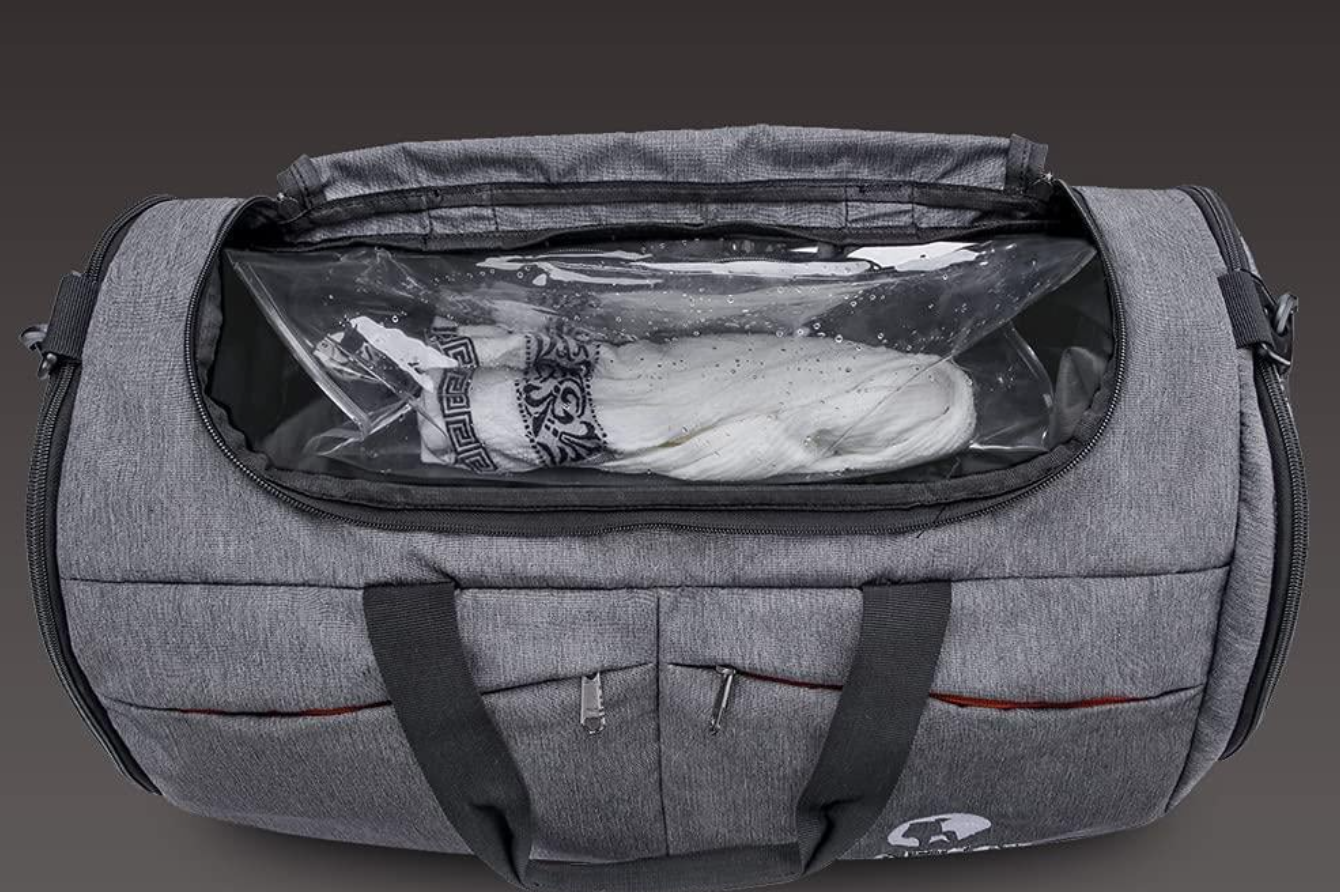
The "Wet" Pocket: A small internal pocket lined with waterproof PEVA.
- Insider Tip: This is cheap to add but saves the user from leaking shampoo bottles ruining their clothes.
-
Quick-Access External Pocket: Located between handle straps.
- Insider Tip: Use a magnetic closure instead of a zipper here. It allows for one-handed access to passports at security checkpoints.
Actionable Manufacturing Tip:
Ventilation is mandatory. If you design a shoe compartment, you must install two metal eyelets (mesh vents) on the exterior. Without airflow, damp shoes trapped inside the nylon pouch will cause the entire bag to smell like mildew within 24 hours.

What Hardware Specs Ensure Durability?
You can have the best leather in the world, but if the D-ring snaps, the bag is garbage.
Always look for YKK or SBS zippers (preferably size #5 or larger for the main compartment) and solid brass or stainless steel hardware. Avoid "zinc alloy" castings for load-bearing points like shoulder strap clips, as these brittle metals often snap under sudden torque or heavy loads.
How Can You Spot Cheap Hardware Instantly?
The "Drop Test" tells you everything.
In the factory, we don’t need a lab to tell if a sample is cheap. We just drop the metal clip on the concrete floor. Solid Brass or Steel makes a heavy, dull thud. Zinc Alloy makes a high-pitched, hollow clack. That high-pitched sound is the sound of a future customer return.
The "Do Not Use" List:
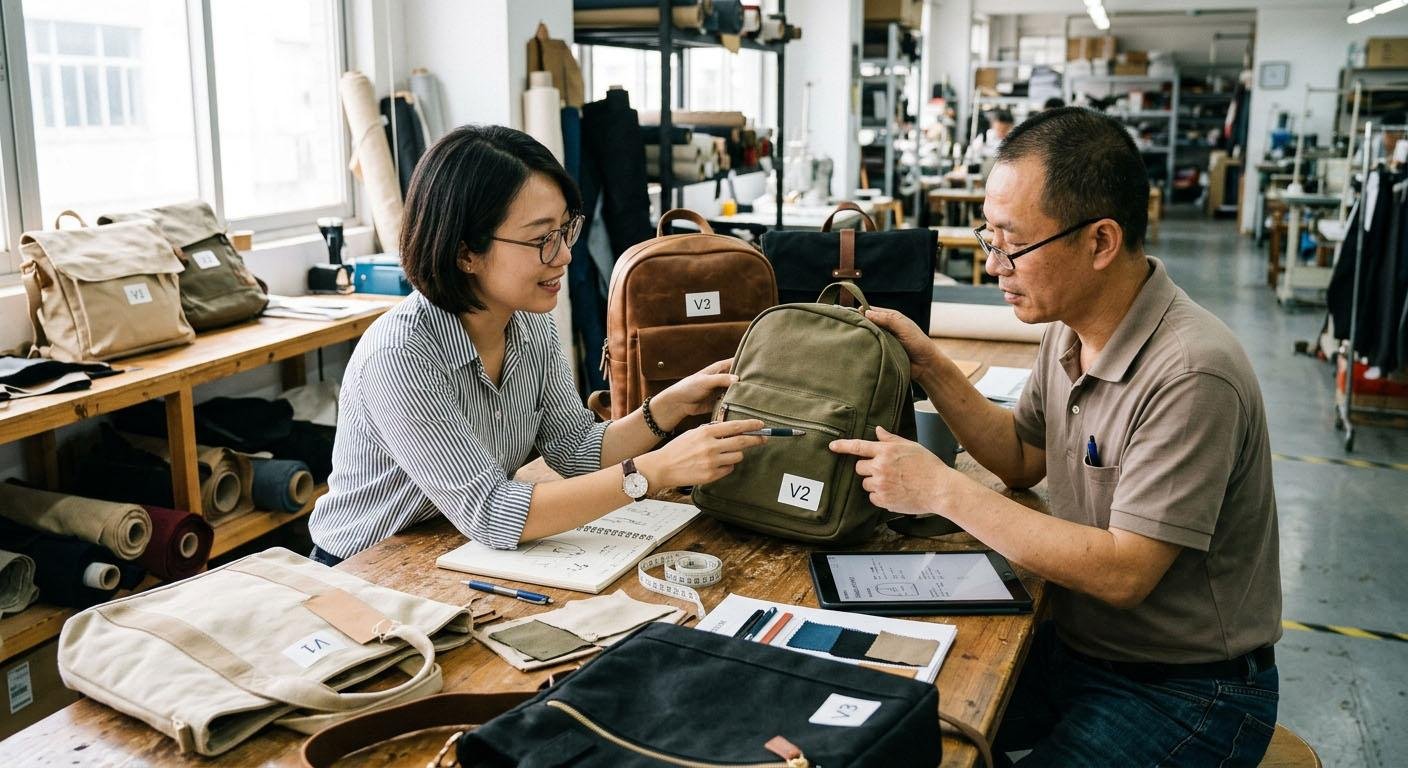
When reviewing a Tech Pack (manufacturing blueprint), we automatically reject the following specs to protect our clients:
- Size #3 Zippers: These are for dresses, not luggage. They will burst open if the bag is overpacked. Always specify Size #5 or #8.
- Plastic D-Rings: Acceptable for gym bags, but unacceptable for a weekend bag carrying 10kg+ of weight.
- Hollow Rivets: If the rivets on the handles aren’t "capped" (double-sided), they will eventually pull through the fabric.
- Exposed Magnetic Snaps6: They often look cheap and scratch easily. We recommend "Hidden Magnets" sewn inside the leather flap for a cleaner, more durable finish.
What Makes a Good Weekend Bag? (Beyond the Specs)
We have talked about nylon densities and zipper gauges, but specs are only half the story. As a manufacturer, I can build a bag that lasts 100 years, but if it hurts your shoulder after 10 minutes, it is a bad bag.
A truly "good" weekend bag isn’t just durable; it must be engineered for human comfort and social versatility. When I test a final prototype, I don’t just look at the stitching; I load it with 10kg of filler and walk around the factory. Here are the invisible qualities that separate a "good" bag from a clumsy one.
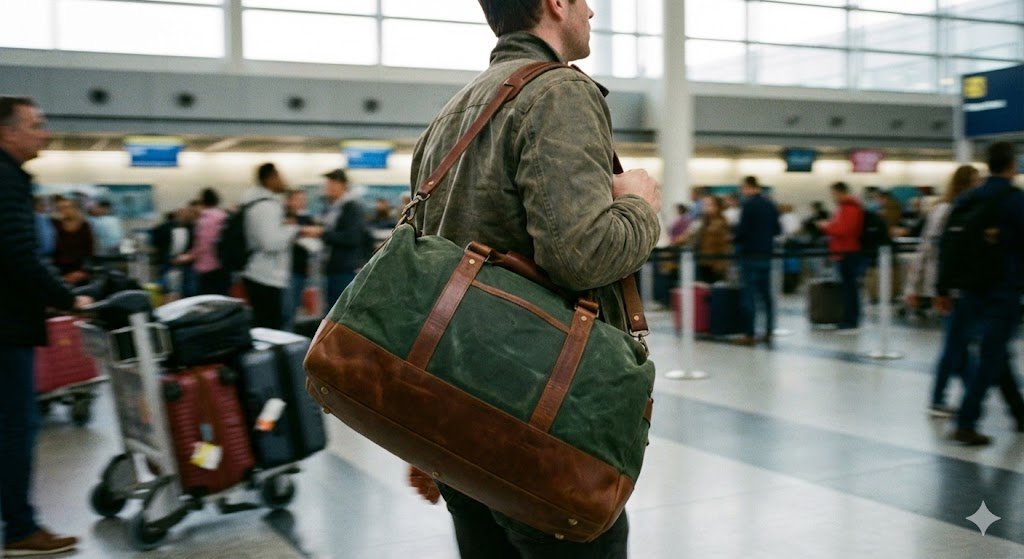
1. The "Center of Gravity" Test
A poorly designed bag sags in the middle (the "banana effect"), causing the contents to shift and putting uneven strain on your shoulder.
- The Good Bag Standard: It should maintain a rectangular structure even when full. The shoulder strap attachment points must be sewn reinforced at an angle, not straight up, to allow the bag to hug your hip rather than bounce against it.
2. The "Gym-to-Boardroom" Versatility
In 2025, no one wants to switch bags between a morning workout and a client meeting.
- The Good Bag Standard: It must lack large, tacky logos. A good weekend bag uses subtle branding (blind embossing or small tags) and premium materials that look at home in a 5-star hotel lobby, not just a locker room.
3. The "Silent" Hardware
This is a detail most people ignore until they buy a bad bag.
- The Good Bag Standard: The hardware shouldn’t jingle like a set of keys with every step. We use tight-tolerance D-rings and pullers to ensure the bag is silent when you walk. There is nothing less professional than walking into a quiet meeting room sounding like a wind chime.
Summary: The 5-Point Quality Checklist
If you are standing in a store right now, run this quick check:
- The Zipper Test: Can you open and close the main zipper with one hand? (It should glide).
- The Handle Test: Are the handles "rolled" and filled? (Flat webbing handles will cut into your palms).
- The Squeeze Test: Does the bag stand up on its own when empty? (It needs structure).
- The Strap Test: Is the shoulder pad sliding and grippy? (Fixed pads never sit right).
- The Lining Test: Pull the lining up. Is it loose and baggy? (Bad) or fitted and anchored? (Good).
Final Thoughts from the Factory Floor
A weekend bag is more than just sewn fabric; it is a precision instrument for travel. Whether you are a brand owner or a buyer, remember that structure matches style. The difference between a 5-star product and a warranty claim usually comes down to the "invisible" details—the reinforced lining, the brass clips, and the density of the nylon.
Don’t build a bag that just looks good in a photo. Build one that survives the journey.
Ready to Launch Your Own Bag Line?
Stop guessing at specs and start manufacturing with confidence. At Osgoodway, we turn complex designs into durable, market-ready products.
Contact Us Today for a Quote
Tell us your vision, and we will tell you exactly how to build it—without the hidden costs or rookie mistakes.
FAQ: Expert Answers to Common Questions
What is the difference between a "Holdall" and a "Weekend Bag"?
In the manufacturing world, the terms are often used interchangeably, but there is a subtle design difference. A "Holdall" (common in British English) is generally a utilitarian, unstructured sack—literally designed to "hold all" your gear, similar to a gym duffel. A "Weekend Bag" implies a higher degree of structure, style, and organization (like shoe pockets), specifically tailored for travel rather than sport.
Is a standard weekend bag big enough for a 4-day trip?
It depends on the season. A standard 40L weekend bag is perfect for 2-3 days. For a 4-day trip, it is possible if the bag is soft-sided (Canvas or Nylon). Unlike a hard suitcase, a soft weekend bag allows you to "overstuff" it by about 10-15%. However, if you are packing heavy winter coats or boots, you will struggle to zip it closed.
Can a backpack be considered a weekend bag?
Yes, but only specific styles. A standard school backpack (20-25L) is too small. To qualify as a "Weekend Backpack," the bag usually needs to be 35L+ and feature a "Clamshell Opening" (opens flat like a suitcase) rather than a top-loading drawstring. We are seeing a massive surge in B2B orders for these hybrid travel backpacks.
Is a large Tote Bag considered a weekend bag?
Only if it has a zipper top closure. From a safety and practical standpoint, an open-top tote is terrible for travel—your items will spill out in the overhead bin or under the seat. A true "Weekender Tote" must have a recessed zipper and reinforced handles to handle the weight of clothes and shoes.
Why are weekend bags sometimes more expensive than hard-shell suitcases?
It comes down to labor complexity. A hard-shell suitcase is largely automated—molded plastic popped out of a machine. A high-quality weekend bag involves cutting and sewing 40+ individual pieces of fabric, reinforcing seams, and hand-painting leather edges. You are paying for manual craftsmanship rather than automated molding.
Footnote
-
Explore authoritative definitions and latest developments about soft-sided luggage. ↩
-
Understanding the water-resistant properties and historical utility of paraffin-treated cotton canvas fabrics. ↩
-
Current airline regulations regarding maximum dimensions and weight limits for cabin baggage. ↩
-
Full-Grain Leather Explained: Quality, Benefits & Key Differences. ↩
-
Find out the 10 best weekender bags with separate shoe compartments. ↩
-
Learn different magnetic closures for bags. ↩