You’ve got a deadline. Maybe it’s a product launch, a trade show, or a retail buyer breathing down your neck. You found a factory in China, sent the inquiry, and they replied: "30–45 days, no problem."
Here’s the problem: that answer is almost always wrong.
I run a custom bag factory in China. We’ve shipped hundreds of thousands of backpacks to buyers in the US, Europe, Australia, and the Middle East. I’m going to tell you exactly what 2,000 custom backpacks actually takes — including the parts nobody puts in their quotation email.
What Does "Lead Time" Actually Include When You Order 2,000 Custom Backpacks?

For a standard 2,000-unit custom backpack order, realistic lead time runs 45–75 days from deposit payment — not from the day you send the inquiry. Factories that quote "30 days" are either lying or skipping steps that will hurt you later.
Lead time is not just "production time." It’s a chain. Every link matters.
Here’s what the chain actually looks like:
| Stage | What Happens | Typical Duration |
|---|---|---|
| Pre-production sample | We build 1–2 samples matching your specs | 7–14 days |
| Sample approval | You review, request revisions | 3–10 days (your side) |
| Material sourcing | Fabric, zippers, hardware, foam, webbing | 7–21 days |
| Bulk production | Cutting, sewing, assembly, QC | 20–30 days |
| Quality inspection | In-house + optional 3rd party | 1–3 days |
| Export packing & customs docs | Carton packing, packing list, invoice, CO | 2–3 days |
| Freight (sea) | FOB Yantian/Ningbo/Xiamen to your port | 14–45 days (destination-dependent) |
Factory Secret: Most suppliers quote you only the "bulk production" stage. That’s the 20–30 days in the middle. The rest? They assume you already know. You don’t. Now you do.
Why Does Material Sourcing Blow Up So Many Timelines?
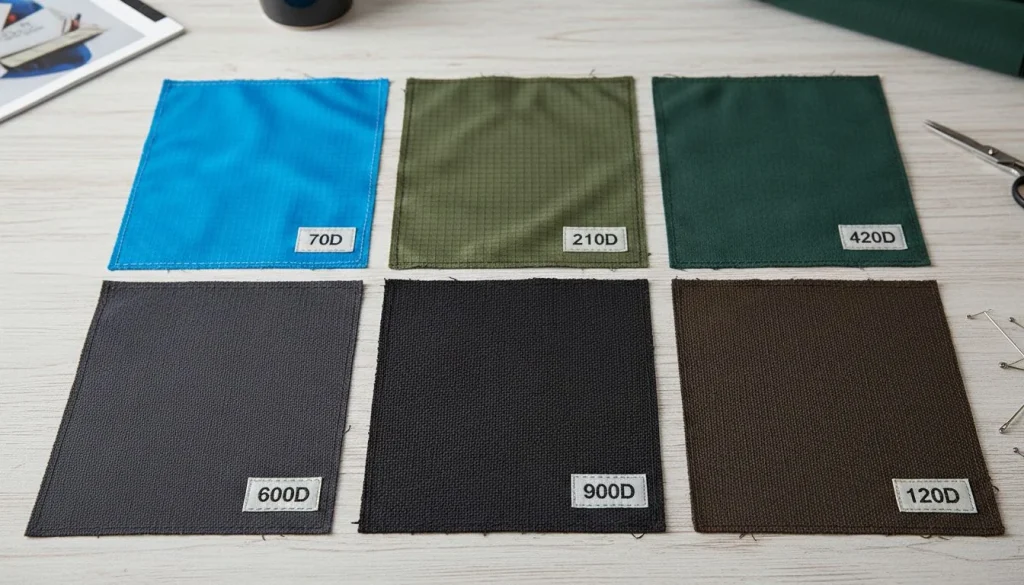
Material sourcing is the single most unpredictable variable in your lead time. If your backpack uses any non-standard fabric, custom hardware, or special zipper — expect 14–21 days just for materials, before a single bag is cut.
I’ve seen orders go sideways not because of factory errors, but because a buyer wanted a specific 1680D ballistic nylon in an olive colorway. That fabric is not sitting in our warehouse. It lives in a Fujian mill. Minimum order from the mill is 500 meters. Lead time from the mill: 15 days on a good week.
Here’s the material sourcing reality by category:
- Standard polyester (600D, 900D): In stock at most factories. Add 0–3 days.
- Nylon (420D HT, 1680D ballistic): Usually sourced. Add 10–15 days.
- Canvas or waxed cotton: Specialty. Add 14–21 days.
- Custom-dyed fabric (Pantone matching): Add 21–30 days. Sometimes more.
- Custom metal hardware (logo zipper pulls, custom D-rings): Add 21–35 days. This is a common killer.
- YKK zippers (specific styles): Add 2-3 weeks if not in stock.
The lesson: If your design has any custom hardware or specialty fabric, your "30-day" factory is already behind before production starts.
How Does Sample Approval Actually Work in the Real Timeline?
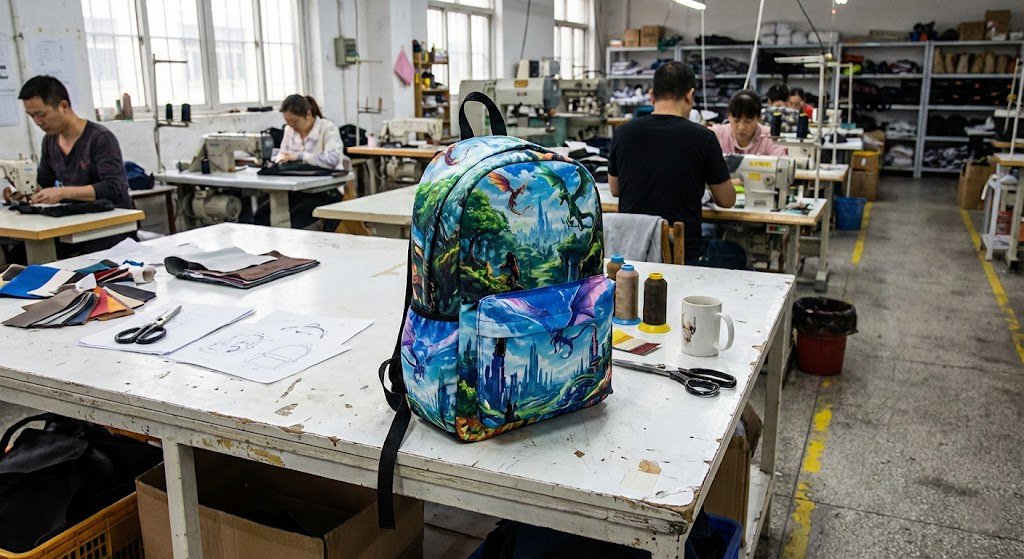
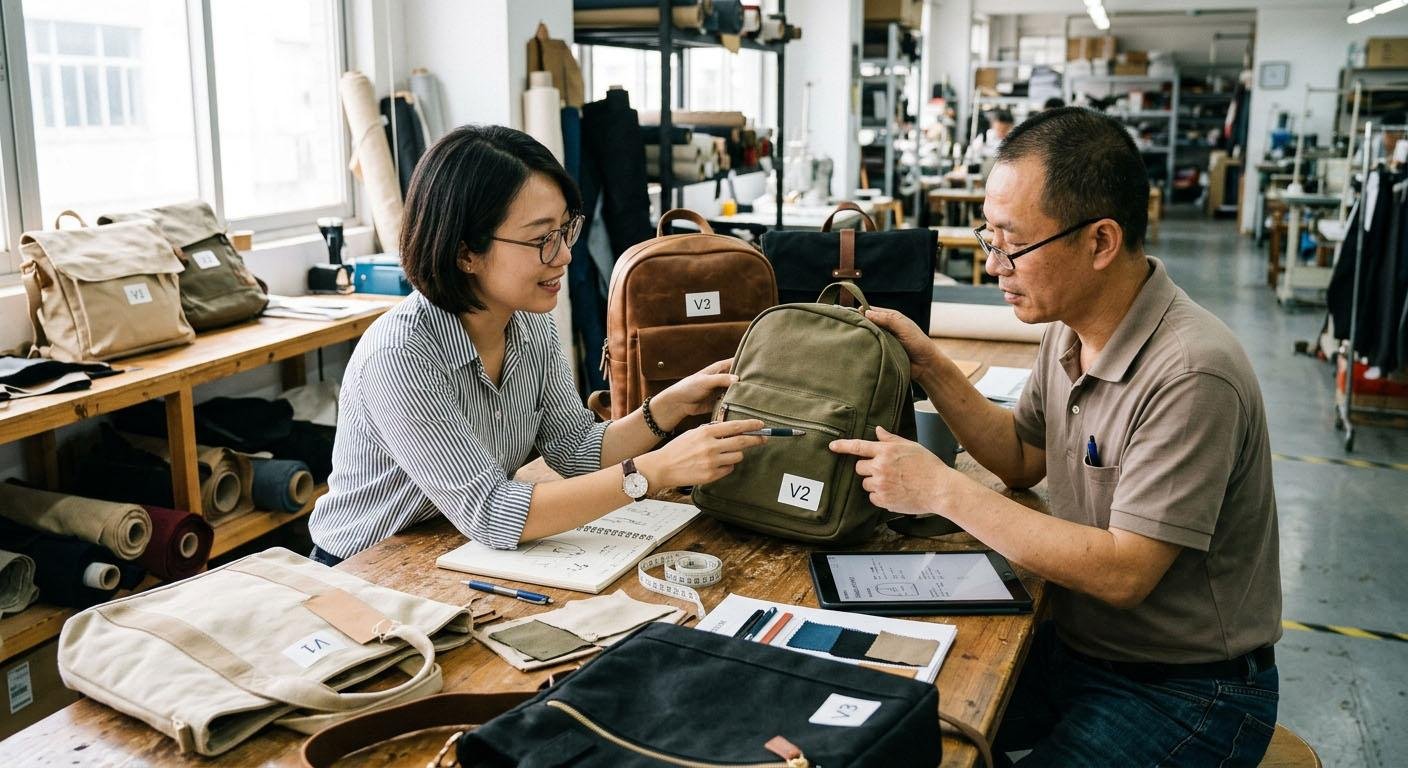
Sample approval is the stage buyers consistently underestimate. In our factory, sample revisions — not production — are the #1 cause of missed deadlines for first-time buyers.
Here’s what happens in reality.
We build your sample in 7–10 days. You receive it. You have feedback. Maybe the shoulder strap is 2cm too narrow. Maybe the zipper placement is off. Maybe your client wants a different pocket layout. That’s all normal. But here’s the math:
- Revision round 1: rebuild sample → 5–7 days → ship back → you review → 3–5 days
- Revision round 2 (common): another 5–7 days each way
Suddenly your "30-day lead time" has burned 3 weeks before bulk production begins.
Our approach: We push buyers to finalize a tech pack — not a mood board, not a reference photo — before we quote. If you send me a detailed spec sheet with measurements, material callouts, and hardware specs, I can build a production-ready sample in one round. If you send me a Pinterest screenshot, plan for two or three rounds.
I’ve written a full breakdown of what a factory actually needs in a bag tech pack — if you’re still in the design stage, read that before you send us anything.
What’s the Realistic Production Timeline for 2,000 Units Specifically?
For 2,000 custom backpacks with approved sample and materials in stock, pure cutting-to-packing production time runs 18–25 working days in our factory. At 2,000 units, you’re not our only line running — but you’re big enough to get a dedicated team.
Let me break it down by production stage:
Cutting
Our cutting room can cut fabric for ~300–500 backpack bodies per day (depending on panel complexity). For 2,000 units: 4–6 days.
Sewing
This is the bottleneck. A trained sewer on a mid-complexity backpack (multiple compartments, padded laptop sleeve, sternum strap) produces 25–40 units per day. With a team of 8 sewers dedicated to your order: roughly 6–10 days.
Assembly & Hardware Attachment
Adding buckles, webbing adjusters, zippers, foam padding, internal organizers. About 3–5 days at this volume.
Quality Control
Our QC team checks every unit against an approved counter sample. At 2,000 units, this runs 1.5–2 days. We reject and repair defects in-line — we don’t pile them up for you to find at destination.
Packing
Poly bagging, hang tagging (if required), carton packing. About 1–2 days.
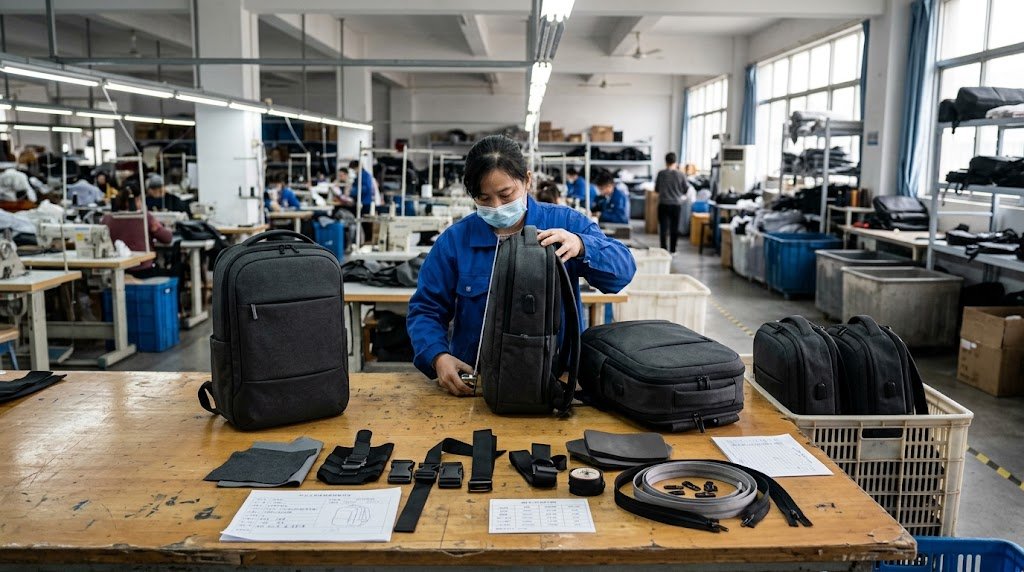
Total factory floor time: 15–25 working days for 2,000 units. That’s 3–5 calendar weeks, assuming no material delays, no major QC failures, and Chinese public holidays don’t fall in the middle of your order.
If you want to understand what’s physically happening during each of those days — cutting room, sewing lines, assembly, the works — I wrote a full factory-floor walkthrough of how backpacks are actually manufactured. Most "how it’s made" articles are written by people who’ve never touched a sewing machine. That one isn’t.
Which Hidden Delays Actually Kill Deadlines in 2026?
The delays that destroy timelines aren’t production failures — they’re the gaps between stages that no supplier puts in the quotation.
Here are the real killers I’ve watched destroy deals, based on what we’ve seen on our production floor this year:
Chinese Public Holidays
In 2026, Chinese New Year falls in late January. Golden Week is October 1–7. Many factories run skeleton crews for 2 weeks before CNY as workers return home early. If your order overlaps these windows, add 2–3 weeks to every estimate.
Buyer-Side Approval Delays
You’re traveling. Your boss is traveling. Your brand team needs to sign off. Every day your sample sits in your office without feedback is a day your factory slot slides. I’ve had buyers take 3 weeks to approve a sample because of internal brand review processes. That’s not the factory’s problem — but it becomes yours.
Port Congestion
Yantian, Ningbo, and Shanghai all experience seasonal congestion. Q4 (October–December) sees significant backlogs as factories push goods for Black Friday and Christmas. In late 2024, some shippers saw 7–10 day delays just to get a booking confirmed. Budget for this in your freight planning.
Mid-Order Design Changes
We had a buyer in 2024 — a US outdoor brand — who approved the sample, paid the deposit, and then emailed us on day 12 of production saying they wanted to change the back panel foam thickness from 8mm to 12mm. That required resourcing the foam (5 days), retesting the bag’s packed dimensions (2 days), and rerunning half the cut panels. Cost them 12 days and a $400 rework fee. Don’t be that buyer.

What Shipment Method Should You Choose for 2,000 Backpacks?
For 2,000 standard-size backpacks, expect 3–5 CBM of cargo and roughly 250–400kg. Sea freight LCL (Less than Container Load) is the default — cost-effective, but add 25–35 days transit to the US East Coast.
Quick shipping comparison:
| Method | Transit Time (to US/EU) | Cost Range (est.) | Best For |
|---|---|---|---|
| Sea LCL | 28–38 days | $300–$600 | Cost-sensitive, no rush |
| Sea FCL (20′) | 25–35 days | $1,800–$3,500 | 3,000+ units, better rate |
| Air freight | 5–10 days | $2,500–$5,000+ | Urgent, small orders |
| Express courier | 3–7 days | $4,000–$8,000 | Samples only, not bulk |
At 2,000 units, you won’t fill a 20′ container (typically needs 5,000+ standard backpacks). You’ll go LCL unless you’re consolidating with other goods.
Factory Secret: If you’re on a tight deadline, ask your factory about "air-sea" hybrid — air to a regional hub (Dubai, LA), then local trucking. It cuts 10–15 days versus full sea at about 40–60% of full air cost. We arrange this for buyers regularly.
What’s the Absolute Fastest Timeline Possible for 2,000 Custom Backpacks?
If every variable goes right — approved tech pack from day one, standard materials in stock, no revision rounds, no holidays — the absolute minimum I’d quote a buyer is 35 days factory-ready. Add freight on top.
This is not normal. This is everything going perfectly. Here’s what "rush mode" looks like on our end:
- Buyer submits a complete, approved tech pack (not a concept)
- Materials are confirmed in-stock before deposit
- Sample built and approved within 72 hours (we do digital mockup first)
- Deposit paid same day as sample approval
- Production starts immediately on a pre-cleared line
- No design changes. Zero.
- QC inspection booked in advance with third-party agency
Even then: 35 days factory-ready is aggressive. Most buyers who ask for "ASAP" end up at 45–55 days because one of those steps slips.
My honest advice: if you’re placing your first order with a factory, don’t try to rush it. Use this order to build a clean process. Your second order — with approved samples on file and a trusted relationship — can hit 30 days reliably.
Ready to Get a Factory-Accurate Quote for Your 2,000-Unit Backpack Order?
We don’t do ballpark numbers. Send us your specs — dimensions, material preference, compartment layout, branding requirements — and I’ll give you a real timeline with a real price.
No sales team. No middlemen. You talk directly to the factory floor.
Get a factory quote — tell us your specs →
Or dig deeper into the decisions that happen before production even starts:
- → Tech Packs for Bags: Why Your "Design" Is a Factory Nightmare (And How to Fix It)
- → What Is a "Mold Fee" in Bag Manufacturing and When Do I Pay It?
- → How Do I Protect My Backpack Design IP When Working with an OEM Factory in China?
- → How Backpacks Are Manufactured — And Why Cheap Manufacturing Fails
- → What Is the MOQ for Custom Logo Backpacks?
- → Vietnam vs. China Bag Manufacturing: 2026 Supply Chain Reality