


In the bag manufacturing trenches for 15 years, I’ve seen fabrics come and go. But rPET isn’t just a trend—it’s the industry’s response to a world drowning in plastic, and frankly, it’s a game-changer for B2B sourcing.it’s the dominant request hitting my desk from European and American buyers.
RPET fabric1 (Recycled Polyethylene Terephthalate) is a sustainable textile made from recycled plastic bottles, giving them a second life instead of ending up in landfills. It’s essentially recycled polyester, created by breaking down PET bottles into flakes, spinning them into yarn, and then weaving or knitting it into fabric for items like clothing, bags, and blankets, while reducing reliance on virgin petroleum resources.
If you are a brand owner or a procurement manager, you don’t need a chemistry lesson. You need to know if this stuff is going to break, if it costs too much, and if it’s actually real. Here is the honest truth from the manufacturing side.
What Exactly Is rPET Fabric and Where Does It Come From?
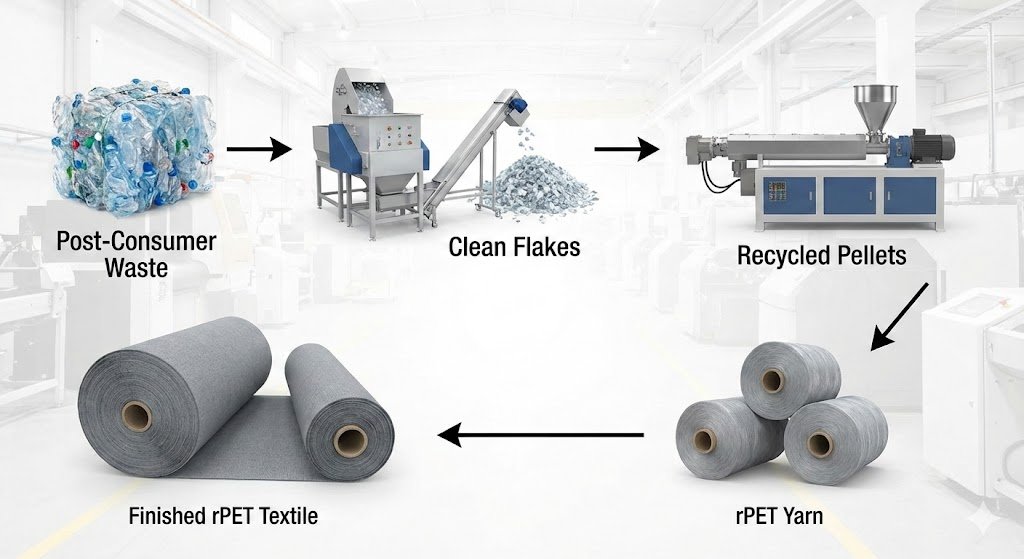
rPET is a recycled material derived from used plastic bottles (PET), processed into flakes and pellets to create new polyester fibers. It creates a closed-loop system that diverts plastic from landfills and oceans back into the manufacturing cycle.
Technically, it’s a mechanical recycling process that aligns polymer chains to mimic virgin yarn. At our facility, we specifically source GRS-certified2 (Global Recycled Standard) flakes to ensure the molecular integrity isn’t compromised by impurities like leftover soda sugars or low-grade dyes.
In our lab, a standard 600D rPET Polyester must pass a 20,000-cycle Martindale abrasion test. We’ve found that high-quality rPET actually maintains color fastness (Grade 4-5) better than some low-end virgin batches due to the advanced dope-dyeing techniques used during extrusion.
How do we verify the source?
- GRS Certification: The "gold standard" for tracking recycled content from bottle to bag.
- TC (Transaction Certificate): The only paper trail that proves your specific batch of fabric is actually recycled.
- Fiber Tracers: Some high-end mills now use molecular "trackers" to prove the yarn is recycled.
Actionable Tip: Never accept a "factory-level" GRS certificate. Always demand a Transaction Certificate (TC)3 specific to your purchase order to ensure the yarn in your bags is actually recycled.
Does rPET Effect the Durability of Heavy-Duty Bags?
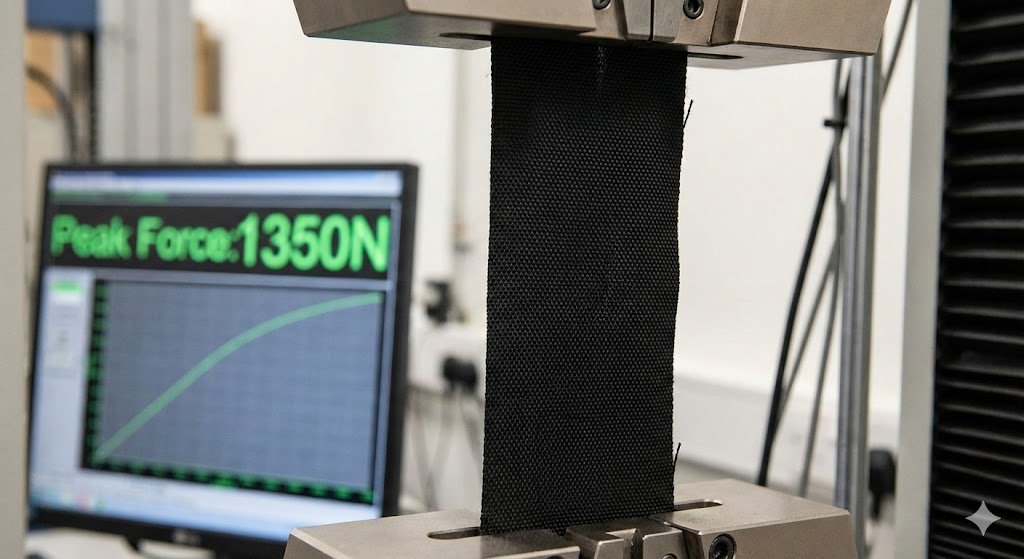
No, rPET does not compromise durability; when properly coated with PU or TPE, rPET fabric achieves the same tear strength and "hand-feel" as traditional 900D or 1600D ballistic nylon.
I remember a German client who was terrified that recycled straps would snap under a 20kg load. We put the rPET samples through our Jerk Test machine (5,000 cycles at 20kg). The result? The rPET webbing held firm, failing only at the 7,200th cycle—nearly identical to our virgin nylon benchmarks.
What are the technical specs of rPET?
Melting Point: ~260°C (Same as virgin).
Denier Options: Available from 150D (linings) to 1680D (heavy-duty bases).
Coating Compatibility: Works perfectly with REACH-compliant PU, PVC-free, and TPU coatings.
How does rPET compare to Virgin Polyester?
| Performance Metric | Virgin Polyester (600D) | rPET (600D) | The Verdict |
|---|---|---|---|
| Tensile Strength | 1200N – 1400N | 1150N – 1380N | Negligible difference |
| Abrasion Resistance | 20,000 Cycles | 20,000 Cycles | Identical |
| Color Vibrancy | Excellent | Very Good | rPET struggles with "Optic White" |
| Water Column Test | 1500mm+ (with coating) | 1500mm+ (with coating) | Identical |
How Can Buyers Certify that the Fabric Is Truly Recycled?
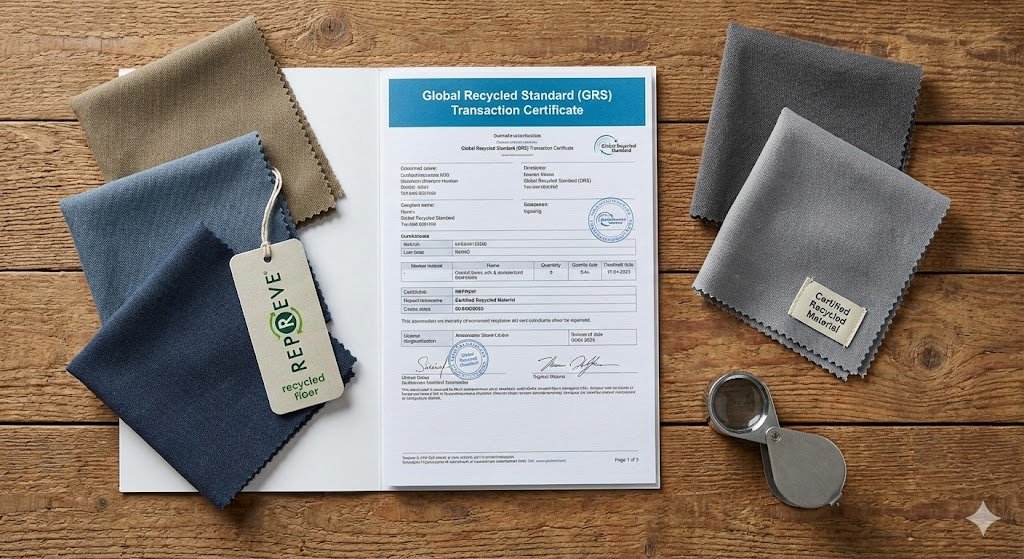
The only industry-accepted proof is a Transaction Certificate (TC) issued under the Global Recycled Standard (GRS), which tracks the material flow from the recycler to the final factory.
Without a TC, you are just buying a story. I’ve seen factories mix 10% rPET with 90% virgin poly and sell it as "recycled." Because the chemical structure is identical, you cannot distinguish them with a simple burn test or lab analysis without expensive carbon dating. The paper trail is your only proof.
We recently audited a supplier claiming "Eco-Friendly" status. They had a general GRS Scope Certificate but refused to issue a Transaction Certificate for our specific batch order. We walked away immediately. That is a massive red flag.
What documents must you request?
- Scope Certificate (SC): Proves the factory is capable of making rPET.
- Transaction Certificate (TC): Proves your specific shipment contains rPET.
- Hangtags: Official tags from fiber suppliers (like REPREVE®4) add consumer trust.
Actionable Tip: Stipulate "GRS TC Required" explicitly on your Purchase Order (PO) terms. Do not rely on email promises; make it a binding contract term.
Does rPET Feel Different from Standard Polyester?
Clients often fear recycled bags will feel "crunchy" or cheap. Ten years ago, early-generation rPET did feel like stiff canvas. Today, the technology has shifted significantly.
Modern rPET fabrics are virtually indistinguishable from virgin polyester in hand-feel, though some lower-denier versions may exhibit a slightly stiffer drape due to shorter fiber lengths.
How do we improve the hand-feel?
We use specific backing coatings to soften the fabric.
- PU (Polyurethane) Coating: Makes the fabric softer and more flexible.
- TPE Backing: Adds a rubbery feel and increases water resistance.
- Brushing: Mechanical finishing to soften the surface fibers.
Common rPET fabric defects?
Color consistency is the main production challenge.
| Defect Type | Virgin Poly | rPET | Cause |
|---|---|---|---|
| Off-Shade | Rare | Occasional | Different base colors of plastic bottles. |
| Black Spots | None | Possible | Tiny non-melted impurities. |
| Hand-feel | Consistent | Variable | Batch-to-batch polymer variance. |
Which Bag Styles Are Best Suited for rPET Materials?
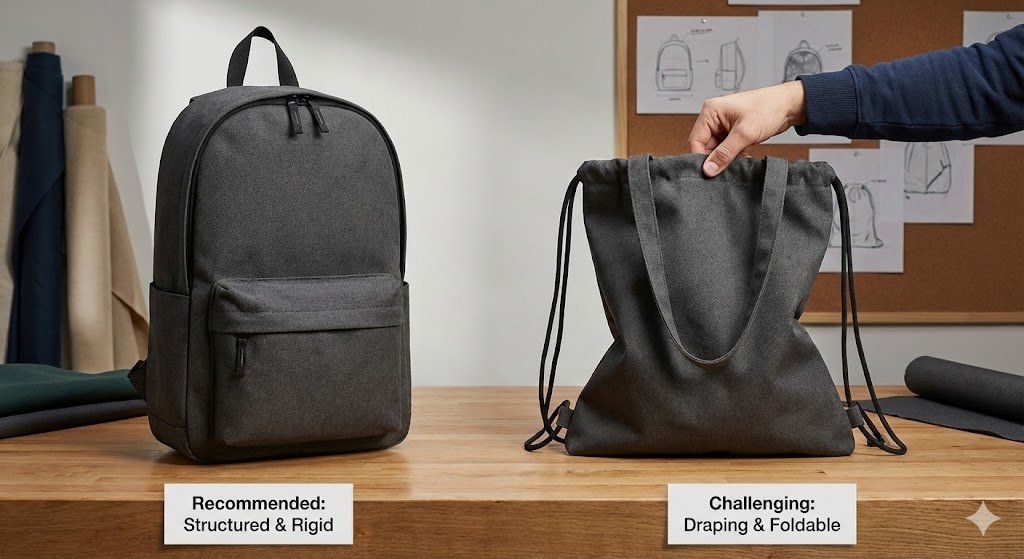
Structured bags like backpacks, laptop sleeves, and cooler bags perform best with rPET because the slightly stiffer nature of the recycled fiber adds desirable form stability.
Draping items like foldable shopping bags or drawstrings can be tricky with heavy rPET (600D+). The fiber memory resists folding more than virgin nylon. We once had a German client insist on a 600D rPET for a tiny pocket-sized pouch. It was a disaster; the seams were too bulky and the bag wouldn’t fold flat.
In 2023, we switched a client’s foldable tote line to 210D rPET. The seam slippage increased by 15% because the yarn was too slick compared to the cotton canvas they used before. We had to change the stitch type to accommodate it.
Recommended rPET deniers by bag type?
- 210D / 230D: Linings and internal pockets.
- 300D / 420D: Lightweight duffels and cosmetic bags.
- 600D / 900D: Standard backpacks, cooler bags, and laptop cases.
- 1200D / 1680D: Heavy-duty luggage and tool bags.
Actionable Tip: Stick to 600D rPET with a PU coating for your first eco-collection. It is the "Goldilocks" material—easy to sew, durable, and widely available.
What Are the Technical Limitations of rPET We’ve Discovered?
I won’t lie to you: rPET isn’t perfect. We’ve had our fair share of headaches on the production line.
rPET’s primary limitations include a narrower "purity" range in light colors and a slightly higher risk of yarn breakage during high-speed weaving. It is not a "magic bullet," but a high-performance material with specific manufacturing quirks.
If you want a pure, snowy white bag, rPET might disappoint you. The recycled pellets often have a microscopic "tint" from the original bottle dyes, which can make extremely light pastels look slightly "muddy."
Real-world factory lessons:
- Avoid Optic White: Use "Natural White" or darker tones like Charcoal and Navy.
- Watch the "Neps": Recycled yarn can have tiny slubs or "neps." On a matte fabric, this looks like "character," but on a shiny fabric, it looks like a defect.
- The Lining Loophole: Many brands use rPET for the shell but virgin poly for the lining. We always suggest 100% rPET linings to simplify your marketing claims.

Why Do We Use rPET for Professional Bag Manufacturing?
We use rPET because it delivers identical tensile strength and water resistance to virgin polyester while reducing CO2 emissions5 by nearly 50% and energy consumption by 30-50% during production.
For B2B buyers, rPET is the ultimate "low-hanging fruit" for sustainability. It fits existing production molds perfectly. We don’t have to change our Juki sewing machine settings or needle gauges (usually 110/18) because the needle-penetration force required for rPET is identical to standard polyester.
Feature comparison
| Feature | Virgin Polyester (600D) | rPET Polyester (600D) |
|---|---|---|
| Tensile Strength | 1200N – 1400N | 1150N – 1350N |
| CO2 Footprint | High (Petroleum-based) | ~50% Lower |
| Water Column Test | 1500mm (w/ PU coating) | 1500mm (w/ PU coating) |
| Unit Cost | $1.00 (Baseline) | $1.15 – $1.25 |
Is the cost premium worth it?
Yes, because the retail markup for "Eco-Friendly" lines usually covers the 15-20% fabric cost increase multiple times over.
- Better brand perception.
- Easier entry into EU/US markets with strict environmental mandates.
Actionable Tip: Don’t go 100% rPET on your first run. Start with the shell fabric and keep the inner lining as standard polyester to balance the total landed cost while still claiming "Made with Recycled Materials."
Conclusion & Next Step
rPET isn’t perfect. It costs more and requires strict paperwork vigilance. But for a B2B buyer, it is the only way to future-proof your product line against EU regulations and consumer demand. Just make sure you are buying the real thing.
Ready to feel the difference? Contact us today
to request a physical swatch kit of our certified 600D rPET fabrics or make a rPET bag sample.

Expert FAQ: The "No-BS" Guide to rPET
Does rPET fabric have a weird smell?
If it smells, the washing process at the recycling plant was garbage. Properly processed GRS-certified rPET has zero odor. If your samples smell like burnt plastic or chemicals, reject the lot.
Is rPET more expensive than regular polyester?
Yes, usually by 10% to 25%. The extra cost comes from the collection, sorting, and intensive cleaning required to turn "trash" into "textile-grade" pellets. If someone offers you rPET at virgin prices, it’s a scam.
Can rPET be recycled again into a new bag?
This is the industry’s dirty secret. Most bags are a mix of fabric, zippers, and foam. Unless you design for "mono-materiality" (all polyester), the bag will end up in a landfill anyway. rPET solves the input problem, not the output problem.
Is rPET waterproof?
Fabric is just a weave. The "waterproofness" comes from the backing (PU/PVC/TPU) and the DWR (Durable Water Repellent) finish. You can make rPET just as waterproof as a submarine if you apply the right coatings.
Is rPET safe (BPA-free)?
Yes. PET (the ‘P’ in rPET) does not contain BPA. We regularly run Oeko-Tex Standard 100 tests on our rPET to ensure no harmful substances are present for skin contact.
Is "Ocean Bound Plastic" the same as rPET?
No. Ocean Bound Plastic is rPET collected from within 50km of a coastline. It is a marketing distinction, not a chemical one. It usually costs 30% more than standard post-consumer rPET because the collection logistics are expensive.
References
-
Explore the transformative impact of rPET fabric on sustainability and its role in reducing plastic waste. ↩
-
Learn about GRS Certification and its significance in ensuring the authenticity of recycled materials. ↩
-
Understand the importance of Transaction Certificates in verifying the recycled content of fabrics. ↩
-
Information on high-quality recycled fibers made from plastic bottles by the REPREVE brand. ↩
-
Data on greenhouse gas emissions and the environmental impact of industrial manufacturing processes. ↩






