


Most buyers look at a spec sheet, see "22 x 14 x 9 inches," and think they’re safe. They’re wrong. In this business, the airline website is marketing; the metal sizing cage at the gate is physics. If your bag doesn’t slide into that cage effortlessly—wheels, handles, and all—your customer pays $60 at the gate, and you lose the contract.
To be strictly carry-on compliant1, a travel backpack must feature a "soft-structure" design that actively compresses to meet the 22 x 14 x 9 inches (56 x 36 x 23 cm) for US domestic flights, or 55 x 40 x 20 cm for international standard, regardless of load.
Novice designers often confuse these airline-specific physical limits with airport security rules. You must account for TSA-approved dimensions for carry-on backpacks when dealing with internal compartments for laptops or liquids, the metal sizer box at the gate is strictly governed by the airline’s own ruthless geometry.
It must fit the airline’s physical sizer box even when fully packed, including all handles, wheels, and protrusions. If you’re a sourcing manager, stop looking at "liters."
Does the "Universal" 22x14x9 Inch Standard Actually Exist?
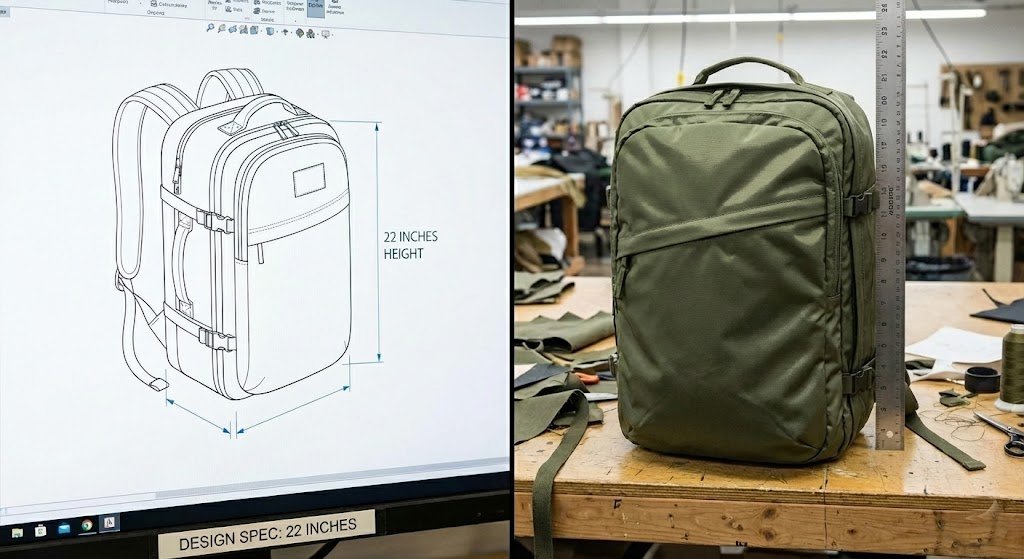
No. There is no global "legal" size. We intentionally size bags at 21.5" x 13.5" x 8.5" to account for fabric stretch and seam allowance, ensuring the bag fits the sizer box every single time.
We don’t trust the label. When we cut fabric, we account for the "stuffed state." A 600D Polyester bag can expand outward by 1-2 inches when fully loaded. If we cut the pattern to exactly 22 inches, that bag is failing the Spirit Airlines test the moment a customer packs an extra pair of jeans.
We once had a UK client insist on exact 56cm height for an EasyJet model. We warned them. The sample came out, they stuffed it, and the fabric tension pushed the height to 57.5cm. Result: Rejection. We now mandate a 0.5-inch undercut on all dimension specs for carry-ons.
- Target Dimension: 21.5" x 13.5" x 8.5" (Safe Zone)
- Maximum Volume: 40 – 42 Liters (Soft Structure)
- Critical Risk: Overstuffing "Bulge" (+1.5" depth)
Which airlines cause the most compliance headaches?
| Airline | Strict Limit (Inches) | Strict Limit (CM) | Factory Risk Factor |
|---|---|---|---|
| Ryanair | 21.6 x 15.7 x 7.8 | 55 x 40 x 20 | High: Shallow depth (20cm) kills most generic designs. |
| United | 22 x 14 x 9 | 56 x 35 x 22 | Med: The standard, but their sizers are unforgivingly metal. |
| Frontier | 24 x 16 x 10 | 61 x 41 x 25 | Low: Generous, but weight checks are frequent. |
| EasyJet | 22 x 17.7 x 9.8 | 56 x 45 x 25 | Med: Generous width, but strict enforcement. |
While these four represent the extremes of the factory risk spectrum, dimensional limits vary wildly across the industry. Before you finalize your product’s target dimensions, cross-reference your blueprints with our comprehensive carry-on backpack size guide, which tracks the exact sizing constraints of all major global carriers.
Actionable Tip: Don’t approve a sample until you have performed a "Stuffed Sizer Test2." Build a plywood box with interior dimensions of 22x14x9. If you can’t slide the fully packed sample in without kicking it, change the foam density or reduce the pattern size.
Also read: Will a 40L Backpack Fit Under the Airplane Seat? (A Factory Insider’s Reality Check)
Why Does "Belly Bulge" Ruin Compliance (and How Do We Fix It)?
The number one reason bags fail at the gate isn’t height; it’s depth expansion.
"Belly Bulge" is the outward distortion of the front panel caused by internal pressure. To fix it, we install 38mm side compression straps anchored to the back panel, not the side seam, effectively cinching the load inward rather than just squashing the sides.
Most factories save money by sewing compression straps3 into the side seam. This is useless. It just creates a "peanut" shape where the middle still bulges. We anchor the strap wings deep into the back panel structure. This transfers the tension across the entire face of the bag, physically flattening the load.
What is the "anchor point" difference?
- Side Seam Anchor (Cheap): Pulls the zipper wavy. Does not reduce overall depth.
- Back Panel Anchor (Pro): Pulls the entire front face toward the wearer’s back. Reduces depth by up to 3 inches.
Comparison of strap effectiveness
| Strap Anchor Point | Tensile Strength (Kg) | Depth Reduction | Production Cost |
|---|---|---|---|
| Side Seam (Standard) | 15kg | ~0.5 inch | Low |
| Back Panel (Compliant) | 45kg | ~2.5 inches | Medium (+5%) |
Can Rigid Back Panels Cause Gate-check Failures?
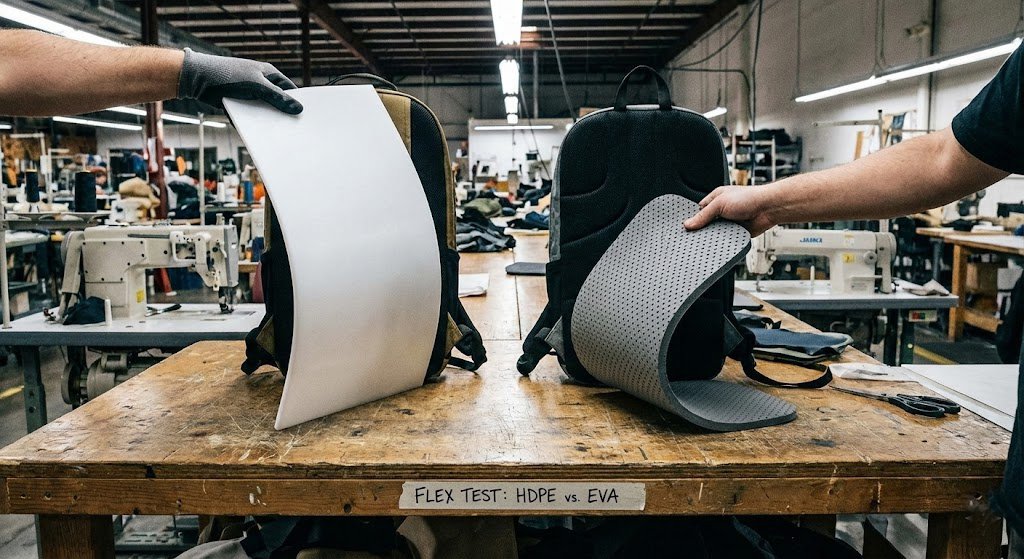
Yes. A fully rigid HDPE frame sheet4 or aluminum stay prevents the bag from "squishing" into a sizer bin. For strict compliance, we replace full sheets with a localized PE foam spine or a removable framesheet, allowing the corners of the bag to deform when forced into a metal cage.
B2B buyers love the idea of "suspension systems" like hiking packs. But hiking packs don’t fly well. If the sizer bin is curved or dented (and they often are), a rigid frame won’t fit. A soft-structured bag allows the traveler to punch the bag into the sizer.
We ran a test with a 45L prototype. Version A had a 2mm HDPE sheet. Version B had high-density EVA foam. Both were slightly overpacked. Version A got stuck halfway into the sizer. Version B compressed at the corners and slid in. Compliance is about flexibility, not rigidity.
What is the best back panel setup for carry-ons?
- Remove the Aluminum Stay: Unless it’s a 60L trekking pack, you don’t need it.
- Use EVA Foam: It provides structure but bends under pressure.
- Chamfered Corners: We round off the internal foam corners so they don’t snag on the sizer bars.
Actionable Tip:
Specify "Removable Framesheet" in your Tech Pack. This gives your end-user a "cheat code." If the gate agent gets aggressive, the user can unzip the lining, remove the plastic sheet, and instantly make the bag 100% squishable.
Does Hardware Protrusion Impact Total Dimensions?
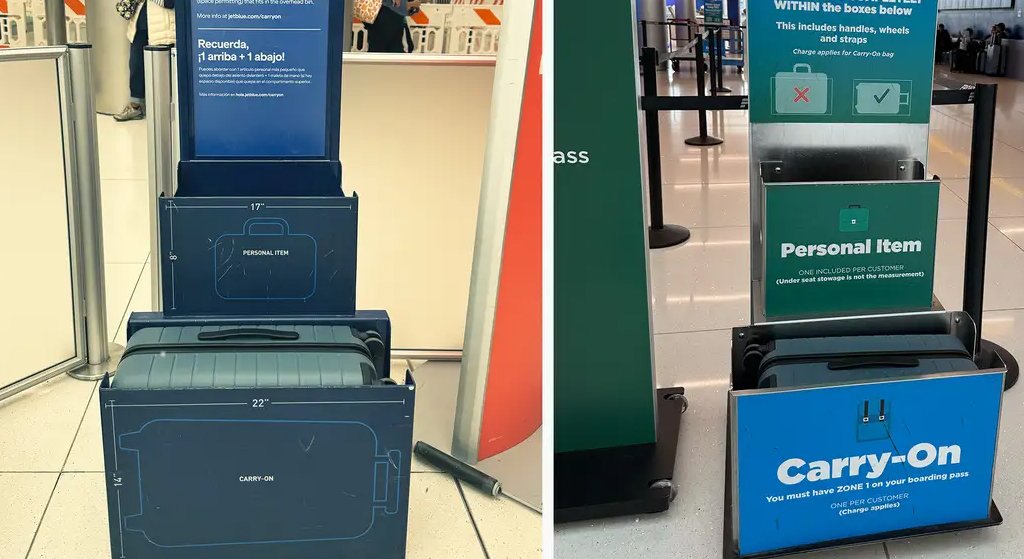
Yes, absolutely. Laser measurements and metal sizer bins include every single protruding element, including grab handles, zipper pulls, and wheels.
Specifically, rigid top handles and trolley housings can add 3-5cm to the "official" height of the bag. To ensure compliance, we address this by using flat webbing grab handles and recessing all telescopic hardware into the bag’s body, maintaining a sleek silhouette that stays flush.
We recently audited a client’s "Travel Pro" prototype. The main body was perfect at 21.5 inches, but the protruding spinner wheels and a thick molded top handle pushed the total height to 23.8 inches. Result: 100% failure rate in the United sizer bin. We redesigned it using the protocols below and passed immediately.
Which hardware features are “Compliance Killers”?
| Compliance Killer (Avoid) | The Factory Fix | Why It Works |
|---|---|---|
| Rigid Molded Handles | Flat Nylon Webbing | The handle lies flush against the bag body, saving 3-4cm of vertical height. |
| Spinner Wheels (4-Wheel) | Recessed Inline Wheels | Buries the wheel housing into the chassis rather than bolting it externally. |
| Standard Coil Zippers | Reverse-Coil Zippers | The flat side faces out, creating a smooth surface that doesn’t bulge outward under pressure. |
Review your Tech Pack’s BOM (Bill of Materials)5 immediately. If you see "Molded Handle" or "Spinner Assembly," strike it out. Swap for high-tensile webbing and inline skate wheels to gain back critical packing volume without breaking dimension limits.
Is Internal Volume (Liters) a Reliable Metric?
Absolutely not. Liters are useless for compliance. A 45L "black hole" duffel-style backpack is often easier to carry on than a 35L "tactical" bag with rigid MOLLE webbing and stiff foam."
Consumers buy based on volume, but gate agents penalize based on the external footprint (linear inches). If you want to understand the exact physics behind this disconnect—and how to accurately test your prototypes like a QC inspector—read our deep dive on how to measure a backpack for airlines.
Think of it this way: I can manufacture a 40-liter PVC tube that is 1 meter long. It holds the correct volume, but it will fail every single gate check. Compliance is about "Shape Efficiency"—how effectively a bag’s geometry fills a rectangular box without bulging—not just raw holding power.
The "Tube Effect": why geometry beats capacity
| Feature | Hiking/Tube Profile (Risk) | Travel/Box Profile (Safe) |
|---|---|---|
| Shape | Tall, Narrow, Cylindrical | Short, Wide, Rectangular |
| Volume Distribution | Vertical (pushes height over 22") | Lateral (fills corners of the bin) |
| Sizer Fit | Fails (Too tall) | Passes (Optimized for 22x14x9) |
| Space Usage | Wasted space in bin corners | 100% Bin Utilization |
Stop asking factories "How many liters is this?" and start asking for the "Geometric Efficiency." Force your design team to maximize the width (14 inches) and depth (9 inches) before adding height. A squat, boxy 35L bag is infinitely better for travel than a tall, sleek 40L bag that gets gate-checked.
What Fabric Offers the Best Weight-to-Durability Ratio?
The best material for strict carry-on compliance is 840D Ballistic Nylon or 600D TPU-Coated Polyester. These fabrics offer high abrasion resistance but are light enough to keep the empty bag weight under 3lbs (1.3kg), leaving the traveler maximum allowance for their gear.
Many buyers ask for 1680D Ballistic Nylon6 because it looks "premium." I usually fight them on it. 1680D is heavy. If a budget airline has a 7kg (15lb) weight limit, and your empty bag weighs 2.5kg because of heavy fabric, you’ve screwed the customer. They can only pack 4.5kg of clothes.
Fabric weight vs. performance breakdown
- 1680D Nylon: Too heavy for strict budget airlines. Great for luggage bottoms, bad for the main body.
- 420D Ripstop: Excellent weight savings, but the "crinkly" texture often looks "cheap" to business travelers.
- 600D TPU-Coated Polyester (The "Tech" Choice): The coating makes it 100% waterproof and sleek/matte. However, it is heavier and stiffer than Nylon, which reduces "squishability." Use it for the front panel only.
- 840D Nylon (The Sweet Spot): The perfect balance. Professional matte look, decent weight, and extreme abrasion resistance.
Actionable Tip:
Request a "GSM (Grams per Square Meter) Report" for your fabric choices. Calculate the total surface area of your pattern. If the fabric weight alone exceeds 1kg, you need to downgrade the denier or switch to a high-tensile lightweight nylon like Robic®.
Deep FAQs: Production & Sourcing Insights
Can we just label the bag "Carry-On Approved" to avoid liability?
You can write whatever you want on the hangtag, but that won’t stop a return. If a customer gets charged $50 at the gate because your bag didn’t fit, they will leave a 1-star review destroying your brand. "Approved" is a marketing term; "Sizer-Tested" is an engineering reality.
Is 40L capacity always carry-on compliant?
Absolutely not. Volume (Liters) is fluid; dimensions are static. I can make a 40L long tube that is 30 inches tall—it holds 40L but won’t fit in any overhead bin. Focus on the chassis dimensions first, then calculate the resulting volume.
Why do you recommend YKK RC zippers specifically for carry-ons?
"RC" stands for Racquet Coil. It is designed specifically for luggage that gets overstuffed. The coil is shaped to resist bursting pressure. Standard zippers will split open when a traveler sits on the bag to close it. Using non-RC zippers on a carry-on is a guaranteed warranty claim.
How does the "Personal Item" differ from "Carry-On" in production?
Huge difference. A Personal Item must fit under the seat (usually 18x14x8 inches). We have to remove the internal frame entirely and shorten the back panel. You cannot just "shrink" a carry-on design; the ergonomics change completely because the torso length becomes too short for a hip belt.
Are wheels worth it for a carry-on backpack?"
Usually, no. A wheel assembly and trolley handle eat 4-5 liters of internal volume and add 3 lbs. In the B2B world, "Hybrid" bags are the highest return/complaint items because they fail at being both a good bag and a good suitcase.
Conclusion: The "Squish" Factor Wins
Don’t over-engineer the structure. The most compliant bags are the ones that can adapt to the chaotic reality of travel.
If you are ready to develop a backpack that survives the Ryanair sizer and the factory quality control floor, we need to look at your tech pack today.
Would you like me to review your current bag dimensions and fabric choices to calculate your theoretical "Squish Factor" and weight compliance?

Footnotes
-
Understanding carry-on compliance is crucial for travelers to avoid extra fees and ensure their luggage fits airline regulations. ↩
-
Find out how a Stuffed Sizer Test can help ensure your luggage meets airline size requirements. ↩
-
How external straps stabilize loads and reduce pack volume for better travel compliance. ↩
-
Properties of High-Density Polyethylene used in structural supports for backpacks. ↩
-
A comprehensive list of raw materials and assemblies required for product manufacturing. ↩
-
Explore the advantages of using Ballistic Nylon for durable and lightweight luggage solutions. ↩






