


Last Updated: July 9, 2026
The best backpack size for students is usually between 20L and 30L. A 20L backpack works well for students carrying a laptop, notebooks, and daily essentials, while a 25L–30L backpack provides more space for textbooks, sports items, and longer school days.
However, backpack size is not only about liters. From our experience developing student backpacks for different markets, we have found that the right capacity depends on what students actually carry, including textbooks, laptops, lunch items, water bottles, and personal belongings.
A high school student and a college student may both need a backpack for school, but their requirements are different. High school students often need more space for books and daily supplies, while college students usually need better laptop protection, organization, and all-day carrying comfort.
In this guide, we will compare student backpack sizes for different education levels and explain how capacity, structure, and design choices affect the final user experience.
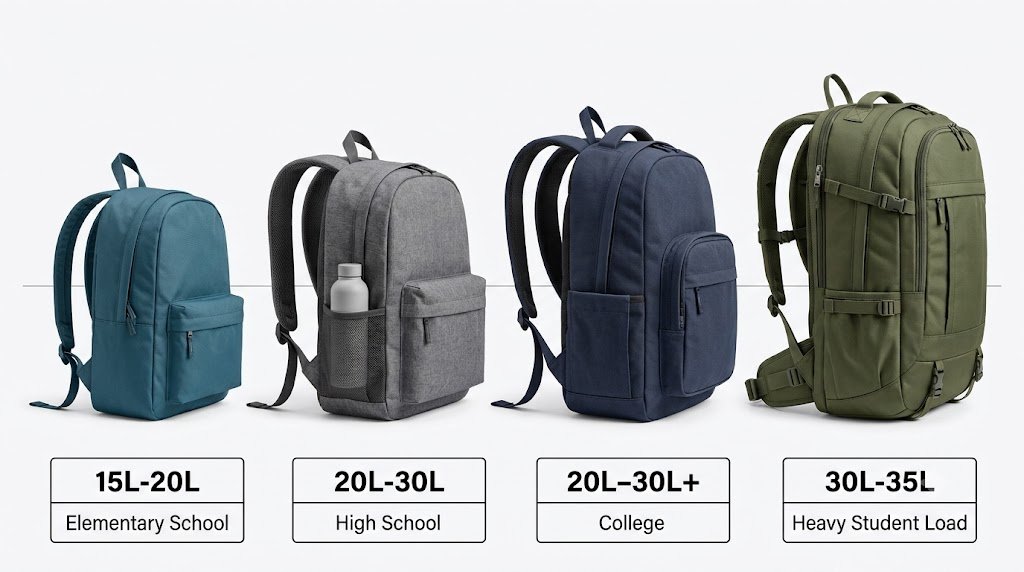
Student Backpack Size Chart: 15L to 35L
Most students need a backpack between 20L and 30L, but the ideal size depends on the student’s age, school level, and daily carrying needs. Younger students usually need smaller and lighter backpacks, while high school and college students often require more capacity for books, laptops, and personal items.
Based on student backpack development experience, the most common capacity ranges are:
| Student Type | Recommended Backpack Size | Typical Items Carried |
|---|---|---|
| Kindergarten / Early School | 10L–15L | Small books, lunch, water bottle, personal items |
| Elementary School | 15L–20L | School supplies, notebooks, light clothing |
| Middle School | 18L–25L | Textbooks, folders, daily supplies |
| High School | 20L–30L | Textbooks, laptop, sports items, personal gear |
| College | 20L–30L+ | Laptop, documents, chargers, books, daily essentials |
For most high school and college students, a 20L–30L backpack provides the best balance between storage, comfort, and everyday usability.
A larger backpack is not always a better choice. During backpack development, we often consider how students actually use the space. A bag that is too small creates overloading problems, while a bag that is too large can become unnecessarily heavy and uncomfortable.
The right student backpack size should provide enough room for daily essentials while maintaining proper weight distribution and carrying comfort.
What Size Backpack Does a High School Student Need?
Most high school students need a 20L–30L backpack, with 25L being a practical middle point for many students. This capacity range usually provides enough space for textbooks, notebooks, laptops, water bottles, and personal items without creating unnecessary bulk.
High school students often carry heavier and more varied loads than younger students. A typical school day may include multiple textbooks, binders, stationery, lunch items, sports clothing, and electronic devices.
From our experience developing school backpacks, we have found that high school backpack sizing is not only about capacity. The backpack also needs enough depth, organization, and support to handle daily school loads comfortably.
| High School Backpack Size | Best For | Typical Carry |
|---|---|---|
| 15L–20L | Light school loads | Small books, notebooks, personal items |
| 20L–25L | Standard high school use | Textbooks, folders, laptop, daily supplies |
| 25L–30L | Heavy school loads | More books, sports gear, electronics |
| 30L+ | Specialized needs | Large equipment, activities, extra clothing |
What Features Matter for High School Backpacks?
A suitable high school backpack should include:
- Enough depth for textbooks, binders, and school supplies
- Laptop protection for students carrying devices
- Comfortable shoulder straps for heavier daily loads
- Organized compartments for separating books and personal items
A backpack that is too small may become overloaded, while a backpack that is too large may encourage students to carry unnecessary weight.
The best high school backpack size is the one that balances capacity, organization, and carrying comfort based on the student’s daily routine.
What Size Backpack Does a College Student Need?
Most college students need a 20L–30L backpack. A 20L backpack works well for students carrying a laptop, notebooks, and daily essentials, while a 25L–30L backpack provides more flexibility for textbooks, electronics, clothing layers, and longer campus days.
Unlike high school students, college students often carry fewer traditional textbooks but more electronic devices and personal equipment. A typical college backpack may need to hold a laptop, charger, tablet, documents, headphones, water bottle, and other everyday items.
College backpack design is usually less about maximum capacity and more about efficient organization, laptop protection, and carrying comfort. Since many college students move between classrooms, libraries, and work spaces throughout the day, a well-structured backpack often performs better than a larger but poorly organized one.
| College Backpack Size | Best For | Typical Carry |
|---|---|---|
| 18L–20L | Light college use | Laptop, notebook, charger, personal items |
| 20L–25L | Everyday campus use | Laptop, books, documents, accessories |
| 25L–30L | Heavy daily carry | Larger laptop, textbooks, gym items, extra clothing |
| 30L+ | Special requirements | Sports equipment, projects, extended activities |
What Makes a Good College Backpack?
A suitable college backpack should provide:
- Dedicated laptop protection for daily device carry
- Organized compartments for chargers, documents, and accessories
- Comfortable straps and back support for long campus walks
- Flexible storage for changing daily requirements
A backpack that is too small may struggle with laptops, books, and personal items. However, a larger backpack is not always better because unnecessary capacity can increase weight and reduce comfort.
For most college students, the ideal backpack size is the one that balances laptop protection, organization, capacity, and everyday mobility.
High School vs College Backpack Size Differences
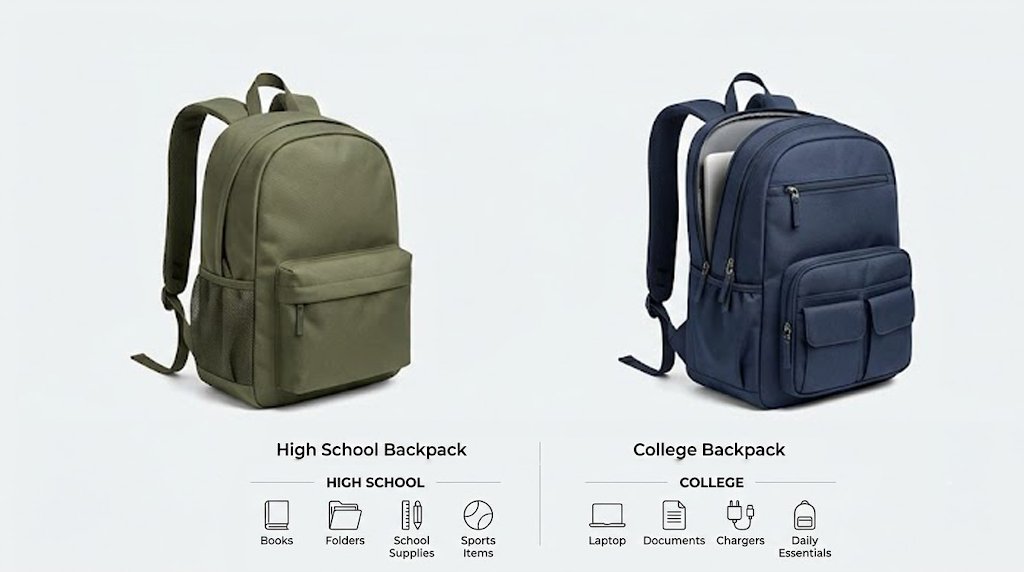
High school and college students often use backpacks in a similar capacity range, but their daily carrying needs are usually different. The difference is not only about how many liters the backpack holds — it is about how the space is used.
| High School Backpack | College Backpack | |
|---|---|---|
| Main Need | Carrying books and school supplies | Carrying laptops, documents, and daily essentials |
| Common Capacity | 20L–30L | 20L–30L+ |
| Important Space | Main compartment depth | Laptop and accessory organization |
| Common Items | Textbooks, binders, lunch, sports items | Laptop, charger, notebooks, documents |
| Design Priority | Durability and storage | Comfort, organization, and device protection |
A high school backpack often needs a deeper main compartment because students may carry multiple textbooks, folders, and larger school items throughout the day.
A college backpack usually benefits from better compartment organization. Students often move between classrooms, libraries, internships, and other locations, making laptop protection and easy access more important.
The capacity range may overlap, but the design approach is different. A well-designed student backpack matches the user’s daily routine rather than simply adding more volume.
What Size Backpack Do Students Need for Different Laptop Sizes?
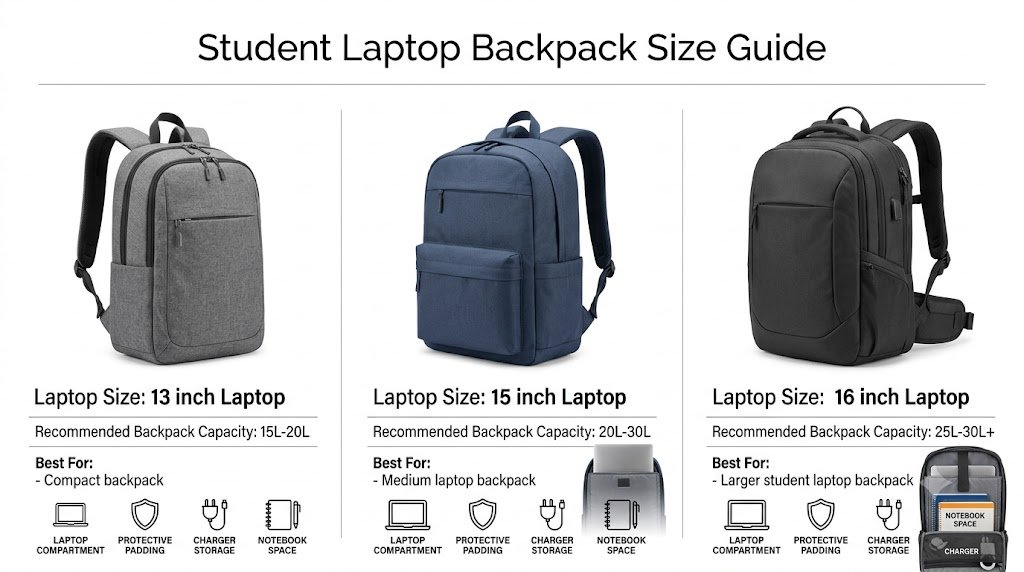
For many students, choosing a backpack size starts with the laptop they need to carry. A backpack that fits a laptop physically may still feel too small if it does not leave enough room for chargers, notebooks, books, and personal items.
Most student laptop backpacks fall between 20L and 30L because this range provides enough space for a laptop while maintaining a comfortable size for daily campus use.
| Laptop Size | Recommended Student Backpack Capacity | Suitable For |
|---|---|---|
| 11–13 inch laptop | 15L–20L | Light carry, younger students, minimal setup |
| 14 inch laptop | 18L–25L | Daily school and college use |
| 15–16 inch laptop | 20L–30L | Most high school and college students |
| Large workstation laptop | 30L+ | Design, engineering, or heavy equipment needs |
A laptop compartment should not be judged only by the screen size. The actual device thickness, protective padding, charger size, and additional items carried during the day also affect the required backpack capacity.
For students, a good laptop backpack should balance:
- Laptop protection without wasting too much storage space
- Easy organization for chargers, notebooks, and accessories
- Comfortable carrying during long school days
The right capacity depends on the complete daily load, not only the laptop size.
For a more detailed comparison of laptop dimensions, backpack capacity, and laptop compartment design, see our laptop backpack size guide.
How Much Can a Student Backpack Carry?
A typical student backpack between 20L and 30L can usually carry a laptop, books, notebooks, water bottle, chargers, and daily personal items. The actual carrying capacity depends on the backpack structure, compartment design, and how efficiently the space is organized.
A student backpack is not only measured by how many items fit inside. The way those items are arranged affects comfort, accessibility, and the overall carrying experience.
| Backpack Size | Typical Carrying Capacity |
|---|---|
| 15L–20L | Notebooks, small books, tablet, water bottle, personal items |
| 20L–25L | Textbooks, laptop, folders, charger, daily essentials |
| 25L–30L | Multiple books, laptop, sports items, extra clothing |
| 30L+ | Larger equipment, activities, projects, or heavier daily loads |
A well-designed student backpack should provide enough space for:
- Books and notebooks without overfilling the main compartment
- Laptop and electronics with proper protection
- Water bottle and personal items with easy access
- Extra clothing or activity gear when needed
However, more capacity does not always mean better performance. A backpack that is too full can become uncomfortable, while unnecessary empty space can make the bag heavier and less practical.
During student backpack development, designers usually consider not only volume but also weight distribution, compartment layout, and carrying comfort. A backpack that organizes the load well often performs better than one with simply more liters.
The right student backpack size should provide enough room for daily needs while keeping the overall weight comfortable to carry.
What Features Make a Good Student Backpack?
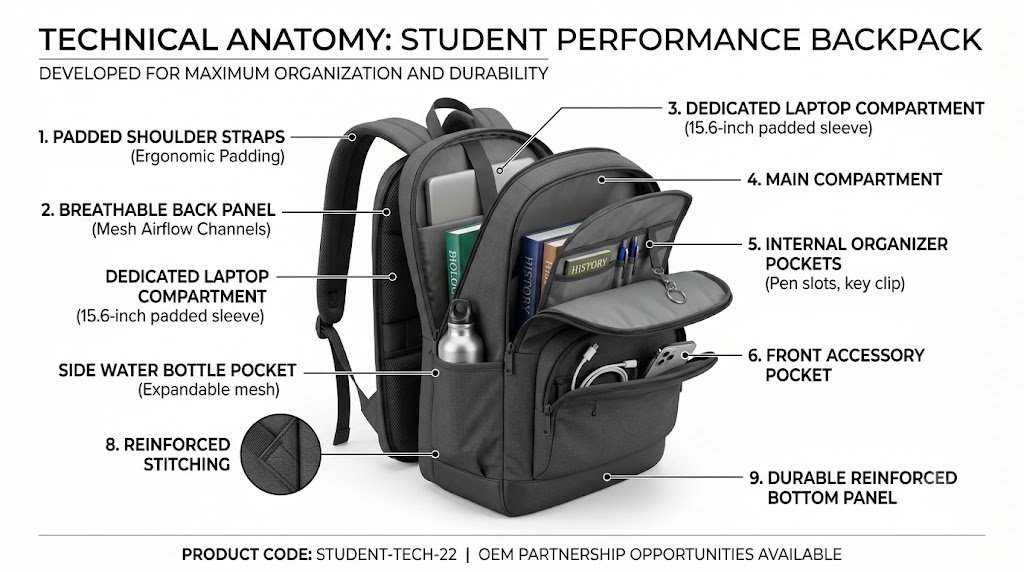
A good student backpack is not only about having enough space. It should also distribute weight comfortably, protect daily essentials, and make it easy to organize books, electronics, and personal items.
Students often carry backpacks for several hours each day, so comfort and usability are just as important as capacity. A well-designed backpack should support the user’s daily routine instead of simply adding more storage.
Health organizations recommend that children avoid carrying backpacks that are excessively heavy compared with their body weight. The American Academy of Pediatrics provides guidance on backpack safety and proper carrying habits.
Key Features to Consider in a Student Backpack
| Feature | Why It Matters |
|---|---|
| Padded shoulder straps | Helps reduce pressure when carrying books and electronics |
| Supportive back panel | Improves comfort and helps distribute weight |
| Laptop compartment | Protects devices and keeps electronics separated |
| Organized pockets | Makes chargers, stationery, and personal items easier to access |
| Durable materials and stitching | Helps the backpack handle daily school use |
| Water-resistant design | Provides additional protection for books and electronics |
A common mistake in backpack selection is focusing only on capacity. A larger backpack may hold more items, but without proper structure, it can become uncomfortable when fully loaded.
During student backpack development, designers often need to balance capacity, weight distribution, durability, and user comfort. The goal is not to create the biggest backpack, but to create one that works well for the student’s daily activities.
The right student backpack combines practical storage with a comfortable carrying experience.

How Should Brands Choose Student Backpack Sizes?
For brands and buyers developing student backpacks, choosing the right capacity is not only about making the bag larger or smaller. The size should match the student’s age group, daily activities, and expected carrying needs.
A successful student backpack collection usually includes different sizes for different users rather than one capacity designed for everyone.
| Target User | Recommended Capacity | Product Focus |
|---|---|---|
| Kindergarten and younger students | 10L–15L | Lightweight design, simple storage, easy carrying |
| Elementary school students | 15L–20L | Books, school supplies, daily comfort |
| High school students | 20L–30L | Textbooks, electronics, heavier school loads |
| College students | 20L–30L+ | Laptop protection, organization, everyday mobility |
When developing student backpacks, brands should consider more than capacity. Important decisions include:
- Age group and body size — Younger students usually need lighter and more compact designs.
- Daily carrying requirements — Different education levels create different storage needs.
- School environment — Some markets require more books, while others rely more on laptops and digital devices.
- Product positioning — Capacity, materials, and features should match the target price and customer expectations.
A common mistake in student backpack development is creating a larger bag with more features without considering the actual user. A successful student backpack should balance size, comfort, functionality, and market demand.
For brands, the right backpack size is the one that supports the student’s daily routine while creating a clear product position in the market.
Conclusion: Choosing the Right Backpack Size for Students
The best backpack size for most students is usually between 20L and 30L, but the right choice depends on the student’s age, daily routine, and carrying needs.
A good student backpack is not only about capacity. It should also provide comfortable carrying, smart organization, and proper protection for books, laptops, and personal items.
For brands and bulk buyers, choosing the right student backpack size is also an important product decision. If you are developing a student backpack collection, our team can help with capacity planning, structure design, and custom backpack development. — CONTACT OSGOODWAY !
For a broader comparison of backpack capacities from 10L to 50L, see our complete backpack size guide.

Frequently Asked Questions About Student Backpack Sizes
What size backpack is best for high school students?
Most high school students need a 20L–30L backpack. This range usually provides enough space for textbooks, notebooks, laptops, water bottles, and personal items while remaining comfortable for daily school use.
What size backpack is best for college students?
A 20L–30L backpack is usually suitable for most college students. Students who carry larger laptops, more documents, gym items, or additional equipment may prefer a slightly larger capacity.
Is a 30L backpack too big for a student?
No. A 30L backpack is not usually too large for high school or college students if the student regularly carries books, electronics, or extra items. However, a smaller backpack may be more comfortable for students with lighter daily loads.
How many liters should a student backpack be?
Most student backpacks are between 15L and 30L. Younger students often need smaller capacities, while high school and college students usually require more space for books, laptops, and personal belongings.
What size backpack fits a laptop for students?
A 20L–30L backpack is commonly suitable for student laptops. The ideal size depends on the laptop dimensions, protective padding, charger storage, and other items carried during the day.
Should students choose a bigger backpack?
Not always. A larger backpack provides more storage, but excessive capacity can add unnecessary weight. The best student backpack size should balance space, comfort, organization, and daily needs.






