


Updated September 2026 | Reviewed from a backpack manufacturing perspective
Polyester and nylon are practical starting points for most laptop backpacks. Specific ballistic nylon or CORDURA® fabrics may suit more demanding abrasion requirements, while canvas and leather offer different appearance, weight and maintenance trade-offs. Laptop protection also depends on the lining, foam, compartment fit and clearance above the base.
For brands and bulk buyers, the useful question is which material combination meets the intended use at an acceptable production cost. A commuter backpack carrying a laptop and charger has different requirements from a work backpack carrying heavier equipment every day.
Start with the maximum device dimensions, expected contents, carrying conditions and target price. These requirements help determine where a material upgrade adds value—and where changes to the construction matter more.
Which Materials Are Best for Laptop Backpacks?

The following options provide starting points for material selection. They are not a fixed durability ranking.
| Material option | Where it can fit | What buyers should check |
|---|---|---|
| Polyester | Everyday commuter bags, student backpacks and corporate products | Fabric weight, weave, backing, abrasion performance and colour availability |
| Nylon | Travel, commuter and lightweight performance backpacks | Actual strength and abrasion performance at the proposed weight, finish and cost |
| Ballistic nylon | Business or work backpacks requiring a substantial exterior | Exact specification, weight, seam bulk and whether the performance justifies the cost |
| CORDURA® fabrics | Products requiring a particular branded performance fabric | Authentic fabric article, composition, finish, availability and relevant performance data |
| Canvas | Lifestyle and casual laptop backpacks | Fibre composition, finished weight, water response and maintenance requirements |
| Leather | Business and lifestyle products with a leather exterior | Leather type, thickness, finish, cutting yield, consistency and finished bag weight |
| Recycled polyester or nylon | Projects with specified recycled-content requirements | Material performance, recycled-content percentage and supporting traceability documents |
These categories overlap. CORDURA® is a fabric brand, canvas describes a fabric construction, and recycled content describes the source of the raw material. One fabric may therefore belong to more than one category.
Nylon vs Polyester
Nylon and polyester are both common choices for laptop backpacks, but they are usually selected for different product requirements.
| Nylon | Polyester | |
|---|---|---|
| Strength | Good strength-to-weight balance | Practical durability for many commercial applications |
| Advantage | Lightweight technical feel | Cost balance, colour options and production flexibility |
| Common use | Travel and performance backpacks | Everyday, school and corporate backpacks |
The material name alone does not define the final performance. Buyers should also confirm the fabric construction, finished weight, coating or backing, and intended application.
For many commercial laptop backpacks, a suitable polyester construction may provide better overall value by leaving more budget for protection features such as padding, laptop sleeves and reinforcement.
Ballistic Nylon and CORDURA®
Ballistic nylon and CORDURA® fabrics are often considered for premium or heavy-use laptop backpacks where abrasion resistance, technical appearance or brand positioning are important.
However, the fabric name alone is not a complete specification.
Before approval, buyers should confirm:
- Exact fabric article
- Fabric weight
- Coating or backing
- Intended application
A heavier performance fabric may improve abrasion resistance, but it can also affect sewing, finished weight and production cost. In some cases, reinforcing high-wear areas can provide a more efficient solution than upgrading the entire backpack shell.
Canvas, Leather and Recycled Fabrics
Canvas and leather are often selected for lifestyle or premium business products where appearance and hand feel are important.
Buyers should also consider:
- Finished weight
- Maintenance requirements
- Water resistance
- Material consistency
Recycled polyester and nylon are increasingly used for sustainability-focused projects. However, recycled content describes the material source, not the finished performance.
Confirm:
- Recycled content percentage
- Certification requirements
- Traceability
- Actual fabric construction
Be precise about sustainability claims. Recycled main fabric does not mean the lining, foam, webbing and entire finished backpack are recycled. Buyers should define which components require recycled content and what supporting documentation is needed.
How Do Fabric Specifications Affect Durability?
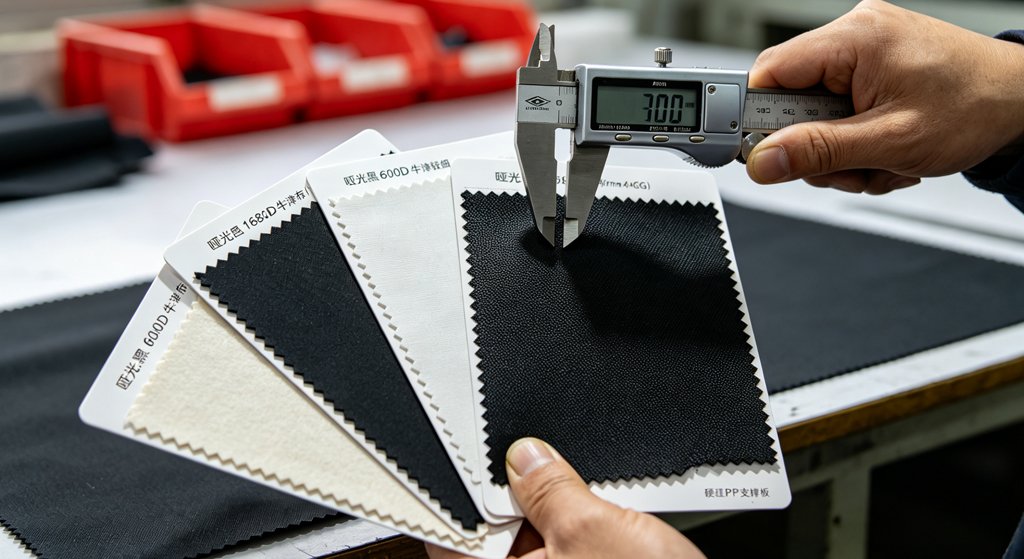
Two suppliers can quote “600D polyester” and still offer different fabrics. Yarn size is only part of the specification.
| Specification | What it tells the buyer |
|---|---|
| Fibre composition | The material used to make the yarn, such as polyester or nylon |
| Denier | Yarn linear density, rather than finished fabric thickness |
| Fabric weight, or GSM | Mass per square metre; confirm whether the value includes coating or backing |
| Weave construction | How the yarns are arranged in the fabric |
| Coating or backing | An added layer that can affect water resistance, stiffness, handling and assembly |
| Usable width | The width available for cutting, which affects panel layout and consumption |
| Performance results | How the specified material performed under an identified test method and conditions |
Higher denier does not automatically mean a more durable backpack. Finished performance also depends on yarn quality, weave, finishing and construction.
Likewise, a heavier backing may make a sample feel substantial without resolving the actual wear problem. Inspect how the material folds, feeds through sewing operations and behaves at the intended seams.
For bulk sourcing, keep an identified reference swatch with the written specification. Approving only the colour and hand feel leaves room for differences that may become visible after cutting or assembly.
What Lining and Foam Should a Laptop Backpack Use?
The laptop-contact surface and cushioning deserve separate specifications. A durable exterior cannot prevent movement inside an oversized sleeve or compensate for inadequate protection around the device edges.
Check the proposed lining for:
- Surface feel and exposed seam edges
- Abrasion during repeated laptop insertion and removal
- Colour transfer and cleaning requirements
Brushed polyester, jersey and tricot describe different fabric constructions rather than a simple quality ranking. Confirm the fibre composition, construction and finish of the supplied material.
The complete opening should also be reviewed. A soft lining provides limited benefit if zipper teeth, binding or other hard components contact the laptop during use.
Compare Foam Grades, Not Just Thickness
Foam can provide cushioning and help maintain compartment shape. The grade and construction determine how it responds to pressure.
| Foam option | Potential role | What to evaluate |
|---|---|---|
| EVA foam | Shaped or relatively firm padding and support | Firmness, compression behaviour, recovery and flexibility at the proposed thickness |
| PE foam, including cross-linked grades | Lightweight cushioning or separation layers | Compression response, recovery, thickness consistency and assembly behaviour |
| Flexible PU foam | Softer cushioning and padded contact areas | Firmness, repeated compression performance and whether it compresses too far under the intended load |
| Layered foam construction | Combining cushioning with shape or support | Total thickness, bonding, movement between layers and finished compartment space |
Density and firmness are different properties. Higher-density foam is not necessarily firmer, so both should be evaluated separately. The Polyurethane Foam Association explains this distinction for flexible polyurethane foam.
A thicker layer may reduce usable compartment space without delivering the required protection. A very soft layer may compress too far, while a firmer layer may change fit and insertion resistance.
Approve the foam inside the assembled sleeve. Material names, density or thickness alone cannot establish a finished backpack’s impact-protection performance.
How Should the Laptop Compartment Be Designed?
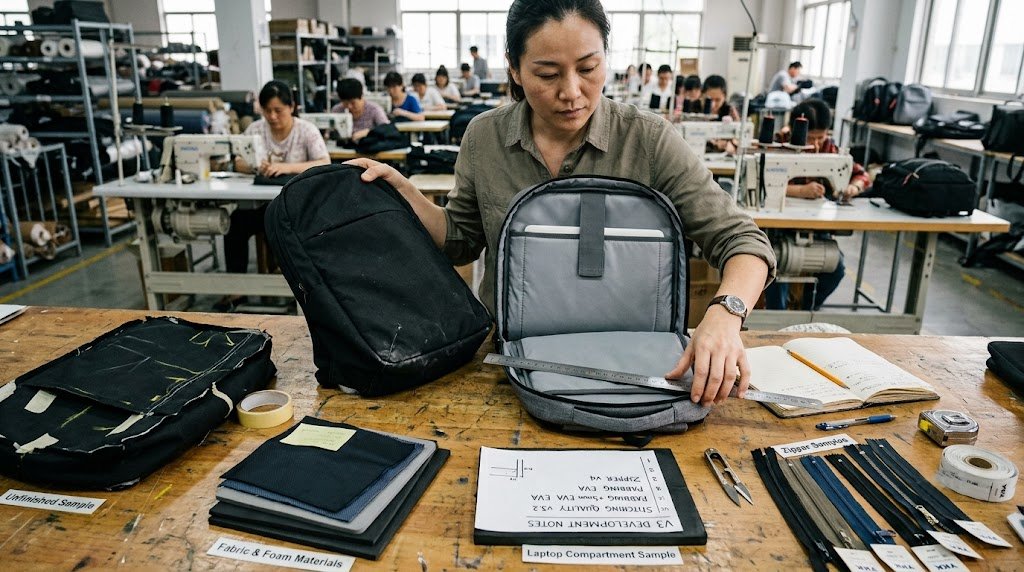
Develop the compartment around maximum device dimensions, not only a screen-size label. Devices sold with the same screen size can have different body dimensions, and a protective case adds further space requirements.
| Construction detail | What to check in the sample |
|---|---|
| Internal dimensions | Fit with the largest intended device and any specified case |
| Opening | Easy insertion without forcing the device past zipper ends or tight corners |
| Retention | Enough control to limit movement without pressing unnecessarily on the device |
| Side and corner protection | Separation from hard components, seams and adjacent contents |
| Bottom clearance | Whether separation from the exterior base remains when the bag is loaded |
| Adjacent pockets | Whether chargers or other hard items press into the laptop compartment |
| Sleeve attachment | Whether the attachment supports the intended device without excessive sagging |
Does a Laptop Backpack Need a Suspended Sleeve?
A suspended laptop sleeve creates a gap between the laptop compartment and the bottom of the backpack. This extra space helps reduce direct impact when the bag is placed on the ground.
However, the gap should be evaluated on a loaded backpack, not only on an empty sample. When the bag carries a laptop, charger and other items, the sleeve may stretch, the padding may compress, and the bottom structure may change.
During development, we normally check:
- Whether the laptop remains separated from the base
- Whether the sleeve keeps its position under load
- Whether the padding still provides protection after compression
For more details about false bottoms and bottom clearance design, see our guide on whether a backpack needs a false bottom.
A suspended sleeve is one way to improve laptop protection, but the final result depends on how the sleeve, padding, base structure and reinforcement work together.
How Much Water Protection Does the Backpack Need?
Water-resistant fabric does not make an assembled laptop backpack waterproof. Water may still enter through zippers, seams, needle holes and openings.
Define the exposure before selecting materials: brief rain during a commute and prolonged outdoor exposure are different requirements.
A water-repellent surface finish helps water bead on the face fabric. A coating or laminate can provide a barrier through the material, but the finished bag still needs suitable closure and seam construction.
Review:
- The specified shell fabric and backing
- Zipper type and exposure
- Seam placement and construction
- Main opening and any protective flap
- Exposure at the base
- The position of the laptop compartment relative to possible entry points
Even a water-repellent zipper should not be assumed to be waterproof. For example, YKK describes AquaGuard® as water-repellent rather than completely waterproof.
Our TPU vs PU coating guide for bags explains additional material-selection considerations. Any finished-bag water-protection claim should match the construction and evaluation conditions.

How Do Zippers, Straps and Seams Affect Durability?
Material selection should include the components and connections that carry load or experience repeated movement.
Match Zippers to Their Position
The main compartment and a small accessory pocket do not necessarily need the same zipper specification.
Select the zipper chain, slider and installation method for the opening shape, expected load and frequency of use. Check operation with the backpack packed, because pressure from the contents can change how the opening behaves.
A larger zipper will not correct an overfilled compartment or a poorly shaped opening. Before upgrading the component, check whether the pattern, seam placement or internal layout is creating unnecessary stress.
Reinforce the Load-Bearing Connections
Shoulder-strap attachments, carry handles, bottom corners and zipper ends deserve particular attention.
Review how the load passes through the shell, backing or reinforcement, stitching and webbing. The overlap, seam allowance and supporting layers should work together.
Adding more stitches is not automatically an improvement. Stitching must suit the material and joint; closely spaced needle holes can damage some constructions.
Our guide to common backpack production quality issues explains how to investigate these problems beyond the material label.
How Can Buyers Balance Material Performance and Cost?
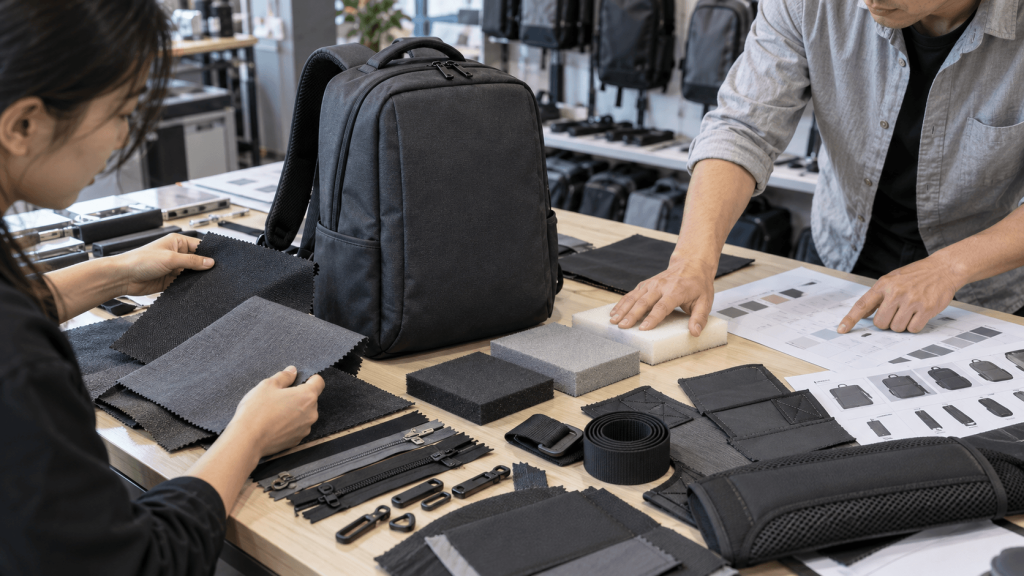
Allocate the budget to the part of the product that needs improvement.
| Development concern | First areas to review |
|---|---|
| Excessive wear at the base | Base material, panel shape and local reinforcement |
| Laptop contacts the bottom | Sleeve support, loaded clearance and cushioning |
| Main zipper is difficult to close | Opening shape, packing pressure and zipper specification |
| Backpack is too heavy | Fabric and backing weight, hardware and unnecessary components |
| Quotation exceeds the target | Material consumption, pocket construction, component variety and colour breakdown |
A premium shell may improve abrasion resistance, but it will not resolve insufficient padding or a sleeve that allows the laptop to contact the base.
Compare Material Cost per Bag
The lowest fabric price per metre does not always produce the lowest material cost per backpack.
Usable width, panel layout, cutting direction and rejected areas affect consumption. A cheaper fabric may cost more per bag if fewer panels fit across its usable width or more material is lost during cutting.
Ask for cost comparisons based on the proposed pattern and specification. Include additional backing or reinforcement if the alternative material requires it.
Simplify Features Before Reducing Every Component
Removing a low-value pocket may eliminate fabric, lining, zipper components and several sewing operations. That can be a more useful saving than reducing the specification of every zipper, including the frequently used main opening.
The choice should reflect the target user. Keep features that support the product’s purpose and assess whether less important details justify their cost and weight.
Confirm the Quantity per Colour
The same total order quantity can produce different costs when split across more colours.
Fabric and trim minimums, dyeing requirements, unused material and production setup can change with the colour breakdown. Compare quotations using the same quantity per colour and clarify which components need matching colours.
Our guide to balancing quality and cost when sourcing backpacks provides further guidance on evaluating savings against the approved product requirements.
What Should Buyers Approve Before Bulk Production?
The production specification should connect the intended use, selected materials and approved sample.
-
Define the use and fit requirements. Record maximum laptop dimensions, expected contents, carrying conditions, target finished weight and any protection claims.
-
Identify the materials and components. Record fabric articles, composition, finished weight, backing, foam grade and thickness, lining, zippers, webbing and hardware. Keep matching reference samples.
-
Evaluate the assembled backpack. Check device fit, loaded sleeve clearance, zipper operation, carrying connections and the effect of adjacent contents.
-
Agree on evaluation methods and acceptance criteria. Separate material tests from finished-product checks. Fabric abrasion results do not establish laptop impact protection, and a water-resistant fabric result does not establish whole-bag waterproofness.
-
Release one approved production version. Keep the bill of materials, drawings, sample and inspection requirements consistent.
If materials or construction change after costing, update the relevant documents and sample details together. Record the revision and approval status, and remove superseded specifications from production use.
Substitutions affecting fit, cushioning, seam performance or water resistance should be checked again before bulk production. A lower quotation is only useful when it clearly identifies what will be supplied.
Plan a Custom Laptop Backpack with Osgoodway
For a custom laptop backpack production project, share your drawings, tech pack or reference sample together with:
- Maximum laptop dimensions and any case allowance
- Intended users, carrying environment and typical contents
- Target quantity by colour
- Target price and destination market
- Preferred materials or recycled-content requirements
- Branding, packaging and required delivery timing
If the material choice is still open, explain which priorities matter most: finished weight, abrasion resistance, laptop protection, appearance or cost.
Send your laptop backpack project details to Osgoodway to discuss material options, construction and sampling requirements for bulk production.







