


I’ve been making backpacks for 15 years. My factory has produced bags for brands across Europe, the US, and Australia — outdoor gear, travel bags, tactical packs. And every few months, a buyer walks into a conversation with me and asks some version of the same question:
"Can you make something like Osprey but cheaper?"
Sometimes yes. Sometimes no. And the "no" is usually more interesting.
So let me stop dancing around it. Here’s a real factory breakdown of why Osprey costs what it costs — and which parts of that price tag are genuinely worth paying for, which parts are brand tax, and what you can actually replicate if you’re sourcing smart.
Is Osprey Actually Worth the Price, or Are You Just Paying for the Logo?
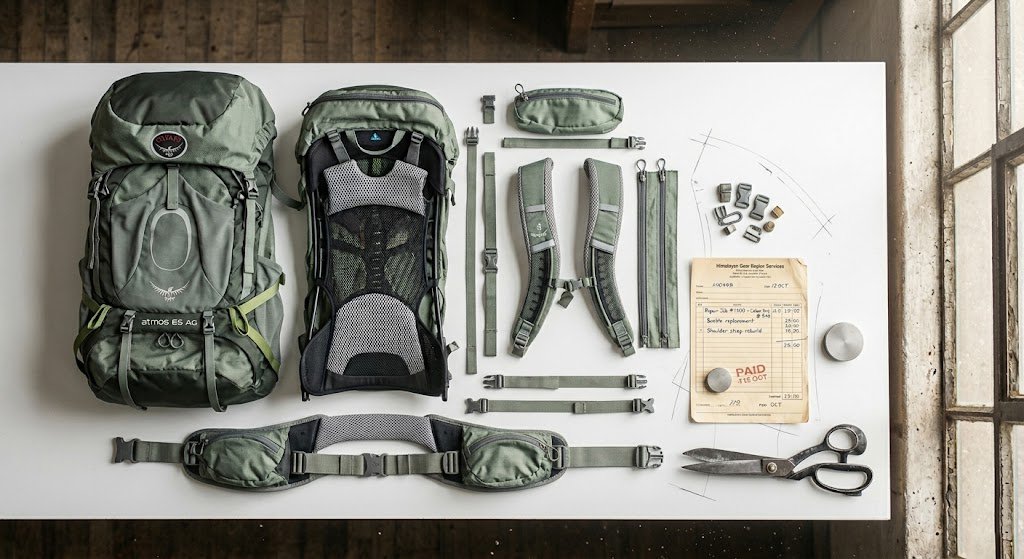
Roughly 60–65% of Osprey’s retail price reflects genuine production value: certified materials, proprietary suspension engineering, YKK hardware throughout, and construction discipline that demands skilled labor. The remaining 35–40% is brand infrastructure, distributor margin, and retailer markup. That’s the honest split.
Here’s the actual factory math on an Osprey Atmos AG 65, which retails around $290. Materials at real certified-mill prices: $18–$28. Labor in a technically competent factory: $6–$10. Overhead, inline QC, final inspection, packaging: $4–$7. Factory total: $30–$45. Osprey’s FOB to distributor: probably $70–$90. Distributor marks up. Retailer marks up. You hit $290 at REI.
That FOB-to-retail multiplier — roughly 3.2–4x — is standard for every premium outdoor brand. It’s not a scam. It’s the cost of running a global operation with a warranty program, a marketing budget, and retail shelf space.
| Cost Layer | Estimated Range |
|---|---|
| Raw materials (certified mill) | $18–$28 |
| Factory labor | $6–$10 |
| Overhead / QC / packaging | $4–$7 |
| Total factory cost | ~$30–$45 |
| Osprey FOB to distributor | ~$70–$90 |
| Final retail price | $120–$380 |
Factory Secret: If a supplier quotes you $22 FOB and says it’s "Osprey-level quality," they’re lying about one of those two things. At $22, you’re getting generic polyester, no-name buckles, and a factory that skips bartacking on stress points. I’ve seen the bags that come out of that price point. I won’t build them.
What Materials Are You Actually Paying For Inside an Osprey Pack?
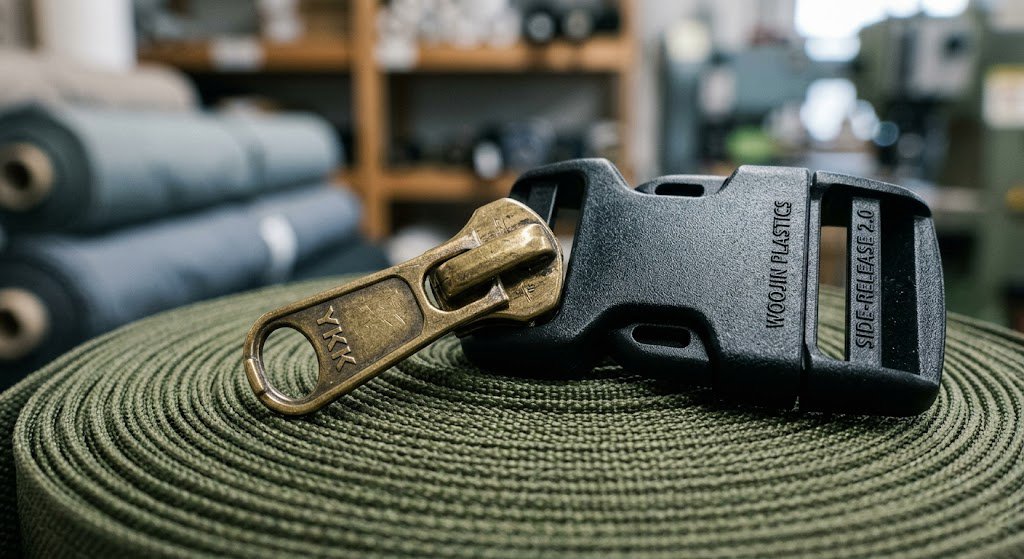
Osprey uses 100D–420D high-tenacity nylon from certified mills, full YKK zipper sets including AquaGuard on weather-exposed pockets, and ITW Nexus or Woojin hardware on every buckle and triglide. These materials cost 3–5x more per unit than generic alternatives. That cost gap is real and it’s justified — but only if the mill certs are genuine.
When Osprey specs fabric, they’re not buying off a Guangzhou market shelf. They specify denier count, tensile strength, Martindale abrasion cycles, DWR coating weight — then audit the mill to verify it. Our factory runs the same process for serious clients.
Here’s the thing nobody tells you: "210D nylon" means nothing without a mill cert. I’ve personally tested fabric from uncertified suppliers labeled 210D that measured actual 175D with inconsistent coating weight. Looks identical on invoice. Fails completely differently in the field.
| Component | Osprey Spec | Certified Mill Cost (FOB) | Generic Alternative Cost |
|---|---|---|---|
| Main body fabric | 210D HT nylon, DWR | $2.80–$4.20/m | $0.60–$0.90/m |
| Base / high-wear panels | 420D HT nylon | $4.50–$6.00/m | $1.00–$1.50/m |
| Back panel mesh | Custom tensioned (Airspeed®) | Not available off-shelf | N/A |
| Main zipper (#10 YKK RC) | YKK RC or AquaGuard | $1.20–$2.80/unit | $0.18–$0.35/unit |
| Side-release buckles | ITW Nexus / Woojin | $0.18–$0.35/unit | $0.04–$0.08/unit |
Most buyers obsess over fabric denier and completely forget hardware. That’s where the real quality split hides.
The buckles, triglides, and sternum strap sliders on a serious outdoor pack come from ITW Nexus or Woojin — two suppliers that dominate this niche specifically because their parts are injection-molded to tight tolerances and cold-weather rated. A Woojin side-release buckle maintains snap-force integrity at -15°C. A $0.04 Yiwu generic cracks. You don’t know which is which until it fails in the field.
On a full technical pack, hardware BOM runs $4–$8 for quality components vs. $0.80–$1.50 for generics. Small brands routinely downgrade hardware to hit price targets. Osprey doesn’t.
Factory Secret: When a supplier sends you a sample, squeeze every buckle and listen for hollow flex. Then ask: "Which brand is this hardware?" If they say "our own brand" or hesitate, it’s generic. That one question tells me more about a factory’s real standards than walking their entire production floor.
Is Osprey’s Lifetime Warranty a Real Cost Driver, or Just a Marketing Line?
The warranty is real — and it does drive real cost. But not the way most people think. Osprey’s "All Mighty Guarantee" is only financially sustainable because their failure rate is low enough that claims stay manageable. The warranty is the output of quality, not the cause of the price.
Two years ago, a client came to me after a disaster with their previous supplier. They’d run 4,000 units of a hiking pack, printed "1-Year Warranty" on the hangtag, priced accordingly. By month eight they had a 12% return rate on shoulder strap failures. The previous factory had swapped their specified bartack thread for a thinner gauge — saved maybe $0.15 per bag. The brand ate the returns, the replacements, and the margin destruction. Nearly put them under.
That’s what a warranty without construction backing looks like. Not a warranty. A delayed liability.
Here’s what I tell every client who asks about offering a warranty on their private-label bags:
- A supplier who offers a warranty without showing you their inline QC process is handing you a piece of paper, nothing more
- Osprey’s lifetime guarantee works because their claim rate is predictably low — which means their production standards are consistently enforced
- If you want to offer your own warranty, start by auditing the production process, not drafting the hangtag copy
- The price premium embedded in Osprey’s warranty is really the price premium of a factory that doesn’t skip specs on unit 3,800
How Does Osprey’s Construction Actually Compare to What Chinese Factories Produce?
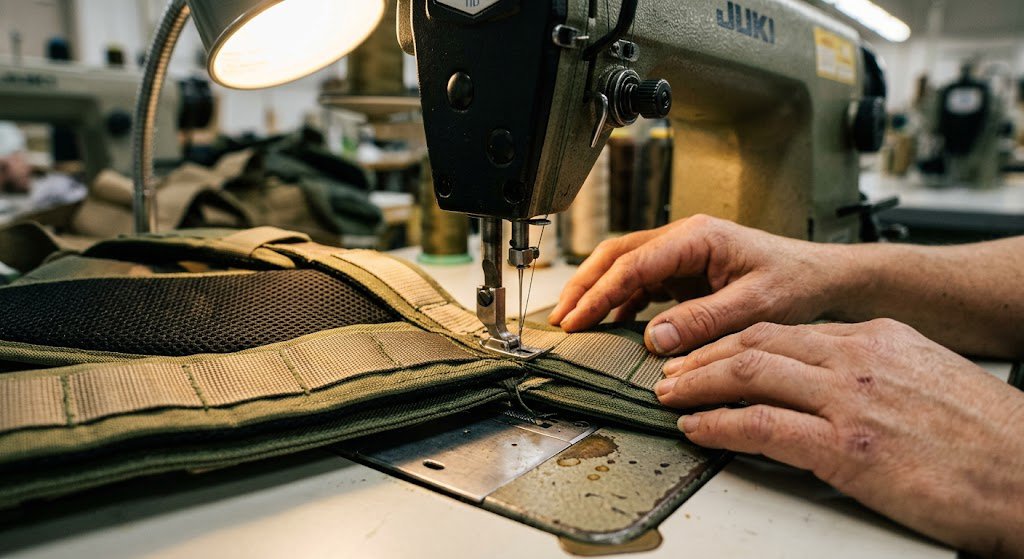
A well-run Chinese factory can match Osprey’s material spec and most construction standards. What most Chinese factories cannot match is the systematic QC discipline — consistent stitch density, mandatory bartacking at every stress point, seam tape calibration — that Osprey’s production partners maintain across every run at scale.
I want to be honest with you here, because I think it’s more useful than factory cheerleading. Most Osprey packs are made in Vietnam and the Philippines. Those factories have built serious technical sewing discipline specifically for outdoor gear over 15+ years. I respect that. Our factory runs the same construction standards on serious orders — but I won’t pretend every Chinese factory does.
In 2022, our factory took over a production run from a Guangdong supplier making hiking packs for a UK brand. I had the rejected samples on my worktable before we started. The stitch density on the harness attachment panel: 6 SPI. Our spec for that seam is 9 SPI minimum. The previous factory was probably hitting 6 because their machines were miscalibrated and nobody was checking. Not malice. Just zero process.
Where Construction Cost Actually Goes on a Technical Pack
- Stitch density: Structural seams need 8–10 SPI minimum. Below 8, seams pull under load. This requires calibrated machines and operators who actually verify their own work.
- Bartacking: Every strap attachment, handle, frame channel, d-ring anchor gets a bartack. A full technical pack has 20–30 stress points. Each bartack is 3–5 seconds of labor. Under price pressure, factories cut here first — and buyers never notice until the field.
- Seam tape application: Temperature and pressure must be calibrated per fabric weight. Under-applied tape peels within 6 months. Over-applied tape scorches the substrate. This is a machine issue, not a skill issue — and most factories don’t audit calibration between runs.
- Frame channel alignment: An internal frame seated 3mm off-center changes how the pack transfers load to the hip belt. Buyers don’t notice until mile 15 of a trail.

How I Would Audit Any Factory Before Placing a Technical Pack Order
I tell our clients: you cannot see construction quality on a factory tour. Clean floors mean nothing.
- Ask for a cross-section cut of a structural seam. Consistent thread penetration, no gaps, no tension irregularity. If they’re reluctant to cut a sample, that’s your answer.
- Count bartacks on the sample against the tech pack spec. Missing even one bartack on a sample — the best unit they’ll ever make you — and you walk.
- Ask who runs inline QC and whether they’re on the production payroll or a separate team. If it’s the same person, there’s no real QC.
- Do a live strap pull test on the spot: 15kg dead load on the shoulder strap attachment point. No deformation. If they resist running the test, you know why.
Our factory runs all of these checks as standard. I’d expect any serious buyer to run them on us too.
Is Osprey’s Fit System Something You’re Actually Paying Extra For?
You’re comparing two $270 packs: one Osprey Atmos AG 65, one unbranded "technical hiking pack" with an adjustable torso system. Same price point. The unbranded one has a cleaner aesthetic. Should you trust it?
Yes, you are paying extra for the fit system — and it’s one of the few Osprey premiums that is genuinely non-replicable at a lower price point. The Anti-Gravity suspension, FitOnSite torso adjustment, and gender-specific harness geometry represent 10+ years of proprietary R&D and tooling investment. You cannot buy an equivalent system off a component catalog.
What the AG Suspension Actually Is — and What Makes It Hard to Copy
- Tensioned mesh back panel (Airspeed®): Custom-engineered, not spacer mesh you can source from a fabric market. Designed to flex with body movement while maintaining frame structure under load. No catalog equivalent exists.
- FitOnSite torso adjustment: The shoulder harness slides on a precision-molded track with indexed positions. Getting this right requires tight-tolerance injection-molded components — not bent aluminum and webbing stitched to a backing panel.
- Gender-specific harness geometry: Different harness angle, hip belt shape, and torso length range between men’s and women’s versions. This is real pattern engineering, not a colorway change.
- Iteration depth: Osprey has been refining suspension systems since the 1970s. The AG system is the output of dozens of design generations and real-world load testing at scale.
What a Custom Suspension System Realistically Costs to Develop
- Custom back frame injection mold: $4,000–$12,000 USD depending on geometry complexity
- Pattern development and fit testing for adjustable torso: 8–16 weeks, multiple sample rounds
- At 500 units: tooling amortization adds $8–$24 per bag before a single stitch
- At 5,000 units: drops to $0.80–$2.40 per bag — the math starts making sense
What I Actually Recommend for Private-Label Clients
I’ve steered every private-label client away from "replicate the AG" as a brief. It’s a money pit at small volumes. The realistic path: use a proven licensed adjustable torso frame from our component network, build your own aesthetic on top — fabrics, colors, branding, pocket architecture — and land at a functional, honest pack at $55–$75 FOB. It won’t be an AG. But it will work, it will carry load correctly, and it makes business sense at 500–2,000 units.
How Does Osprey Actually Stack Up Against Gregory, The North Face, and Deuter?
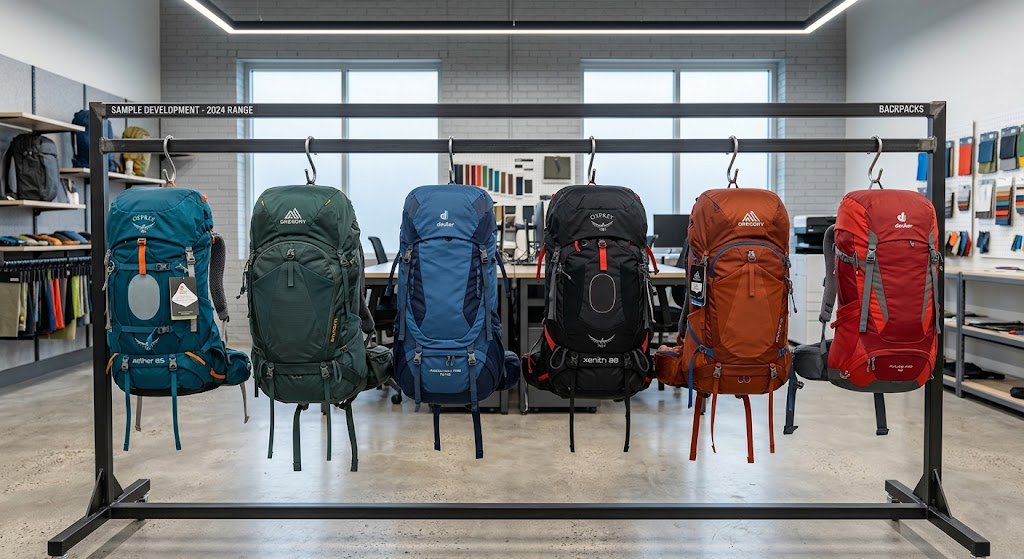
From a factory standpoint, Osprey and Gregory are in the same production tier — near-identical material standards, proprietary suspension systems, and consistent QC across their product lines. The North Face is two brands in one catalog: legitimate technical gear on the high end, value-engineered product on the volume lines. Deuter is closer to Osprey than most buyers realize and is underrated as a benchmark.
I’ve had samples from all four on my worktable. Here’s what I see when I actually pull them apart.
For deeper model-level comparisons on these brands, I’ve written these:
- Osprey vs. Gregory: Which Hiking Backpack Brand Offers a Better Fit for Long Hikes?
- How Do Osprey Backpacks Compare to The North Face Backpack?
Osprey vs. Gregory: Nearly the Same at the Factory Level
Gregory is Samsonite-owned now. A lot of buyers assume that means quality slipped. On the upper product lines — Baltoro, Deva, Paragon — I don’t see it. Material spec is comparable to Osprey: high-tenacity certified nylon, YKK zippers, real hardware. The Futura Pro suspension uses a different back panel geometry — more rigid frame, less tensioned mesh — but it’s genuine engineering.
Retail price gap between comparable models: $10–$20. Factory production requirement: identical. If you can make one, you can make the other.
The real difference is suspension feel: Gregory is firmer, Osprey AG is more breathable. Personal preference, not a quality gap.
Osprey vs. The North Face: Two Brands in One Catalog
The North Face is the most inconsistent brand at this price tier. Their top technical packs — the Verto series, Cinder — are legitimately well-constructed. Certified fabrics, real hardware, serious construction. I respect those products.
Then there’s the Recon, the Jester, the Borealis. Volume sellers. Lower-denier fabric, simplified construction, basic hardware. Fine for daily commuting. Not built for technical hiking. I’ve had buyers send me a Recon as a reference and ask for "something like this but cheaper." My answer: I can build that at $28–$38 FOB. It’s not a hard job. Because the Recon isn’t a hard bag.
The North Face charges Osprey-adjacent prices across their whole catalog. With Osprey, you get consistent construction standards from their $130 daypacks up through their $350 expedition packs. The North Face doesn’t give you that consistency.
Osprey vs. Deuter: The Most Underrated Comparison in the Market
Deuter is German-heritage, Vietnam-manufactured, and criminally underrated in English-language gear discussions. Their Aircomfort Flexlite suspension is proprietary, genuinely engineered, and in my opinion better optimized for heavy multi-day loads than Osprey’s AG. The hip belt padding compound on Deuter’s Aircontact series is different from anything else in this tier — I’ve cut into four of them and I still can’t fully reverse-engineer the foam spec.
Material standards are Osprey-equivalent. Production discipline is comparable. Retail pricing is similar: $180–$320 for core hiking packs.
Where Deuter lags: brand recognition in North American markets and a limited US retail footprint. For buyers sourcing for European outdoor brands, Deuter is actually a more precise benchmark than Osprey — their ergonomic standards map better to European end-consumer expectations.
| Brand | Construction Tier | Suspension Type | Line Consistency | Factory Replication Difficulty |
|---|---|---|---|---|
| Osprey | Premium | Proprietary AG | High | High |
| Gregory | Premium | Proprietary Futura | High | High |
| Deuter | Premium | Proprietary Aircomfort | High | High |
| The North Face | Mixed | Varies by line | Medium | Low–High |
| REI Co-op | Mid | Licensed standard frames | Medium | Low–Medium |
Factory Secret: The clearest brief I get from buyers is: "better than REI Co-op, but we don’t need Osprey-level suspension." That lands at $45–$65 FOB with certified materials, YKK zippers, ITW Nexus hardware, and a proven adjustable frame system. That’s the honest value zone for serious private-label technical packs.
So When You Pay $290 for an Osprey, What Are You Actually Getting?
You’re paying for certified materials, construction discipline, a proprietary suspension system that took decades to engineer, and a warranty backed by genuinely low failure rates. You’re also paying for distributor margins, retailer markups, and brand equity. The first group is inside the bag. The second group isn’t.
| What You’re Paying For | Real Production Value? | Replicable at Lower Cost? |
|---|---|---|
| Certified high-tenacity nylon | Yes | Yes — with mill audit and cert verification |
| YKK zippers throughout | Yes | Yes — same parts, we stock them |
| ITW Nexus / Woojin hardware | Yes | Yes — same parts, we stock them |
| AG suspension system | Yes | No — proprietary tooling and R&D |
| Construction discipline (QC, bartacking, seam tape) | Yes | Yes — in a well-run factory with real process |
| Lifetime warranty backing | Yes (indirectly) | Only if production failure rate is low enough |
| Brand name / retail resale value | Debatable | No |
| Distributor + retailer markup | No | Eliminated by going factory-direct |
My honest read: end consumers buying for personal use — buy Osprey. The system works, the construction is real, the warranty gives you real coverage. It’s worth the money.
Private-label buyers building their own outdoor pack line — you can reach 80% of Osprey’s actual production quality at 40–50% of retail price. But only if you know how to spec materials correctly, audit construction properly, and build a suspension system that’s honest about what it is. Most buyers don’t know how. Most factories won’t tell them the truth. I will.
Ready to Source Without Paying the Brand Tax?
You’ve read this far because you’re not a casual shopper. You’re trying to figure out what quality actually costs — and whether you can get it without the retail markup.
Osgoodway has been producing technical and fashion bags for 15 years. We source full YKK zipper lines, ITW Nexus and Woojin hardware, and certified nylon from audited mills. We run bartack inspection at inline QC — not just at final inspection when it’s too late to fix anything. And I’ll tell you directly if your target price and your target quality don’t match up — because finding that out after production is a lot more expensive than finding it out before.
Ready to get a factory quote? Tell us your specs →Contact us here!
Send us your target retail price, annual volume, and a reference bag. We’ll come back with what’s actually buildable — and where the real trade-offs are.







