


I’ve seen it happen a hundred times. A client wants to save $1.00 per unit on a tactical backpack, so they specify generic Polypropylene (PP) hardware. Three months later, their customer support is flooded with photos of shattered buckles from a ski trip in Colorado.
Yes, standard plastic buckles (specifically Polypropylene1 and cheap ABS) will become brittle and crack below freezing (0°C/32°F). However, high-quality buckles molded from Acetal (POM)2 or Impact-Modified Nylon retain their flexibility and structural integrity down to -40°C.
In this guide, I’m opening our factory lab reports to show you exactly why cheaping out on “generic plastic” is the most expensive mistake you’ll make this season.
Why Do Standard Plastic Buckles Fail in Freezing Temps?
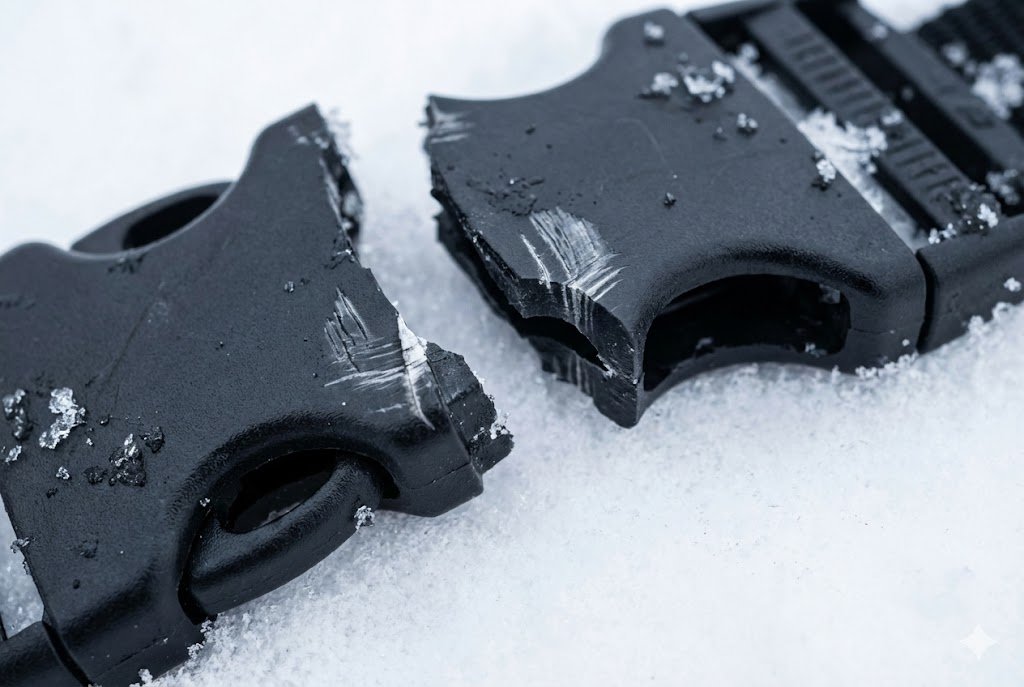
Low-grade plastics like standard Polypropylene (PP) become "glass-like" and brittle when temperatures drop below freezing, losing their ability to flex and snapping under the slightest tension.
When the temperature drops, the molecular "wiggle room" inside the plastic disappears. In this state, any impact energy (like dropping the bag) isn’t absorbed by stretching; it simply snaps the molecular bonds.
In our lab, we’ve found that generic PP buckles lose 70% of their impact resistance at just -10°C. We once ran a batch for a budget client who insisted on PP; every single buckle failed the "drop test" after two hours in the freezer.
Which factors accelerate buckle failure?
- Internal Stress: Poor injection molding cooling cycles.
- Moisture Content: Nylon (PA6) absorbs water, which freezes and expands.
- UV Degradation: Sun-damaged plastic is already "pre-cracked" at the molecular level.
Action: If your current BOM (Bill of Materials) lists "Plastic" or "PP" without specification, stop production and audit immediately.
POM vs. Nylon: Which Material Actually Survives -40°C?
You might think all "tough" buckles are the same, but the chemistry in your hand determines whether that buckle survives a winter expedition or becomes a liability.
POM (Polyacetal) is the industry gold standard for cold-weather buckles because it maintains high stiffness and dimensional stability without becoming brittle at sub-zero temperatures.
Why do we prefer POM over standard Nylon?
POM offers a lower friction coefficient and better "spring" memory in the cold. Unlike Nylon 6, it doesn’t soak up water that eventually turns into ice crystals inside the buckle. However, virgin High-Impact Nylon 66 is excellent for extreme cold if conditioned correctly.
| Material Type | Performance at -20°C | Performance at -40°C | Best Use Case |
|---|---|---|---|
| Standard PP(Polypropylene) | Fails (Shatters) | Dangerous | Promotional bags / Summer use only |
| Nylon 6 (PA6)3 | Risky (Becomes stiff) | Likely to crack | Indoor/Urban lifestyle |
| Acetal (POM) (Duraflex/Woojin) | Excellent | Stable | Alpine, Military, Ski Gear |
| Virgin High-Impact Nylon 664 | Excellent | Good | Tactical / Industrial / Extreme Cold |
Quick Note from the Factory Floor:
Why distinguish "Virgin High-Impact"? Because standard recycled Nylon behaves very differently. Virgin High-Impact Nylon 66 has specific modifiers that prevent the crystal structure from snapping in the cold. It rivals POM in strength but is often slightly more expensive. If your client demands "Tactical Specs," this is usually the material you want to quote.

How Do We Test Buckle Durability in Our Lab?
We subject buckles to a "Cold Impact Test[5]" where samples are frozen to -20°C for 24 hours, then immediately hit with a 2kg weighted pendulum to ensure zero shattering.
This isn’t just "putting it in a freezer." We measure the tensile strength before and after the deep freeze. Most "factory" tests are just a guy hitting a buckle with a hammer; we use calibrated equipment because $0.05 differences in material purity matter.
- 1. The Soak: Submerge buckles in water for 4 hours (simulating wet snow).
- 2. The Deep Freeze: Transfer immediately to -20°C chamber for 24 hours.
- 3. The Impact: Drop a 10kg weight from 0.5m directly onto the release mechanism.
- 4. The Cycling: Open and close the mechanism 50 times while still frozen.
What does a "Pass" look like?
- Zero Stress Whitening: The plastic shouldn’t turn white at the bend points.
- Spring Retention: The "tongue" of the buckle must snap back to its original shape instantly.
- No Micro-cracks: Under 10x magnification, the surface must remain smooth.
Actionable Tip: Ask your supplier for their "Low-Temperature Impact Test Report."If they only send a tensile report, they are hiding something.
Can Design Tweaks Fix a Cheap Material?
No. You cannot engineer your way out of bad chemistry. No amount of reinforcing ribs or thicker walls will prevent a Polypropylene buckle from shattering if the molecular structure turns into glass.
I once had a client try to save $0.04 per unit by keeping a PP resin but thickening the prongs of the male buckle. It was a disaster. Thicker plastic actually cools unevenly during molding, creating internal vacuum voids (bubbles) that act as stress concentrators. In the cold, these voids are where the cracks start. The "fix" actually made the breakage rate higher.
| Design Tweak | Cold Weather Result |
|---|---|
| Thicker Walls | Higher risk of molding voids; no fix for brittleness. |
| Rounded Edges | Slight improvement (reduces notch sensitivity), but not a cure. |
| Changing Material | The only 100% solution. |
Stop looking for a design workaround. Switch the BOM (Bill of Materials) to POM. It is the only responsible engineering decision for products sold in markets with winter seasons.
Are Metal Buckles Always Better than Plastic for Winter Gear?
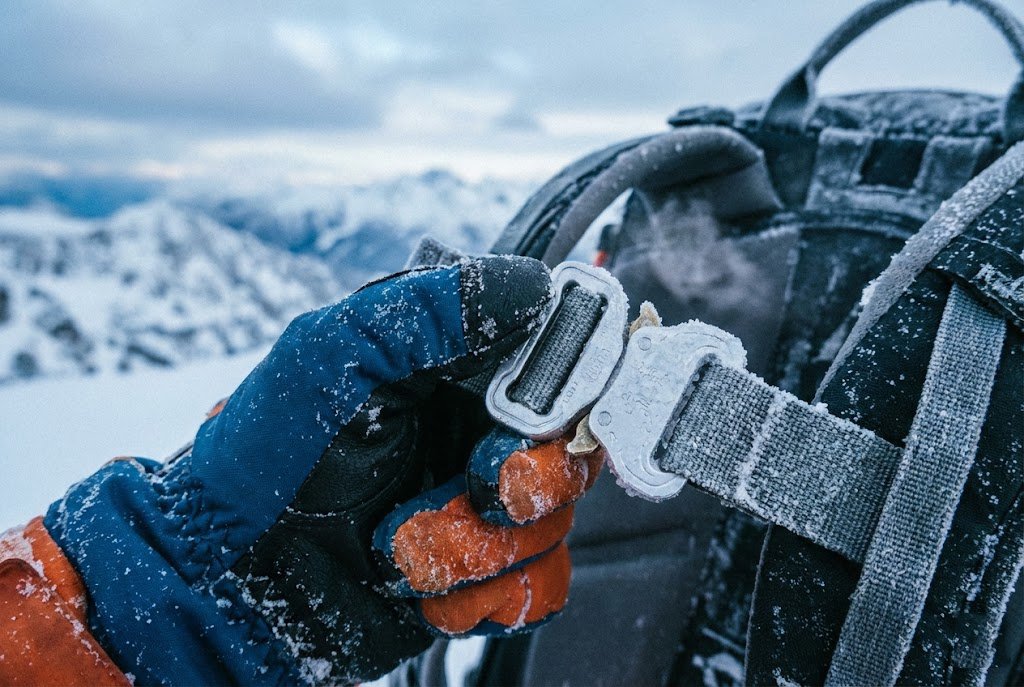
Many "premium" brands switch to Aluminum or Zinc Alloy to avoid breakage.
Not necessarily. While metal won’t crack, it freezes bare skin instantly and can jam permanently if ice builds up inside the mechanism.
I’ve had clients switch back from Aluminum to POM after field testing. Why? Because trying to open a frozen metal cobra buckle with thick ski gloves is a nightmare. Metal conducts cold; plastic insulates.
Which is superior for user experience?
High-grade POM plastic is often superior for the end-user because it remains warm to the touch, sheds ice easily, and allows for "glove-friendly" large-sized designs.
Metal vs. POM in Snow
| Feature | Aluminum/Zinc | Acetal (POM) |
|---|---|---|
| Breakage Risk | Zero | Low (if high quality) |
| Skin Contact | Painful/Dangerous | Neutral/Safe |
| Ice Jamming | High | Low |
| Weight | Heavy | Light |
Conclusion
Cold weather doesn’t forgive cheap manufacturing. If you are selling gear for snow sports, military use, or Northern climates, you cannot cut corners on your hardware.
The formula is simple: Use Acetal (POM), radius your design corners, and torture-test it at -30°C.
Industry FAQ: The Questions Suppliers Avoid
1. Can I use Recycled Plastic (rPET/rPP) for winter buckles?
Absolutely not. I love sustainability, but recycled plastics have degraded polymer chains and inconsistent impurities. In sub-zero temps, recycled material shatters like glass. Use virgin material for hardware; use recycled material for the fabric.
2. Does the color of the buckle affect cold strength?
Surprisingly, yes. Black is usually the safest because Carbon Black is a stable additive. Heavy amounts of dye (especially neon colors or white) can slightly alter the chemical bond stability in some cheap resins, leading to earlier failure in extreme cold.
3. Is "Military Grade" a real spec for cold resistance?
Mostly marketing fluff. However, actual Mil-Spec (like Berry Compliant hardware) usually mandates POM or GhillieTEX material which has infrared reduction and cold weather additives. Don’t trust the label; ask for the resin data.
4. How much more does cold-resistant POM cost compared to standard PP?
You’re looking at roughly 3x to 4x the raw material cost. But considering a buckle uses only 10-20 grams of material, the cost difference per bag is maybe $0.15. Is saving 15 cents worth a 1-star review? No.
5. How can I tell if a buckle is POM or PP just by looking?
You can’t. But you can do the "Burn Test" (if you’re okay sacrificing one). PP smells like birthday candles (paraffin). POM smells like acrid formaldehyde and burns with a clear blue flame.
6. Are "Quick-Release" buckles more prone to cold cracking?
Yes, because they rely on the "spring" of the side prongs. If that prong gets brittle, it won’t bend—it will just snap off. This is why material choice is more critical for side-release designs than for simple ladder locks.
7. Is "Cold Resistant Nylon" a real thing?
It exists (impact-modified Nylon), but it’s expensive and tricky to mold consistently. Suppliers often claim they use it but swap it for standard PA6. POM is safer because it works naturally without complex additives that can be forgotten in production.
Footnotes
-
Understanding the limitations of Polypropylene (PP) can help you make informed decisions about materials for cold-weather gear. ↩
-
Exploring the benefits of Acetal (POM) can reveal why it’s the go-to choice for durability in extreme conditions. ↩
-
Details the chemical properties and durability of Nylon 6, known for high mechanical strength and rigidity. ↩
-
Discovering the properties of Virgin High-Impact Nylon 66 can help you understand its advantages over standard materials. ↩






