Updated August 2026 | Reviewed from a backpack manufacturing perspective
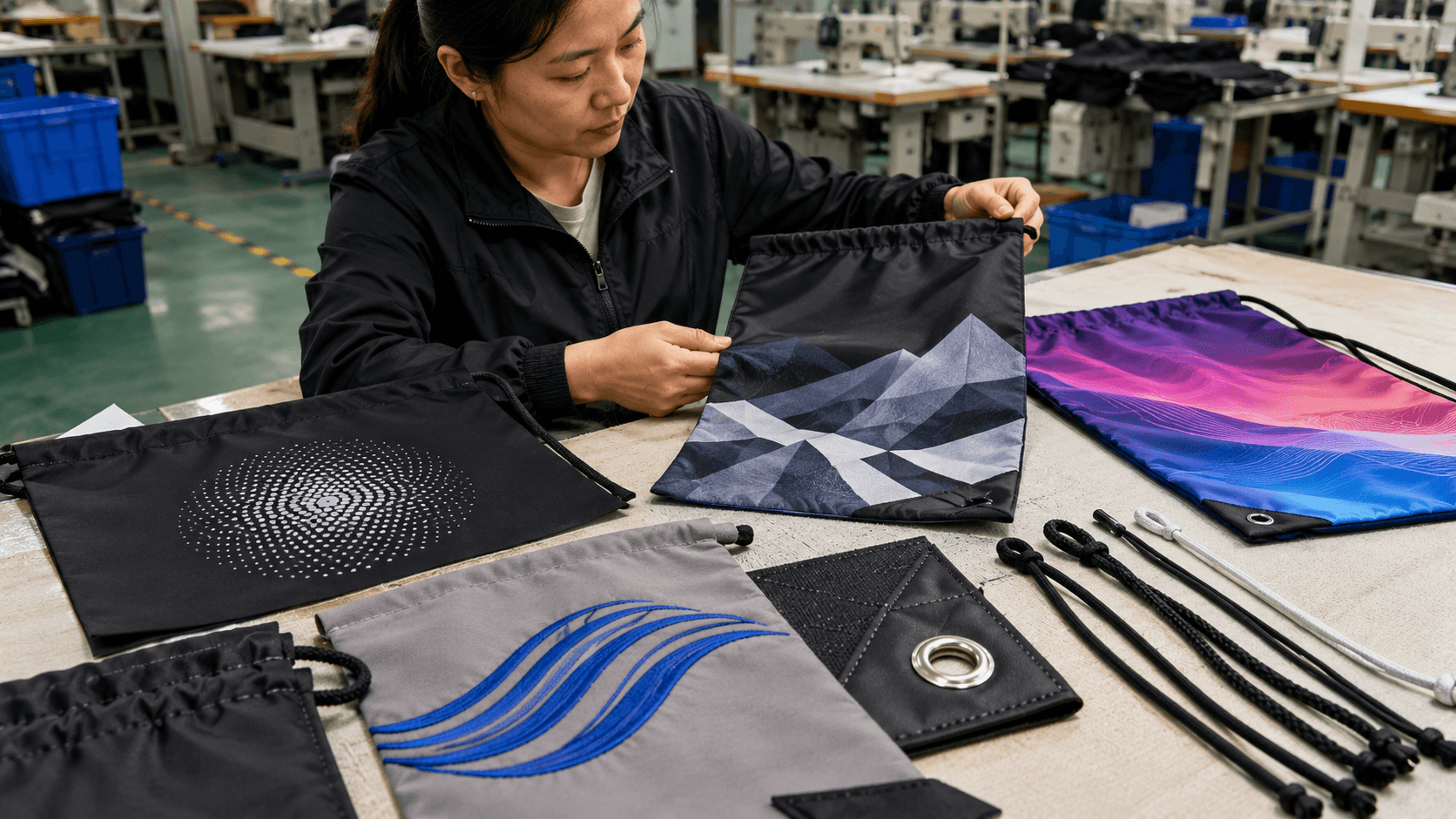
The best logo method for a custom bag depends on the fabric surface, artwork, logo position, end use, quantity and desired brand effect. Screen printing suits many simple graphics, heat transfer handles detailed multicolor artwork, embroidery creates raised textile branding, while patches and woven labels are useful when direct printing or stitching is less practical.
There is no universal “best” or “most durable” logo method. The decoration must fit the actual bag material and construction.
A logo that works well on a canvas tote may be unsuitable for a water-repellent nylon backpack. A process that looks perfect on a flat fabric swatch may become difficult when the same logo is placed beside a zipper, over foam padding or on a curved pocket.
From a custom bag manufacturer’s point of view, the useful question is not:
Which logo method is best?
It is:
Which method fits this exact fabric, artwork, placement, end use, quantity and brand requirement?
That distinction affects sampling, cost, production sequence, durability and sometimes even the construction of the bag itself.
Quick Guide: Which Bag Logo Methods Should You Evaluate First?

| If your priority is… | Methods worth evaluating first | Main point to check |
|---|---|---|
| Simple, solid-color branding | Screen printing | Fabric surface, coating, placement |
| Detailed or multicolor graphics | Heat transfer | Heat tolerance, adhesion, texture |
| Raised textile branding | Embroidery | Fabric stability, stitch density, waterproofing |
| Fine textile detail | Woven label | Size, edge finish, attachment |
| 3D outdoor or technical branding | Rubber, silicone or PVC patch | Tooling, weight, flexibility, attachment |
| Lifestyle or premium casual branding | Leather or PU patch | Material consistency, aging, attachment |
| Structured premium branding | Metal badge | Weight, corrosion resistance, fixing |
| Large-area graphics on suitable polyester | Sublimation | Fabric composition, color and production stage |
This table is only a starting point.
Two heat-transfer systems can perform differently on the same material. Two fabrics both sold as “600D polyester” can also behave differently if their surface treatments are different.
That is why we prefer to review the actual material, artwork and logo position before confirming a method for bulk production.
What Determines the Best Logo Method for a Bag?
For most custom bag projects, six factors matter together:
Fabric surface × Artwork × Placement × End use × Quantity × Brand effect
| Factor | Factory question |
|---|---|
| Fabric surface | What is the logo actually being printed, pressed, stitched or attached onto? |
| Artwork | Is it simple, detailed, multicolor, small or gradient-based? |
| Placement | Is the area flat, curved, padded, close to a zipper or already assembled? |
| End use | Will the logo face rubbing, moisture, flexing or heavy handling? |
| Quantity | How do setup and per-piece costs behave at this volume? |
| Brand effect | Should the logo look flat, textile, technical, 3D or premium? |
Ignoring one of these factors can turn a visually attractive logo into a production problem.
If you are still selecting the base material, our guide to common backpack materials and their pros and cons explains the differences between polyester, nylon, canvas, TPU-coated materials, RPET and other common bag fabrics.
Which Logo Methods Are Used on Custom Bags?
The most common methods are not limited to screen printing, embroidery and heat transfer.
| Method | Typical strength | Main factory check |
|---|---|---|
| Screen printing | Simple repeat graphics | Surface compatibility and curing |
| Heat transfer | Detailed multicolor graphics | Heat, pressure and adhesion |
| Embroidery | Raised textile branding | Fabric stability and needle penetration |
| Woven label | Fine textile detail | Attachment and edge finish |
| Rubber / silicone / PVC patch | Dimensional technical branding | Mold, flexibility and attachment |
| Leather / PU patch | Lifestyle branding | Aging and material consistency |
| Metal badge | Structured premium detail | Weight, reinforcement and fixing |
| Sublimation | Large graphics on suitable polyester | Material, base color and production stage |
Screen Printing
Screen printing applies ink directly to the material surface.
It is often worth evaluating for:
- Simple logos
- Solid colors
- Flat panels
- Repeat production
- Promotional, sports and everyday bags
Its cost can become attractive in volume because screen/setup work is spread across more pieces.
However, a large order does not automatically make screen printing suitable.
The factory still needs to check whether the fabric accepts the ink system, whether the panel is accessible and flat enough, and whether coating, flexing or abrasion may affect the result.
Heat Transfer
Heat transfer uses controlled heat and pressure to apply a prepared graphic onto the material.
It is useful when buyers need:
- Multiple colors
- Fine detail
- Gradients
- Complex graphics
- Clean graphic edges
- Development or smaller production runs
But “heat transfer” is not one single quality level.
The transfer material, adhesive, bag surface, temperature tolerance, pressure and placement all affect the final result.
A transfer applied to a smooth flat panel is a very different production situation from the same transfer placed over foam or beside a thick seam.
Embroidery
Embroidery creates the logo with thread stitched through the bag material.
It is often selected for:
- Raised texture
- Corporate branding
- Textile appearance
- Premium or classic styling
Before recommending it, we look at:
- Fabric stability
- Stitch density
- Logo size
- Fine text
- Backing
- Waterproof requirements
- What is behind the embroidery area
Embroidery may resist peeling, but that does not mean it is automatically the best choice for every waterproof or lightweight panel.
Labels, Patches and Other Alternatives
A woven label can reproduce fine textile detail without forcing a complex logo into direct embroidery.
Rubber, silicone and PVC patches can create a technical or dimensional look.
Leather or PU patches work well for many lifestyle and travel products.
Metal badges can create a more structured premium identity.
Sublimation printing can be useful for large colorful graphics on suitable polyester materials, especially when the decorated panel can be processed before final bag assembly.
A professional bag factory should not force every branding project into the same three processes.
Sometimes the buyer asks for embroidery, but a woven label solves the artwork more cleanly. Sometimes printing is visually attractive, but the selected coating creates an avoidable adhesion risk.
How Do Fabric and Coating Affect Logo Selection?
The fabric name is only the beginning.
Buyers often ask:
- Can you print on polyester?
- Can you embroider nylon?
- Can heat transfer be used on waterproof fabric?
Those are reasonable questions, but “polyester” or “nylon” alone is usually not enough information.
Fabric Name Is Not Enough
The logo interacts with the actual material surface.
That surface may be affected by:
- Weave and texture
- PU, PVC or TPU
- Lamination
- Water-repellent treatment
- Matte or glossy finishing
- Stretch
- Heat sensitivity
- Foam or backing
Two materials both described as “600D polyester” can behave differently during logo application if their surface finishes are different.
If 600D is one of the materials you are considering, see our factory guide to 600D polyester bag fabric for a closer look at its construction and common bag applications.
This is why we prefer the final material swatch when logo performance depends strongly on heat, adhesion, pressure or surface texture.
A specification sheet tells us the material category.
A real swatch tells us what the logo will actually touch.
Waterproof, Coated and Textured Fabrics Need Extra Evaluation
Water-resistant bags often create one of the most common logo-selection misunderstandings.
A buyer may assume:
“If the fabric is durable and waterproof, applying a logo should also be easy.”
Not necessarily.
A surface designed to resist water or contamination may also behave differently with some inks and adhesives.
For printing or transfer, the factory may need to check:
- Adhesion
- Heat response
- Surface texture
- Edge stability
- Flexing
- Abrasion
For embroidery, the risk is different.
The thread may be durable, but the needles penetrate the panel.
If water resistance is an important product requirement, we need to consider whether those needle holes are acceptable or whether another branding method would be more appropriate.
This is why “embroidery is more durable” is too simple a rule for technical bags.
The logo itself may be durable while the application method creates another product risk.
Printing and Embroidery Create Different Material Risks
A rough woven fabric may reduce fine print definition or transfer contact.
A thin soft panel may pucker under dense embroidery.
A heavily structured panel may support a patch well but create uneven pressure for some transfer applications.
There is no universal rule such as:
“Thicker fabric is better.”
The factory needs to evaluate how the logo interacts with the complete material and panel structure.
How Should Your Logo Artwork Affect the Method?

The fabric may be technically suitable, but the artwork can still change the answer.
Simple vs Detailed Artwork
A simple one- or two-color wordmark gives the factory many options.
It might be:
- Screen printed for a flat graphic look
- Embroidered for textile texture
- Heat transferred
- Made as a woven label
- Molded into a silicone or PVC patch
- Debossed into a PU patch
The artwork has not changed.
The product identity has.
Complex artwork narrows the options.
If the design contains:
- Gradients
- Photographic detail
- Many tonal changes
- Fine lines
- Small gaps
- Very small text
heat transfer or sublimation may be worth evaluating where the material allows it.
Embroidery works differently because the artwork must be translated into stitches.
A digital gradient cannot simply be copied into thread in the same way it appears on a monitor.
The buyer may need to decide whether the priority is:
- Exact graphic reproduction
- Textile appearance
A good supplier should explain that trade-off before sampling.
Small Text and Fine Lines
Fine detail is a common reason a logo looks excellent in a PDF but needs adjustment during production.
Small lettering can be affected by:
- Fabric texture
- Printing method
- Transfer edge definition
- Stitch structure
- Patch molding limits
- Actual logo size
Embroidery is especially sensitive because the artwork must be digitized into stitch paths.
Instead of using one universal minimum text size, a more reliable sequence is:
Artwork review → digitization → physical sew-out → approval
If a buyer wants textile branding but direct embroidery makes small details too heavy or unclear, a woven label may sometimes be the better answer.
Pantone and Physical Color Approval
Color also behaves differently depending on the branding process.
Screen printing: ink may be mixed or selected toward a required color.
Heat transfer: color is produced through the chosen transfer system.
Embroidery: the factory normally selects from available thread shades.
Rubber or PVC patch: the molded material and production process affect the physical result.
Metal badge: plating, enamel, brushing or other finishing may define the final appearance.
For brand-sensitive projects, a digital reference alone is not enough. Pantone itself notes that on-screen simulations may not accurately match physical standards and recommends a current physical Pantone reference for color-critical physical products.
Depending on the logo method, physical approval may involve:
- Print strike-off
- Transfer sample
- Embroidery sew-out
- Thread card
- Molded patch sample
- Metal finish sample
How Do Logo Placement and Sewing Sequence Affect the Method?
Logo placement is not only a branding decision.
It is also a production decision.
The same logo may be easy to apply in one position and difficult in another.
Logo Placement Risk Guide
| Logo position | Production issue | Factory concern |
|---|---|---|
| Flat front cut panel | Low structural interference | Broad method choice |
| Near zipper | Raised uneven surface | Print or press clearance |
| Near thick seam | Uneven height | Contact and alignment |
| Foam-padded panel | Compresses under pressure | Heat, pressure, deformation |
| Curved pocket | Difficult to keep flat | Access and positioning |
| Bottom panel | High abrasion | Durability |
| Side panel | Rubbing and flexing | Wear |
| Shoulder strap | Narrow, padded, curved | Equipment access and logo size |
| Webbing | Narrow and textured | Detail and process limits |
| Fold line | Repeated movement | Cracking or flex stress |
A logo should therefore not be positioned only from a digital rendering.
A factory also wants to know:
What is underneath the logo area, and what happens to that panel after sewing?
Why Logos Are Often Applied Before Sewing
A flat cut panel is easier to control than a finished three-dimensional bag.
When the logo is applied before assembly, the factory usually has better control over:
- Positioning
- Surface flatness
- Printing contact
- Heat-transfer pressure
- Embroidery access
- Patch stitching
This fits naturally into the wider bag manufacturing process, where material preparation, cutting, panel decoration and sewing need to be planned in the correct sequence.
A simplified production flow may look like:
Fabric inspection → cutting → logo application → inspection → sewing → assembly
The exact sequence depends on the product, but the principle is important:
Logo production should be planned as part of bag construction, not treated as an afterthought.
Can You Add or Change a Logo After the Bag Is Finished?
Sometimes.
But the available options usually become more limited.
A finished bag may already contain:
- Foam
- Lining
- Zippers
- Reinforcement
- Pockets
- Webbing
- Buckles
- Hardware
- Curved surfaces
These can reduce machine access or make printing and pressing less even.
Depending on the structure, the factory may need to use:
- A smaller working area
- A jig or support
- A different logo size
- A patch or label
- A different position
- Another branding method
In some projects, a late logo change can require making a new panel and sewing the sample again.
Moving a logo early in product development may take minutes.
Changing it after the bag has been assembled can affect cutting, sewing, sampling and lead time.
Screen Printing vs Embroidery vs Heat Transfer

These three methods are frequently compared, but they solve different branding problems.
| Factor | Screen Printing | Heat Transfer | Embroidery |
|---|---|---|---|
| Appearance | Flat | Graphic / smooth | Raised / textile |
| Artwork fit | Simple solid graphics | Detailed multicolor graphics | Stitch-friendly designs |
| Gradients | Process dependent | Generally easier | Requires interpretation |
| Main cost driver | Colors and setup | Transfer size/type | Stitch count |
| Fabric concern | Ink/surface compatibility | Heat and adhesion | Fabric stability |
| Waterproof concern | Surface treatment | Surface treatment | Needle penetration |
| Best production stage | Usually easier on flat panel | Construction dependent | Usually before difficult closure |
| Main durability risk | Adhesion, curing, abrasion | Edge lifting, bonding | Puckering, thread/fabric stress |
Screen Printing vs Embroidery: Which Is Better for Bags?
Screen printing is usually worth evaluating when the buyer wants a flat graphic, relatively simple colors and efficient repeat production on a compatible surface. Embroidery is worth evaluating when the buyer wants raised textile branding and the material can support the stitch structure.
The biggest difference is not simply durability.
It is the way the logo becomes part of the product.
Screen printing works well when the graphic itself is important.
Embroidery works well when texture is part of the brand identity.
Cost is also calculated differently.
Screen-printing cost is influenced by factors such as:
- Number of colors
- Screen/setup requirements
- Print size
- Quantity
Embroidery cost is influenced by:
- Stitch count
- Stitch density
- Logo size
- Backing
- Machine time
A small embroidered logo is not automatically inexpensive if it contains dense fills and detailed lettering.
Material also matters.
On coated or waterproof panels, printing requires surface compatibility, while embroidery introduces needle penetration.
So the better choice depends on the complete bag specification rather than a universal rule that one method is “higher quality.”
Screen Printing vs Heat Transfer: Which Is Better for Bags?
Screen printing is usually worth evaluating for simpler repeat graphics on compatible surfaces. Heat transfer is often useful for detailed, multicolor or gradient artwork.
Screen printing often benefits from a flat panel and suitable surface.
Heat transfer may reproduce complex artwork more easily, but the factory must still confirm:
- Transfer material
- Adhesive compatibility
- Heat tolerance
- Surface texture
- Pressure access
- Logo position
A common mistake is to assume that heat transfer is automatically the solution when a bag is already sewn.
It can sometimes offer more flexibility than screen printing, but a finished bag may still contain foam, seams, zippers and hardware that make even pressure difficult.
The accurate rule is:
Once the bag is assembled, the factory has fewer unrestricted processing options.
Neither method is the universal durability winner.
The important question is:
Which complete logo system has been verified on this exact bag material and use position?
When Is a Patch or Woven Label a Better Choice?

Sometimes the best answer is not screen printing, embroidery or heat transfer.
| Buyer problem | Alternative worth evaluating |
|---|---|
| Fine textile detail is difficult to embroider | Woven label |
| Direct printing is difficult on the selected area | Patch |
| Buyer wants 3D outdoor branding | Rubber, silicone or PVC patch |
| Buyer wants a subtle lifestyle look | Leather or PU patch |
| Buyer wants structured premium detail | Metal badge |
When a requested method creates technical difficulty, one of the most useful questions is:
Which part of this logo request is non-negotiable?
Is it:
- Exact artwork?
- Exact color?
- Textile texture?
- 3D appearance?
- Waterproof performance?
- Target price?
- Logo position?
Once the real priority is clear, the factory can suggest another method without changing what matters most to the brand.
Which Bag Logo Method Is Most Durable?
There is no universal durability winner for every custom bag. Durability depends on the decoration system, bag material, coating, placement, application quality and real-use stress.
A more useful comparison is to look at how each method can fail.
| Logo method | Main durability points to evaluate |
|---|---|
| Screen printing | Adhesion, curing, abrasion, cracking |
| Heat transfer | Edge adhesion, bonding, heat compatibility |
| Embroidery | Thread wear, puckering, fabric penetration |
| Woven label | Edge wear and attachment |
| Rubber / silicone / PVC patch | Flexibility and attachment |
| Leather / PU patch | Abrasion, aging and attachment |
| Metal badge | Fixing, scratches and corrosion |
| Sublimation | Material and color stability |
The logo position matters too.
A logo on the protected upper front of a business backpack does not experience the same stress as the same logo near the bottom of a gym bag.
For durability-sensitive projects, define the real use first:
- Will the logo rub against clothing?
- Will the bag touch the floor?
- Will the panel bend repeatedly?
- Will it be exposed to moisture?
- Will users wipe or wash it?
If a buyer requires formal laboratory criteria rather than a factory-side screening check, the test method should be agreed before production. AATCC’s published textile test methods include methods for colorfastness to crocking/rubbing and water repellency, among other textile performance properties.
How Does Order Quantity Affect Logo Cost?
Quantity affects economics, but it should not decide technical suitability.
Different logo methods divide their costs differently.
| Method | Main setup / development cost | Main per-piece cost driver |
|---|---|---|
| Screen printing | Screens and setup | Colors, printing and quantity |
| Embroidery | Digitizing | Stitch count and machine time |
| Heat transfer | Transfer preparation | Transfer size/type and application |
| Patch / badge | Mold, tooling or sample development | Component and attachment |
This is why fixed rules such as:
“Use heat transfer under 100 pieces.”
or:
“Screen printing only makes sense above 500 pieces.”
are too simplistic.
Consider two orders of 1,000 bags.
Project A
- Small one-color logo
- Flat front panel
- Simple artwork
Project B
- Large multicolor graphic
- Fine detail
- Coated material
- Logo close to a zipper
The quantity is the same.
The production problem is not.
A better procurement question is:
How does the cost behave at this volume after we know which methods are technically suitable?
Technical feasibility comes first.
Cost optimization comes after.
How We Evaluate a Logo Before Bulk Production

When a buyer sends us a logo, we do not recommend a method from the artwork alone.
A practical factory workflow is:
Artwork → Material & Placement → Feasible Methods → Physical Sample → Bulk Specification
Step 1: Review the Artwork
We check:
- Colors
- Fine text
- Thin lines
- Gradients
- Logo dimensions
- Brand color requirements
This helps eliminate methods that would require too much compromise.
Step 2: Confirm Material and Placement
We check:
- Final fabric
- Coating
- Surface texture
- Heat sensitivity
- Logo position
- What sits behind the logo area
- Expected use
A logo on a flat front panel may have several feasible options.
The same artwork on a padded shoulder strap may not.
Step 3: Compare Feasible Methods
Only after the first two steps do we compare:
- Appearance
- Cost
- Development requirements
- Durability risks
- Production sequence
This keeps the discussion focused on realistic options.
Step 4: Make a Physical Sample
A digital mock-up can show size and position.
It cannot fully show:
- Thread texture
- Actual print color
- Transfer edge
- Patch thickness
- Material reaction
- Physical hand feel
Depending on the project, physical approval may be a:
- Print strike-off
- Embroidery sew-out
- Heat-transfer trial
- Patch sample
- Material/logo swatch
- Complete bag sample
Step 5: Lock the Bulk Specification
Before production, the factory and buyer should agree on:
- Artwork
- Logo size
- Placement
- Color reference
- Final material
- Branding method
- Attachment
- Approved sample
- Relevant inspection requirements
The goal is simple:
Solve logo questions while changes are still inexpensive.
Sample Approval Is Not the End
One good sample proves the design can be made.
Bulk production must prove it can be repeated.
Depending on the method, the factory may still check:
- Final material lot
- First-piece result
- Placement
- Color
- Application quality
- Inline production consistency
If an issue appears early, it is easier to investigate before the whole order is completed.
Factory Case: Why We Changed a Gym Bag Logo Before Bulk Production
A buyer was developing a custom gym bag using 600D polyester and originally requested a large heat-transfer logo on the lower side panel.
The first sample looked good visually, but we were concerned about the placement.
The lower side of a gym bag receives more rubbing during normal use and may come into contact with clothing, benches or the floor.
During our sample-stage rubbing check, we noticed that the edges of the transfer began to show wear earlier than we wanted.
Instead of trying to solve the issue only by adjusting heat or pressure, we reviewed the logo together with its size, position and expected use.
We made three changes:
- Moved the logo higher on the side panel
- Reduced the logo size
- Changed the decoration to a high-density silicone heat-transfer logo
The revised solution was checked again before mass production, and we did not observe the same logo-wear issue during the bulk order.
The lesson: when a logo problem is strongly related to placement and abrasion, changing application parameters alone may not solve the real risk.
Sometimes the better solution is to adjust the logo position, size and decoration method together.
Frequently Asked Questions
Is Screen Printing or Embroidery Better for Bags?
Neither is universally better.
Screen printing is often suitable for simple flat graphics on compatible surfaces, while embroidery is useful when the brand wants raised textile branding.
The better choice depends on artwork, fabric, coating, waterproof requirements, placement, quantity and desired appearance.
Is Heat Transfer Better Than Screen Printing for Detailed Logos?
Heat transfer is often worth evaluating for detailed multicolor graphics, gradients and fine artwork.
Screen printing is often more efficient for simpler repeat graphics.
However, the final choice also depends on fabric texture, coating, heat tolerance, logo position and quantity.
What Is the Best Logo Method for Waterproof Backpacks?
There is no single best method.
Printing and transfer require compatibility with the outer surface treatment.
Embroidery introduces needle holes.
Patches and labels may also be suitable depending on the construction.
The final fabric, coating or lamination and required water resistance should be confirmed before approving the logo.
Can a Logo Be Added After the Backpack Is Already Sewn?
Sometimes, but finished construction usually reduces the available options.
Foam, zippers, seams, lining and hardware can affect machine access or pressure.
The factory may need to change the logo size, position or method, use a patch or label, or remake the affected panel.
How Can I Prevent a Printed Bag Logo from Peeling?
Match the logo process to the final fabric surface, coating, placement and expected use.
A good-looking sample is not enough.
Check material compatibility, real-use friction or flexing risks, and bulk-production consistency before approving mass production.
Final Thoughts
Choosing a logo method should not begin with a ranking of screen printing, embroidery and heat transfer.
It should begin with the product.
Ask:
- What is the final material?
- What surface treatment does it have?
- What does the artwork require?
- Where will the logo sit?
- How will the bag be used?
- What brand effect is required?
- What quantity are we producing?
For one project, screen printing may be the right answer.
For another, it may be embroidery, heat transfer, a woven label, a silicone patch, leather branding, a metal badge or sublimation.
The goal is not to choose the most impressive-sounding process.
It is to choose a logo solution that can be sampled, approved and reproduced consistently on the actual bag.
Get a Pre-Production Logo Feasibility Check
Not sure which logo method fits your bag?
Send us:
- Your bag design or reference image
- Fabric specification
- Logo artwork
- Logo size and placement
- Estimated order quantity
- Intended use
Our team can review the technically suitable options and identify likely material, placement or production risks before you invest in a full production sample.